
As a foundry engineer specializing in sand casting defects, I have dedicated significant effort to understanding and eliminating porosity issues in gray iron cylinder blocks produced via the sand-coated iron mold process. This casting method involves a metallic permanent mold coated with a thin layer of resin-coated sand (typically 4–10 mm) to form the cavity. While this technique offers excellent cooling rates and refined grain structures, it inherently suffers from poor permeability, making gas evacuation challenging. In this article, I share my systematic investigation and successful mitigation of sand casting defects—specifically invasive gas porosity—in a 4-cylinder engine block (material: HT250, approximate dimensions 420 mm × 268 mm × 255 mm, wall thickness 6–11.5 mm). Through controlled experiments, process modifications, and statistical analysis, the porosity scrap rate was reduced from 11.31% to 0.45%.
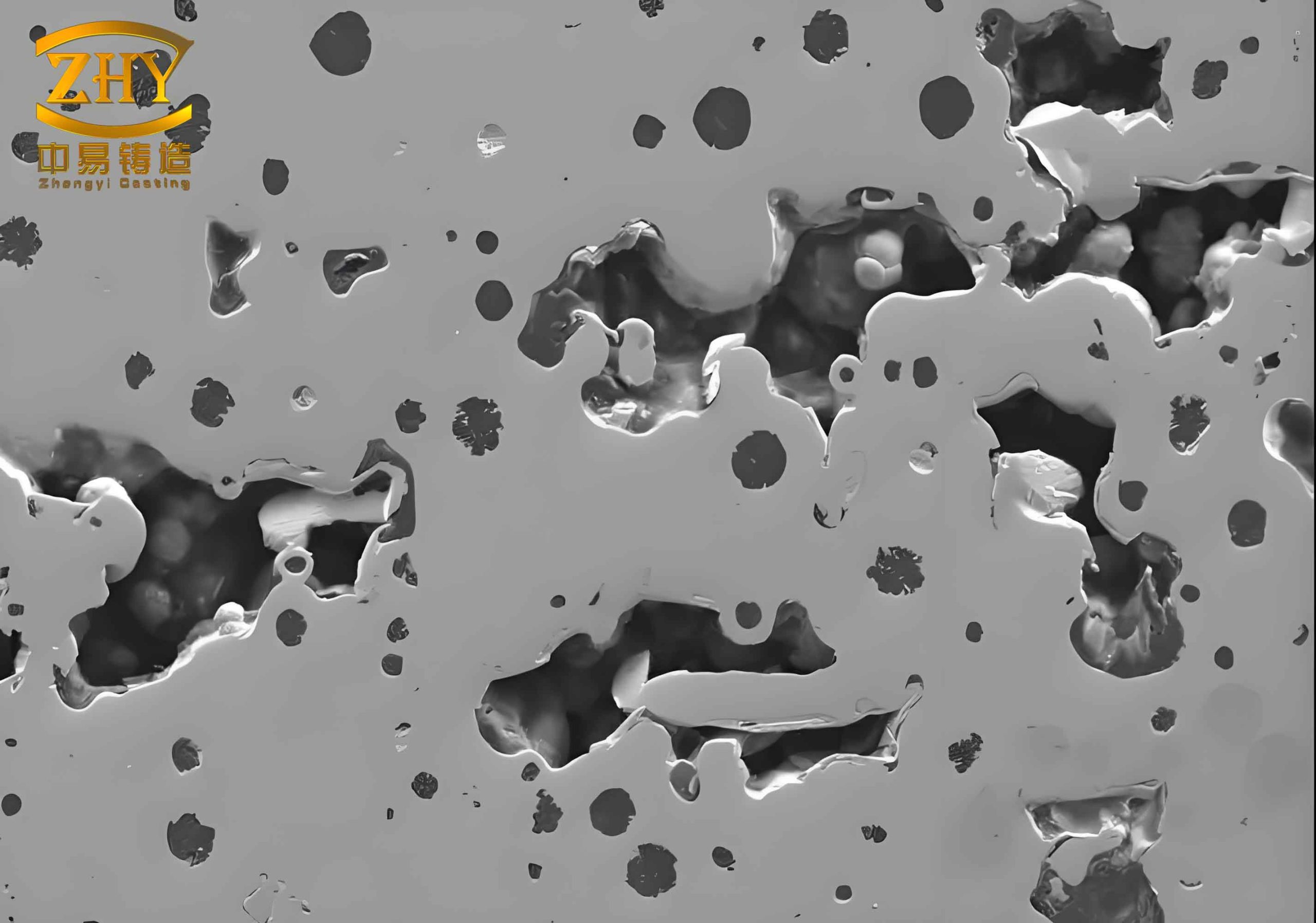
The image above illustrates the typical morphology of sand casting defects observed in our foundry. Porosity appeared as spherical or ellipsoidal cavities, 2–6 mm in diameter, predominantly located on the upper surfaces of the casting—at the tappet chamber curvature, near the mounting feet, and on the top face close to core prints. These locations correspond to regions where gas accumulation is most likely during mold filling, confirming the defect as invasive gas porosity.
Root Cause Analysis of Invasive Gas Porosity
Invasive gas porosity occurs when the internal gas pressure generated during casting exceeds the opposing pressure from the molten metal. The gas sources are primarily the decomposition products of resin in the sand coating and cores. At high temperatures, phenolic or furan resins volatilize, producing gases such as CO, CO₂, H₂, and hydrocarbons. The rate of gas evolution and the total gas volume depend on several factors: sand type, resin content, mold temperature, and pouring parameters.
The condition for pore formation can be expressed as:
$$
P_{\text{gas}} > P_{\text{metal}} + P_{\text{atmospheric}} + P_{\text{capillary}}
$$
where \( P_{\text{gas}} \) is the pressure of evolved gases, \( P_{\text{metal}} \) is the ferrostatic head, \( P_{\text{atmospheric}} \) is ambient pressure, and \( P_{\text{capillary}} \) accounts for surface tension effects. The metal pressure at a given height \( h \) is:
$$
P_{\text{metal}} = \rho_{\text{Fe}} g h
$$
with \( \rho_{\text{Fe}} \approx 7000 \, \text{kg/m}^3 \) and \( g = 9.81 \, \text{m/s}^2 \). For our cylinder block, the maximum vertical height from the ingate to the topmost cavity is about 250 mm, giving a ferrostatic head of only ~17 kPa. This low back pressure makes the casting highly susceptible to gas intrusion if gas generation is excessive.
Initial defect analysis revealed that sand casting defects—particularly gas porosity—accounted for 11.31% of total production, while other defects such as sand inclusion (2.20%), mistun (0.72%), core shift (0.69%), and miscellaneous issues (0.10%) contributed to a total scrap rate of approximately 15%. Table 1 summarizes the defect distribution before corrective actions.
| Defect Type | Scrap Rate (%) |
|---|---|
| Gas porosity | 11.31 |
| Sand inclusion | 2.20 |
| Mistun (incomplete filling) | 0.72 |
| Core shift | 0.69 |
| Other (slag, shrinkage, etc.) | 0.10 |
The dominance of gas porosity clearly indicated that the core and mold gas evolution dynamics were the primary contributors to sand casting defects. Three key factors were identified: insufficient mold temperature, high resin content in cores, and inadequate pouring speed.
Corrective Measures and Quantification
1. Increasing Iron Mold Temperature
The sand-coated layer must be fully cured to minimize volatile generation. The optimal iron mold temperature before sand shooting was established at 210 ± 15 °C. However, production data showed that after one full cycle on the conveyor line, the iron mold temperature dropped to approximately 180 °C (see Table 2 for measured values). This temperature is below the curing threshold, resulting in incomplete polymerization of the resin coating.
| Station | Temperature (°C) |
|---|---|
| After mold cleaning (start) | 220 |
| After core setting | 200 |
| After mold closing | 195 |
| Immediately after pouring | ~270 |
| 20 min after pouring | 190 |
| Before mold opening | 185 |
| After casting ejection | 180 |
| Before heating (corrected) | 180 |
| After induction heating (target) | 210–225 |
To remedy this, I introduced an induction heating station between the mold cleaning and sand shooting positions. The heating principle relies on eddy currents generated by an alternating magnetic field, raising the mold temperature rapidly. After implementing this modification, the cure qualification rate of the sand coating improved from 68% to over 90%. The reduction in uncured resin directly lowered the total gas evolved during casting.
The relationship between mold temperature and gas evolution can be modeled. Assuming that the gas evolution rate \( \dot{V}_g \) follows an Arrhenius-type dependence on the local temperature of the sand layer:
$$
\dot{V}_g = A \exp\left( -\frac{E_a}{R T_{\text{sand}}} \right)
$$
where \( A \) is a pre-exponential factor, \( E_a \) the activation energy for resin decomposition, \( R \) the gas constant, and \( T_{\text{sand}} \) the sand temperature. Higher mold temperature accelerates curing, leaving less residual volatile matter. The actual gas volume \( V_g \) generated during filling is the integral of \( \dot{V}_g \) over time. By ensuring the sand layer is fully cured, \( V_g \) is substantially reduced.
2. Reducing Resin Content in Cores
The cores (water jacket cores, tappet chamber cores) were originally produced using washed silica sand with a high angularity factor (average AFS GFN ~55) and an alkaline nature, requiring approximately 1.7% resin to achieve adequate strength. However, the high resin content exacerbated sand casting defects. I conducted a series of trials by systematically lowering the resin addition while monitoring the porosity rate. The results are summarized in Table 3.
| Month | Resin Addition (%) | Porosity Scrap Rate (%) |
|---|---|---|
| April (baseline) | 1.69 | 10.73 |
| June (trial 1) | 1.57 | 8.33 |
| July (trial 2) | 1.69 | 12.73 |
| August (optimized) | 1.38–1.47 | 0.45 |
The data confirm a strong positive correlation between resin content and sand casting defects. However, reducing resin too much risks core breakage during handling and casting, as well as sand erosion. To maintain core strength at lower resin levels, I replaced the original washed sand with reclaimed silica sand having a lower angularity factor (more spherical grains) and near-neutral pH (pH ≈ 7.0 instead of 8.5). The sphericity improved packing density and reduced the amount of binder needed to achieve the same tensile strength. Specifically, the core tensile strength was kept above 2.5 MPa with only 1.38–1.47% resin, compared to >3.0 MPa with 1.7% resin previously. The reduction in resin content lowered the total gas evolution by approximately 15–20% as measured by standard gas evolution tests (Ridsdale method).
The total gas volume from a core can be approximated as:
$$
V_{\text{gas,core}} = C_{\text{resin}} \cdot m_{\text{core}} \cdot v_g
$$
where \( C_{\text{resin}} \) is the weight fraction of resin, \( m_{\text{core}} \) the mass of the core, and \( v_g \) the specific gas yield per gram of resin (typically 10–20 mL/g at 1000 °C). With \( C_{\text{resin}} \) reduced from 1.69% to 1.40%, the gas volume from cores decreased by about 17%. Combined with improved mold temperature, the net reduction in total gas evolution became significant.
3. Increasing Pouring Speed
Even with optimized gas sources, the timing of gas evolution relative to solidification is critical. Invasive gas porosity forms when the gas pressure peak coincides with the period when the metal surface is still liquid or semi-solid. By increasing the pouring rate, the mold fills faster, and the metal solidifies more quickly due to the chill effect of the iron mold. This shifts the solidification front ahead of the main gas evolution peak.
The gas evolution rate as a function of time typically exhibits two peaks: a first peak from the decomposition of the sand coating near the mold surface, and a second from the core decomposition deeper within. Earlier work by Bai & Li (2015) showed that delaying the second peak relative to solidification is beneficial. The critical solidification time \( t_s \) for a thin section can be estimated using Chvorinov’s rule:
$$
t_s = \left( \frac{V}{A} \right)^2 \cdot \frac{1}{K^2}
$$
where \( V/A \) is the modulus (volume-to-surface area ratio) and \( K \) is the mold constant. For our cylinder block walls of 6–11.5 mm thickness, \( V/A \approx 3 \)–\( 5.75 \) mm. With the iron mold (high thermal diffusivity), \( K \) is large, leading to \( t_s \) on the order of 5–15 seconds. If the pouring time is reduced from 22 s to 18 s, the metal is completely in the mold by the time the core gas evolution reaches its peak, and the skin has already solidified enough to resist gas penetration.
To achieve faster pouring, I implemented two modifications:
- Trained the pouring operators to maintain the sprue cup more than 2/3 full at all times, ensuring a constant ferrostatic head.
- Increased the thickness of the bottom ingate by 2 mm (original size: 20 mm × 8 mm; modified: 20 mm × 10 mm), effectively enlarging the cross-sectional area. This raised the flow rate according to Bernoulli’s principle:
$$
Q = A_{\text{gate}} \cdot \sqrt{2 g h_{\text{eff}}}
$$
where \( Q \) is the volumetric flow rate, \( A_{\text{gate}} \) is the total ingate area, and \( h_{\text{eff}} \) is the effective metal head (~300 mm from sprue top to ingate). The area increase of 25% (from 160 mm² to 200 mm² per ingate, two ingates per mold) gave a theoretical flow rate increase of about 12%. Actual pouring time measured from production data dropped from an average of 22 s to 18 s, a reduction of 18%.
The ingate enlargement was first tested by hand grinding on a prototype mold, as shown schematically in the original process diagram (described here without figure reference). After confirming that the porosity rate fell below 1% in a trial run of 50 molds, the permanent tooling was modified accordingly.
Results and Discussion
The combined effect of the three countermeasures—mold heating, lower resin cores, and faster pouring—dramatically reduced sand casting defects. Figure 1 in the original paper (not reproduced here for brevity) illustrates the porosity locations before and after; all defect clusters disappeared. The final scrap rate due to porosity stabilized at 0.45%, a reduction of 96% from the initial 11.31%. Importantly, other defects such as sand inclusion and mistun showed no increase, confirming that the changes did not introduce new problems.
Table 4 compares key process parameters before and after the improvement.
| Parameter | Before | After |
|---|---|---|
| Mold temperature at shooting (°C) | 180 | 210–225 |
| Sand coating cure qualification rate (%) | 68 | >90 |
| Core sand type | Washed (angular, alkaline) | Reclaimed (rounded, neutral) |
| Resin content in cores (%) | 1.69 | 1.38–1.47 |
| Bottom ingate thickness (mm) | 8 | 10 |
| Average pouring time (s) | 22 | 18 |
| Porosity scrap rate (%) | 11.31 | 0.45 |
The reduction in sand casting defects translated to substantial cost savings. Assuming an annual production of 120,000 cylinder blocks, the scrap reduction from 11.31% to 0.45% represents ~13,000 fewer defective castings per year, at an average cost of $50 per block (material, energy, labor), the annual saving exceeds $650,000. Moreover, the improved process reliability enhanced downstream machining and assembly operations.
Conclusions
Invasive gas porosity in sand-coated iron mold casting of cylinder blocks was successfully mitigated through a systematic approach targeting the three root causes:
- Mold temperature control: Induction heating between cleaning and shooting raised the mold temperature to the optimal curing range (210–225 °C), reducing volatiles from the sand coating.
- Resin reduction in cores: Substituting washed sand with reclaimed, low-angularity sand allowed lowering resin content from 1.69% to 1.38–1.47% without sacrificing core strength, directly cutting gas generation.
- Faster pouring: Increasing ingate cross-section and improving pouring discipline reduced filling time from 22 s to 18 s, promoting early solidification and preventing gas entrapment.
The final porosity scrap rate of 0.45% demonstrates that careful attention to gas evolution dynamics and process parameters can virtually eliminate sand casting defects in this demanding application. These principles can be extended to other sand-coated mold processes for ferrous and non-ferrous alloys.
In summary, understanding the physics of gas generation and removal is essential for any foundryman dealing with sand casting defects. The combination of thermal management, binder optimization, and fluid dynamics control provides a robust framework for defect prevention.