
The automotive cylinder block is the foundational component of an internal combustion engine. Its structural complexity, demanding dimensional accuracy, and significant wall thickness variations make it one of the most challenging castings to produce. A primary obstacle to achieving high yield in its manufacture is the prevalence of gas-related defects, chiefly manifested as porosity in casting. This defect not only compromises the structural integrity and pressure tightness of the component but also directly leads to elevated scrap rates, impacting cost and productivity. The challenge is intrinsically linked to the process itself: the extensive use of intricate sand cores, binders, and coatings generates substantial volumes of gas during metal pouring. If this gas is not effectively vented out of the mold cavity, it becomes entrapped within the solidifying metal, creating voids known as porosity in casting. In this analysis, I will systematically examine the root causes of this defect through a specific case study and detail the comprehensive improvement measures we implemented to significantly reduce scrap and achieve our quality enhancement goals.
Initial Process Assessment and Problem Definition
The subject of this study was a cylinder block for a diesel engine compliant with Euro IV emission standards. Key characteristics of this complex, thin-walled casting are summarized below:
| Parameter | Value |
|---|---|
| Outline Dimensions (L x W x H) | 980 mm x 425 mm x 525 mm |
| Weight | 30 kg |
| Maximum Wall Thickness | 30 mm |
| Minimum Wall Thickness | 4 mm |
| Required Quality Standard | Free from sand inclusions, porosity in casting, cracks, etc. |
The original production process utilized a KW high-pressure molding line with a horizontally parted flask (size: 1350 mm x 950 mm x 420/380 mm), producing one casting per mold. The core assembly consisted of 13 individual cold-box sand cores. The gating system was a combined top-and-bottom design, intended to ensure rapid yet tranquil mold filling. To manage gas, the process incorporated vents at the core prints and overflow risers with vent pins at the highest points of the mold cavity.
Despite these provisions, mass production revealed an unacceptably high scrap rate. A detailed failure analysis over a several-month period yielded the following data, clearly pinpointing the dominant issue:
| Scrap Category | Rate | Major Defect Contributors (and their rate) |
|---|---|---|
| Internal Scrap (found at the foundry) | 5.11% | Porosity in Casting (3.13%), Sand Inclusions (0.93%), Core Shift (0.51%) |
| External Scrap (found at the customer) | 3.94% | Porosity in Casting (1.54%), Sand Inclusions (0.94%), Slag Inclusions (0.49%) |
The data unequivocally showed that porosity in casting was the single largest contributor to waste, accounting for over 60% of internal scrap defects and nearly 40% of external scrap. The most frequent locations for these gas pores were the top deck (cylinder head mating surface) and the main bearing cap areas. This established a clear imperative: to improve overall quality and yield, the problem of porosity in casting had to be decisively addressed.
Root Cause Analysis of Porosity Formation
To formulate an effective solution, a deep understanding of the mechanisms behind gas defect formation is essential. In green sand casting with complex cores, the predominant type of porosity in casting is invasive porosity. The formation process can be described by a competition between gas generation, pressure buildup, and metal head pressure.
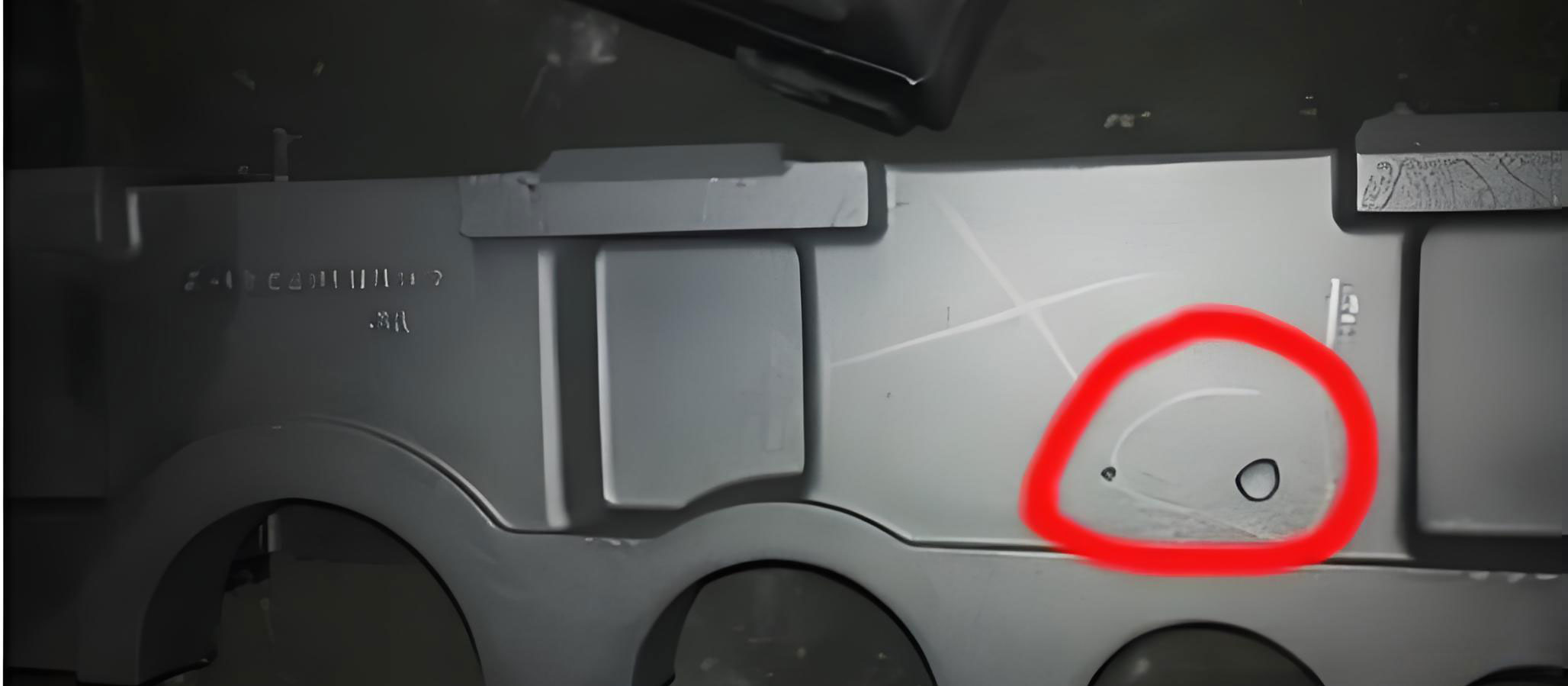
When molten iron enters the mold, intense heat is transferred to the sand cores and mold walls. This thermal energy causes the decomposition of organic materials (resin binders, coatings, additives) and the vaporization of moisture, generating large volumes of gas. The gas pressure ($P_{gas}$) in localized pockets within the core or at the metal-core interface increases. A gas pore will form and invade the metal when the following condition is met:
$$P_{gas} > P_{metal} + \frac{2\gamma}{r} + \rho g h$$
Where:
$P_{metal}$ = Local metallostatic pressure
$\gamma$ = Surface tension of the molten metal
$r$ = Radius of a potential bubble nucleus
$\rho$ = Density of the molten metal
$g$ = Acceleration due to gravity
$h$ = Depth of molten metal above the point of interest
This equation explains the typical locations of porosity in casting. Areas with low metallostatic pressure ($h$ is small), such as the upper surfaces of a casting (e.g., the top deck), are most vulnerable. Conversely, the bottom of the casting, where $h$ is large, is generally free of such defects. Thin sections, despite low pressure, often solidify quickly, forming a solid skin that blocks gas ingress. However, isolated thick sections or “hot spots” remain liquid longer, allowing gas more time to invade, making them prime locations for porosity in casting.
For our specific cylinder block, the analysis pinpointed two key issues:
1. Top Deck Porosity: This area was the farthest from the ingates, resulting in the coolest metal. The large, thin-walled water jacket core created a significant gas-generating surface area directly beneath it. While vent pins were present, their effectiveness was sometimes compromised by misalignment during molding. The combination of high gas volume, low metal temperature (higher viscosity, slower bubble rise), and potentially restricted venting led to gas entrapment.
2. Bearing Cap Porosity: The geometry of the original gating system created flow paths that were not optimal for evacuating gas from the deep, enclosed crankshaft cavity. The distance and curvature of the ingates made it difficult for the incoming metal to create a uniform, sweeping front that would push gas towards vents, leading to gas entrapment in these recessed areas.
The fundamental causes were thus tripartite: excessive gas generation from cores/molds, insufficient and inefficient gas evacuation pathways, and sub-optimal thermal and dynamic conditions during mold filling.
Comprehensive Process Optimization Strategy
Our counter-strategy was a multi-pronged attack targeting each root cause. The goal was to reduce the source term (gas generation), drastically improve the sink term (gas evacuation), and optimize the filling conditions to minimize the window of opportunity for porosity in casting formation.
Pillar 1: Reduction of Gas Generation
The focus here was on minimizing the volume of gas produced by the sand cores and the mold itself. We implemented the following changes:
- Core Resin Reduction: For the set of water jacket and ancillary cores (#9-#13), we optimized the resin content. While maintaining adequate core strength for handling and casting forces, we reduced the resin addition from 1.6% to 1.4%. This directly lowered the core’s gas potential.
- Molding Sand Optimization: We switched from a high-gas-emitting bentonite activator (FS powder) to a low-gas-emitting alternative. Furthermore, we tightened control over sand moisture and reduced the mold hardness specification from 38-45 to 38-42. A less dense mold has higher inherent permeability, allowing some internal gas to escape through the sand itself, though this is secondary to dedicated vents.
- Core Weight Reduction: We redesigned two of the largest crankshaft cores (#7 and #8) to remove non-critical mass, reducing their weight by 2.5 kg and 2.7 kg respectively. Less sand mass directly correlates to less total binder and, consequently, less gas generated.
- Process Discipline: We enforced a strict maximum 2-day storage period for coated cores. Prolonged storage can allow moisture absorption or coating degradation, both of which increase gas generation upon contact with molten metal.
Pillar 2: Enhancement of Gas Evacuation
This was the most critical and impactful area of improvement. The principle is to provide easy, high-capacity, low-resistance paths for the generated gas to escape to the atmosphere before it can invade the metal. We significantly expanded the venting system:
| Modification Location | Description of Change | Estimated Increase in Vent Area |
|---|---|---|
| Water Jacket Core (Top Deck) | Added four new open vent pins directly into the core prints. | 942 mm² |
| Overflow Riser Vent Pins (5 locations) | Increased the root diameter from 20 mm to 24 mm. | ~630 mm² |
| Top Deck Core Connection Vents (4 locations) | Increased the root diameter from 30 mm to 45 mm. | ~2,825 mm² |
| Core Print Connections | Added tapered “bridges” (60mm base, 80mm height) to connect vent passages more smoothly to vent pins. | Improved flow efficiency |
| Crankshaft Core Base | Added two new dedicated vent channels (20mm wide) leading from deep within the core assembly to the mold exterior. | ~2,000 mm² |
| Miscellaneous Core Prints | Drilled vent holes in 9 separate core print locations. | ~1,091 mm² |
| Total Additional Vent Area | ~6,488 mm² | |
Furthermore, we introduced positive location guides for all vent pins on the pattern to eliminate misalignment during molding, ensuring every vent was open and functional. The total added vent area of approximately 6,488 mm² represented a massive increase in the system’s capacity to expel gas. The efficiency of a venting system can be conceptualized by its ability to reduce the internal gas pressure before it reaches the critical invasion threshold. We can model this as aiming for a venting rate that outpaces gas generation during the critical filling and solidification phase.
Pillar 3: Optimization of Gating and Pouring Parameters
This pillar aimed to create favorable thermal and dynamic conditions in the mold cavity. We modified two key parameters:
- Gating Geometry Modification: The internal ingates leading to the critical bearing areas were redesigned. The curvature on the inside of the gate was sharpened to a 50° angle, and the outside profile was smoothed. The connection to the runner was also raised by 15 mm. This improved the metal flow direction, helping to push gas ahead of the metal front towards the vents rather than trapping it in pockets.
- Pouring Temperature and Time Control: We established a tighter, optimized window for these critical parameters. The pouring temperature was increased from approximately 1400-1420°C to 1420-1440°C. A higher temperature lowers metal viscosity ($\mu$ in fluid dynamics), which aids bubble floatation according to Stokes’ Law ($v = \frac{2r^2(\rho_{metal}-\rho_{gas})g}{9\mu}$). Concurrently, we reduced the total pour time from 26-28 seconds to 24-26 seconds. A faster pour maintains a higher metallostatic head pressure ($\rho g h$) throughout the cavity for a longer portion of the filling sequence, helping to suppress gas invasion. However, it must not be so fast as to cause turbulent entrapment of air (a different type of porosity in casting). The new settings were the result of a balanced optimization.
| Process Parameter | Original Specification | Optimized Specification | Intended Effect |
|---|---|---|---|
| Core Resin Content (#9-#13) | 1.6% | 1.4% | Reduce gas generation source term. |
| Mold Hardness | 38 – 45 | 38 – 42 | Moderate permeability, reduce gas pressure build-up. |
| Total Vent Area | Base | Base + ~6,488 mm² | Maximize gas evacuation capacity. |
| Pouring Temperature | ~1400-1420 °C | 1420-1440 °C | Lower metal viscosity, promote bubble rise. |
| Pouring Time | 26-28 s | 24-26 s | Increase metallostatic pressure during filling. |
Results and Quantitative Validation of Improvement
The fully optimized process, incorporating all three pillars of improvement, was put into full-scale production. The results were monitored over the subsequent quarter and compared directly with the baseline data. The impact on defect reduction, particularly concerning porosity in casting, was dramatic and conclusive.
The scrap rate data after implementation is presented below, alongside the previous figures for clear comparison:
| Scrap Category | Original Scrap Rate | Optimized Process Scrap Rate | Absolute Reduction | % Reduction |
|---|---|---|---|---|
| Internal Scrap | 5.11% | 1.93% | 3.18 percentage points | 62.2% |
| – Porosity in Casting | 3.13% | 0.87% | 2.26 p.p. | 72.2% |
| External Scrap | 3.94% | 2.11% | 1.83 percentage points | 46.4% |
| – Porosity in Casting | 1.54% | 0.96% | 0.58 p.p. | 37.7% |
The data speaks for itself. The internal scrap rate was more than halved, falling from 5.11% to 1.93%. Most significantly, the contribution of porosity in casting to internal scrap was reduced by over 72%, from 3.13% down to 0.87%. This demonstrates that our targeted measures were highly effective at solving the primary defect issue within the foundry. The external scrap rate also saw a substantial improvement, dropping by almost half, with porosity in casting defects reduced by 38%. The remaining external scrap from porosity likely relates to very small, sub-surface pores only detectable by more stringent customer inspection, indicating a potential area for future refinement.
Discussion and Deeper Analysis of the Improvement Mechanisms
The success of this project underscores that combating porosity in casting in complex components is not about a single “silver bullet” but requires a systems engineering approach. Each pillar of our strategy interacted synergistically.
The reduction in gas generation (Pillar 1) lowered the initial gas load on the system. However, even with reduced generation, significant gas is still produced. The dramatic enhancement of venting capacity (Pillar 2) was arguably the most critical factor. By providing ample, low-resistance escape routes, we ensured that the gas pressure ($P_{gas}$) at the metal-interface rarely, if ever, exceeded the suppressing forces defined in our earlier equation. The relationship can be thought of as ensuring the venting flow rate exceeds the gas generation rate during the critical period. We can express a simplified venting efficacy ($E_v$) as:
$$E_v \propto \frac{A_v \cdot \sqrt{\Delta P}}{L_v}$$
Where $A_v$ is the total vent area, $\Delta P$ is the pressure differential between the gas pocket and the atmosphere, and $L_v$ is the flow path length/resistance. Our actions maximized $A_v$ and minimized $L_v$ through direct, large-diameter vents.
The optimized pouring parameters (Pillar 3) supported these mechanical changes. The higher temperature lowered viscosity, which, according to fluid dynamics, reduces the pressure drop required for gas to flow through the vents and also aids the floatation of any minute bubbles that might form. The shorter pour time increased the average head pressure ($\rho g h$) throughout filling, raising the right-hand side of the gas invasion inequality and making it harder for gas to penetrate the metal.
In conclusion, the persistent challenge of porosity in casting in intricate automotive components like cylinder blocks can be systematically defeated. The methodology involves: a rigorous root-cause analysis linking defect location to process physics; a targeted, multi-faceted strategy to reduce gas generation, maximize gas evacuation, and optimize filling dynamics; and the quantitative validation of results through scrap rate analysis. This case study proves that through such a comprehensive engineering approach, significant quality improvements and cost savings are achievable, transforming a high-scrap process into a reliable and efficient manufacturing operation. The principles established here—source reduction, path enhancement, and parameter optimization—form a universal framework for addressing invasive porosity in casting across a wide range of complex castings.