
In the field of power generation equipment, components operating under extreme conditions demand exceptional quality and reliability. One such critical part is the high-pressure steam chamber, a core element within steam turbines. This component functions as a pressure vessel and flow distributor, channeling high-energy steam to drive the turbine rotor. Its operational environment is severe, involving sustained exposure to temperatures around 565°C and internal pressures exceeding 8 MPa. Consequently, the integrity of this casting is paramount to ensure leak-free performance and a lifespan measured in decades. The manufacturing method of choice for such complex, high-integrity parts is often sand casting, which offers the design flexibility required for intricate geometries. This article details a comprehensive study on the process design and numerical simulation for producing this demanding component via sand casting, focusing on defect prediction and mitigation strategies essential for high-quality sand casting products.
The base material specified for the steam chamber is the low-alloy heat-resistant cast steel ZG15Cr2Mo1. The chemical composition of this grade is critical for achieving the necessary high-temperature strength and stability, and is detailed in Table 1.
| C | Mn | Si | Cr | Mo | S | P |
|---|---|---|---|---|---|---|
| ≤0.18 | 0.40–0.70 | ≤0.60 | 2.00–2.75 | 0.90–1.20 | ≤0.030 | ≤0.030 |
The cast part, with its added machining allowances, possesses a complex geometry featuring a large central cylindrical cavity, multiple inlet/outlet nozzles, and significant variations in wall thickness. Its overall envelope dimensions are approximately 1648 mm x 620 mm x 1077 mm. A fundamental analysis of wall thickness is the first step in designing a robust casting process. For cast steel sand casting products of this size, the minimum recommended wall thickness is typically 20 mm. Our analysis confirms that all sections of this component meet or exceed this requirement, with critical thick sections identified as potential hot spots. Key dimensions and attributes are summarized in Table 2.
| Parameter | Value |
|---|---|
| Approximate Volume | 0.251 m³ |
| Calculated Mass (Solid) | ~1958 kg |
| Maximum Wall Thickness | 153 mm |
| Minimum Wall Thickness | 30 mm |
| Liquidus Temperature | 1501 °C |
| Patternmaker’s Shrinkage Allowance | 1.8% |
The initial and crucial decisions in crafting a process for such sand casting products involve determining the pouring position and the parting line. For this component, two primary options were evaluated: a vertical orientation and a horizontal orientation. The horizontal position was selected for several compelling reasons. It allows the parting line to be placed at the mold’s largest cross-sectional area, simplifying pattern withdrawal. More importantly, it positions the major thick sections of the casting (like the base and top bosses) in the upper regions of the mold cavity. This strategic placement facilitates the effective use of feeders (risers) to compensate for solidification shrinkage, a fundamental principle for sound sand casting products. Furthermore, this orientation avoids the need for complex core supports or chills within the cavity, enhancing process reliability.
Given the high pouring temperature of steel (targeted at ~1580°C), the mold and core materials must exhibit high refractoriness and thermal stability. A silica sand (>97% SiO2) bonded with phenolic resin was chosen for both the mold and cores. This system provides adequate strength and good collapsibility. For the coating, an alumina-based alcohol-borne wash was specified to be applied via spraying, ensuring a smooth, refractory surface on the mold cavity to improve the surface finish of the final sand casting products. The internal geometry requires three distinct sand cores: two to form the left and right sections of the main cylindrical cavity, and a smaller core to create the external port passages.
The design of the gating system is paramount to ensure a tranquil fill and control solidification. For medium-to-large steel castings, a bottom-poured, unpressurized (open) gating system is standard. The pouring time \( t \) is a key parameter calculated to achieve a desired metal rise velocity \( v_L \) in the cavity, minimizing turbulence and erosion. The calculation is based on the total weight of metal to be poured, including the casting, feeders, and gating system. The formula used is:
$$ t = \frac{G_L}{N \cdot n \cdot v_{\text{pack}}} $$
Where \( G_L \) is the total molten metal weight (kg), \( N \) is the number of ladles, \( n \) is the number of nozzles per ladle, and \( v_{\text{pack}} \) is the pouring rate per nozzle (kg/s). For this casting, with a single ladle and nozzle (diameter 70 mm, \( v_{\text{pack}} \approx 120 \) kg/s), the pouring time was calculated to be approximately 18 seconds. This was verified against the required rise velocity using the formula:
$$ v_L = \frac{h_C}{t} $$
Where \( h_C \) is the height of the casting in the pouring position (620 mm). The resulting \( v_L \) of 34.4 mm/s was deemed acceptable. The gating system was designed with a ratio of sprue:runner:ingate cross-sectional areas of approximately 1.0 : 1.9 : 2.2. Three ingates were placed symmetrically along the parting plane to promote even filling.
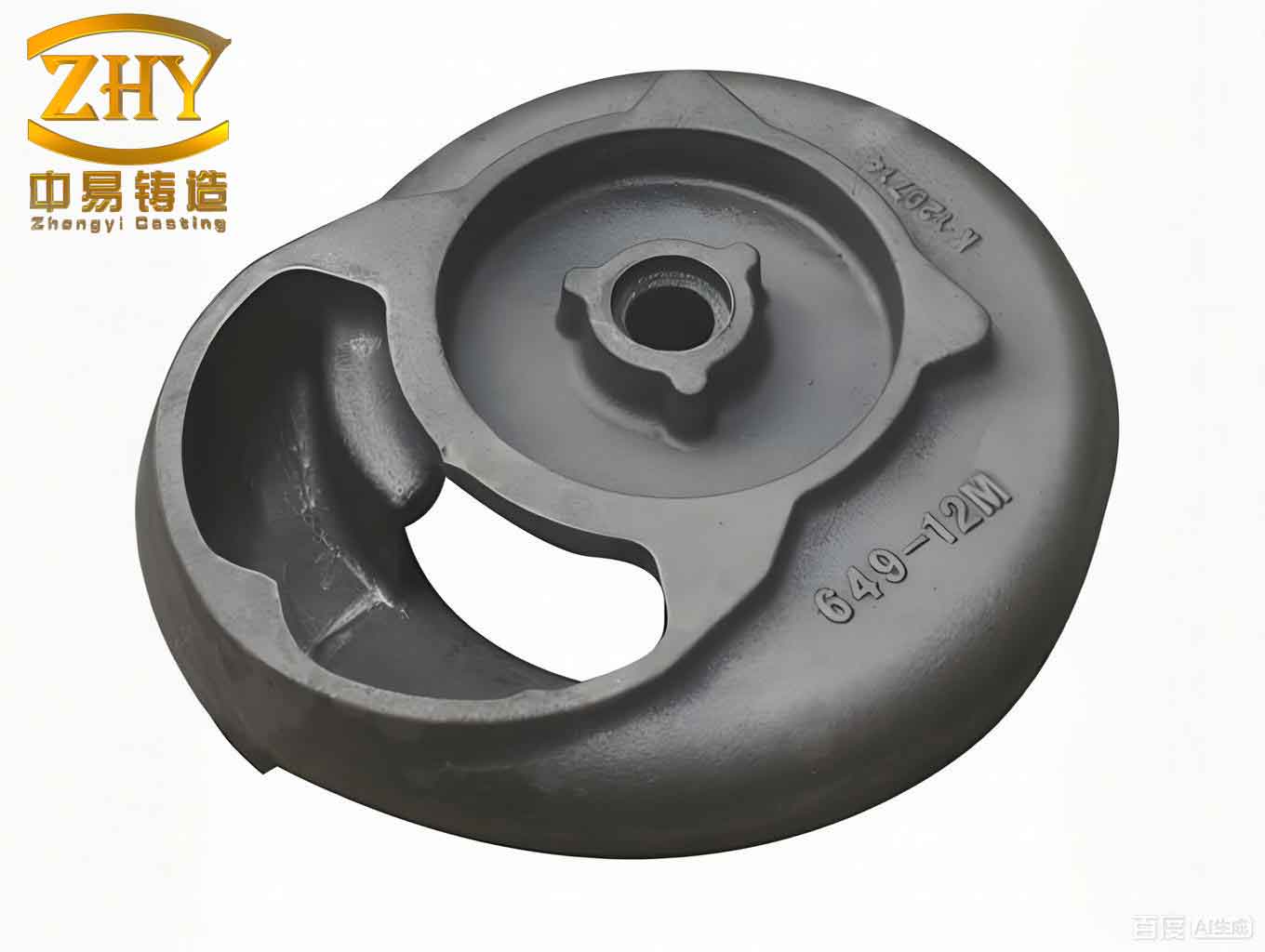
To move beyond theoretical calculation and predict the actual behavior of the molten metal, numerical simulation is an indispensable tool for modern foundries. We employed ProCAST software to simulate the filling and solidification stages of the initial process design. The model was meshed, and key simulation parameters were defined as shown in Table 3.
| Parameter | Value |
|---|---|
| Pouring Temperature | 1600 °C |
| Pouring Time | 18 s |
| Mold Material | Phenolic Resin Sand |
| Metal-Mold Heat Transfer Coefficient | 750 W/(m²·K) |
The filling simulation confirmed a stable, progressive fill with no indication of cold shuts or misruns. This validated the basic design of the gating system. However, the solidification simulation revealed significant issues, as anticipated from the hot spot analysis. Major volumetric shrinkage porosity (macro-shrinkage) was predicted in two key locations: the thick sections at the base of the steam chamber and the top boss sections. Furthermore, dispersed micro-porosity (shrinkage) was indicated in the junctions between walls. These defects are unacceptable for a high-integrity pressure vessel, confirming that the initial rigging was insufficient for these heavy sections common in large sand casting products.
The solidification pattern showed that these thick sections remained isolated liquid pockets after the surrounding thinner walls had solidified, cutting off any possibility of feed metal from the gating system. To address this, the principle of directional solidification must be enforced, guiding shrinkage to designated feeders. This is achieved by calculating the geometric modulus (volume-to-surface-area ratio) of the problematic sections and designing risers with a higher modulus to ensure they solidify last. The modulus \( M \) of a section is given by:
$$ M = \frac{V}{A} $$
Where \( V \) is volume and \( A \) is the surface area through which heat is extracted. For effective feeding, \( M_{\text{riser}} > 1.2 \times M_{\text{casting section}} \). Based on this, four cylindrical side risers were designed and attached to the thick base sections and the top bosses.
To further enhance directional solidification and accelerate cooling in specific internal areas that were difficult to feed directly, chills were introduced. Internal chills (made from molded sand coated with a high-thermal-capacity material) were placed inside the cavity cores, adjacent to the heavy base sections and the dividing walls between inlets. The placement of these chills and risers fundamentally alters the thermal gradients, promoting a more controlled solidification sequence from the casting extremities toward the risers.
The modified process, incorporating risers and chills, was subjected to a second simulation. The results demonstrated a marked improvement. The macro-shrinkage defects were completely eliminated from the casting body and successfully relocated into the risers, which is their intended function. The total predicted shrinkage porosity in the final casting was reduced to a minimal level. The simulation parameters for this optimized run are summarized in Table 4, highlighting the unchanged pouring conditions but radically improved thermal management.
| Metric | Initial Design | Optimized Design (with Risers & Chills) |
|---|---|---|
| Macro-shrinkage in Casting | Significant volumes in base and top bosses | None |
| Dispered Micro-porosity | Present in wall junctions | Greatly reduced, localized only in top boss feed path |
| Defect Location | Critical casting sections | Transferred to sacrificial risers |
| Predicted Casting Soundness | Unacceptable for service | High, meeting quality standards |
This case study underscores the power of integrated process design and numerical simulation in the production of complex, high-duty sand casting products. By combining foundational casting principles—such as modulus calculation for feeder design and strategic use of chills—with advanced simulation tools like ProCAST, it is possible to predict and eliminate major defects before any metal is poured. The iterative process of design, simulation, analysis, and optimization directly leads to higher yield, improved reliability, and reduced development time and cost. For the high-pressure steam chamber, the optimized sand casting process successfully addresses the solidification challenges inherent in its geometry, resulting in a simulated casting that meets the stringent quality requirements for high-temperature, high-pressure service. Future work could focus on further fine-tuning, such as exploring the use of insulating riser sleeves to improve feeding efficiency or conducting stress simulation to assess residual stresses in this large steel casting.