
In the traditional foundry industry, the production of castings typically follows a trial-and-error approach, involving iterative adjustments to the casting scheme, which is not only wasteful in terms of manpower and material resources but also significantly extends the production cycle. The application of casting simulation software for the study and optimization of casting processes can effectively reduce development time and costs. This approach has been widely adopted for various complex castings, including steel, iron, and aluminum. This research focuses on the simulation and optimization of the sand casting process for a high-pressure steam chamber casting, a critical component in steam turbines. The component is subjected to extreme service conditions, including high temperatures (approximately 565°C) and high pressures (8.28 MPa), requiring exceptional integrity and a long service life of up to 20 years. Therefore, the casting must exhibit high-quality metallurgical soundness, free from major shrinkage defects. The study employs ProCAST software to simulate the filling and solidification processes, aiming to design a robust sand casting process that minimizes defects.
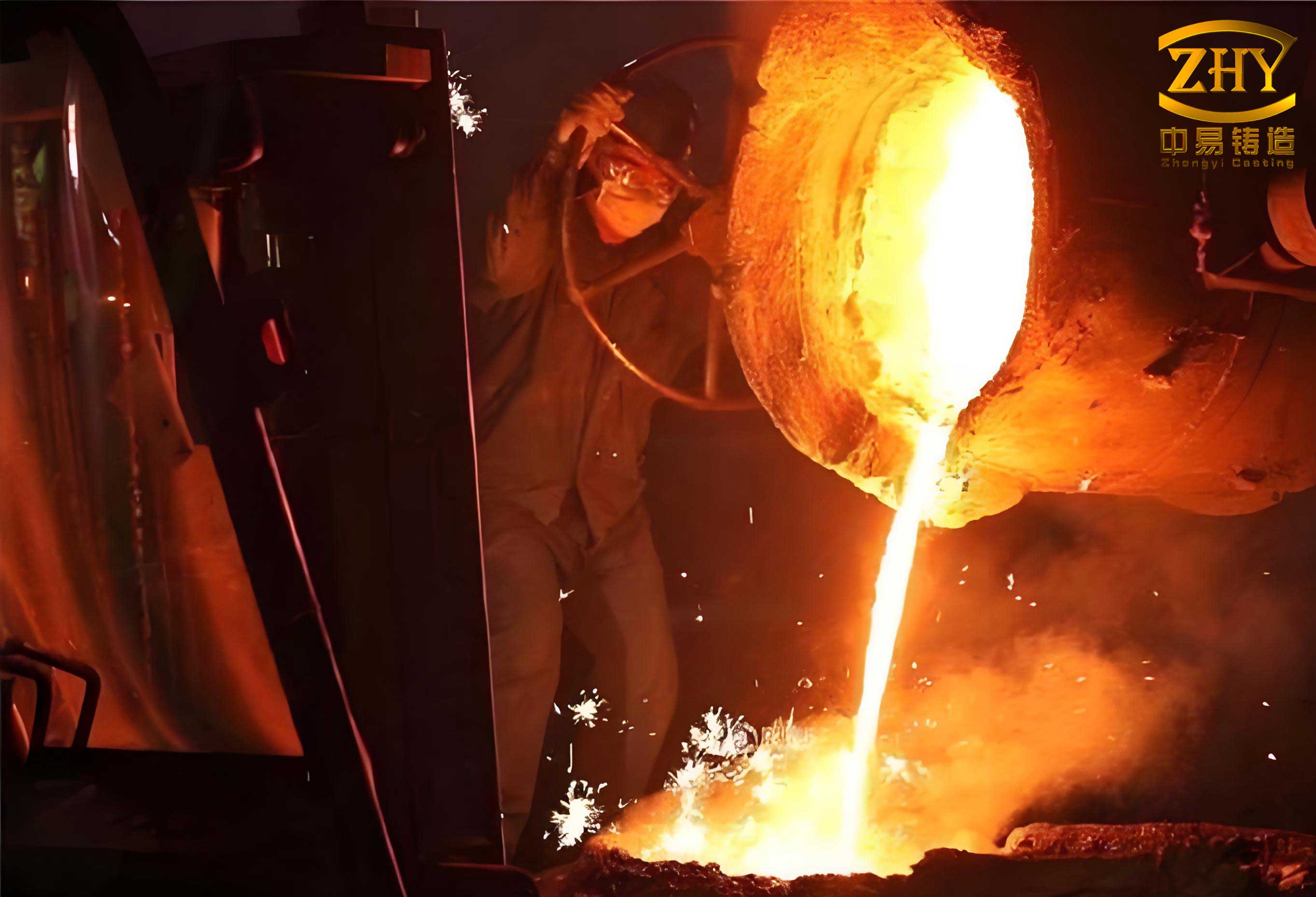
The material specified for the high-pressure steam chamber is alloy cast steel ZG15Cr2Mo1. Its chemical composition is a critical factor influencing its mechanical properties and castability. The nominal composition is provided in the table below.
| Element | Content (wt.%) |
|---|---|
| C | ≤ 0.18 |
| Mn | 0.40 – 0.70* |
| Si | ≤ 0.60 |
| Cr | 2.00 – 2.75 |
| Mo | 0.90 – 1.20 |
| S | ≤ 0.030 |
| P | ≤ 0.030 |
*Note: For every 0.01% reduction in C content above the minimum, the Mn content is allowed to increase by 0.04%, up to a maximum of 1.20%.
The casting has a complex geometry with an envelope dimension of 1648 mm × 620 mm × 1077 mm. The volume of the casting is approximately 0.251 m³, leading to a calculated weight of about 1957.8 kg, assuming a density of 7.8 g/cm³ for the material. A wall thickness analysis reveals a maximum thickness of 153 mm and a minimum thickness of 30 mm, which is well above the recommended minimum wall thickness of 20 mm for steel castings produced via sand casting, ensuring castability.
The first step in process design is determining the pouring position and parting line. For this component, two primary options were considered: a vertical position and a horizontal position. A horizontal pouring position was selected for several advantages pertinent to sand casting: it allows the parting line to be placed at the largest cross-section, simplifying mold assembly and core placement; it positions the thickest sections of the casting (which will require feeding) in the upper regions of the mold, facilitating the placement of risers; and it avoids the need for complex core supports. The gating system was designed as an open type, typical for steel castings poured with a bottom-pour ladle. To ensure a rapid fill and minimize radiative heating of the sand mold, the theoretical pouring time was calculated. The total metal weight $G_L$ (including casting, risers, and a 7% allowance for mold wall movement) is 2094.85 kg. Using a ladle with one nozzle of 70 mm diameter (approximate pouring rate $v_{ladle}$ = 120 kg/s), the pouring time $t$ is given by:
$$ t = \frac{G_L}{N \cdot n \cdot v_{ladle}} $$
where $N$ is the number of ladles (1) and $n$ is the number of nozzles per ladle (1). This yields a theoretical pouring time of approximately 17.46 seconds, which was rounded to 18 seconds for the simulation. The rise velocity $v_L$ of the metal in the mold cavity is verified using the casting height $h_c$ (620 mm in the horizontal position):
$$ v_L = \frac{h_c}{t} $$
This calculation gives $v_L$ = 34.4 mm/s, which is acceptable for a steel casting of this complexity. The gating system ratio was designed as $\Sigma A_{nozzle} : \Sigma A_{sprue} : \Sigma A_{runner} : \Sigma A_{ingate} = 1.0 : 1.9 : 1.9 : 2.2$. Three ingates were placed along the parting plane to promote uniform filling. The design of the mold involves three sand cores made from phenolic resin-bonded sand to create the internal cavities of the steam chamber. A high-silica sand (>97% SiO₂) with an alumina-based coating is specified to withstand the high thermal load of the steel pour, which is characteristic of robust sand casting practice for steel.
The initial process design, without risers or chills, was modeled and simulated in ProCAST. Key simulation parameters were set based on the material properties and process design: a pouring temperature of 1600°C (liquidus temperature is 1501°C), a pouring time of 18 seconds, and a heat transfer coefficient $h$ of 750 W/(m²·K) at the metal-mold interface. The mesh of the system, including the casting, gating, and mold, was generated to ensure computational accuracy. The filling simulation confirmed a smooth fill without any mistrun or cold shut issues, validating the basic gating design for this sand casting application.
However, the solidification and shrinkage prediction analysis revealed significant defects. Large volume shrinkage cavities were predicted in the thick sections at the base of the steam chamber and at the top boss sections. Additionally, dispersed microporosity (shrinkage) was present in other areas. These defects are classic problems in sand casting, arising because these thick sections, or “hot spots,” remain liquid longer than the surrounding material, creating isolated liquid pools that cannot be fed once the feeding paths solidify. The solidification sequence was not directional toward a designed feeding source.
To address these defects, the sand casting process was optimized by introducing feeding aids: risers and chills. The optimization principle is to establish a controlled directional solidification sequence, where the casting sections solidify first, followed by the risers, thereby concentrating shrinkage in the risers which are later removed. Four risers were strategically placed atop the two thick base sections and the two top boss sections, which were identified as the major hot spots. The riser dimensions were determined using the modulus method, a standard technique in sand casting design, ensuring their solidification time is longer than that of the sections they are intended to feed.
Furthermore, external chills were added to critical areas to accelerate local cooling and modify the solidification pattern. Chills were placed inside the cavity adjacent to the thick base sections and near the divider walls of the steam inlets. The function of these chills in the sand casting process is to increase the local cooling rate, effectively eliminating the thermal center of the hot spot and promoting faster solidification in those regions, thus forcing the thicker sections to be fed by the designated risers.
| Process Modification | Location/ Purpose | Expected Effect |
|---|---|---|
| Addition of Riser 1 & 2 | Above thick base sections | Feed shrinkage in the massive base regions. |
| Addition of Riser 3 & 4 | Above top boss sections | Feed shrinkage in the upper thick bosses. |
| Addition of Chill A & B | Inside cavity near base | Accelerate cooling of base, promote directional solidification towards risers 1 & 2. |
| Addition of Chill C & D | Near steam inlet dividers | Accelerate cooling of divider walls, modify thermal profile to reduce isolated liquid zones. |
The optimized sand casting process, incorporating these risers and chills, was subjected to a second numerical simulation. The results demonstrated a marked improvement. The large shrinkage cavities in the base and top bosses were completely eliminated, with the shrinkage now successfully relocated to the riser volumes. The total shrinkage porosity in the casting itself was significantly reduced to a predicted 2.71%. This confirms the effectiveness of using simulation-driven design to optimize riser and chill placement in sand casting. However, the simulation also indicated that the accelerated cooling from the chills on the divider walls altered the feeding flow, potentially deepening the microporosity zone in the top boss. This highlights an important aspect of process optimization—modifications can have complex interactions. Further refinement, such as adjusting riser size, using insulating riser sleeves, or fine-tuning chill dimensions, could be explored in subsequent simulation iterations to achieve an even more optimal soundness prediction for this demanding sand casting component.
In conclusion, this study successfully applied numerical simulation to design and optimize the sand casting process for a high-pressure steam chamber cast steel component. The initial process design, while yielding a sound fill, led to unacceptable shrinkage defects. Through systematic analysis of the solidification patterns, an optimized process was developed employing strategic riser and chill placement. The final simulation of this optimized sand casting process confirmed the elimination of major shrinkage cavities, with defects successfully redirected to the sacrificial risers. This work underscores the critical value of simulation technology in modern foundry practice, enabling the development of robust and reliable sand casting processes for complex, high-integrity steel castings while reducing the time and cost associated with physical trial runs.