
The manufacturing of high-integrity, complex thin-walled components for aerospace applications presents significant challenges. Traditional sand casting often falls short in meeting the stringent requirements for dimensional accuracy, internal soundness, and superior mechanical properties in such parts. For critical shell castings with intricate geometries and substantial variations in wall thickness, the gypsum mold low-pressure casting process has emerged as a superior alternative. This process combines the excellent surface finish and replication fidelity of gypsum molds with the controlled filling and feeding capabilities of low-pressure casting. However, the very complexity that necessitates this advanced process also makes it prone to defects like shrinkage porosity and cavities, particularly in isolated thick sections or hot spots. These defects can drastically reduce yield rates and increase production costs. To address this, numerical simulation technology has become an indispensable tool for visualizing the filling and solidification dynamics, predicting defect formation, and guiding process optimization before physical trials. This article details a comprehensive study on the application of numerical simulation to optimize the gypsum mold low-pressure casting process for a specific aerospace shell casting, demonstrating a systematic approach from virtual analysis to production validation.
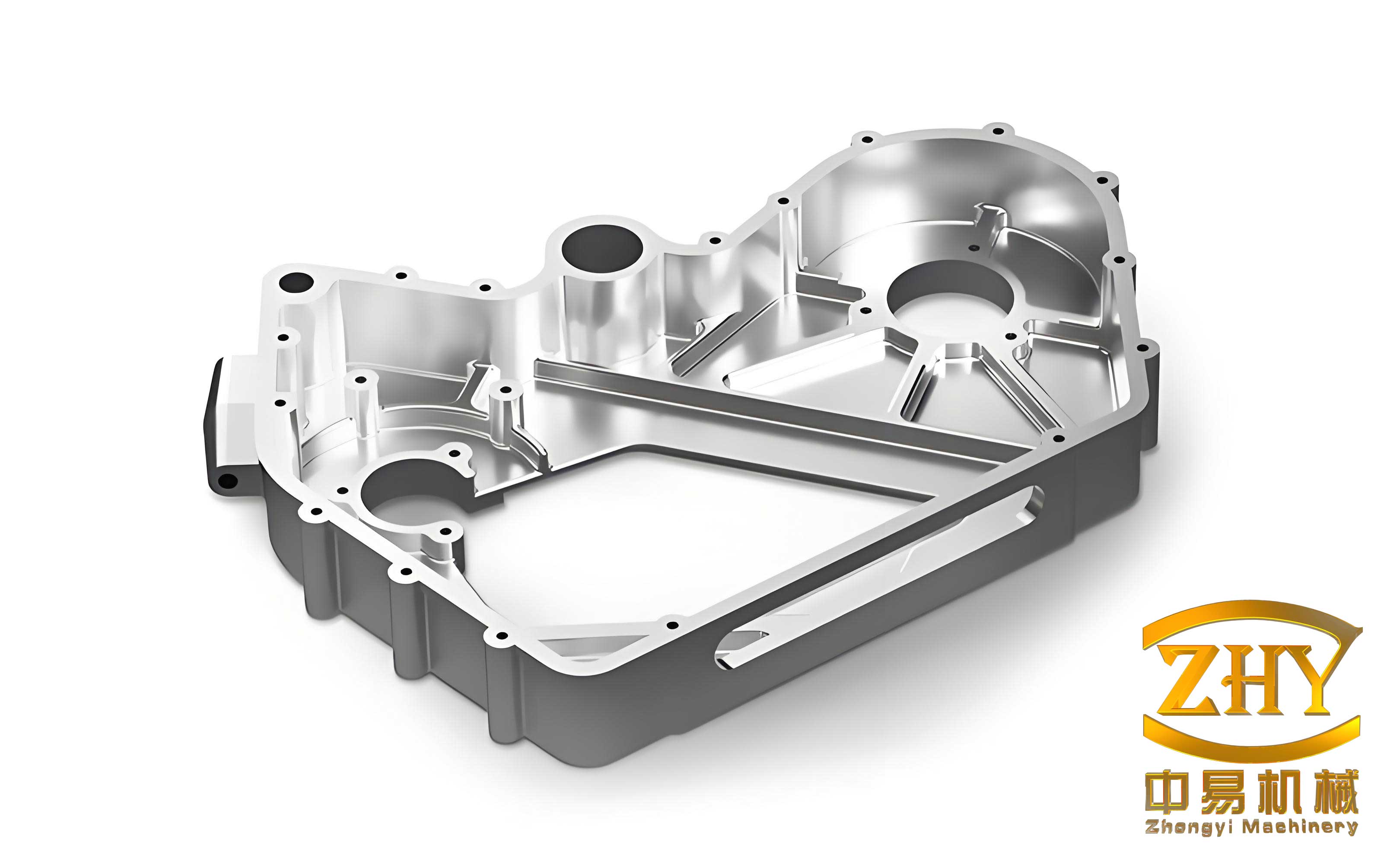
The subject of this study is an aerospace housing, a quintessential shell casting with a complex structure. The material specified is ZL114A aluminum alloy, chosen for its good castability and mechanical properties. The casting’s external dimensions are 409 mm × 259 mm × 122 mm, with a mass of approximately 6.19 kg. A primary challenge lies in its highly uneven wall thickness, ranging from a mere 1.5 mm in thin sections to 26 mm in thick bosses and mounting lugs (referred to as “ears”). This disparity creates pronounced thermal gradients during solidification. According to the stringent aerospace standard HB963, this casting is classified as a Category I part, requiring X-ray inspection free of any shrinkage porosity or cavities. The geometric complexity and quality requirements made gypsum mold low-pressure casting the process of choice to achieve the necessary precision and internal quality.
The foundation of an accurate numerical simulation lies in robust mathematical models that govern the underlying physics. The simulation of low-pressure casting for shell castings involves solving coupled equations for fluid flow, heat transfer, and solidification. The core governing equations are as follows:
The fluid flow during mold filling is described by the Navier-Stokes equations for incompressible, transient flow, incorporating the Volume of Fluid (VOF) method to track the liquid-metal/air interface. The continuity and momentum equations are:
$$
\nabla \cdot \vec{u} = 0
$$
$$
\frac{\partial (\rho \vec{u})}{\partial t} + \nabla \cdot (\rho \vec{u} \vec{u}) = -\nabla p + \nabla \cdot (\mu \nabla \vec{u}) + \rho \vec{g} + \vec{F}_{st}
$$
where $\vec{u}$ is the velocity vector, $\rho$ is the density, $p$ is the pressure, $\mu$ is the dynamic viscosity, $\vec{g}$ is the gravitational acceleration, and $\vec{F}_{st}$ represents the surface tension force at the interface.
Heat transfer during filling and solidification is governed by the energy conservation equation, which includes the latent heat of fusion:
$$
\rho C_p \frac{\partial T}{\partial t} + \rho C_p \vec{u} \cdot \nabla T = \nabla \cdot (k \nabla T) + Q_{latent}
$$
Here, $C_p$ is the specific heat capacity, $k$ is the thermal conductivity, $T$ is the temperature, and $Q_{latent}$ is the latent heat source term related to the phase change. The solidification process is often modeled using a porosity prediction model based on the Niyama criterion or a direct shrinkage volume calculation. A simplified form of the thermal transport during solidification, neglecting flow, is the Fourier heat conduction equation:
$$
\frac{\partial T}{\partial t} = \alpha \nabla^2 T
$$
where $\alpha = k / (\rho C_p)$ is the thermal diffusivity. For shell castings, the boundary conditions at the metal-mold interface are critical, with heat transfer coefficients defined for the gypsum mold material.
Based on the casting geometry, an initial process scheme was designed. A 3D model of the casting and gating system was created in Pro/ENGINEER and imported into the ViewCast simulation software in STL format. The system was discretized into approximately 2 million finite element cells to ensure resolution of thin walls and complex features of the shell casting. The material properties for ZL114A alloy and the gypsum mold were assigned from the software’s database. The initial process parameters are summarized in the table below:
| Process Parameter | Initial Value |
|---|---|
| Pouring Temperature | 730 °C |
| Mold Preheating Temperature | 190 °C |
| Lift Pressure | 40 kPa |
| Filling Pressure | 45 kPa |
| Intensification Pressure | 50 kPa |
| Pressure Holding Time | 600 s |
The filling simulation results showed a relatively smooth and sequential filling pattern from the bottom to the top of the mold cavity, with no apparent signs of turbulence or misruns, which is a key advantage of low-pressure casting for complex shell castings. However, the solidification simulation revealed critical issues. The temperature field and liquid fraction isosurfaces indicated that while thin walls and top sections solidified rapidly, the thick “ear” sections remained liquid for an extended period. Crucially, these sections became isolated liquid pools, cut off from the feeding paths provided by the gating system before they fully solidified. This is a classic scenario for the formation of macro-shrinkage. The defect prediction module of the software subsequently highlighted these “ear” regions as high-risk areas for significant shrinkage porosity and cavities. The simulated defect distribution aligned with the actual production results of the initial trial batch of 28 shell castings, where X-ray inspection revealed extensive flake-like shrinkage in the side ear regions, yielding an unacceptably low qualification rate of only 46%.
A thorough analysis of the initial simulation and casting defects led to a targeted optimization strategy. The core problem was identified as insufficient directional solidification and inadequate feeding of the thick, thermally isolated sections of the shell casting. The optimization focused on three main aspects: modifying thermal gradients, improving feed paths, and adjusting process parameters. The specific changes implemented are contrasted with the initial scheme in the following table:
| Aspect | Initial Process | Optimized Process | Rationale |
|---|---|---|---|
| Thermal Control | None | Addition of chill inserts at thick wall/ear junctions. | To accelerate local cooling, promote earlier solidification of hot spots, and eliminate isolated liquid pools. |
| Feeding System | Single bottom-filling point. | Addition of supplementary ingates directed towards the side ear sections. | To establish direct and extended feeding channels to the problematic thick sections, ensuring liquid metal supply until solidification is complete. |
| Pouring Temp. | 730 °C | Reduced to 710-720 °C. | To reduce the total heat content, lessen thermal stress, and shorten the overall solidification time. |
| Mold Temp. | 190 °C | Reduced to 100-120 °C. | To increase the cooling rate, steepen the thermal gradient, and further promote directional solidification. |
| Holding Time | 600 s | Increased to 800 s. | To ensure that feeding pressure is maintained throughout the entire solidification sequence of the now-slower-feeding thick sections. |
The optimized process was subjected to a new simulation cycle. The results demonstrated a dramatic improvement. The solidification sequence became markedly more directional. The areas with chills solidified significantly earlier. Most importantly, the previously isolated liquid pools in the ear sections were now continuously connected to the liquid metal in the newly added ingates until the final stages of solidification. The revised feeding system effectively acted as thermal and mass reservoirs. The final defect prediction simulation confirmed that the risk of shrinkage in the main body of the shell casting was eliminated, with any predicted porosity being confined to the sacrificial gating system itself. This virtual result indicated a high probability of success for the optimized process.
The optimized parameters were transferred to the foundry floor for production validation. A batch of 18 shell castings was produced using the new scheme. Non-destructive X-ray inspection of these castings showed a homogeneous internal structure with no discernible shrinkage defects in the critical ear regions or elsewhere in the casting body. The qualification rate soared to 94%, conclusively validating the simulation predictions and optimization strategy. Furthermore, samples from the optimized castings were subjected to a standard T6 heat treatment (solution heat treatment and artificial aging) and their mechanical properties were tested. The results, presented below, consistently exceeded the minimum requirements specified by the relevant aerospace material standard (HB962-2005), proving that the optimized process not only eliminated defects but also preserved the alloy’s intrinsic performance capabilities.
| Sample | Tensile Strength (MPa) | Elongation (%) | Brinell Hardness (HBW) |
|---|---|---|---|
| 1 | 340 | 4.5 | 110 |
| 2 | 335 | 5.0 | 111 |
| 3 | 329 | 6.5 | 110 |
| Standard (HB962-2005) Minimum | ~300 (Typical for similar grades) | ~2.0 | > 90 |
This case study underscores the powerful synergy between advanced manufacturing processes and digital simulation tools. For complex shell castings produced via gypsum mold low-pressure casting, numerical simulation is not merely a diagnostic tool but a proactive engineering platform. It allows for the visualization of inherent process risks, such as unfavorable solidification patterns leading to shrinkage in thick sections, before any metal is poured. By guiding targeted optimizations—such as the strategic placement of chills, redesign of feeding systems, and fine-tuning of thermal parameters—simulation enables a first-time-right manufacturing approach. The successful transition from a 46% to a 94% qualification rate for a high-integrity aerospace shell casting demonstrates significant gains in product quality, resource efficiency, and overall cost-effectiveness. This methodology establishes a reliable framework for the development and optimization of casting processes for other critical, geometrically complex components across demanding industries.