
The bearing housing is a crucial auxiliary component in power transmission systems, tasked with supporting and fixing the outer ring of a bearing. Its primary functions are to ensure precise and continuous rotation of the inner ring, minimize friction, and thereby enhance the operational efficiency, reliability, and lifespan of the entire assembly. The dimensional accuracy of its internal bore and mounting base is paramount to the performance of the transmission unit. The primary challenge in producing such a housing via gray iron casting lies in its complex geometry, characterized by significant variations in wall thickness. These thick sections become hotspots during solidification, leading to shrinkage porosity and cavities if the casting process is not meticulously controlled. This detailed account presents a comprehensive methodology for optimizing the gray iron casting process of an upper bearing housing using advanced numerical simulation, moving beyond traditional trial-and-error methods.
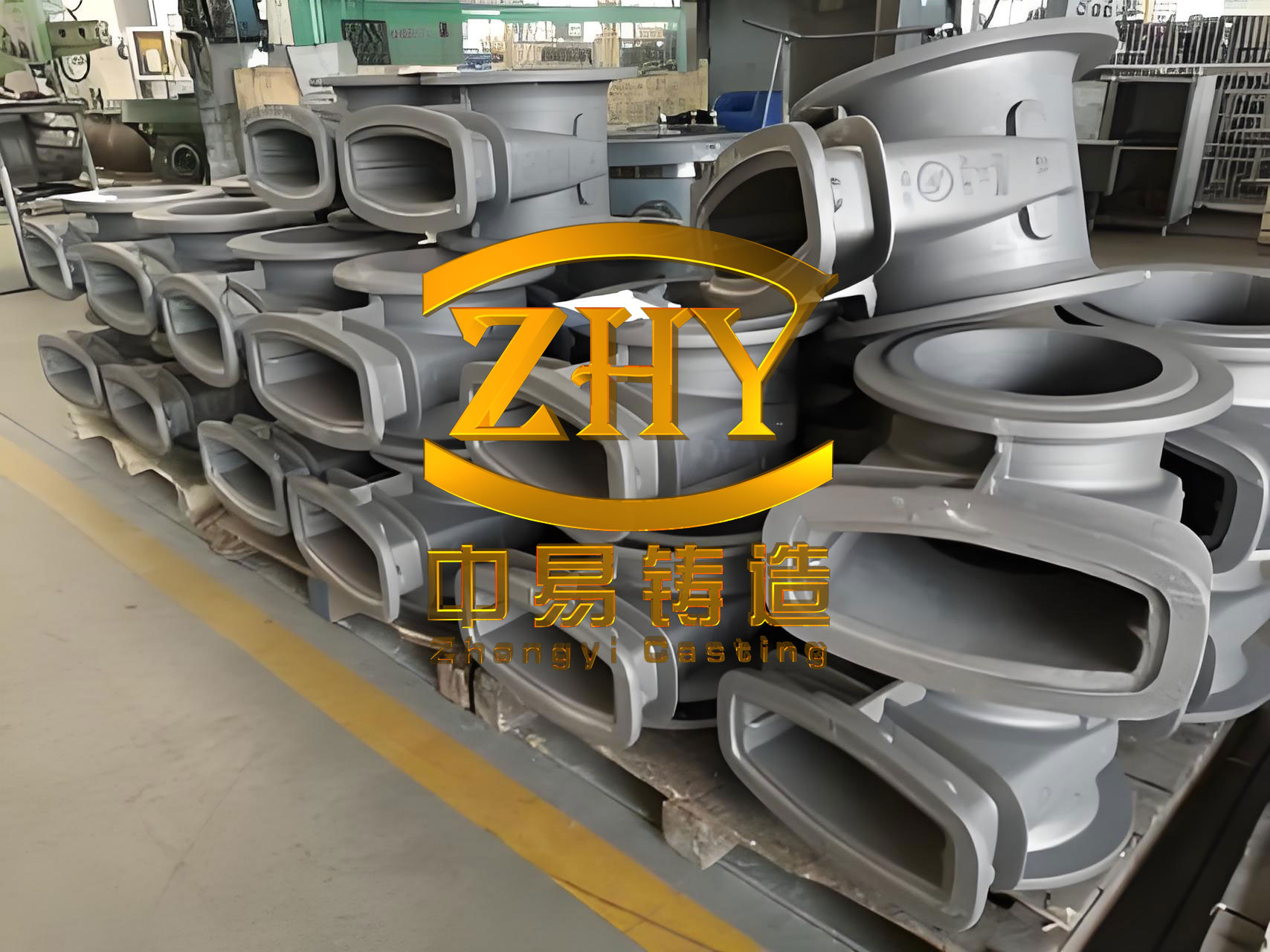
The component under consideration is the upper half of a bearing housing, with an overall envelope dimension of 1085 mm × 910 mm × 380 mm. The wall thickness varies drastically from a minimum of 20 mm to a maximum of 145 mm, with an average of approximately 25 mm. The part is largely symmetrical and features a large internal cavity. The material specified is HT250 gray iron, with a final casting weight of 566 kg. The choice of HT250, with its pearlitic matrix and flake graphite, provides an excellent combination of strength, wear resistance, damping capacity, and machinability for this application. A key material characteristic influencing the process design is the expansion during the eutectic solidification of gray iron casting. The growth of graphite flakes displaces the surrounding liquid, which can compensate for the inherent liquid shrinkage, thereby reducing the demand for extensive external feed metal compared to other alloys. For this small-batch production, the acid-catalyzed furan resin no-bake sand process was selected for mold making due to its good thermal stability, dimensional accuracy, and suitability for jobbing shops.
Foundry Process Design Strategy
The initial phase of the project involved a fundamental design of the foundry process based on established principles for gray iron casting. This included defining the pouring position, parting line, and gating system layout.
Pouring Position and Parting Line Selection: Three potential pouring orientations were evaluated. The chosen orientation places the large, critical mounting base face downward. This strategy offers several advantages: it improves the metallurgical quality of this primary machining and load-bearing surface by minimizing slag and gas entrapment; it facilitates core placement and stability; and it positions the major thick sections in the upper regions of the mold, which is conducive to the effective placement of feeders (risers) for controlled solidification. The parting line was set at the plane of this large base to enable simple two-part mold construction, keeping the entire casting in the drag (lower mold half) to maximize dimensional consistency.
Gating System Design: A bottom-gating system was designed to ensure a calm, non-turbulent fill. Turbulence during mold filling in gray iron casting can lead to mold erosion, slag entrainment, and excessive oxidation. The system was designed as a pressurized type with a choke at the ingates to promote rapid filling and a favorable temperature gradient. The key parameters were calculated as follows. The total weight of metal in the mold (casting + gating system) was estimated at 679.2 kg (1.2 times the casting weight). The pouring time \( t \) (in seconds) was calculated using an empirical formula for castings between 100 and 1000 kg:
$$ t = S_1 \sqrt[3]{G_L} $$
where \( G_L \) is the total weight of metal in the mold (679.2 kg), and \( S_1 \) is an empirical coefficient. For a quick pour suited to gray iron casting, \( S_1 \) was taken as 1.7. This yielded a theoretical pouring time:
$$ t = 1.7 \times \sqrt[3]{679.2} \approx 46.4 \text{ seconds} $$
The choke area \( \Sigma S_{choke} \) was calculated using the common Oseen formula, resulting in an area of 8.75 cm². For a pressurized system, the typical cross-sectional area ratios were set as \( \Sigma S_{sprue} : \Sigma S_{runner} : \Sigma S_{ingate} = 1.15 : 1.1 : 1 \). From these ratios and the choke area, the dimensions for each gating element were determined and are summarized in the table below.
| Gating Element | Design Principle | Calculated Area (cm²) | Final Dimension |
|---|---|---|---|
| Sprue (Downsprue) | \( \Sigma S_{sprue} = 1.15 \times \Sigma S_{choke} \) | 10.06 | Diameter = 36 mm (circular) |
| Runner | \( \Sigma S_{runner} = 1.1 \times \Sigma S_{choke} \) | 9.63 | Rectangular, sized accordingly |
| Ingate (Choke) | \( \Sigma S_{ingate} = \Sigma S_{choke} \) | 8.75 | Rectangular, sized accordingly |
Initial Numerical Simulation and Defect Prediction
A three-dimensional model of the casting, complete with the designed gating system, was created and meshed for numerical analysis. The simulation software ProCAST was employed to solve the coupled equations of fluid flow, heat transfer, and solidification. The initial conditions were set with a pouring temperature of 1350°C, a mold initial temperature of 20°C, and the calculated pouring time of 46.4 seconds. The filling pattern simulation confirmed a smooth, bottom-up fill with minimal turbulence, taking approximately 47.7 seconds to complete, closely matching the designed time. The temperature distribution during filling was uniform, indicating a well-designed gating system for this gray iron casting.
The core of the analysis lay in the solidification simulation. The thermal history revealed several distinct hotspots (regions that solidified last), primarily located at the junctions of thick walls and the isolated heavy section in the central hub. The Niyama criterion and shrinkage porosity algorithms within the software were used to predict the location and severity of potential shrinkage defects. The results for the initial design (without any risers or chills) are conceptually summarized below, showing defect concentration in the predicted hotspots.
| Hotspot Location (Refer to Geometry) | Relative Severity of Predicted Shrinkage | Root Cause |
|---|---|---|
| Central Hub (Thickest Section) | High | Large thermal mass, isolated from feed paths. |
| Upper Rib Intersections | Medium-High | Junction of several walls creating a localized heavy section. |
| Side Wall Connections | Medium | Geometric junctions acting as heat concentrators. |
The simulation clearly indicated that the natural solidification pattern of this gray iron casting was insufficient to produce a sound part. The liquid metal in the thick sections would shrink and become isolated, leading to macro- and micro-porosity. This validated the need for an optimized feeding system to enforce directional solidification.
Process Optimization via Riser and Chill Design
Guided by the principle of directional solidification—where the casting solidifies from the extremities toward a designated feed source (the riser)—a system of exothermic risers and chills was designed. The goal is to create a controlled thermal gradient, making the riser the last point to solidify. For gray iron casting, the expansion phenomenon modifies the required feed metal volume, but risers are still essential for controlling shrinkage in heavy sections.
Riser Design: Two exothermic side risers were designed to feed the two main hotspot clusters. The riser neck was designed to delay its solidification relative to the casting hotspot. A common proportional method was used. For a cylindrical riser, the diameter \( D_R \) is typically 1.2 to 2.5 times the thermal modulus of the casting section it feeds. The thermal modulus is approximately the volume-to-area ratio (\( V/A \)) of the hotspot, often simplified for simple shapes to half the wall thickness or the radius of the inscribed circle (hotspot diameter \( T \)).
$$ D_R = K \times T $$
$$ H_R = (1.2 \text{ to } 2.5) \times D_R $$
where \( K \) is a factor between 1.2 and 2.5. For the central hub with a hotspot diameter \( T_1 = 66.5 \) mm, a factor of \( K=1.5 \) was chosen, giving \( D_{R1} = 100 \) mm and a height \( H_{R1} = 150 \) mm. A similar calculation was performed for the secondary hotspot.
Chill Design: External chills, made of cast iron or steel, are used to increase the local cooling rate. They act as heat sinks, eliminating thermal centers and extending the effective feeding range of a riser. Six chills were strategically placed on thinner sections adjacent to the thick areas to encourage solidification to initiate from these points and progress toward the risers. The chill thickness is critical; it must be sufficient to absorb the latent heat without becoming saturated. An empirical rule is to make the chill thickness 0.8 to 1.2 times the thickness of the casting section it contacts. For walls around 20-30mm, chills of 10-30mm thickness were designed.
The table below summarizes the first optimization attempt.
| Optimization Element | Quantity | Primary Function | Key Dimension Basis |
|---|---|---|---|
| Exothermic Riser #1 | 1 | Feed central hub and surrounding ribs. | \( D_R = 1.5 \times T_{hotspot} \) |
| Exothermic Riser #2 | 1 | Feed rear wall junction. | \( D_R = 1.5 \times T_{hotspot} \) |
| External Chill (6 pcs) | 6 | Accelerate cooling on thin walls/edges to create directional solidification toward risers. | Thickness ≈ Casting wall thickness. |
Simulation of Optimized Process and Further Refinement
The redesigned process, including risers and chills, was simulated. The results showed marked improvement. The solidification sequence was altered, with the risers now becoming the last regions to solidify. A significant portion of the predicted shrinkage porosity was successfully moved from the casting body into the risers, which is the intended function. However, the simulation revealed a remaining, albeit smaller, isolated液相区 (liquid pocket) near the neck of Riser #1. A detailed analysis of the temperature field slice at the final stages of solidification showed a lingering elliptical hotspot that had not been fully directed into the riser.
This called for a second, finer optimization. The thermal analysis indicated that the cooling power near this specific junction was insufficient. Therefore, a seventh, larger chill (Chill #7) was added specifically targeting this residual hotspot. Its thickness was increased to 30 mm to match the greater thermal mass of the area it needed to influence. The final simulation of this twice-optimized process yielded excellent results. The solidification pattern showed a clear directional progression from the chilled areas and the casting extremities toward the two risers. The predicted shrinkage defects were almost entirely confined to the riser volumes, indicating a high probability of achieving a sound gray iron casting.
The effectiveness of the sequential optimization can be conceptualized by the reduction in the “Shrinkage Index” within the casting body, as shown below:
| Process Stage | Key Features | Relative Shrinkage Volume in Casting Body | Solidification Control |
|---|---|---|---|
| Initial Design | Gating only, no feeding. | High | Random, hotspot-controlled. |
| First Optimization | 2 Risers + 6 Chills. | Medium | Mostly directional, one residual hotspot. |
| Second Optimization | 2 Risers + 7 Chills (incl. one enhanced). | Very Low | Fully directional toward risers. |
Conclusion and Broader Implications for Gray Iron Casting
This systematic study demonstrates the powerful synergy between fundamental foundry engineering principles and modern numerical simulation for optimizing gray iron casting processes. The procedure followed a clear logic: 1) Initial design based on geometry and material (HT250) characteristics; 2) Simulation-based validation and defect prediction; 3) Targeted optimization using risers and chills to enforce directional solidification; 4) Iterative refinement guided by detailed thermal analysis from the simulation.
The final process design, featuring a bottom-gating system, two exothermic risers, and seven strategically placed chills, successfully redirected the solidification pattern. This minimized internal shrinkage defects in the critical bearing housing casting by effectively moving the shrinkage volume into the sacrificial risers. The project underscores that while the graphitic expansion in gray iron casting provides some self-feeding capability, complex geometries with varying sections still require carefully engineered thermal management. Numerical simulation serves as an indispensable virtual foundry, allowing for rapid, cost-effective exploration of “what-if” scenarios. It provides visual and quantitative insights into filling behavior, temperature gradients, and defect formation mechanisms that are impossible to obtain through physical prototyping alone. This methodology is universally applicable to enhancing the quality, yield, and development efficiency of intricate gray iron casting components across various industries.