
As a casting engineer, I have witnessed the transformative impact of numerical simulation on modern foundry practices. Casting, fundamentally a process transitioning from solid to liquid and back to solid, is fraught with uncontrollable variables, particularly during mold filling and solidification. However, with advancements in numerical simulation technology, we can now predefine controllable parameters—such as sand properties in sand castings, pouring temperature, and chemical composition—and input them into simulation software like ProCAST to simulate flow and solidification. Based on these results, we optimize processes before physical production. The computer simulation of mold filling and solidification has reached an engineering practical stage, shifting casting production from经验-based to scientifically guided. Numerical simulation of casting processes enables预测 of potential defects, their size, location, and timing, allowing for pre-emptive adjustments to ensure quality, shorten development cycles, and reduce costs.
In this article, I will delve into the application of numerical simulation in sand castings and die casting, emphasizing how it revolutionizes process design. The core lies in mathematical modeling and computational methods that replicate physical phenomena. For instance, the heat transfer during solidification can be described by the heat conduction equation:
$$ \rho c_p \frac{\partial T}{\partial t} = \nabla \cdot (k \nabla T) + Q $$
where \( \rho \) is density, \( c_p \) is specific heat, \( T \) is temperature, \( t \) is time, \( k \) is thermal conductivity, and \( Q \) represents heat sources such as latent heat release. Similarly, fluid flow during mold filling obeys the Navier-Stokes equations:
$$ \frac{\partial \mathbf{u}}{\partial t} + (\mathbf{u} \cdot \nabla) \mathbf{u} = -\frac{1}{\rho} \nabla p + \nu \nabla^2 \mathbf{u} + \mathbf{g} $$
with \( \mathbf{u} \) as velocity vector, \( p \) as pressure, \( \nu \) as kinematic viscosity, and \( \mathbf{g} \) as gravitational acceleration. Solving these equations numerically allows us to visualize and analyze the casting process virtually.
The benefits are profound, especially for sand castings, which involve complex sand molds. By simulating sand castings, we can preempt issues like shrinkage, porosity, and misruns. Let me detail this through specific casting methods.
Numerical Simulation in Sand Castings: Vertical Flaskless Molding
In sand castings using vertical flaskless molding, I often start by defining real-world production conditions: sand parameters (e.g., permeability, strength), molten metal pouring temperature, and chemical composition. Gravity casting is assumed, and the process is simulated to analyze the gating system. This approach yields optimized工艺 in a short time, reducing costs, development time, and defects while enhancing product quality.
Key simulation components for sand castings include:
- Fluid flow simulation (mold filling)
- Solidification simulation
- Microstructure simulation
- Defect analysis and prediction (shrinkage, porosity, sand erosion, misruns)
For flow simulation, I monitor temperature field evolution. For example, at time \( a = 1.7 \, \text{s} \), the flow might show initial filling patterns, and by \( e = 7.2 \, \text{s} \), complete filling with potential涡流.涡流 can entrap air or slag, leading to defects. Through simulation, I adjust the gating design to ensure smooth filling. Solidification simulation, say at \( g = 35 \, \text{s} \) and \( k = 686 \, \text{s} \), reveals temperature gradients that guide riser placement and optimization, maximizing yield and profitability.
To systematize this, I use tables to summarize parameters. For instance, typical input parameters for sand castings simulation are:
| Parameter | Description | Typical Range for Sand Castings |
|---|---|---|
| Sand Permeability | Ability of sand to allow gas passage | 50-150 AFS units |
| Pouring Temperature | Initial temperature of molten metal | 700-1600°C (depending on alloy) |
| Chemical Composition | Alloy elements (e.g., C, Si in iron) | Defined by weight percentage |
| Mold Material Properties | Thermal conductivity, density | \( k \approx 0.5-1.5 \, \text{W/m·K} \) |
Simulation outcomes are evaluated using criteria like temperature uniformity and solidification time. A common metric is the Niyama criterion for predicting shrinkage porosity in sand castings:
$$ G / \sqrt{T} > C $$
where \( G \) is temperature gradient, \( T \) is local solidification time, and \( C \) is a material-dependent constant. Values below threshold indicate risk zones.
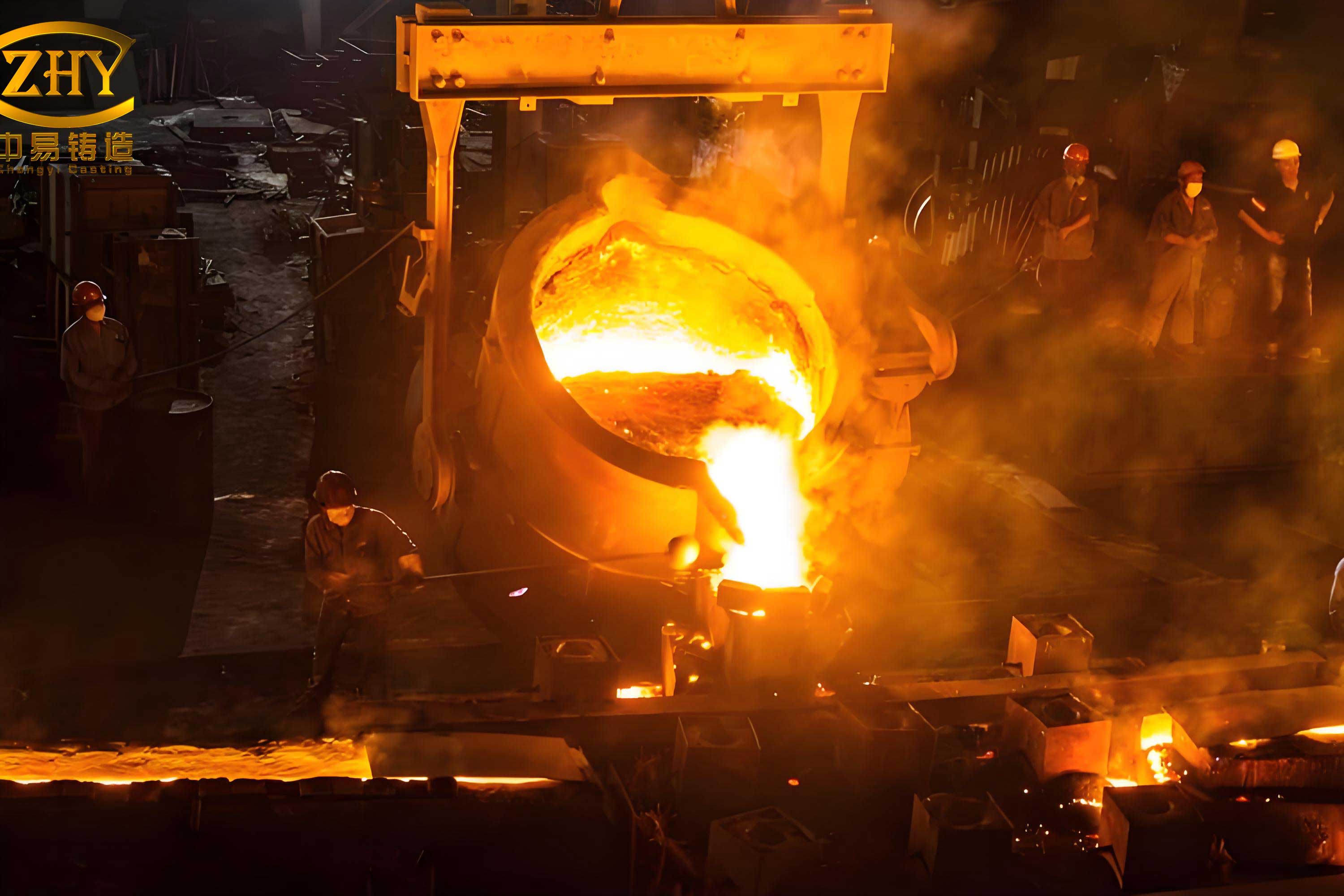
This image exemplifies typical sand-cast components, where simulation helps refine geometry and工艺. In my experience, simulating sand castings reduces trial-and-error by over 50%, as shown in this table comparing traditional vs. simulation-based approaches for sand castings:
| Aspect | Traditional Method | Simulation-Based Method |
|---|---|---|
| Development Time | 4-6 weeks | 1-2 weeks |
| Defect Rate | 10-15% | 2-5% |
| Material Waste | High due to scrapping | Low via virtual optimization |
| Cost Impact | Elevated from rework | Reduced through pre-validation |
Thus, for sand castings, numerical simulation is indispensable for achieving robust designs.
Low-Pressure Die Casting: Wheel Hub Production
Moving to low-pressure die casting for wheel hubs, I employ simulation to address challenges like shrinkage and coarse microstructure. This process uses bottom gating and air/water cooling to control mold temperature. Focusing on water cooling, I integrate模拟 with water-cooling controllers to design optimal cooling systems that manage heat dissipation or accumulation during cycles.
Simulation involves pre-processing, numerical computation, and post-processing. Pre-processing includes 3D solid modeling and meshing of the casting and mold. In software, I import the model and set boundary conditions: inflow boundaries, initial temperatures, thermocouple positions, pouring temperature, aluminum chemistry, and filling time. For sand castings, similar steps apply, but here for metal molds.
Numerical computation simulates cycles, including mold closing (filling and solidification) and opening (mold heat transfer). Multiple cycles are analyzed for process stability. The energy equation coupled with phase change models the solidification:
$$ \frac{\partial}{\partial t}(\rho h) + \nabla \cdot (\rho \mathbf{u} h) = \nabla \cdot (k \nabla T) + S_h $$
where \( h \) is enthalpy and \( S_h \) accounts for latent heat. Post-processing visualizes results for工艺 adjustment.
Defects like gas entrapment often occur at metal confluence zones. Simulation predicts temperature and filling effects on hub defects, enabling optimization. For instance, I adjust cooling rates to minimize shrinkage in sand castings and die castings alike. A comparative table of simulation parameters for low-pressure casting versus sand castings highlights differences:
| Parameter | Low-Pressure Die Casting | Sand Castings |
|---|---|---|
| Mold Type | Permanent metal mold | Sand mold (expendable) |
| Cooling Method | Active water/air cooling | Natural cooling or有限的 chilling |
| Pressure Application | Low pressure (0.5-1 bar) | Gravity-driven |
| Typical Cycle Time | 2-5 minutes | Hours to days |
| Simulation Focus | Cycle stability, thermal fatigue | Sand-metal interaction, defect prediction |
By correlating simulation with actual results, I validate and refine processes, boosting productivity through reduced cycle times and defects.
Advances in High-Pressure Die Casting Numerical Simulation
High-pressure die casting (HPDC) involves dynamic cycles where mold temperature fluctuates periodically. Upon metal injection, temperatures peak rapidly then drop, causing thermal expansion, contraction, and stress that lead to模具热 fatigue. Numerical simulation predicts temperature distributions in casting and mold, optimizing工艺 to ensure quality, shorten trials, and cut costs.
Given the high cost and precision of压铸模具, simulation provides a digital检验 platform. I model the cyclic thermal process using transient heat transfer equations with boundary conditions accounting for interfacial heat transfer coefficients (HTC). For example, the HTC between molten metal and mold can be expressed as:
$$ q = h_c (T_m – T_d) $$
where \( q \) is heat flux, \( h_c \) is HTC, \( T_m \) is metal temperature, and \( T_d \) is die temperature. Simulation software solves this iteratively over cycles.
Key advancements include multiphysics coupling—integrating fluid flow, heat transfer, stress analysis, and microstructure prediction. This is crucial for sand castings too, but in HPDC, the focus is on high-speed filling and thermal management. I often use finite element methods (FEM) to discretize the governing equations. For instance, the discretized heat equation for a node \( i \) is:
$$ \sum_j k_{ij} (T_i – T_j) + Q_i = \rho_i c_{p,i} \frac{dT_i}{dt} $$
where summation is over neighboring nodes \( j \).
To illustrate application areas, here is a table summarizing simulation benefits across casting types, emphasizing sand castings:
| Casting Process | Primary Simulated Defects | Key Optimization Outcomes |
|---|---|---|
| Sand Castings | Shrinkage, porosity, sand inclusion | Improved gating, reduced scrap |
| Low-Pressure Die Casting | Gas porosity, shrinkage, cold shuts | Enhanced cooling, shorter cycles |
| High-Pressure Die Casting | Hot tearing, die wear, entrapped air | Better venting, prolonged die life |
In sand castings, simulation also aids in environmental aspects by optimizing sand usage and reducing waste. For example, I simulate sand reclamation processes to assess sustainability.
Mathematical Models and Computational Techniques
Delving deeper, the success of numerical simulation hinges on robust models. For sand castings, the sand mold’s behavior is critical. I model sand as a porous medium, using Darcy’s law for gas flow during casting:
$$ \mathbf{v} = -\frac{\kappa}{\mu} \nabla P $$
where \( \mathbf{v} \) is gas velocity, \( \kappa \) is sand permeability, \( \mu \) is gas viscosity, and \( P \) is pressure. This helps predict gas defects in sand castings.
Microstructure simulation involves phase-field models or cellular automata to predict grain growth. For instance, the phase-field equation for solidification in sand castings is:
$$ \frac{\partial \phi}{\partial t} = M \left( \epsilon^2 \nabla^2 \phi – f'(\phi) \right) $$
with \( \phi \) as phase field variable, \( M \) as mobility, \( \epsilon \) as gradient coefficient, and \( f \) as free energy density. This predicts grain size and distribution, impacting mechanical properties in sand castings.
Defect prediction uses criteria beyond Niyama. For microporosity in sand castings, I apply the Lee-Chang criterion:
$$ \Delta P > \frac{2 \sigma \cos \theta}{r} $$
where \( \Delta P \) is pressure drop, \( \sigma \) is surface tension, \( \theta \) is contact angle, and \( r \) is pore radius. Simulation tracks pressure fields to identify risk areas.
Computationally, I employ finite volume method (FVM) for fluid flow and FEM for thermal-stress analysis. Meshing is crucial; for complex sand castings geometries, I use adaptive meshing to refine regions of interest. A typical simulation workflow involves:
- Geometry import and cleanup
- Mesh generation (e.g., tetrahedral elements for sand castings)
- Physical property assignment (density, viscosity, etc.)
- Boundary condition definition
- Solver execution (implicit/explicit schemes)
- Result visualization and analysis
This process is iterative, with each cycle refining the model. For sand castings, I often simulate multiple design variants to compare performance. The table below shows a hypothetical comparison for a sand-cast bracket:
| Design Variant | Filling Time (s) | Solidification Time (s) | Predicted Shrinkage Volume (cm³) | Optimized Riser Size |
|---|---|---|---|---|
| Original | 8.5 | 120 | 5.2 | Large |
| Modified Gating | 7.2 | 115 | 2.1 | Medium |
| Added Chills | 8.0 | 100 | 0.8 | Small |
Such data-driven decisions enhance sand castings quality.
Integration with Industry 4.0 and Future Trends
Numerical simulation is evolving with Industry 4.0, integrating with IoT and AI for smart foundries. For sand castings, real-time sensor data can validate and update simulation models, creating digital twins. I envision adaptive simulation systems that learn from production feedback to improve accuracy.
Future trends include high-performance computing (HPC) enabling faster simulations of large sand castings assemblies, and additive manufacturing integration for sand molds simulation. Additionally, sustainability drives simulation to optimize energy and material use in sand castings.
In conclusion, numerical simulation is a cornerstone of modern casting, particularly for sand castings and die casting. It empowers me to predict and mitigate defects, optimize工艺 digitally, and achieve substantial cost savings. As software and hardware advance, simulation will further democratize, making previously uncontrollable factors manageable. The journey from art to science in casting is well underway, with numerical simulation leading the charge.