
In recent decades, the advancement of computer-aided design and manufacturing technologies has significantly enhanced the capabilities of casting simulation, particularly in the context of lost foam casting. Lost foam casting is a sophisticated process that involves the use of expendable foam patterns, which are vaporized during metal pouring, leading to complex fluid dynamics and thermal behaviors. This study focuses on the numerical simulation of the lost foam casting process for ball mill liners, which are critical components in grinding equipment, subjected to severe wear, impact, and corrosion. The objective is to optimize the casting process to minimize defects such as shrinkage porosity and improve the overall quality of the castings. Through the use of ProCAST software, we simulate the filling and solidification stages, analyze the effects of different sand types and riser positions, and propose improvements to the casting design.
The lost foam casting process involves creating a foam pattern that is embedded in unbonded sand, and when molten metal is poured, the foam vaporizes, allowing the metal to take its shape. This method offers advantages in terms of design flexibility and reduced post-processing, but it requires precise control to avoid defects.
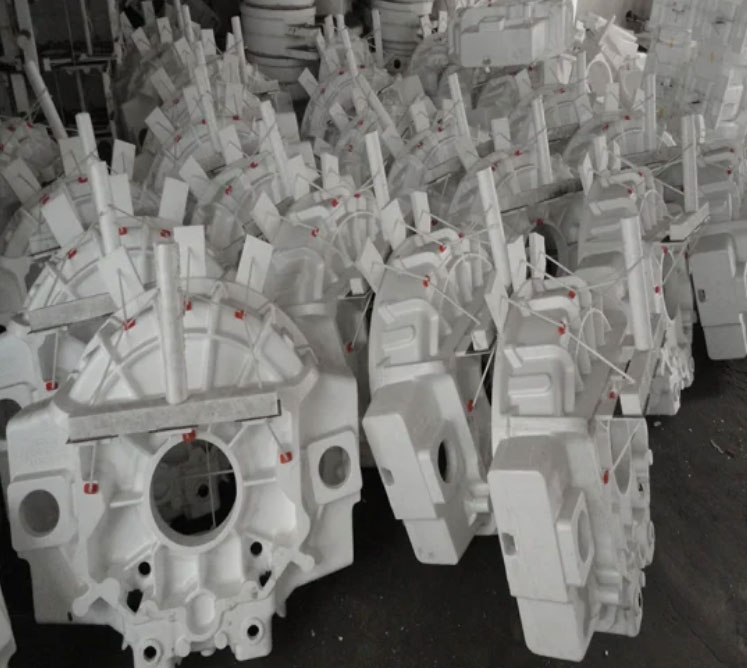
As such, numerical simulation becomes an indispensable tool for predicting and mitigating potential issues in lost foam casting.
Previous research in the field of lost foam casting has demonstrated the importance of simulation in predicting temperature fields, fluid flow, and defect formation. For instance, studies have shown that the choice of sand type, such as silica sand versus iron sand, can significantly influence the permeability and thermal conductivity, thereby affecting the filling and solidification behaviors. Additionally, the placement of risers plays a crucial role in controlling shrinkage defects, as improper riser design can lead to concentrated porosity in critical areas of the casting. The application of lost foam casting in industries like mining and manufacturing underscores its relevance, especially for components like ball mill liners that demand high durability and performance.
In this study, we employ ProCAST, a comprehensive casting simulation software, to model the lost foam casting process for a ball mill liner. The liner has dimensions of approximately 500 mm in length, 314 mm in width, and 40-50 mm in thickness, with a mass of 45-55 kg. Due to its thin-walled nature, it is not feasible to attach separate risers directly to the casting; therefore, a top-gating system with integrated risers is adopted to facilitate feeding and reduce stress concentrations. The geometric model of the liner, gating system, and sand mold is created using UG NX6.0 software and imported into ProCAST. The mesh generation is performed in MeshCAST, with a fine mesh size to ensure accuracy, resulting in 23,894 nodes and 117,409 elements. The material properties and process parameters are defined based on standard lost foam casting practices, as detailed in the following sections.
The chemical composition of the ZGMn13 high manganese steel used in the simulation is critical for accurate modeling of the lost foam casting process. The composition affects the solidification behavior and mechanical properties of the final casting. Table 1 summarizes the chemical composition in weight percentage.
| Element | C | Mn | Si | Cr | Mo | W | S | P | Re |
|---|---|---|---|---|---|---|---|---|---|
| Content | 1.0-1.2 | 12.0-14.0 | 0.4 | 1.0-2.0 | 0.4-0.6 | 1.0 | <0.5 | <0.5 | 0.1-0.3 |
The foam pattern used in lost foam casting is typically made of expandable polystyrene (EPS) with a density of 25 kg/m³. Its thermal properties, such as thermal conductivity and specific heat, play a vital role in the vaporization process during metal pouring. The thermal decomposition of the foam can be described by the following equation, which models the energy absorption rate:
$$ \frac{dQ}{dt} = m_f \cdot L_f \cdot \frac{dT}{dt} $$
where \( Q \) is the heat absorbed, \( m_f \) is the mass of the foam, \( L_f \) is the latent heat of vaporization (100 kJ/kg for EPS), and \( \frac{dT}{dt} \) is the rate of temperature change. This equation highlights the importance of foam properties in the lost foam casting process, as they directly influence the cooling rate and defect formation.
Table 2 provides the key process parameters used in the simulation of lost foam casting for the ball mill liner. These parameters are essential for replicating real-world conditions and ensuring accurate results.
| Parameter | Value |
|---|---|
| Pouring Temperature | 1480°C, 1520°C |
| Sand Type | Silica Sand, Iron Sand |
| Pouring Time | 10-20 s |
| Mold Temperature | 20°C |
| Environment Temperature | 20°C |
| Vacuum Pressure | 0.03-0.05 MPa |
| Foam Density | 25 kg/m³ |
| Foam Thermal Conductivity | 0.15 W/(m·K) |
| Foam Specific Heat | 3.7 kJ/(kg·K) |
The heat transfer during the lost foam casting process is governed by the Fourier equation, which can be expressed in three dimensions for transient analysis:
$$ \rho c_p \frac{\partial T}{\partial t} = \nabla \cdot (k \nabla T) + S $$
where \( \rho \) is density, \( c_p \) is specific heat capacity, \( T \) is temperature, \( t \) is time, \( k \) is thermal conductivity, and \( S \) represents source terms such as latent heat release during solidification. In lost foam casting, the source term may include energy absorbed by foam decomposition, making the simulation more complex. The thermal diffusivity \( \alpha \) is given by \( \alpha = \frac{k}{\rho c_p} \), which influences how quickly heat propagates through the sand and metal.
For the solidification process in lost foam casting, the fraction of solid \( f_s \) can be modeled using the Scheil equation for non-equilibrium conditions:
$$ f_s = 1 – \left( \frac{T_m – T}{T_m – T_l} \right)^{\frac{1}{1-k}} $$
where \( T_m \) is the melting temperature, \( T_l \) is the liquidus temperature, and \( k \) is the partition coefficient. This equation helps predict microsegregation and shrinkage formation in the lost foam casting of high manganese steel liners.
The simulation results for the original casting design in lost foam casting revealed significant shrinkage porosity defects, particularly at the interface between the liner and the gating system. This is attributed to the small diameter of the runner, which solidifies early, preventing effective feeding from the riser. The original design with a combined gating and riser system exhibited severe shrinkage porosity in the working surface of the liner, as visualized in the simulation results. To address this, we modified the riser position by adding a riser neck, which improved the feeding channel and relocated the defects to the riser itself, thereby eliminating porosity in the critical areas. This optimization is crucial in lost foam casting to ensure the integrity of components like ball mill liners.
We evaluated several process schemes by varying the pouring temperature and sand type in the lost foam casting simulation. The results are summarized in Table 3, which compares filling times and behaviors for different combinations. This analysis highlights the impact of sand selection on the lost foam casting process.
| Scheme | Pouring Temperature (°C) | Sand Type | Filling Time (s) | Filling Behavior |
|---|---|---|---|---|
| 1 | 1480 | Silica Sand | 5.905 | Intermittent |
| 2 | 1480 | Iron Sand | 4.496 | Smooth |
| 3 | 1520 | Silica Sand | 6.086 | Intermittent |
| 4 | 1520 | Iron Sand | 4.658 | Smooth |
The results indicate that iron sand, with its superior permeability and thermal conductivity, promotes a smoother filling process and shorter filling times compared to silica sand in lost foam casting. This is crucial because better permeability enhances degassing and slag floating, leading to improved casting quality. The properties of the sand types are further detailed in Table 4, which underscores why iron sand is preferred in lost foam casting applications for components like ball mill liners.
| Sand Type | Permeability (m²) | Thermal Conductivity (W/(m·K)) | Density (kg/m³) | Impact on Lost Foam Casting |
|---|---|---|---|---|
| Silica Sand | 1.0 × 10⁻¹⁰ | 0.5 | 1600 | Lower permeability, slower filling |
| Iron Sand | 5.0 × 10⁻¹⁰ | 2.0 | 2500 | Higher permeability, faster and smoother filling |
The filling process of the lost foam casting for the ball mill liner is simulated at different time steps. Initially, the metal front advances slowly due to the energy absorption by the foam decomposition. The rate of foam vaporization can be approximated by the following kinetic equation:
$$ \frac{dm}{dt} = -A \cdot k_0 \cdot e^{-\frac{E_a}{RT}} $$
where \( \frac{dm}{dt} \) is the mass loss rate of the foam, \( A \) is the surface area, \( k_0 \) is the pre-exponential factor, \( E_a \) is the activation energy, \( R \) is the gas constant, and \( T \) is the temperature. This equation explains why higher pouring temperatures in lost foam casting can accelerate foam removal but may also increase turbulence. As the process continues, the filling accelerates, completing in approximately 4.5 seconds for the optimal case with iron sand at 1480°C. The sequential simulation results demonstrate that the foam vaporization front matches the metal advancement, ensuring complete mold filling without premature solidification, a key advantage of lost foam casting.
During solidification in lost foam casting, the edges of the liner solidify first, followed by the gating system and risers. The solid fraction distribution and solidification time plots reveal that the riser regions remain liquid longest, acting as effective feeders to compensate for shrinkage. The improved design with the riser neck ensures a progressive solidification pattern, minimizing the risk of defects. The solidification time \( t_s \) for a section can be estimated using Chvorinov’s rule, which is commonly applied in casting simulations:
$$ t_s = C \left( \frac{V}{A} \right)^n $$
where \( V \) is the volume of the casting section, \( A \) is the surface area, and \( C \) and \( n \) are constants dependent on the material and mold conditions. For lost foam casting, this rule helps in designing risers to achieve directional solidification.
The temperature distribution during solidification in lost foam casting can be analyzed using the heat conduction equation with phase change:
$$ \frac{\partial H}{\partial t} = \nabla \cdot (k \nabla T) $$
where \( H \) is the enthalpy, which includes both sensible and latent heat components. In lost foam casting, the latent heat release during solidification is critical for predicting shrinkage porosity. The enthalpy is defined as:
$$ H = \int \rho c_p dT + \rho L f_s $$
where \( L \) is the latent heat of fusion, and \( f_s \) is the solid fraction. This formulation allows ProCAST to accurately simulate the thermal history in lost foam casting processes.
The optimization of the lost foam casting process for ball mill liners highlights the importance of riser design and sand selection. By relocating the riser and using iron sand, we achieve a more uniform temperature distribution and reduced defects. This approach not only improves the mechanical properties of the casting but also enhances production efficiency by reducing scrap rates. The benefits of lost foam casting, such as reduced machining and assembly costs, make it an attractive option for complex components. However, challenges like foam pattern integrity and environmental concerns require ongoing research. Future work in lost foam casting could involve multi-scale modeling to capture microstructural evolution or the integration of artificial intelligence for real-time process control.
In conclusion, numerical simulation using ProCAST provides valuable insights into the lost foam casting process for ball mill liners. The study demonstrates that iron sand offers better performance than silica sand in terms of filling and solidification control. Moreover, strategic riser placement is critical for eliminating shrinkage porosity. The repeated emphasis on lost foam casting throughout this analysis underscores its significance in modern manufacturing. As simulation technologies advance, lost foam casting will continue to evolve, enabling the production of high-integrity castings with minimal defects. This research contributes to the broader understanding of lost foam casting and its applications in demanding industries.