
As a researcher in the field of materials science and engineering, I have dedicated significant effort to studying the numerical simulation of microstructure formation in ductile cast iron. This material, known for its high strength and low cost, is widely used in critical industrial sectors such as automotive, agricultural machinery, and pipeline engineering. However, the complexity of the casting process often leads to quality issues, particularly shrinkage defects, which are prominent challenges in production. Numerical simulation of solidification provides a powerful tool to visualize and optimize casting processes, thereby improving product quality and advancing foundry technology. In this article, I will present my research on developing and applying numerical models to simulate the microstructure of ductile cast iron, incorporating theoretical foundations, simulation techniques, program design, and experimental validation. I will emphasize the use of tables and formulas to summarize key aspects, and ensure the frequent mention of “ductile cast iron” to highlight its relevance.
The casting industry is a traditional pillar of the national economy, and with continuous economic development, there is an increasing demand for higher productivity and quality in casting production. The advent of computer technology has enabled simulation techniques to play a massive role in product design, effectively optimizing structures and shortening development cycles. In particular, automotive components require reliable quality, including material homogeneity and dimensional accuracy, driving in-depth research into solidification processes. While experimental methods offer直观 insights, they are often time-consuming and labor-intensive. Thus, numerical simulation based on computational methods, such as finite difference or finite element techniques, has rapidly developed. These simulations allow for the prediction of temperature fields and shrinkage defects, which are crucial for controlling internal quality. By inputting parameters like casting dimensions and alloy physical properties into computers, we can simulate temperature fields during solidification and rationally control工艺流程.
Fundamental Theory of Solidification in Ductile Cast Iron
Solidification in ductile cast iron is a phase transformation process where metal and graphite spheres transition from liquid to solid states. It involves macroscopic phenomena like heat transfer and microscopic processes such as nucleation and growth of grains. Solidification is a complex process that blends phase transformation thermodynamics, solidification kinetics, and other factors. Since metal solidification typically occurs at high temperatures, the solidification of ductile cast iron determines the morphology of grains in the casting, and controlling this process has long been a goal in materials science. The formation of grains consists of nucleation and growth stages. Nuclei in the liquid continuously aggregate surrounding atoms to grow into grains, with stable solid particles of a critical size forming as nuclei. The overall result of nucleation and growth is the solidified microstructure.
In ductile cast iron, graphite nucleation is heterogeneous, often involving carbon atoms clustering around impurity particles as nucleation sites. As the iron cools, carbon atoms form aggregates that nucleate under certain cooling rates. Two common nucleation models are instantaneous and continuous nucleation, with the continuous model being more realistic for practical production. When the cooling rate reaches a specific range, the number of nuclei increases dramatically, which can be viewed as a nucleation threshold. The chemical composition of ductile cast iron primarily includes high levels of C and Si, along with residual Mg elements. Solidification occurs at the eutectic point, where graphite precipitates, and carbon transfer from the liquid to initial graphite involves diffusion and interfacial chemical reactions.
Ductile cast iron exhibits unique solidification characteristics compared to steel, such as a longer eutectic solidification time and different internal pressure changes during solidification. After molten iron is poured into the mold, the surface cools rapidly, and the sand mold absorbs heat, balancing heat loss from the surface and internal conduction. The surface solidified layer in ductile cast iron is thinner than in gray iron. The prolonged eutectic solidification is due to a non-cooperative growth mode, where carbon atoms diffuse through the solid austenite shell to the graphite sphere, which is slower than diffusion in liquid iron. Additionally, the lower thermal conductivity of ductile cast iron results in slower heat dissipation and graphite growth. Microstructure simulation is still in exploratory stages, with significant deviations between simulation and experimental results for large castings, indicating that current micro-models are imperfect and limited to simple, small-volume castings.
To summarize key parameters in the solidification theory, I present Table 1, which lists typical chemical compositions and properties used in simulations of ductile cast iron.
| Parameter | Value or Range | Description |
|---|---|---|
| C Content | 3.6–4.0 wt% | Primary element for graphite formation |
| Si Content | 2.0–3.0 wt% | Promotes graphite nucleation and growth |
| Mg Content | 0.03–0.06 wt% | Residual element for spheroidization |
| Cooling Rate | 0.1–10 °C/s | Affects nucleation density and microstructure |
| Eutectic Temperature | ~1150 °C | Approximate temperature for eutectic reaction |
| Thermal Conductivity | 30–40 W/(m·K) | Lower than steel, influencing solidification time |
Mathematically, the nucleation rate can be described using a continuous model formula. For instance, the nucleation rate \( N \) as a function of undercooling \( \Delta T \) is often expressed as:
$$ N = N_0 \exp\left(-\frac{\Delta G^*}{k_B T}\right) $$
where \( N_0 \) is a pre-exponential factor, \( \Delta G^* \) is the activation energy for nucleation, \( k_B \) is Boltzmann’s constant, and \( T \) is temperature. In the context of ductile cast iron, this relates to graphite nucleation under cooling conditions.
Numerical Simulation Techniques for Ductile Cast Iron
Ductile cast iron possesses excellent mechanical properties, making it vital in mechanical products. As casting products evolve, requirements for ductile cast iron castings increase, especially for large castings where shrinkage porosity is not easily concentrated, posing higher demands on工艺 design. The gradual solidification process of ductile cast iron often hinders liquid feeding, and reducing shrinkage typically relies on the self-feeding effect of graphite expansion. Investigating the influence of工艺 factors on shrinkage in ductile cast iron and proposing improvements are essential for enhancing product quality. Numerical simulation technology for casting processes involves geometric finite discretization of the forming system and numerical analysis of physical field changes during casting. Solidification microstructure numerical simulation includes both macroscopic and microscopic simulations.
Simulation of casting solidification began with temperature field numerical simulation, and countries worldwide have conducted research in this area. In my work, I focus on both macro- and micro-simulation approaches. Macroscopic numerical simulation methods have evolved to include finite element method, direct finite difference method, and others. The goal of macroscopic simulation is to compute temperature fields and other parameters, but simplified models for phase transformation used in heat flow calculations cannot predict microstructural parameters, which are crucial for controlling intrinsic quality and performance. Often,经验 and experimental methods combine to predict casting quality and performance. For microstructure formation, growth kinetics must be considered, and effective numerical techniques for solidification simulation models are vital.
Traditionally, casting process numerical simulation referred to模拟 of fluid flow during filling and solidification. However, microstructure determines the mechanical properties of castings, and simulating it allows for predicting as-cast microstructure and adjusting production processes to achieve superior comprehensive mechanical properties. Solidification simulation involves spatiotemporal description of moving solid-liquid interfaces, with temperature field simulation representing macroscopic工艺-level simulation.
At the microscopic scale, solidification is examined as a nucleation and growth process. Numerous models have been proposed internationally to simulate nucleation and growth in eutectic alloys for microstructure numerical simulation. Many microstructural parameters are directly related to macroscopic temperature fields, such as columnar grain growth velocity being associated with isotherm movement speed. It is necessary to independently investigate microstructure formation mechanisms and establish models coupled with macroscopic continuum equations. Currently, microstructure simulation of casting alloys is a hot research topic in materials science, with methods including deterministic approaches and phase-field methods. Under current computer hardware and software conditions, macroscopic and microscopic simulations cannot be entirely separated. Microscopic simulation requires smaller cell sizes than macroscopic simulation, and partitioning large castings into tiny cells for micro-simulation is computationally infeasible. An existing method is to use a macro-micro结合 approach to simulate specific regions of large castings, reading data from macroscopic simulation result files to shorten micro-simulation time. While some achievements have been made in microstructure simulation of casting solidification, it remains exploratory, with significant deviations for large castings.
To illustrate simulation techniques, I present Table 2, comparing common numerical methods used in ductile cast iron simulation.
| Simulation Method | Description | Applications in Ductile Cast Iron |
|---|---|---|
| Finite Difference Method (FDM) | Discretizes differential equations on a grid; efficient for temperature fields | Temperature field calculation, shrinkage prediction |
| Finite Element Method (FEM) | Uses variational principles; suitable for complex geometries | Stress analysis, distortion prediction |
| Phase-Field Method (PFM) | Models interface dynamics; captures microstructure evolution | Graphite growth, eutectic solidification |
| Cellular Automaton (CA) | Rule-based cell state updates; simulates grain growth | Microstructure formation, nucleation events |
| Macro-Micro Coupling | Combines macroscopic heat transfer with microscopic models | Integrated simulation of large castings |
A key formula in temperature field simulation is the heat conduction equation, which in its transient form for isotropic materials is:
$$ \rho c_p \frac{\partial T}{\partial t} = \nabla \cdot (k \nabla T) + Q $$
where \( \rho \) is density, \( c_p \) is specific heat, \( k \) is thermal conductivity, \( T \) is temperature, \( t \) is time, and \( Q \) is a heat source term accounting for latent heat release during solidification of ductile cast iron. This equation is discretized using FDM or FEM for numerical solution.
Program Design for Microstructure Simulation of Ductile Cast Iron
In my research, I developed a simulation program specifically for microstructure formation in ductile cast iron. Graphite precipitation during solidification causes volume expansion, leading to mold wall deformation and shrinkage defects, which are primary reasons for casting scrap. Since ductile cast iron solidification differs significantly from other materials, numerical simulation technology aims to solve工艺 optimization design problems, with shrinkage prediction being a key aspect. Predicting shrinkage porosity helps improve不合理工艺, control internal quality, and reduce costs. Deriving specific difference equations from mathematical models is the foundation for writing simulation programs. The solute distribution at the solid-liquid interface greatly affects heat transfer and interface morphology, and precisely calculating the solute field at the solidification front is critical for simulating microscopic grain growth.
Microstructure simulation of ductile cast iron requires expressing model algorithms in computer language. Before programming, I outlined an implementation plan. The simulation program should have a user-friendly interface and main functionality to obtain data from macroscopic temperature fields for microstructure simulation, providing reliable basis for improving casting processes. Among various platforms, I chose Visual C++ 6.0 for numerical simulation of ductile cast iron microstructure. During程序设计, an important requirement was to design a friendly user interface with practical functions. To facilitate user interaction, I implemented dialog boxes for various functions. The program主界面 includes menus for pre-processing, such as selecting macroscopic temperature field files, where I used the CFileDialog class to handle file dialogs. These dialogs pass file paths to loading functions like Load. The pre-processing menu also includes dialogs for initial conditions, providing initialization messages for the simulation program. In the OnInitDialog function of these dialogs, default states are set based on experimental conditions, allowing users to reset parameters. The OnOK function adds user-set information to program memory.
The main interface includes commands to中止当前运算, with a dialog appearing upon execution. A display box on the主界面 shows program运行速度, implemented in the OnTimer function of the main window. The microstructure simulation program consists of several functions performing different tasks. The Mainfunction is the main function, executing corresponding operation commands and creating new threads to continuously call other functions for temperature field acquisition, austenite nucleation, and other processes. The Mainfunction ends computations and closes opened threads. Temperature field data must be provided for subsequent simulation steps. Initialization before simulation计算 is achieved through designed dialog classes and common dialog classes like CFileDialog. For operational convenience, the simulation program includes a display section, allowing users to statistically study parameter changes during运算. The CSetshoDlg class is the display settings dialog class, determining whether graphics are shown during program运行. The display dialog for ductile cast iron microstructure simulation动态显示 can be set to continuously display saved files, with the interface providing information like current solidification time. During simulation运算, users can pause by selecting the中止当前运算 command, protecting the current thread for user use. Before releasing memory, the program calls Save3File to save现场数据.
Ductile cast iron is a crucial metal material in modern industry, rapidly developing due to its low cost and广泛应用 in shipbuilding, pipeline engineering, and other sectors. However, shrinkage defects are prominent issues in ductile cast iron production. With advances in solidification simulation technology, it has become an essential tool in foundry research for analyzing solidification processes and optimizing casting工艺. Solidification simulation enables工艺 designers to scientifically ensure casting工艺 design. In my software system, I adopted modular structured programming, where functional modules are organically integrated through interfaces. Modular design方便实现功能拓展. The software system includes simulation calculation programs and pre- and post-processing software. Pre-processing software covers CAD/CAM STL model interface files, while post-processing software displays results from pre-processing and simulation calculations. Modules interact via data files as接口形式. The system uses object-oriented programming methods, incorporates Chinese information technology for a friendly human-machine interface, and employs an explicit finite difference-based method for temperature field calculation that saves memory. This method computes the temperature field during ductile cast iron solidification. The developed post-processing software uses 3D color graphics display technology to show partitioned mesh diagrams, offering convenience, speed, and直观 advantages, providing basis for predicting casting defects.
To summarize program design parameters, Table 3 lists key inputs and outputs for the microstructure simulation program of ductile cast iron.
| Program Component | Input Parameters | Output Results |
|---|---|---|
| Temperature Field Module | Casting geometry, alloy properties, boundary conditions | Time-dependent temperature distribution |
| Nucleation Module | Undercooling data, impurity concentrations | Nucleation sites and rates |
| Growth Module | Diffusion coefficients, interface kinetics constants | Graphite sphere size and distribution |
| Shrinkage Prediction | Thermal and shrinkage parameters | Location and volume of shrinkage porosity |
| Visualization Module | Simulation data files | 2D/3D graphics of microstructure evolution |
In terms of mathematical models, the growth of graphite spheres in ductile cast iron can be described by diffusion-controlled growth laws. For example, the radius \( r \) of a graphite sphere as a function of time \( t \) might follow:
$$ \frac{dr}{dt} = \frac{D (C_l – C_s)}{r} $$
where \( D \) is the diffusion coefficient of carbon in the melt, \( C_l \) is the carbon concentration in the liquid, and \( C_s \) is the concentration at the graphite surface. This is integral to the program’s growth algorithms.
Numerical Simulation of Microstructure in Ductile Cast Iron
The mechanical and physical properties of metals and alloys are closely related to their solidified microstructures, necessitating control over the casting solidification process. Computer application software provides technical support for the foundry industry, and the goal of numerical simulation of microstructure formation is to predict the mechanical properties of castings. Ductile cast iron holds a significant position in industrial applications, and in recent years, model development has made considerable progress. In my research, I designed experimental specimens and developed a 3D numerical simulation calculation program based on the local unit替代放大 method. Simulation results showed good agreement with actual microstructures. The micro-model for ductile cast iron includes nucleation and growth models. Nucleation encompasses instantaneous and continuous nucleation, while primary graphite sphere growth is mainly controlled by carbon diffusion and interface reactions.
For reference, Table 4 presents casting工艺 and simulation calculation parameters used in my studies.
| Parameter Type | Value or Specification |
|---|---|
| Casting Specimen Size | 10 mm × 10 mm × 20 mm (1# specimen) |
| Chemical Composition | 3.76% C, 2.5% Si, 0.05% Mg (typical) |
| Inoculant Composition | 73% Si, Al < 1.0% |
| Nodularizing Treatment Temperature | 1460–1480 °C |
| Inoculant Addition | 0.2% primary, 0.2% secondary |
| Simulation Method | Local unit替代放大法 with macro-micro coupling |
| Software Tools | Custom C++ program, Flow3D, Huazhu CAE |
The austenite shell on graphite spheres forms instantaneously, with carbon diffusing through the shell to the graphite sphere. Experimental equipment included optical microscopes, an IAS4 image analysis system, a KGPS-500 medium-frequency induction furnace, and others. In program development, I proposed the local unit替代放大法 for microstructure simulation, where macroscopic partition unit blocks are magnified, and替代 blocks are constructed based on macroscopic unit information for microstructure calculation. This allows flexible computation of microstructure formation at any part of the casting, selecting macroscopic partition units for calculation with替代 blocks. Using designed specimen experiments and the compiled calculation program, I simulated and calculated specimens, and simulation values matched experimental values well.
I applied mathematical models to simulate experimental specimens and actual ductile cast iron castings. Production used green sand molds in a production line. The number and diameter of graphite nodules from simulation agreed well with experiments, as nodule nucleation and growth are primarily related to undercooling. During the eutectoid stage, lower temperatures at certain points facilitated pearlite nucleation and growth. Quantitative and qualitative analysis indicated that pearlite volume fraction was less at some points, and hardness values suggested lower pearlite volume fraction. In the eutectoid stage, ferrite easily nucleates依附于 graphite spheres. When the number of eutectic graphite spheres is high, pearlite nucleation and growth become difficult. The volume fraction of pearlite in the matrix relates to undercooling during the eutectoid stage. Quantitative analysis results and hardness values showed higher pearlite数量 at certain points, but due to excessive undercooling, simulation errors indicated room for model improvement.
Dynamic display of microstructure formation in ductile cast iron, based on interfaces, lacks experimental foundation. I employed computer graphics processing techniques to simulate behaviors like contact and collision during microstructure formation. For simulating graphite sphere shell growth, I used a dodecagon to represent the shell, assuming growth along the vertices. Different growth scenarios were considered, such as collisions between adjacent graphite sphere shells and受阻尖端 growth. By selecting appropriate parameters, I simulated the ferrite matrix organization in ductile iron, and program research results matched experiments. To validate the accuracy of my developed system, I used commercially available Flow3D software to simulate castings. My system simulated defects at 1350°C, with a微缩孔 volume of -90.76 cm³. Huazhu CAE simulation results showed no shrinkage at junction points, while Flow3D results indicated small pits at the top. My system’s secondary shrinkage values were small, suggesting proximity to actual results.
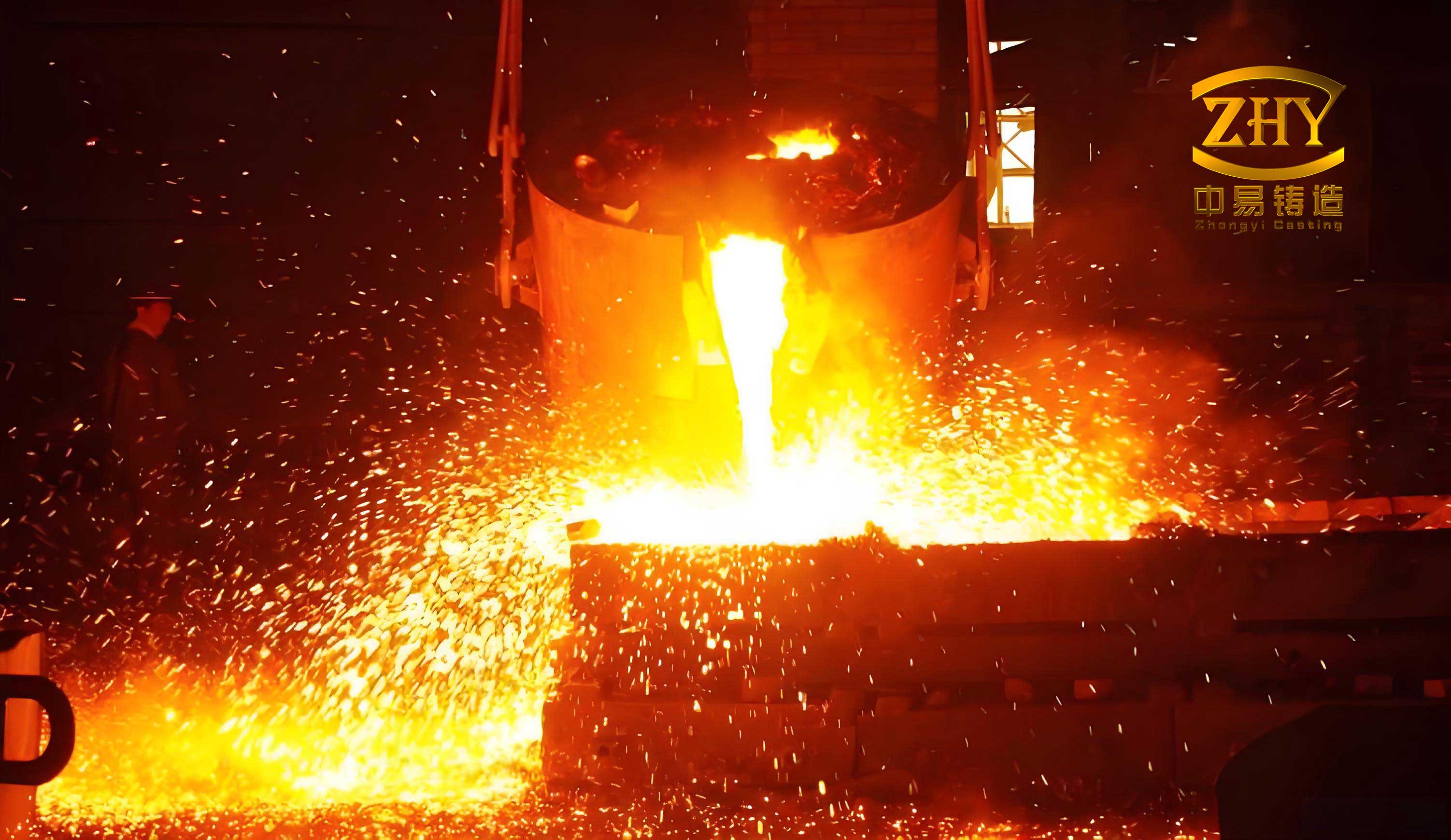
This image illustrates a typical ductile iron casting, highlighting its complex geometry where numerical simulation of microstructure is crucial for quality control. The visualization aligns with my simulation efforts to predict defects like shrinkage porosity in such components.
In terms of mathematical representation, the volume change due to graphite expansion in ductile cast iron can be modeled. The net volume change \( \Delta V \) during solidification is given by:
$$ \Delta V = V_g \cdot (1 + \beta) – V_s $$
where \( V_g \) is the volume of graphite formed, \( \beta \) is the expansion coefficient due to graphite precipitation, and \( V_s \) is the volume of the solid metal. This affects shrinkage predictions and is incorporated into my simulation algorithms.
Conclusion
Numerical simulation of casting solidification is a core component of casting工艺 CAD, aiming to control and predict casting quality. Based on temperature field calculations, shrinkage prediction allows for多次反复修改 to obtain optimal工艺. In my work, I established physical-mathematical models for the microstructure formation process of graphite nodular铸铁 in practical production. The local unit替代放大 algorithm for microstructure formation simulation proved flexible and practical. Through precise calculation and development, I successfully completed a 3D numerical simulation program for the microstructure of ductile cast iron. This program can display the microstructure formation process, including random growth phenomena like collisions, and present it in 2D dynamic visualizations. Comparing simulation calculations with experimental results demonstrated the reasonableness of the simulation models and algorithms.
Looking ahead, further research should focus on refining micro-models for large castings of ductile cast iron, improving accuracy in predicting pearlite formation, and integrating advanced techniques like machine learning for parameter optimization. The frequent mention of “ductile cast iron” throughout this article underscores its importance in industrial applications and simulation studies. By continuing to enhance numerical simulation tools, we can better address shrinkage defects and other challenges, ultimately advancing the production of high-quality ductile cast iron components for various engineering fields.
In summary, my research contributes to the growing body of knowledge on microstructure simulation in ductile cast iron, offering practical insights for foundry professionals and researchers alike. The use of tables and formulas, as presented herein, facilitates clear communication of complex parameters and relationships, supporting ongoing efforts to optimize casting processes for this vital material.