
Grinding operations are critical for mineral liberation but suffer from high energy consumption, steel wear, and poor product characteristics. This study proposes a novel approach to optimize steel ball axial spatial distribution by modifying lining plate structures and combinations. Using the Discrete Element Method (DEM), we systematically investigated how lining plate geometry, combined arrangements, and rotational speed affect axial segregation and grinding efficiency. Our findings demonstrate that lining plate modifications significantly enhance selective grinding performance while reducing operational costs.
Introduction
Mineral grinding consumes approximately 1.15% of China’s total energy and over 50% of concentrator steel consumption. Traditional solutions like compartment mills or Hardinge-type designs face practical limitations in manufacturing and maintenance. Lining plates—critical for energy transfer and wear protection—directly influence grinding media dynamics. We hypothesize that strategic lining plate modifications can spatially segregate steel balls by size along the mill axis, enabling impact grinding for coarse particles at the feed end and fine grinding near discharge.
Methodology
DEM simulations modeled a Φ0.4 m × 0.8 m cylindrical mill with 35% filling rate. Steel balls were sized Φ40 mm (large), Φ30 mm (medium), and Φ20 mm (small) in equal mass proportions. Three key variables were tested:
- Lining plate face angles (45°, 75°, 90°) defining lifter profiles
- Four multi-segment combinations (Table 1)
- Rotational rates (55%–95% critical speed)
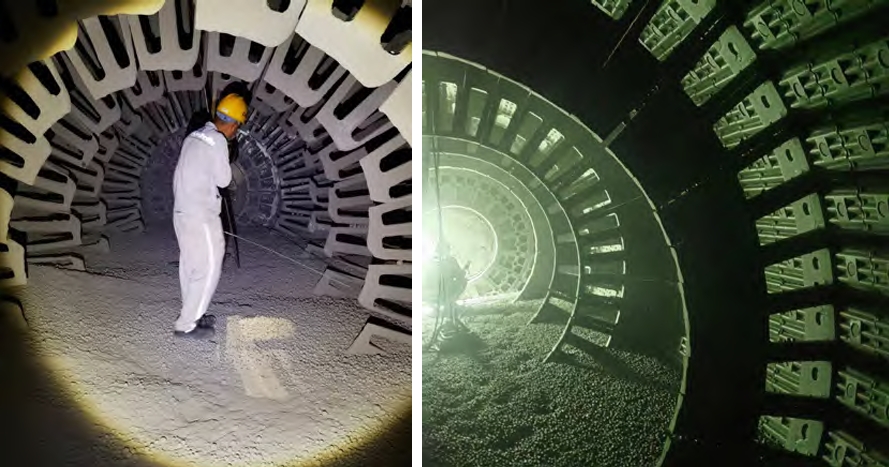
Simulation parameters followed Hertz-Mindlin contact mechanics:
$$
\begin{align*}
F_n &= \frac{4}{3} E^* \sqrt{R^* \delta_n^{3/2}} \\
F_t &= – \min\left( \mu_s |F_n|, \, k_t \delta_t + \gamma_t v_t \right) \hat{t}
\end{align*}
$$
where \(F_n\) and \(F_t\) are normal/tangential forces, \(E^*\) is effective elasticity, \(R^*\) effective radius, \(\delta\) overlap, and \(\mu_s\) static friction. Parameters are listed in Table 2.
| Combination ID | Segment 1 (Feed) | Segment 2 | Segment 3 | Segment 4 (Discharge) |
|---|---|---|---|---|
| C1 | 75° | 75° | 75° | 75° |
| C2 | 90° | 75° | 45° | 45° |
| C3 | 90° | 75° | 75° | 45° |
| C4 | 75° | 75° | 45° | 45° |
| Parameter | Value |
|---|---|
| Density (steel) | 7,850 kg/m³ |
| Poisson’s ratio | 0.3 |
| Shear modulus | 10,000 MPa |
| Restitution coefficient | 0.6 |
| Static friction | 0.4 |
| Rolling friction | 0.01 |
| Time step | 2×10⁻⁶ s |
Results and Discussion
1. Influence of Lining Plate Face Angle
Single-segment tests at 75% critical speed revealed profound face angle effects:
- 90° lining plates: Maximized ball lift height (cataracting motion) but minimized cumulative kinetic energy (14.69 J) due to reduced cascading.
- 75° lining plates: Achieved optimal cascading-cataracting balance, yielding peak cumulative kinetic energy (17.77 J).
- 45° lining plates: Promoted cascading with 203.01 W power draw but limited impact energy.
Kinetic energy distribution follows:
$$ E_k = \sum_{i=1}^{n} \frac{1}{2} m_i v_i^2 $$
where \(m_i\) and \(v_i\) are mass and velocity of ball \(i\). The 75° lining plate enhanced energy transfer by 21% versus 90° designs.
2. Axial Segregation via Lining Plate Combinations
Multi-segment lining plate configurations dramatically altered axial ball distribution (Fig. 1). At 75% speed:
- C1 (uniform 75° lining plates): Induced size-independent mixing (R²=0.12 for segregation).
- C2 (90°-75°-45°-45° lining plates): Achieved strong segregation—78.5% large/medium balls concentrated at feed end (Segments 1–2), while 48.0% small balls migrated to discharge (Segments 3–4).
- C3/C4 lining plates: Showed moderate segregation but inferior to C2.
Power consumption varied with lining plate geometry:
| Lining Plate Combination | Power (W) |
|---|---|
| C1 | 801.26 |
| C2 | 789.23 |
| C3 | 788.38 |
| C4 | 795.25 |
The C2 lining plate configuration reduced power by 1.5–1.7% versus uniform designs while optimizing size-based ball positioning.
3. Rotational Speed Optimization
For the optimal C2 lining plate configuration, rotational speed critically modulated segregation efficiency. Small ball (Φ20 mm) counts in Segment 4 followed:
$$ N_{s} = 534 + 69 \cdot \omega – 0.42 \cdot \omega^2 \quad (55\% \leq \omega \leq 95\%) $$
where \(\omega\) is percentage of critical speed. Peak segregation occurred at 85% speed (659 small balls), declining to 597 at 95% due to centrifugal homogenization. Power consumption exhibited a concave response:
| Rotational Speed (%) | Power (W) |
|---|---|
| 55 | 732.4 |
| 65 | 781.2 |
| 75 | 789.2 |
| 85 | 791.5 |
| 95 | 767.8 |
The 75–85% range maximized both segregation and energy efficiency. This lining plate-dependent optimum enables speed adjustments for ore variability.
Conclusions
- Lining plate face angle governs motion regimes: 90° plates maximize cataracting but minimize energy transfer; 75° plates optimize kinetic energy via balanced cascading-cataracting.
- Strategic lining plate combinations enable axial ball segregation. The 90°-75°-45°-45° sequence concentrates large balls at the feed end (impact grinding) and small balls at discharge (abrasive grinding), reducing power by 1.5–1.7%.
- Rotational speed nonlinearly controls segregation intensity. For the optimal lining plate configuration, 85% critical speed maximizes axial separation while maintaining power efficiency.
- Lining plate redesign provides a practical alternative to compartment mills, enhancing selective grinding without mechanical complexity. Future work will integrate ore breakage models for full process optimization.