
In the production of centrifugal composite rolls, which are critical components for hot strip mills, plate mills, and other rolling applications, the core material typically consists of ductile iron cast via gravity casting methods. Historically, the bottom neck section of the roll core has been manufactured using a traditional sand coated iron mold casting approach. This method, while offering advantages in模具通用性和 space efficiency, often leads to中心疏松 defects in the bottom neck due to inadequate directional solidification. These defects pose significant risks during operation, as the bottom neck is subjected to high轧制 loads. In this study, we address this issue by designing a new permanent mold for the bottom箱, replacing the conventional sand coated iron mold casting process. We employ numerical simulation using ProCAST to analyze the solidification behavior and validate the design through actual production trials. The goal is to eliminate中心疏松, improve microstructure, and enhance mechanical properties, thereby ensuring safer roll performance under demanding conditions.
The centrifugal composite roll structure comprises a high-alloy working layer produced by centrifugal casting and a ductile iron core made via gravity casting. The core is divided into the top neck (冒颈), barrel (辊身), and bottom neck (底颈), each cast using corresponding molds: the top箱, chill mold, and bottom箱. The traditional bottom箱 utilizes a sand coated iron mold casting technique, where a砂层 is applied inside a metal mold to provide some insulation and flexibility. However, this setup often disrupts sequential solidification, as the barrel section cools faster than the bottom neck, blocking补缩 channels and promoting中心疏松. To overcome this, we developed a new permanent mold for the bottom箱 that promotes directional solidification from the bottom upward. This report details our design rationale, simulation findings, and production验证, emphasizing the limitations of sand coated iron mold casting and the benefits of the optimized approach.
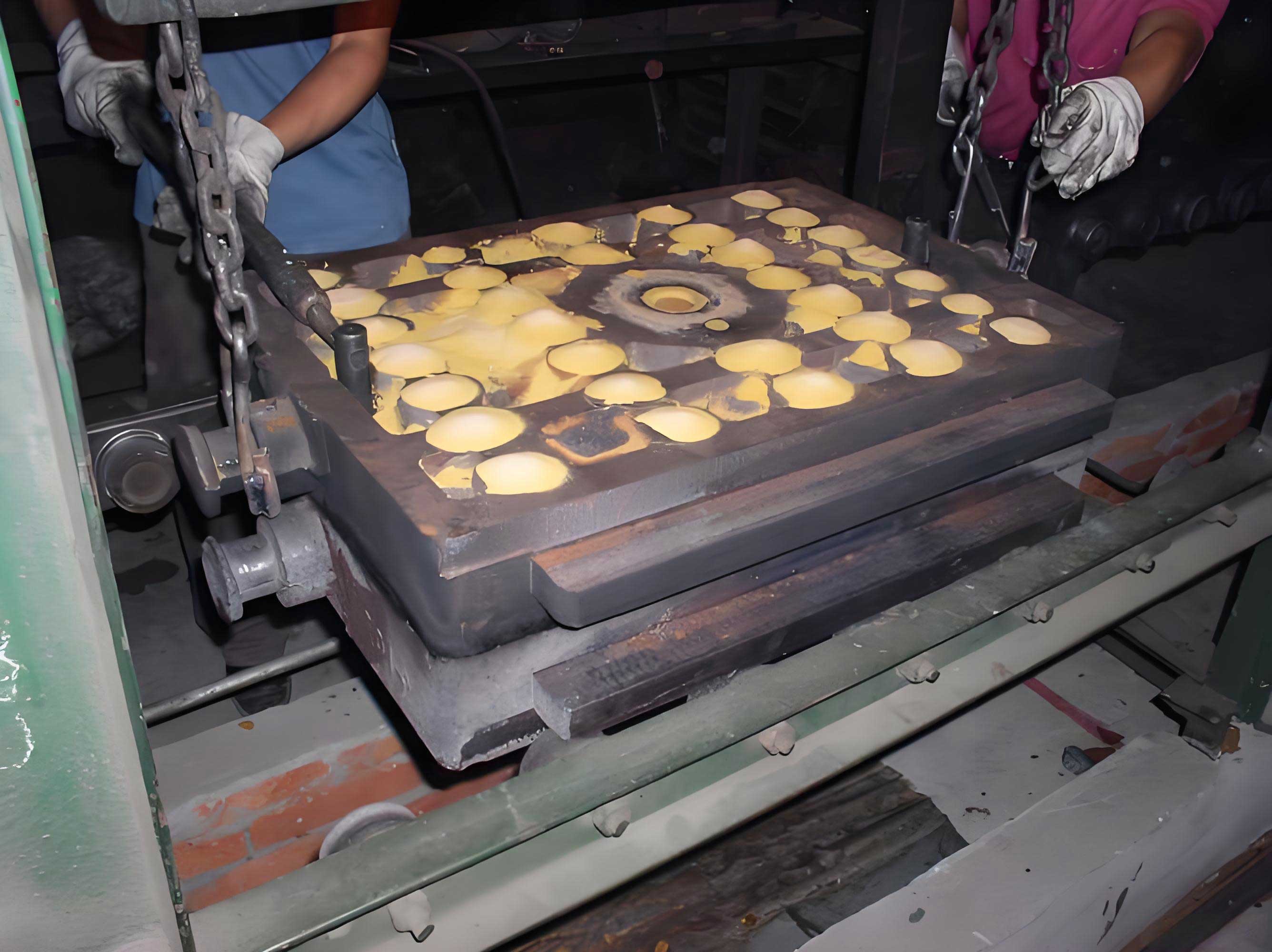
The core chemistry for centrifugal composite rolls is crucial for achieving desired properties. In sand coated iron mold casting, the typical composition ranges are as follows, which influence solidification behavior and defect formation:
| Element | Composition Range (wt.%) |
|---|---|
| C | 3.2–3.8 |
| Mn | 0.4–0.8 |
| Si | 2.0–3.0 |
| P | < 0.05 |
| S | < 0.03 |
This composition is common in ductile iron cores, but in sand coated iron mold casting, the slow cooling in the bottom neck can lead to graphite flotation and porosity. Our new permanent mold aims to accelerate cooling in this region, refining the microstructure and reducing defects.
From a heat transfer perspective, the solidification process in casting is governed by the Fourier heat conduction equation. For a cylindrical geometry like a roll core, the temperature distribution can be modeled using:
$$
\frac{\partial T}{\partial t} = \alpha \left( \frac{\partial^2 T}{\partial r^2} + \frac{1}{r} \frac{\partial T}{\partial r} \right)
$$
where \( T \) is temperature, \( t \) is time, \( \alpha \) is thermal diffusivity, and \( r \) is the radial coordinate. In sand coated iron mold casting, the砂层 acts as an insulator, reducing the heat extraction rate in the bottom neck. This can be expressed through the boundary condition at the mold-metal interface:
$$
-k \frac{\partial T}{\partial n} = h (T – T_{\text{mold}})
$$
Here, \( k \) is thermal conductivity, \( h \) is the heat transfer coefficient, and \( T_{\text{mold}} \) is the mold temperature. For sand coated iron mold casting, \( h \) is relatively low due to the砂层, leading to slower cooling. In contrast, our new permanent mold has a higher \( h \), promoting faster solidification. The Niyama criterion, often used to predict shrinkage porosity, is given by:
$$
N_y = \frac{G}{\sqrt{\dot{T}}}
$$
where \( G \) is the temperature gradient and \( \dot{T} \) is the cooling rate. A lower \( N_y \) value indicates a higher risk of porosity. In sand coated iron mold casting, the bottom neck often exhibits low \( G \) and high \( \dot{T} \) variations, resulting in \( N_y \) below critical thresholds and causing中心疏松. By optimizing the mold design, we aim to increase \( G \) and control \( \dot{T} \) to achieve \( N_y > \) critical value, thereby eliminating defects.
To compare the solidification processes, we conducted numerical simulations using ProCAST for both the traditional sand coated iron mold casting and the new permanent mold. The simulation parameters were based on a typical roll for a 2250 hot strip mill, with a barrel diameter of 850 mm, barrel length of 2250 mm, bottom neck dimensions of Φ(500–512) mm × 1580 mm, and total length of 5690 mm. Initial temperatures were set as follows, derived from实际 measurements to ensure accuracy:
| Parameter | Temperature (°C) |
|---|---|
| Mold temperature for barrel section, \( T_{\text{barrel,0}} \) | 250 |
| Temperature of solidified working layer, \( T_{\text{outer,0}} \) | 1080 |
| Mold temperature for other sections, \( T_{\text{mold,0}} \) | 30 |
| Pouring temperature of core iron, \( T_0 \) | 1400 |
In sand coated iron mold casting, the砂层 in the bottom箱 has a thickness that affects heat transfer. We modeled this using an effective heat transfer coefficient \( h_{\text{eff}} \) calculated from the砂 properties. For the traditional setup, \( h_{\text{eff}} \) is approximately 500 W/m²·K, while for the new permanent mold without砂, \( h_{\text{eff}} \) increases to 1500 W/m²·K. The simulation domain was meshed with fine elements in critical regions, and the governing equations were solved iteratively to track solidification fronts.
The results clearly show the drawbacks of sand coated iron mold casting. In the traditional process, solidification initiates rapidly in the barrel due to direct metal-mold contact, while the bottom neck cools slower because of the insulating砂层. This creates a thermal profile where the barrel solidifies first, blocking补缩 paths to the bottom neck. As a result, a hot spot forms in the bottom neck center, leading to shrinkage porosity. The solidification time \( t_s \) for each section can be estimated using Chvorinov’s rule:
$$
t_s = B \left( \frac{V}{A} \right)^n
$$
where \( V \) is volume, \( A \) is surface area, \( B \) is a mold constant, and \( n \) is an exponent (typically 2 for sand molds). For sand coated iron mold casting, the \( V/A \) ratio is higher in the bottom neck due to the砂层, increasing \( t_s \) and promoting中心疏松. In contrast, the new permanent mold reduces \( t_s \) in the bottom neck, enabling directional solidification.
The simulated temperature distributions at different times are summarized below for both molds. The data highlights the reversal in cooling rates between the barrel and bottom neck:
| Time (s) | Traditional Sand Coated Iron Mold Casting: Bottom Neck Temperature (°C) | New Permanent Mold: Bottom Neck Temperature (°C) | Traditional Sand Coated Iron Mold Casting: Barrel Temperature (°C) | New Permanent Mold: Barrel Temperature (°C) |
|---|---|---|---|---|
| 100 | 1350 | 1320 | 1300 | 1330 |
| 500 | 1200 | 1150 | 1100 | 1180 |
| 1000 | 1050 | 980 | 950 | 1020 |
| 2000 | 900 | 820 | 800 | 880 |
These values indicate that with the new permanent mold, the bottom neck cools faster than the barrel, facilitating sequential solidification and reducing porosity risk. The fraction solid \( f_s \) over time can be modeled using the lever rule for binary systems, but for ductile iron, we consider graphite expansion effects. However, in thick sections like the bottom neck, graphite expansion has minimal impact on macro-porosity, so we忽略 it in simulation for simplicity. The Niyama criterion values computed from the simulations further confirm the improvement: for sand coated iron mold casting, \( N_y \) in the bottom neck center is around 0.5 °C·s¹/²/mm, below the critical value of 1.0 °C·s¹/²/mm, while for the new mold, \( N_y \) exceeds 1.5 °C·s¹/²/mm, indicating sound casting.
Based on the simulation insights, we proceeded with actual production trials to validate the new permanent mold design. Two rolls of identical specifications were produced: one using the traditional sand coated iron mold casting (designated TR01) and another using the new permanent mold (designated NM02). All other process parameters, such as pouring temperature and cooling conditions, were kept constant to ensure a fair comparison. The production setup involved standard foundry practices, with careful monitoring of temperatures and times.
After casting, the rolls underwent non-destructive testing via ultrasonic inspection to detect internal defects. A 100% backwall echo method was employed using a 1 MHz single-crystal直探头. The results are summarized below, showing the extent of底波衰减 in the bottom neck:
| Roll ID | Mold Type | Bottom Neck Ultrasonic Test Result | Estimated Defect Length (mm) |
|---|---|---|---|
| TR01 | Sand Coated Iron Mold Casting | Significant backwall echo attenuation over ~300 mm | 300 |
| NM02 | New Permanent Mold | No noticeable attenuation; uniform echo | 0 |
This confirms that sand coated iron mold casting leads to中心疏松, while the new design eliminates it, aligning with simulation predictions. The improved soundness is attributed to better heat extraction, which we quantify through the effective cooling rate \( \dot{T}_{\text{eff}} \) calculated from实测 data:
$$
\dot{T}_{\text{eff}} = \frac{T_{\text{pour}} – T_{\text{solidus}}}{t_{\text{solidification}}}
$$
For TR01, \( \dot{T}_{\text{eff}} \) in the bottom neck was approximately 0.8 °C/s, whereas for NM02, it increased to 1.5 °C/s, enhancing directional solidification.
Metallographic samples were taken from the bottom neck at a depth of 100 mm from the surface to analyze microstructure. The observations reveal significant differences between the two processes:
| Roll ID | Graphite Morphology (Unetched) | Nodularity (%) | Matrix Structure (Etched) | Carbide Content (Approx. %) |
|---|---|---|---|---|
| TR01 | Irregular团/团虫状石墨 | 60–70 | Pearlite + Ferrite | 5 |
| NM02 | Spherical/团状石墨, more uniform | >90 | Pearlite + Ferrite | 3.5 |
The superior microstructure in NM02 is due to faster cooling in the new permanent mold, which refines石墨 and reduces carbide precipitation. This aligns with the Hall-Petch relationship for strength, where finer microstructure enhances mechanical properties. The graphite nodule count per unit area also increased from 150 nodules/mm² in TR01 to 250 nodules/mm² in NM02, contributing to improved toughness.
Mechanical properties were evaluated through hardness measurements and tensile tests on specimens extracted from the bottom neck. The results demonstrate the advantages of moving away from sand coated iron mold casting:
| Roll ID | Hardness (HSD) | Tensile Strength (MPa) | Yield Strength (MPa) | Elongation (%) |
|---|---|---|---|---|
| TR01 | 33–37 | 350–420 | Not measurable due to defects | Not measurable |
| NM02 | 40–44 | 500–530 | ~450 | 2 |
The enhanced properties in NM02 are critical for roll safety, as the bottom neck withstands high轧制 stresses. We attribute this improvement to the elimination of中心疏松 and finer microstructure. The relationship between hardness and tensile strength can be approximated by:
$$
\text{Tensile Strength} \approx C \times \text{Hardness}
$$
where \( C \) is a material constant. For ductile iron, \( C \) is around 3.2 for sound castings, but in sand coated iron mold casting, defects lower this value. In NM02, the consistency confirms better integrity.
In conclusion, our study successfully addresses the limitations of traditional sand coated iron mold casting for centrifugal composite roll cores. By designing a new permanent mold for the bottom箱, we achieve directional solidification that eliminates中心疏松 in the bottom neck. Numerical simulations using ProCAST provided valuable insights into the solidification dynamics, showing that sand coated iron mold casting creates unfavorable thermal gradients, while the new mold promotes faster cooling in the bottom neck. Production验证 confirmed these findings: ultrasonic testing revealed no defects in the new design, metallography showed refined石墨 and reduced carbides, and mechanical properties improved significantly. This optimization enhances roll reliability under severe operating conditions, offering a robust alternative to sand coated iron mold casting. Future work could explore further refinements, such as varying mold coatings or integrating real-time monitoring, to extend these benefits to other roll geometries and materials.