
In my years of involvement in the foundry industry, I have observed that the efficiency and quality of sand casting services heavily depend on the optimization of mold design and manufacturing processes, as well as the advancement of supporting equipment. This article delves into key considerations for metal mold design in sand casting, using complex thin-walled castings like engine cylinder blocks as examples, and explores innovations in evaporative pattern casting equipment, such as three-dimensional vibration tables. My goal is to share insights that can enhance the rapid and optimized design and manufacturing in sand casting services, ensuring high productivity and cost-effectiveness.
Sand casting services are fundamental to producing a wide range of metal components, from automotive parts to industrial machinery. The design of metal molds for sand casting is a critical aspect that influences casting accuracy, surface finish, and production speed. However, traditional approaches often fall short in terms of optimization and speed. Based on my experience, several technical issues must be addressed to achieve rapid and optimized mold design and manufacturing. Similarly, in evaporative pattern casting—a variant of sand casting services—the vibration table used for compacting sand around patterns requires sophisticated control to ensure proper filling and densification. Here, I discuss these aspects in detail, incorporating tables and formulas to summarize key points.
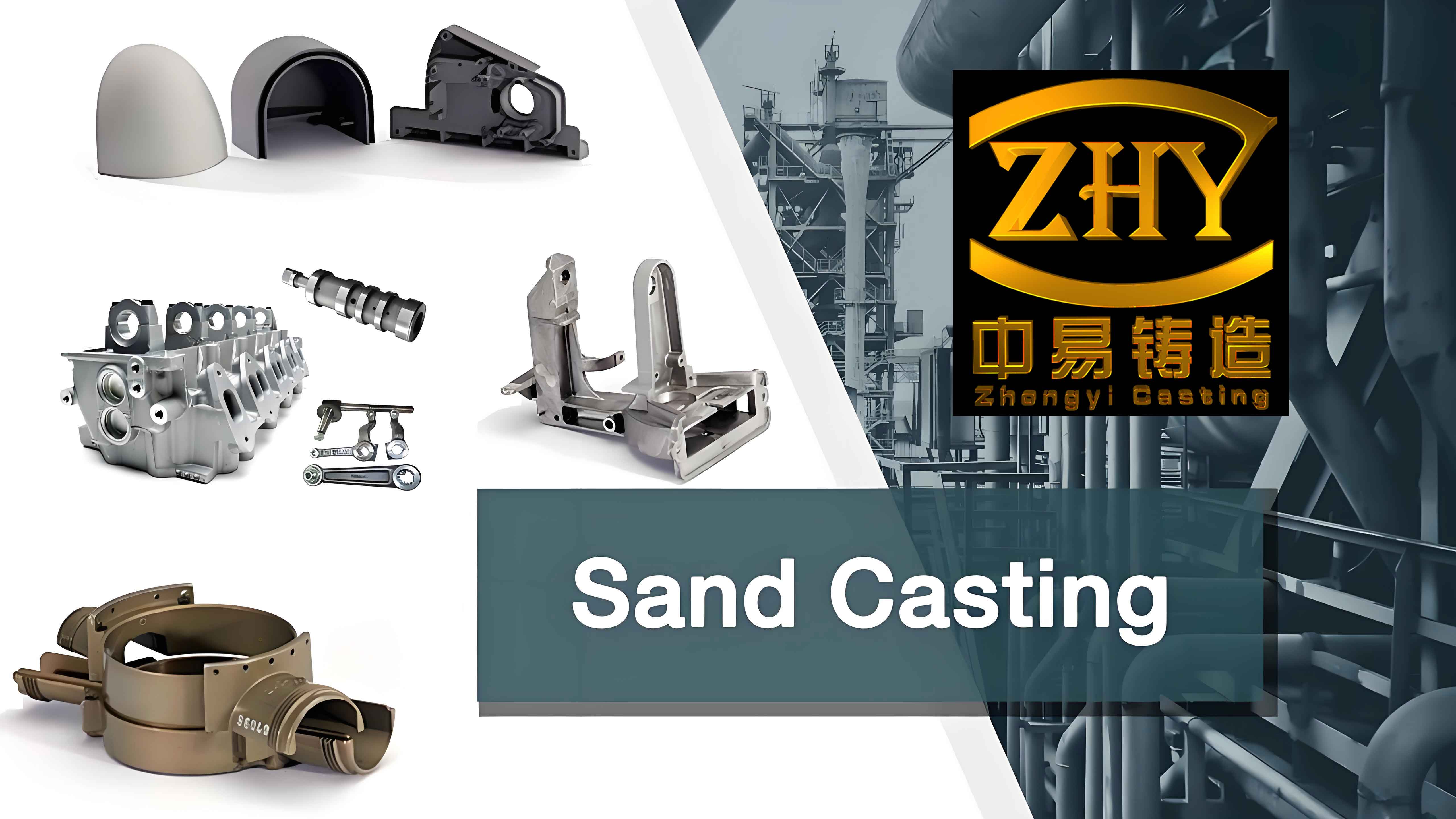
First, let’s focus on metal mold design for sand casting services. A high-quality mold design team is essential for rapid and optimized outcomes. Designers must possess not only extensive experience in mold design but also a deep understanding of casting process design. This dual expertise allows for early involvement in the casting process design, facilitating optimizations that simplify mold design. For instance, in cylinder block castings, improper process schemes can significantly hinder mold design efficiency. Optimized casting process design includes aspects like core design, gating system layout, and riser placement. For sand casting services, core optimization—such as enlarging core heads for cylinder block crankshaft cores—can improve cavity ventilation, riser placement, and reduce machining surfaces on molds, thereby speeding up design and manufacturing.
To quantify the impact of optimization, consider the following table summarizing key factors in mold design for sand casting services:
| Factor | Importance | Optimization Strategy |
|---|---|---|
| Designer Expertise | High | Combine mold design experience with casting process knowledge; use CAD/CAM tools. |
| Casting Process Design | Critical | Optimize core and riser designs; use standardized gating systems. |
| Benchmark Setting | Moderate | Adopt coordinate directions (X, Y, Z) aligned with product drawings; consider shrinkage factors. |
| Dimension Chain Annotation | High | Use baseline methods to simplify size chains; avoid over-dimensioning. |
| Standardized Components | High | Employ standard parts and universal modules to reduce design time and cost. |
In sand casting services, the setting of benchmark lines is crucial for complex molds. I recommend using coordinate directions—X for length (e.g., crankshaft radial direction), Y for height (e.g., cylinder bore radial direction), and Z for width (e.g., oil pan face direction). This approach, as illustrated in design drawings, clarifies dimension chains and accommodates different shrinkage rates across directions. For example, shrinkage factors can be expressed mathematically: if $S_x$, $S_y$, and $S_z$ are shrinkage percentages in X, Y, and Z directions, then the mold dimensions $D_m$ can be derived from casting dimensions $D_c$ using:
$$D_m = \frac{D_c}{1 – S/100}$$
where $S$ is the shrinkage factor for the respective direction. This ensures accuracy in mold design for sand casting services.
Another key aspect is the rational application of dimension chain annotation methods. By establishing baselines from product drawings, designers can simplify size chains, reducing design and verification time. For complex molds like cylinder blocks, this involves defining reference points along X, Y, and Z axes. The use of CAD software further enhances this process, allowing for automatic dimensioning and error checking. In my practice, I’ve found that this method cuts down design time by up to 30% in sand casting services.
Standardized parts and universal components play a vital role in optimizing mold design for sand casting services. For example, in hot box cores for cylinder blocks, using universal top core plates and water-cooled shooting plates across similar core boxes reduces manufacturing costs and speeds up core box changes. This not only optimizes design but also improves the efficiency of core-making machines. The table below highlights the benefits of standardization in sand casting services:
| Component Type | Application | Benefits |
|---|---|---|
| Standard Core Box Parts | Hot box cores for engine blocks | Reduces design iterations; lowers production costs. |
| Universal Mounting Plates | Mold assembly and disassembly | Enables quick mold changes; enhances equipment utilization. |
| Modular Inserts | Complex cavity shapes | Facilitates repairs and modifications; extends mold life. |
Transitioning to equipment aspects, evaporative pattern casting—a specialized sand casting service—relies on three-dimensional vibration tables to compact sand around foam patterns. Traditional vibration tables in domestic settings often suffer from low and fixed vibration acceleration, typically around 1-2 g (where g is gravitational acceleration), which limits sand densification and pattern integrity. In contrast, advanced systems use variable frequency and microcomputer control to achieve adjustable acceleration up to 3-4 g, with real-time monitoring and programmable vibration sequences.
From my perspective, the development of a variable-frequency microcomputer-controlled 3D vibration table addresses these shortcomings. This equipment features rapid start-up, instant braking, and acceleration capabilities that can be tailored to different foam pattern complexities. The vibration acceleration $a$ can be expressed as:
$$a = f(F, \omega)$$
where $F$ is the frequency and $\omega$ is the angular velocity. By adjusting these parameters, optimal compaction for sand casting services is achieved. The control system allows for setting multiple vibration intervals with different accelerations, durations, and directional combinations. For instance, a vibration program might include:
– Interval 1: Acceleration of 2 g for 10 seconds in X-direction.
– Interval 2: Acceleration of 3 g for 15 seconds in XYZ combined directions.
– Interval 3: Acceleration of 1.5 g for 5 seconds for settling.
This programmability ensures that sand fills all pattern cavities uniformly, a critical factor in high-quality sand casting services. The following formula relates vibration parameters to sand densification $\rho$:
$$\rho = \rho_0 + k \int a(t) \, dt$$
where $\rho_0$ is initial sand density, $k$ is a material constant, and $a(t)$ is time-dependent acceleration. By optimizing $a(t)$ through microcomputer control, densification requirements are met without pattern deformation.
In practical applications for sand casting services, the integration of such advanced vibration tables with sand handling systems enhances overall efficiency. For example, in evaporative pattern casting lines, the vibration table can be synchronized with sand filling and pattern placement stages. The table below compares traditional and advanced vibration tables in sand casting services:
| Aspect | Traditional Vibration Table | Advanced Variable-Frequency Table |
|---|---|---|
| Acceleration Range | Fixed, 1-2 g | Adjustable, 1-4 g |
| Control System | Manual or simple relays | Microcomputer with software interface |
| Vibration Programmability | Limited or none | Multiple intervals with custom settings |
| Real-time Monitoring | Absent | Acceleration and amplitude display |
| Adaptability to Patterns | Poor | High, based on pattern complexity |
To further illustrate the optimization in sand casting services, consider the overall workflow from mold design to casting production. The use of CAD/CAM systems, as mentioned earlier, enables rapid prototyping and simulation of casting processes. For instance, fluid flow and solidification analyses can be performed using software tools, reducing trial-and-error in sand casting services. The mathematical modeling of these processes involves equations like the Navier-Stokes equations for fluid flow:
$$\rho \left( \frac{\partial \mathbf{v}}{\partial t} + \mathbf{v} \cdot \nabla \mathbf{v} \right) = -\nabla p + \mu \nabla^2 \mathbf{v} + \mathbf{f}$$
where $\rho$ is density, $\mathbf{v}$ is velocity, $p$ is pressure, $\mu$ is viscosity, and $\mathbf{f}$ is body force. By simulating these phenomena, designers can optimize gating and riser systems before physical mold manufacturing, saving time and resources in sand casting services.
Moreover, the adoption of standardized components in mold design not only speeds up manufacturing but also facilitates maintenance and repair. In my experience, sand casting services that implement modular mold systems see a reduction in downtime by up to 40%. This is particularly important for high-volume production of parts like cylinder blocks, where mold wear and tear are common. The economic impact can be summarized with a cost function $C$ for mold lifecycle:
$$C = C_d + C_m + C_r \cdot N_r$$
where $C_d$ is design cost, $C_m$ is manufacturing cost, $C_r$ is repair cost per instance, and $N_r$ is number of repairs. By optimizing design and using standard parts, $C_d$ and $C_m$ are reduced, and $N_r$ decreases due to improved durability.
In conclusion, the optimization of sand casting services requires a holistic approach encompassing mold design, process engineering, and equipment innovation. For metal mold design, key considerations include designer expertise, casting process optimization, benchmark setting, dimension chain methods, and standardization. These elements collectively enhance speed and efficiency in sand casting services. Similarly, for evaporative pattern casting, advanced vibration tables with variable frequency and microcomputer control offer superior sand compaction and adaptability. As the industry evolves, integrating these strategies will be essential for competitive sand casting services, enabling the production of high-quality castings with reduced lead times and costs. Through continuous improvement and adoption of technologies like CAD/CAM and programmable equipment, sand casting services can meet the growing demands of modern manufacturing.
To reiterate, sand casting services benefit immensely from these optimizations. Whether it’s through refined mold design for complex geometries or advanced vibration control for pattern integrity, the focus remains on delivering reliable and efficient casting solutions. In my practice, I have seen how these approaches transform foundry operations, making sand casting services more agile and responsive to market needs. As we move forward, further research in materials science and automation will likely unlock new potentials for sand casting services, solidifying their role in the global supply chain.