
As a researcher focused on advanced manufacturing and material forming technologies, I have extensively studied the casting processes for large-scale nodular cast iron components. Nodular cast iron, known for its excellent mechanical properties and ductility, is widely used in heavy machinery, such as machine tool stands. However, the production of thick-section nodular cast iron castings often presents challenges, including shrinkage porosity and solidification defects, due to its prolonged solidification time and graphite expansion characteristics. In this article, I will share my firsthand experience in analyzing and optimizing the casting process for a nodular cast iron machine tool stand, emphasizing the transition from a traditional riser-based method to a riser-free approach. This optimization not only improves casting quality but also enhances process efficiency and yield.
The machine tool stand under consideration is made of nodular cast iron grade QT400-18, with dimensions of 2,230 mm × 1,750 mm × 550 mm and a weight of approximately 2,483 kg. It features a complex internal cavity structure with significant wall thickness variations, ranging from 20 mm to 80 mm. The top section includes thick support frames for shaft holes, which require high microstructural integrity and performance. The casting quality standards adhere to EN 12890 level H2 and DIN ISO 8062-CT12, with surface roughness requirements as low as Ra 12.5 μm on working surfaces, achieved through subsequent machining. Defects like shrinkage cavities, porosity, and sand inclusions are strictly unacceptable.
Initially, the casting process employed manual molding with furan resin-bonded self-hardening sand and a step gating system. The molten iron composition was controlled within specific ranges: for base iron, 3.6%–4.0% C, 1.3%–1.6% Si, Mn ≤ 0.5%, S ≤ 0.03%, and P ≤ 0.04%; after nodularization treatment, 3.5%–3.9% C, 2.2%–2.5% Si, Mn ≤ 0.45%, S ≤ 0.02%, P ≤ 0.04%, and residual Mg ≤ 0.05%. The pouring temperature was maintained between 1,310°C and 1,330°C, using a calcium-containing rare-earth magnesium alloy as the nodularizing agent at 1.4% of the iron weight. The gating system was designed as an open-type step system with multiple ingates to ensure balanced filling and solidification. However, the original process relied on large risers to feed the thick shaft hole support frames, which, in practice, led to minor shrinkage porosities at the riser roots, resulting in defective castings. This issue is common in nodular cast iron due to its mushy solidification behavior, where risers often prove ineffective.
To address this, I conducted numerical simulations using AnyCasting software to analyze the solidification process. The temperature field results indicated that the last areas to solidify were the thick shaft hole regions, as shown in the simulation outputs. The solidification time \( t_s \) for a casting can be approximated by the Chvorinov’s rule:
$$ t_s = k \left( \frac{V}{A} \right)^n $$
where \( V \) is the volume, \( A \) is the surface area, \( k \) is a mold constant, and \( n \) is an exponent typically around 2 for sand castings. For the nodular cast iron stand, the high volume-to-area ratio in thick sections prolonged solidification, increasing shrinkage risk. The simulation confirmed that risers solidified earlier than the casting, failing to provide adequate feeding. This aligns with the inherent properties of nodular cast iron, where graphite expansion during solidification can counteract liquid contraction, but only if the mold is rigid enough to contain the pressure.
Based on these insights, I proposed a riser-free casting process. The key modifications included replacing the risers with wedge-shaped vent holes, reducing the ingate thickness to promote earlier solidification, and applying external or internal chills near the shaft holes to enhance cooling and microstructural properties. The gating system was optimized with thin rectangular ingates (18 mm thick) to ensure they solidify before the casting, thereby sealing the mold cavity and leveraging graphite expansion for self-feeding. The pouring temperature was kept at 1,320°C to minimize liquid contraction. The mold, made of high-strength furan resin sand and secured with metal frames and bolts, provided the necessary rigidity to withstand internal pressures. The table below summarizes the original and optimized process parameters for the nodular cast iron stand:
| Parameter | Original Process | Optimized Riser-Free Process |
|---|---|---|
| Gating System | Step system with multiple ingates and large risers | Step system with thin ingates (18 mm) and wedge vents |
| Feeding Mechanism | Riser-based feeding | Self-feeding via graphite expansion in sealed mold |
| Cooling Aids | None | External or internal chills near shaft holes |
| Pouring Temperature | 1,310–1,330°C | 1,320°C (controlled low range) |
| Mold Rigidity | Standard furan sand with metal jacket | High-strength furan sand with bolted frames |
| Shaft Hole Treatment | Casted out with risers | Optionally casted out or machined later with chills |
The effectiveness of this riser-free approach for nodular cast iron relies on balancing thermal dynamics. The heat transfer during solidification can be modeled using Fourier’s law:
$$ q = -k \frac{dT}{dx} $$
where \( q \) is the heat flux, \( k \) is the thermal conductivity of the mold, and \( \frac{dT}{dx} \) is the temperature gradient. By applying chills, we increase the gradient in critical areas, accelerating solidification. The numerical simulation for the optimized design showed that the ingates and vent holes solidified prior to the casting, creating a closed system where graphite expansion compensates for shrinkage. The solidification time field indicated more uniform cooling, especially with chills added. For instance, the local solidification time \( t_l \) at the shaft hole support can be reduced by chill application, as per the relation:
$$ t_l = \frac{\rho L}{h(T_m – T_0)} $$
Here, \( \rho \) is density, \( L \) is latent heat, \( h \) is heat transfer coefficient, \( T_m \) is melting temperature, and \( T_0 \) is chill temperature. This reduction minimizes porosity risk in nodular cast iron components.
In production trials, multiple schemes were tested: one with external chills and shaft holes cast out, another with internal chills and holes machined later, and a baseline with only vent holes. All variants produced sound castings without shrinkage defects, as verified through ultrasonic testing and sectioning. The table below compares the outcomes of these schemes for the nodular cast iron stand:
| Scheme | Chill Type | Shaft Hole Processing | Casting Quality | Process Yield Improvement |
|---|---|---|---|---|
| 1 | External chills | Casted out | No shrinkage, good microstructure | ~15% higher than original |
| 2 | Internal chills | Machined later | No shrinkage, enhanced hole quality | ~20% higher than original |
| 3 | No chills (only vents) | Casted out | Acceptable, slight risk in thick zones | ~10% higher than original |
The success of the riser-free process for this nodular cast iron stand hinges on several factors. First, the high mold rigidity confines the graphite expansion pressure, which can be estimated as \( P_e = \alpha \Delta T \beta \), where \( \alpha \) is the expansion coefficient, \( \Delta T \) is the temperature drop, and \( \beta \) is a material constant for nodular cast iron. Second, the low pouring temperature reduces liquid contraction volume \( V_c \), given by \( V_c = \gamma V_0 (T_p – T_s) \), where \( \gamma \) is the contraction coefficient, \( V_0 \) is initial volume, \( T_p \) is pouring temperature, and \( T_s \) is solidus temperature. For nodular cast iron, typical values of \( \gamma \) range from 0.01 to 0.02 per °C, so lowering \( T_p \) by 10°C can decrease contraction by 0.1–0.2%. Third, the multiple ingates ensure balanced filling, reducing thermal gradients that cause defects.
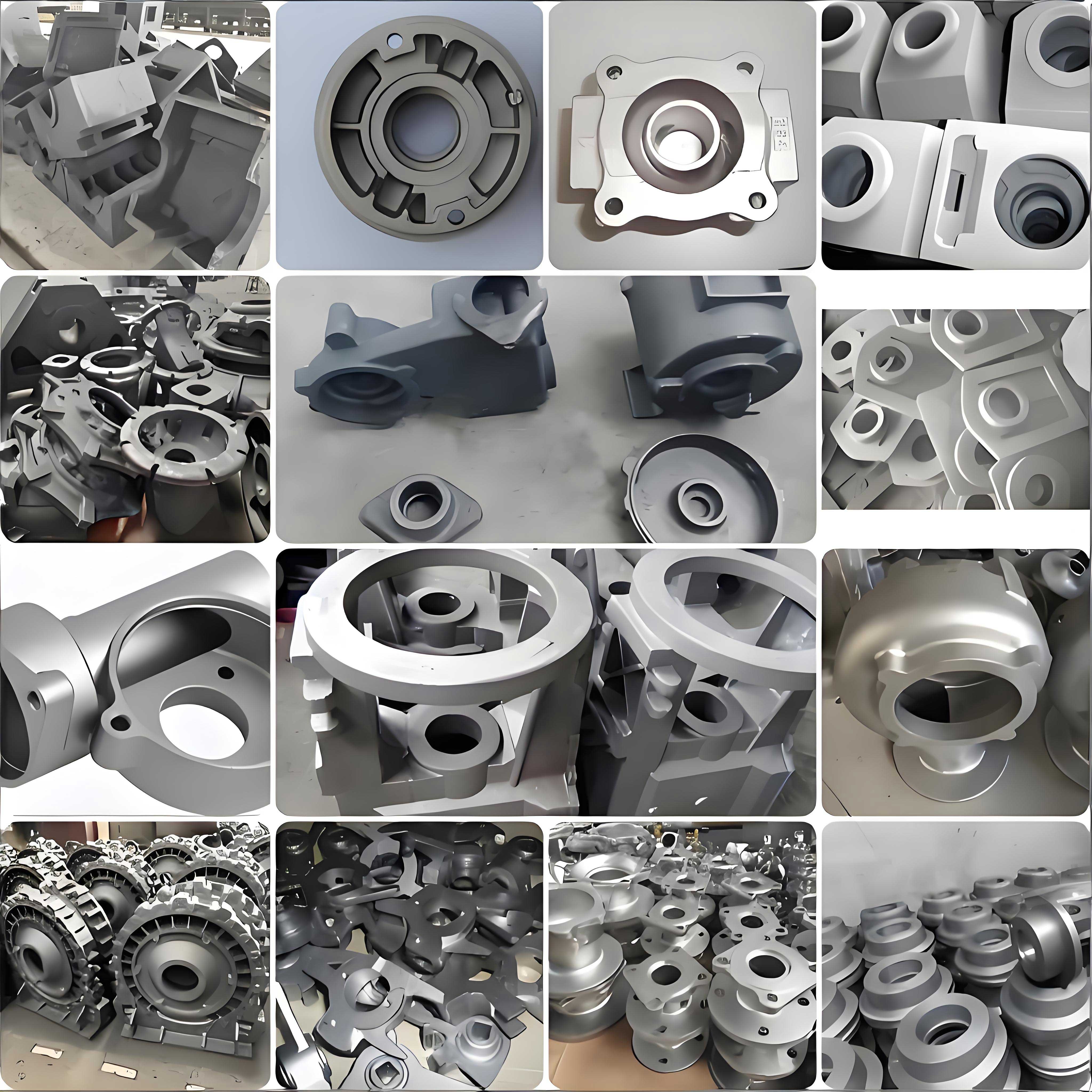
From a microstructural perspective, nodular cast iron solidification involves graphite nodule formation, which releases expansion energy. The number of nodules \( N \) per unit volume influences shrinkage compensation, as described by \( N = \frac{1}{d^3} \), where \( d \) is the average nodule diameter. In thick sections, slower cooling leads to larger \( d \) and lower \( N \), reducing expansion effectiveness. However, with chills, we increase cooling rate \( R \), which refines nodules and enhances expansion pressure. The relation \( R = \frac{T_l – T_m}{t_s} \) shows that higher \( R \) (achieved via chills) improves nodular cast iron properties.
In practice, the riser-free process simplified molding operations and increased the casting yield from about 65% to over 85%. The elimination of risers reduced material waste and cleaning effort. For the shaft holes, the option to machine them later allowed for better dimensional accuracy and surface finish, though casting them out with external chills also yielded satisfactory results. This flexibility is valuable for custom nodular cast iron parts. The overall cost savings were significant, considering the high value of nodular cast iron material and the reduced scrap rate.
To generalize these findings, I derived a set of guidelines for riser-free casting of nodular cast iron components:
- Use high-strength mold materials (e.g., furan resin sand) with secure clamping to withstand internal pressures from graphite expansion.
- Design thin ingates that solidify early to seal the mold cavity; the ingate thickness \( t_g \) should satisfy \( t_g \leq 0.5 t_{min} \), where \( t_{min} \) is the minimum casting wall thickness.
- Employ vent holes at high points to release gases but ensure they solidify quickly—wedge shapes are effective.
- Apply external or internal chills in thick sections to accelerate cooling and refine microstructure; the chill mass \( m_c \) can be estimated as \( m_c = \frac{\rho_c V_h C_p (T_m – T_0)}{L} \), where \( \rho_c \) is chill density, \( V_h \) is hot spot volume, \( C_p \) is specific heat, and \( L \) is latent heat of nodular cast iron.
- Control pouring temperature in a low range (e.g., 1,310–1,330°C) to minimize liquid contraction.
- Use multiple ingates for balanced filling, especially for complex nodular cast iron castings.
These principles have been validated through both simulation and production, demonstrating robust applicability for nodular cast iron parts ranging from 500 kg to 5,000 kg.
In conclusion, the optimization from a riser-based to a riser-free process for the nodular cast iron machine tool stand proved highly successful. By leveraging graphite expansion in a rigid mold, along with strategic cooling aids and gating design, we eliminated shrinkage defects and improved yield. This approach underscores the unique solidification characteristics of nodular cast iron, where traditional feeding methods may fall short. Future work could explore automated simulation tools for optimizing chill placement and gating geometry for various nodular cast iron grades. As the demand for high-performance nodular cast iron components grows, such process innovations will be crucial for sustainable and efficient manufacturing.