
In the field of high-performance turbochargers, turbine casting parts serve as critical components due to their complex curved surfaces and high-speed rotational demands. These casting parts must exhibit exceptional dimensional accuracy, mechanical properties, and reliability to withstand extreme operational conditions, including centrifugal forces, vibrational loads, and temperatures up to 750°C. The manufacturing of large-size turbine casting parts, particularly those with diameters exceeding 300 mm, presents significant challenges, such as poor dimensional control, inconsistent performance, and coarse grain structures in thick sections like the hub. This study focuses on addressing these issues through advanced casting process simulation and grain refinement techniques, ultimately producing defect-free turbine casting parts that meet stringent specifications. The integration of simulation tools like ProCAST with practical foundry practices has revolutionized the development of such casting parts, enabling precise optimization before physical trials.
The turbine casting part under investigation is fabricated from K418B, a nickel-base precipitation-hardened equiaxed casting superalloy. This material is chosen for its high-temperature strength, fatigue resistance, and durability, but it contains oxidation-prone elements like Cr, Al, and Ti, which necessitate vacuum melting to minimize defects. The casting part features a large轮廓尺寸 of φ400 mm × 240 mm, consisting of a thick trapezoidal hub with dimensions of φ220 mm/φ120 mm × 202 mm and 12 radially distributed blades with free-form surfaces, each 118 mm long. The blades are exceptionally thin, with a minimum thickness of 1.8 mm at the outermost diameter, posing challenges in mold filling and solidification. Conversely, the hub section represents a massive thermal node with a hot spot diameter of φ162 mm, leading to prolonged solidification times and potential grain coarseness. The dimensional tolerances for these casting parts align with CT6 level per GB/T6414, with surface profile requirements of 0.8 mm, emphasizing the need for precise process control. The success in producing such casting parts hinges on overcoming these structural and material hurdles through innovative casting strategies.
The casting process for these turbine casting parts begins with vacuum induction melting of master alloy bars, followed by vacuum remelting for pouring, ensuring high purity by reducing oxide formation, gas entrapment, and inclusions. This approach is essential for maintaining the integrity of the casting parts under operational stresses. The design of the gating and feeding system is critical, given the single geometric hot spot at the hub center. Initially, two feeder head placement schemes were considered: one with the friction-weld end facing downward and another with it facing upward. Simulation analysis using ProCAST revealed that the downward-facing scheme led to isolated liquid pools and shrinkage defects, as shown in the solidification analysis. The upward-facing scheme, though requiring modification of the friction-weld end diameter to accommodate an adequate feeder neck, promoted directional solidification from the blade tips to the feeder head, effectively eliminating shrinkage porosity and cavities. This optimization underscores the importance of simulation in refining the casting process for complex casting parts.
To ensure dimensional accuracy, the comprehensive shrinkage rate must account for alloy contraction, pattern wax shrinkage, and mold shell expansion. Given the varying wall thicknesses in these casting parts, empirical data from similar components guided the selection of differential shrinkage factors: 3.0% along the axial direction and 2.7% radially. Additionally, a cold wax block, 5–7 mm smaller per side than the hub dimensions, was pre-embedded in the mold to enhance pattern precision. The casting process employs silica sol shell investment casting with a top-feeding approach, one part per mold. However, conventional methods risk grain coarsening at the feeder neck due to overheating, which could compromise the strength of the casting parts, especially at the friction-weld interface. To address this, a grain refinement technique involving alternating centrifugal搅拌 was implemented, with parameters set at 150 rpm, 40 s per direction, and transitions under 5 s, totaling over 45 minutes based on simulation results. This process refines grains in the thick hub section, ensuring uniform microstructure and mechanical properties in the final casting parts.
The simulation model in ProCAST incorporated coupled filling and solidification analyses to validate the process. The alloy properties of K418B, including a liquidus temperature of 1344.7°C and solidus temperature of 1235.7°C, were input with a pouring temperature of 1410°C and a choke cross-section of φ40 mm, resulting in a total filling time of 13 s. The filling analysis demonstrated平稳 flow without turbulence, splash, or air entrapment, with the thin blade sections filling completely early in the process. Solidification analysis indicated that the blade tips began solidifying immediately after filling, followed by complete blade solidification at 580 s, full part solidification at 2965 s, and feeder head solidification at 5865 s. The temperature gradients favored directional solidification from the blades to the hub and from the bottom to the top, with no isolated liquid zones, confirming the absence of shrinkage defects. The shrinkage porosity prediction model supported this, showing values below critical thresholds. These insights highlight how simulation tools can optimize the casting process for high-integrity casting parts.
The grain refinement process for these casting parts leverages alternating centrifugal搅拌 to disrupt dendritic growth and promote nucleation. The原理 can be described by the equation for grain size refinement: $$d = k \cdot (G \cdot v)^{-n}$$ where \(d\) is the grain size, \(G\) is the temperature gradient, \(v\) is the solidification velocity, and \(k\) and \(n\) are material constants. By applying mechanical搅拌 during solidification, the effective \(G\) and \(v\) are modulated, reducing \(d\) and enhancing mechanical properties. For the K418B alloy, the搅拌 parameters were optimized through experimentation, ensuring that the thick hub section of the casting parts achieved a fine grain size of ASTM 4 or better. This is crucial for meeting the performance requirements of turbine casting parts, particularly in high-stress applications.
The production verification involved trial casts of two turbine casting parts using the optimized process. After standard investment casting steps—pattern making, shell building, mold firing, melting, pouring, and cleaning—the casting parts were subjected to comprehensive evaluation. Chemical composition analysis confirmed all elements within specified ranges, while mechanical testing of samples from the feeder neck area showed compliance with strength and ductility standards. Non-destructive testing via X-ray and ultrasonic inspection revealed no internal defects such as porosity, inclusions, shrinkage cavities, or cracks in the casting parts. Surface penetrant testing further verified the absence of surface flaws. Dimensional inspection using 3D scanning technology compared the point cloud data of the casting parts with the CAD model, confirming adherence to tolerances for key features like blade thickness and profile. The successful outcomes demonstrate the efficacy of the simulation-driven approach for manufacturing large-size turbine casting parts.
| Parameter | Value | Unit |
|---|---|---|
| Alloy Type | K418B (Ni-base) | – |
| Liquidus Temperature (Tliq) | 1344.7 | °C |
| Solidus Temperature (Tsol) | 1235.7 | °C |
| Pouring Temperature | 1410 | °C |
| Axial Shrinkage Rate | 3.0 | % |
| Radial Shrinkage Rate | 2.7 | % |
| Feeder Head Type | Spindle-shaped | – |
| Grain Refinement搅拌 Speed | 150 | rpm |
The simulation results provided quantitative insights into the behavior of these casting parts during solidification. The temperature distribution can be modeled using the heat conduction equation: $$\frac{\partial T}{\partial t} = \alpha \nabla^2 T$$ where \(T\) is temperature, \(t\) is time, and \(\alpha\) is thermal diffusivity. For the turbine casting parts, the ProCAST simulation solved this numerically, predicting thermal gradients that ensured sequential solidification. The solid fraction evolution over time, as shown in the analysis, confirmed that the last areas to solidify were in the feeder head, preventing defects in the casting parts themselves. Additionally, the Niyama criterion for shrinkage prediction was applied: $$G / \sqrt{v} \geq C$$ where \(G\) is the temperature gradient, \(v\) is the cooling rate, and \(C\) is a constant. Values above the threshold indicated low risk of microporosity in the casting parts, validating the process design.
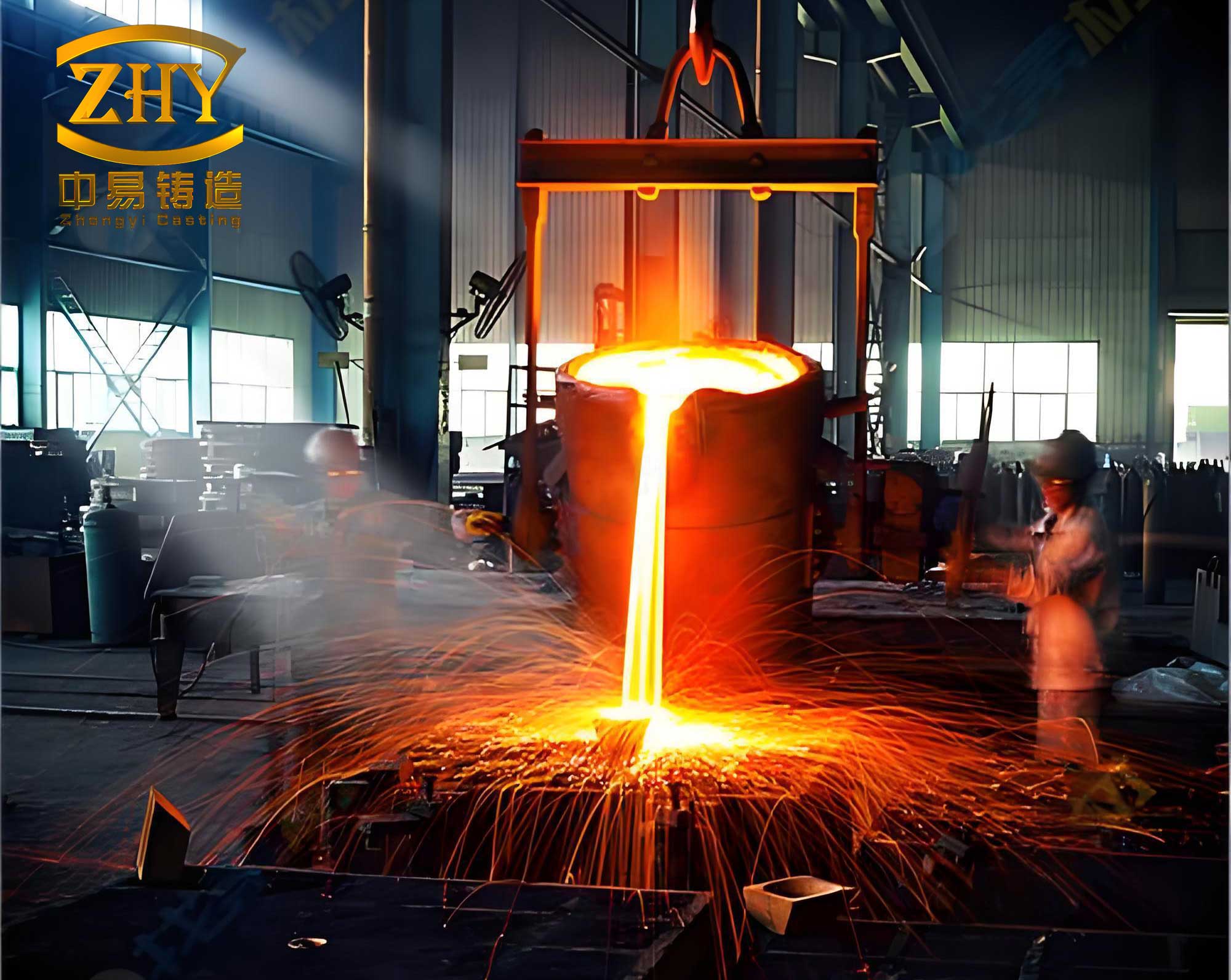
The integration of simulation and grain refinement has profound implications for the manufacturing of high-performance casting parts. In this study, the use of ProCAST enabled virtual testing of multiple gating designs, reducing the need for physical prototypes and accelerating development. The alternating centrifugal搅拌 technique addressed grain coarsening in thick sections, a common issue in large casting parts. The table below summarizes key findings from the production verification, highlighting the quality achieved in the turbine casting parts. These results underscore the importance of a holistic approach that combines advanced software with practical metallurgical innovations for producing reliable casting parts.
| Assessment Criteria | Result | Standard |
|---|---|---|
| Chemical Composition | Within specifications | ASTM/GB |
| Average Grain Size (Hub) | ASTM 4 | Achieved |
| Tensile Strength | Compliant | Material specs |
| X-ray Inspection | No defects detected | Class A |
| Ultrasonic Testing | No internal flaws | Acceptable |
| Dimensional Accuracy | Within CT6 tolerance | 3D scan verified |
| Surface Profile | 0.8 mm or better | Required |
The economic and technical benefits of this optimized process for turbine casting parts are substantial. By minimizing defects and ensuring consistent quality, the yield of acceptable casting parts increases, reducing waste and cost. The simulation-guided design also allows for faster iteration, which is critical in industries like aerospace and automotive where turbocharger components are in high demand. Furthermore, the grain refinement process enhances the fatigue and creep resistance of the casting parts, extending their service life under cyclic loading. These advantages make the approach applicable to other complex casting parts beyond turbines, such as impellers or structural components in high-temperature environments.
In conclusion, this study demonstrates the successful optimization of the casting process for large-size turbine casting parts through simulation and experimental validation. The use of ProCAST software enabled the identification of an optimal gating design that promotes directional solidification, eliminating shrinkage defects. The incorporation of alternating centrifugal搅拌 effectively refined grain structures in thick sections, meeting mechanical property requirements. The produced casting parts exhibited excellent dimensional accuracy, internal integrity, and surface quality, as verified by comprehensive testing. This methodology highlights the synergy between digital simulation and traditional foundry techniques in advancing the manufacturing of high-performance casting parts. Future work could explore further refinements in simulation accuracy or alternative grain refinement methods for even larger casting parts. Overall, the insights gained contribute to the broader field of metal casting, offering a roadmap for producing reliable and efficient casting parts for critical applications.