
In my extensive experience in foundry engineering, the production of high-integrity gray iron castings, particularly for complex spiral series components, presents significant challenges due to their thick sections and uneven wall thickness distribution. This article details my first-person research and practical implementation of an optimized casting process aimed at mitigating shrinkage porosity and slag inclusion defects in such gray iron castings. The spiral series under investigation, resembling the structural complexity of many industrial gray iron castings, typically weighs between 500 and 2000 kg, with nominal wall thicknesses of 20 mm and maximum sections up to 100 mm. The inherent thermal gradient variations in these gray iron castings necessitate meticulous process design to ensure defect-free final machined parts, as required by stringent UT and MT inspection standards. My work focuses on a bottom-gating system combined with strategic use of chills and risers, a methodology that has proven effective not only for the specific spiral series but also for a broad range of thick-walled gray iron castings.
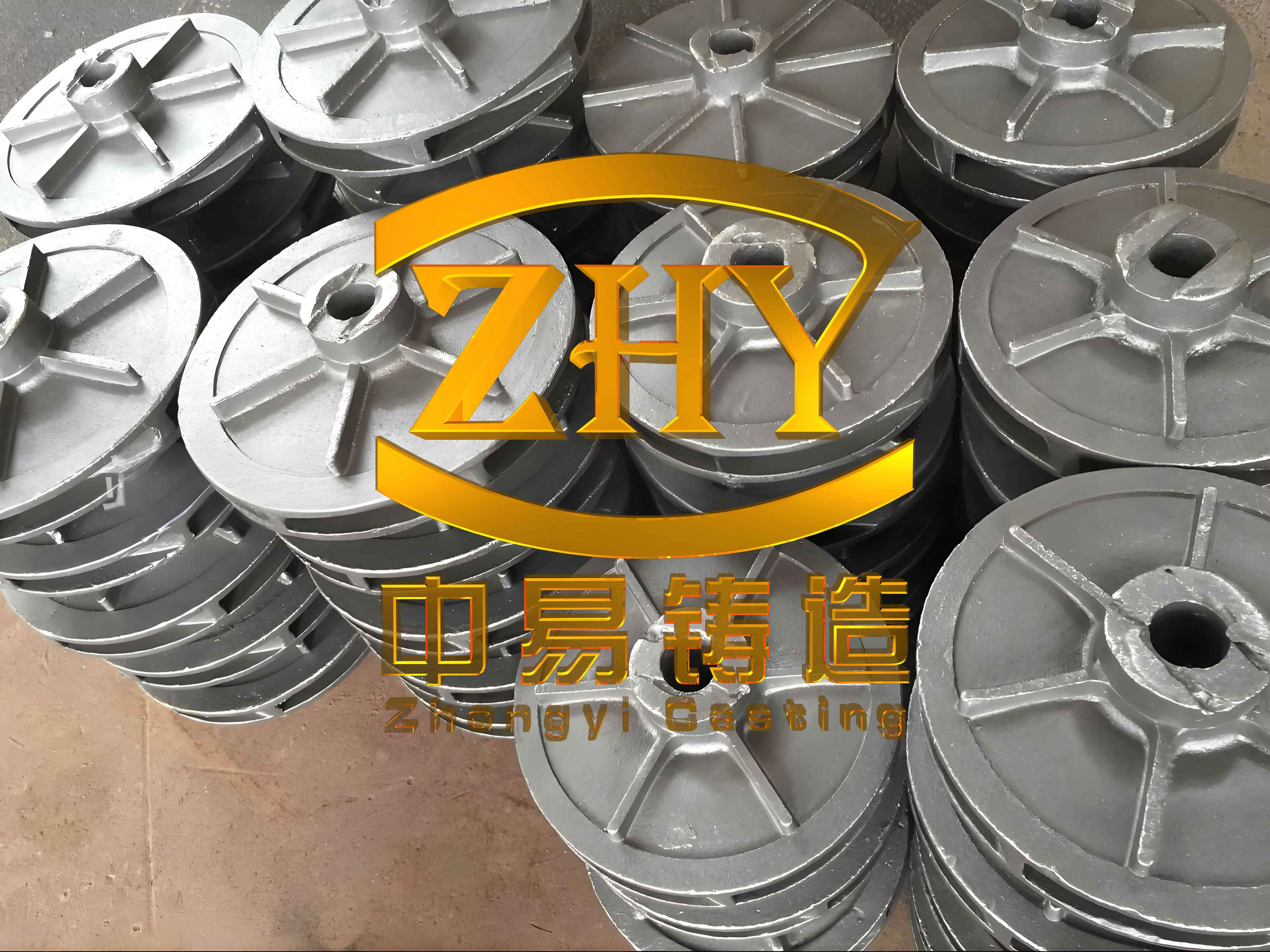
The fundamental challenge in producing sound gray iron castings, especially thick-section variants, lies in controlling the solidification pattern. For gray iron castings, the expansion due to graphite precipitation can partially compensate for shrinkage, but in heavy sections, this self-feeding capability is often insufficient, leading to dispersed micro-shrinkage or porosity. The casting modulus, a key parameter for riser sizing, is defined as the volume-to-surface area ratio of the casting section. For a simple plate-like section, the modulus \( M \) is given by:
$$ M = \frac{V}{A} $$
where \( V \) is the volume and \( A \) is the surface area of the casting segment. In complex gray iron castings like the spiral series, local moduli vary drastically, creating isolated thermal centers. My analysis involved calculating moduli for different sections to identify hot spots requiring external feeding or chilling. For a cylindrical hot spot of diameter \( D \) and height \( H \), the approximate modulus is:
$$ M_{cylinder} \approx \frac{D \times H}{2(D + H)} $$
For the spiral’s thick法兰 sections with \( D = 100 \, \text{mm} \) and \( H = 100 \, \text{mm} \), \( M \approx 25 \, \text{mm} \), indicating a significant feeding demand. This quantitative approach is critical for designing risers for gray iron castings, where riser modulus \( M_r \) must satisfy \( M_r \geq 1.2 \times M_c \) (where \( M_c \) is the casting modulus) to ensure adequate feeding pressure until the final stage of solidification.
The metallurgy of gray iron castings also influences defect formation. The tendency for slag inclusion is exacerbated by oxidation during pouring and turbulence. The cleanliness of the iron melt is paramount. I monitored the oxygen activity index, often related to the formation of oxide slags in gray iron castings. While precise thermodynamic modeling is complex, a simplified relation for the critical pouring time \( t_p \) to minimize reoxidation can be derived from fluid dynamics:
$$ t_p \propto \frac{\mu \cdot L^2}{\Delta P \cdot \delta} $$
where \( \mu \) is dynamic viscosity, \( L \) is characteristic linear dimension of the gating system, \( \Delta P \) is pressure head, and \( \delta \) is boundary layer thickness. In practice, for gray iron castings, I enforced a maximum hold time of 10 minutes from tapping to pouring to reduce slag generation. Furthermore, the use of filters in the gating system, as implemented, increases flow resistance, which can be modeled by the Darcy-Forchheimer equation for flow through porous media:
$$ \frac{\Delta P}{L} = \frac{\mu}{K} v + \beta \rho v^2 $$
where \( K \) is permeability, \( v \) is velocity, \( \rho \) is density, and \( \beta \) is an inertial coefficient. This pressure drop helps in trapping non-metallic inclusions before the metal enters the mold cavity, a vital step for high-quality gray iron castings.
| Parameter | Value or Description | Rationale for Gray Iron Castings |
|---|---|---|
| Casting Weight Range | 200–1500 kg | Represents medium to heavy gray iron castings |
| Main Wall Thickness | 20 mm | Typical for many engineering gray iron castings |
| Maximum Wall Thickness | 100 mm | Creates thermal centers requiring control |
| Material Specification | Analogous to Grade 250-400 Gray Iron | Gray iron castings require specific carbon equivalence |
| Pouring Temperature | 1330 ± 10 °C | Low temperature reduces shrinkage but must avoid mistruns |
| Gating System Type | Bottom-Gating with Filters | Minimizes turbulence and slag entrainment in gray iron castings |
| Riser Type | Insulated Sleeve Riser (Ø200 mm, Ø100 mm) | Provides feed metal for thick sections of gray iron castings |
| Chill Material | Cast Iron or Steel Chills | Accelerates solidification at hot spots in gray iron castings |
| Mold Media | Air-Setting Silicate Sand | Common for jobbing production of gray iron castings |
My experimental approach began with a thorough structural analysis of the spiral series, which shares geometric features with many valve or pump bodies produced as gray iron castings. The component’s 3D geometry was segmented into functional zones: the central hub, spiral vanes, and mounting flanges. Each zone has distinct modulus values, necessitating a customized feeding and cooling strategy. For gray iron castings, the solidification sequence should ideally be directional toward the risers. I employed numerical simulation (using ProCAST software) to predict shrinkage porosity. The Niyama criterion, often used for steel but adapted for gray iron castings, provides a threshold for porosity prediction:
$$ N_y = \frac{G}{\sqrt{\dot{T}}} $$
where \( G \) is temperature gradient (°C/cm) and \( \dot{T} \) is cooling rate (°C/s). Regions with \( N_y \) below a critical value (e.g., 1 °C1/2·min1/2/cm for some gray irons) are prone to microporosity. My simulations indicated that without chills, several hot spots in the spiral gray iron castings showed \( N_y < 0.8 \), confirming shrinkage risk. The optimized design with chills elevated \( N_y \) above 1.2 in those areas.
The gating system design is pivotal for the quality of gray iron castings. I adopted a bottom-gating system with multiple ingates to ensure quiescent filling. The gating ratio (sprue:runner:ingate area) was set at 1:2:4, a moderately pressurized system to reduce aspiration but maintain enough velocity to avoid premature freezing. The initial sprue diameter \( d_s \) is determined based on the required pouring time \( t \) and effective metallostatic head \( H \):
$$ d_s = \sqrt{\frac{4 \cdot W}{\rho \cdot \pi \cdot C_d \cdot t \cdot \sqrt{2gH}}} $$
where \( W \) is casting weight, \( \rho \) is liquid density (~7.0 g/cm³ for gray iron), \( C_d \) is discharge coefficient (~0.8), and \( g \) is gravity. For a 1000 kg gray iron casting with \( t=30 \, \text{s} \) and \( H=40 \, \text{cm} \), \( d_s \approx 60 \, \text{mm} \), matching the implemented design. This scientific sizing ensures reproducible flow characteristics across various sizes of gray iron castings in the series.
To address slag inclusion, a multifactorial approach was taken. First, melt treatment for gray iron castings involves inoculation to promote type A graphite formation, which improves fluidity and reduces oxidation tendency. The inoculation effect can be quantified by the fade time, but practically, rapid pouring is key. Second, the use of ceramic filters (with pore size ~2 mm) in the runner system mechanically traps slag particles. The filtration efficiency \( \eta \) for particles larger than pore size approaches 100%, but for finer inclusions, it follows a log-normal distribution. For critical applications of gray iron castings, I specified double filtration. Third, mold cleanliness prevents sand erosion; the binder system strength must withstand metal pressure without veining or washing. The mold shear strength \( \tau_m \) should exceed the fluid shear stress \( \tau_f \) at the mold wall:
$$ \tau_f = \mu \frac{du}{dy} $$
where \( du/dy \) is velocity gradient. Using ceramic tubes for ingates eliminates sand contact in high-flow zones, a proven tactic for high-density gray iron castings.
| Defect Type | Root Cause in Gray Iron Castings | Optimized Process Measure | Expected Outcome |
|---|---|---|---|
| Shrinkage Porosity | Inadequate feeding in thick sections | Combination of insulated risers and chills | Directed solidification, reduced isolated hot spots |
| Slag Inclusions | Oxidation during pouring, sand erosion | Bottom gating, filters, ceramic tubes, short hold time | Cleaner metal entry, reduced turbulence |
| Sand Inclusions | Weak mold surfaces, turbulent flow | Mold hardening control, low velocity gating | Intact mold walls, minimal sand entrainment |
| Cold Shuts | Low fluidity, excessive surface area | Controlled pouring temperature (1330±10°C) | Complete filling without mistruns |
| Graphite Flotation | High carbon equivalent, slow cooling | Chills in heavy sections, controlled chemistry | Uniform graphite distribution in gray iron castings |
The role of chills in gray iron castings cannot be overstated. Chills extract heat rapidly, converting a hot spot into a chill zone that solidifies early, thereby eliminating the need for feeding from a distant riser. The chill design involves calculating the chill volume \( V_{chill} \) needed to absorb the excess heat from the casting hot spot. For a gray iron casting hot spot of volume \( V_h \) and superheat \( \Delta T \), the heat content \( Q_h \) is:
$$ Q_h = \rho \cdot V_h \cdot [C_p \cdot \Delta T + L_f] $$
where \( C_p \) is specific heat (~0.65 kJ/kg·K) and \( L_f \) is latent heat (~230 kJ/kg for gray iron). The chill, typically made of cast iron or copper, absorbs this heat until the interface reaches equilibrium. A simplified balance for a neutral chill (which neither creates nor feeds shrinkage) is:
$$ V_{chill} \cdot \rho_{chill} \cdot C_{p,chill} \cdot (T_{interface} – T_{initial}) \approx Q_h \cdot f $$
where \( f \) is an efficiency factor (0.6-0.8). In practice, for the 100 mm thick sections of our spiral gray iron castings, I used rectangular chills of size 50 mm × 100 mm × 20 mm, placed contiguously to the mold cavity. The chilling power is enhanced by coating the chill with a thin refractory wash to prevent fusion and promote heat transfer.
Riser design for gray iron castings follows the modulus method but must account for graphite expansion. In ductile iron, this expansion can enable riserless casting, but for gray iron castings, the expansion is less pronounced and often insufficient to compensate fully in heavy sections. Therefore, I designed risers with insulating sleeves to prolong liquid availability. The feeding distance \( L_f \) from a riser in a plate-like section of gray iron can be estimated as:
$$ L_f = k \cdot \sqrt{t} $$
where \( t \) is plate thickness and \( k \) is a material constant (≈ 14 for gray iron with chills). For a 20 mm wall, \( L_f \approx 62 \, \text{mm} \), but for 100 mm sections, this reduces, necessitating multiple risers or chills. My placement of ø200 mm risers on the upper hubs and a ø100 mm riser on the flange provided adequate coverage, as verified by simulation. The riser neck must be sized to prevent premature freezing and allow feed metal passage; the neck modulus \( M_n \) should be > 0.67 × casting modulus at the junction.
Process consolidation for a multi-variant product family like the spiral series required ingenious tooling strategies. For gray iron castings produced in small batches, wooden patterns are economically viable. I designed a modular pattern system comprising a base pattern and exchangeable extensions, allowing rapid changeover for different spiral sizes. This reduced pattern cost by over 50% compared to metal patterns, a significant advantage for jobbing foundries specializing in gray iron castings. The mold-making process used a master jig (胎膜) to position the pattern and extensions on the molding board, enabling flask sizes to be adjusted by shifting the gating system modules. This flexibility is crucial when using existing flasks for various gray iron castings, minimizing sand consumption and handling.
The pouring practice is the final critical step. For gray iron castings, I maintained a pouring temperature of 1330±10°C, measured with calibrated thermocouples. Lower temperatures reduce total liquid contraction and shrinkage tendency but must be balanced against fluidity. The Reynolds number \( Re \) in the gating system should be kept below 20000 to ensure laminar flow:
$$ Re = \frac{\rho v d}{\mu} $$
For a 60 mm sprue with velocity \( v \approx 2 \, \text{m/s} \), \( \mu \approx 0.005 \, \text{Pa·s} \) for gray iron at pouring temperature, \( Re \approx 168000 \), indicating turbulent flow in the sprue. However, the subsequent expansion into the runner and ingates reduces velocity, and the filter breaks up the stream, promoting quieter mold entry. After pouring, I allowed the gray iron castings to cool in the mold for 24 hours to avoid cracking due to residual stresses.
Quality verification involved non-destructive testing (NDT) and machining trials. All prototype gray iron castings were subjected to magnetic particle testing (MT per DIN EN 1369 Grade SM 3) and ultrasonic testing (UT per DIN EN 12680-1 Grade 1). The acceptance criteria allowed no linear indications or isolated discontinuities exceeding 3 mm. The optimized process yielded gray iron castings with 100% compliance. Machining of faces and bores revealed no subsurface defects, confirming the elimination of shrinkage and slag. The process robustness was further validated by batch production of 35 variants totaling over 150 castings, all meeting specifications. This consistency underscores the reliability of the methodology for thick-walled gray iron castings.
From a metallographic perspective, the gray iron castings produced exhibited a pearlitic matrix with type A graphite flakes of size 4-5 (ASTM A247), typical for high-strength grades. The chill-affected zones showed finer graphite (size 6-7) and increased pearlite content, enhancing local hardness and wear resistance. Chemical analysis confirmed a carbon equivalent (CE) in the range of 3.9-4.1, suitable for good castability and mechanical properties in gray iron castings:
$$ CE = \%C + 0.33(\%Si + \%P) $$
The targeted composition minimized primary carbide risk while ensuring sufficient graphitization expansion to aid feeding.
| Parameter | Formula or Criterion | Application in Gray Iron Castings |
|---|---|---|
| Modulus (M) | $$ M = \frac{V}{A} $$ | Sizing risers and identifying hot spots |
| Riser Modulus Requirement | $$ M_r \geq 1.2 \, M_c $$ | Ensuring riser remains liquid longer than casting |
| Niyama Criterion (adapted) | $$ N_y = \frac{G}{\sqrt{\dot{T}}} $$ | Predicting shrinkage porosity in simulation |
| Pouring Time Estimation | $$ t = \frac{W}{\rho \cdot A_{sprue} \cdot C_d \cdot \sqrt{2gH}} $$ | Determining gating dimensions for gray iron castings |
| Chill Volume Approximation | $$ V_{chill} \approx \frac{Q_h \cdot f}{\rho_{chill} \cdot C_{p,chill} \cdot \Delta T_{chill}} $$ | Designing chills to eliminate shrinkage in gray iron castings |
| Feeding Distance | $$ L_f = k \cdot \sqrt{t} $$ | Planning riser placement for gray iron castings |
| Reynolds Number in Gating | $$ Re = \frac{\rho v d}{\mu} $$ | Assessing turbulence risk during pouring of gray iron castings |
In conclusion, my research demonstrates that a systematically optimized casting process, featuring a bottom-gating system with filters, combined with calculated application of chills and insulated risers, effectively resolves shrinkage porosity and slag inclusion issues in thick-walled spiral series gray iron castings. The integration of numerical simulation, modular tooling, and stringent process controls ensures reproducible high quality across a range of casting sizes. The principles established here—modulus-based feeding, turbulence minimization, and thermal management—are broadly applicable to other complex gray iron castings with varying section thicknesses. Future work could explore the integration of real-time monitoring sensors during pouring to further enhance yield and consistency in the production of premium gray iron castings. The success of this project underscores the importance of a holistic, science-driven approach in modern foundry practice for gray iron castings.