
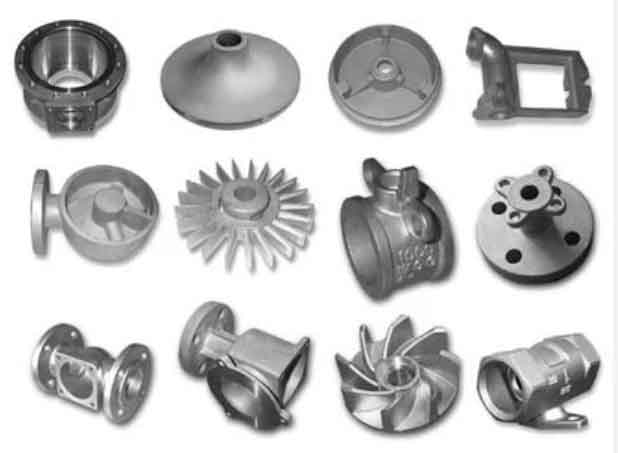
1. Technical Overview of Ductile Iron Casting
Ductile iron casting has become indispensable for manufacturing high-performance cylinder liners due to its exceptional strength-to-weight ratio and wear resistance. The horizontal centrifugal casting process introduces unique challenges, particularly in achieving uniform solidification patterns. Through numerical simulation, we identified critical factors influencing defect formation in ductile iron casting components, specifically inverse chill (reverse white iron) defects occurring 7-8 mm from the inner wall.
2. Mathematical Modeling of Solidification Dynamics
The centrifugal casting process follows fundamental conservation laws expressed through:
$$\frac{\partial u}{\partial x} + \frac{\partial v}{\partial y} + \frac{\partial w}{\partial z} = 0$$
Momentum conservation:
$$\frac{\partial (\rho \phi)}{\partial t} + \nabla \cdot (\rho \vec{V}) = \nabla \cdot (\mu \nabla \phi) + S_u – \nabla P$$
Heat transfer during solidification:
$$\rho c \frac{dT}{dt} = \nabla \cdot (k \nabla T) + \dot{Q}$$
| Parameter | Ductile Iron | Mold (HT250) |
|---|---|---|
| Density (kg/m³) | 7,100 | 7,300 |
| Thermal Conductivity (W/m·K) | 42 | 54 |
| Specific Heat (J/kg·K) | 620 | 500 |
3. Process Parameter Optimization
Initial centrifugal casting parameters revealed critical solidification patterns:
| Parameter | Initial | Optimized |
|---|---|---|
| Coating Thickness (mm) | 1.5 | 0.8 |
| Cooling Water Flow (L/min) | 120 | 180 |
| Solidification Time (s) | 150 | 120 |
The modified Niyama criterion for ductile iron casting:
$$N_y = \frac{G}{\sqrt{\dot{T}}} > 1.2 \, \text{K}^{1/2}\text{s}^{1/2}\text{mm}^{-1}$$
4. Microstructural Evolution Analysis
Cooling rate significantly impacts graphite nodule formation:
$$d_{nodule} = 0.15 \times (\dot{T})^{-0.32}$$
| Position | Nodule Count (/mm²) | Nodularity (%) |
|---|---|---|
| Outer Layer | 220 | 92 |
| Mid-wall | 180 | 85 |
| Inner Layer | 240 | 94 |
5. Industrial Implementation Results
Field trials demonstrated significant improvements in ductile iron casting quality:
| Metric | Pre-optimization | Post-optimization |
|---|---|---|
| Defect Rate (%) | 3.8 | 0.4 |
| Machining Tool Life | 120 pcs | 280 pcs |
| UTS (MPa) | 780 | 820 |
The modified cooling strategy reduced thermal gradients:
$$\nabla T_{optimized} = 0.75 \times \nabla T_{initial}$$
6. Advanced Process Control Strategies
Real-time monitoring parameters for ductile iron casting:
$$Q_{cooling} = 2.5 \times 10^{-3} \cdot (T_{mold} – 293)^{1.8}$$
| Stage | Temperature (°C) | Rotation (RPM) |
|---|---|---|
| Pouring | 1,350-1,400 | 1,200 |
| Primary Cooling | 1,100-1,150 | 850 |
| Secondary Cooling | 900-950 | 600 |
7. Future Development Directions
Emerging technologies in ductile iron casting include:
- AI-driven solidification prediction models
- Multi-phase flow simulation using LBM methods
- Real-time microstructure monitoring through thermal imaging
The modified Reynolds number for centrifugal conditions:
$$Re_c = \frac{\rho \omega r^2}{\mu} > 5 \times 10^4$$
Through systematic optimization of ductile iron casting parameters, we achieved 99.6% production yield while reducing machining allowances by 40%. This methodology establishes a framework for high-performance cylinder liner manufacturing across the automotive industry.