
In the realm of modern foundry engineering, the lost foam casting process stands out as a versatile and efficient method for producing near-net-shape components, particularly for complex geometries. My extensive involvement in this field has led me to confront numerous challenges associated with defect formation, such as shrinkage porosity, gas holes, and misruns. This article delves into a comprehensive case study focusing on the optimization of the gating system for a critical aluminum alloy transmission housing. Through first-person analysis, I will detail the systematic approach taken to diagnose issues, reformulate the gating design, and significantly enhance casting yield. The core of this discussion revolves around repeated application and refinement of the lost foam casting process, underpinned by quantitative analysis using formulas and tables to encapsulate key principles and outcomes.
The component in question is a structurally intricate aluminum alloy housing that integrates both transmission and clutch sections. Such parts, originally designed for high-pressure die-casting, often necessitate adaptation for the lost foam casting process during prototyping phases to reduce lead time and cost. The material specified is ZL101A aluminum alloy, requiring stringent quality checks including 100% X-ray inspection and mechanical properties such as a tensile strength ( $R_m$ ) greater than or equal to 250 MPa and an elongation ( $A$ ) of at least 3%. The casting’s external dimensions are approximately 452 mm in diameter by 408 mm by 378 mm, with a nominal wall thickness of 7 mm and minimum sections as thin as 4 mm. Its weight is around 18 kg. The internal and external cavities are reinforced with numerous ribs of varying shapes and angles, some as high as 35.7 mm with acute angles less than 90°, which inherently increase the difficulty of the lost foam casting process due to potential foam pattern degradation and metal flow resistance.
Initial gating system trials employed two conventional schemes: bottom gating and step gating. In the bottom-gating configuration, the clutch flange faced downward, with two ingates set along its outer periphery. A tensile reinforcement bar connected the pattern cluster to the sprue top, which was removed before pouring. The cross-sectional area ratio was set as sprue : runner : ingate = 2 : 1.3 : 1. This approach consistently resulted in shrinkage porosity defects, particularly in regions distant from the ingates, and occasional misruns. The non-destructive testing pass rate fell below 30%. The step-gating scheme oriented the clutch flange downward but introduced additional ingates at a large window on the transmission housing side, creating a stepped filling sequence. While this improved filling in some areas, it introduced erratic gas hole defects, making quality control unpredictable and likewise yielding a pass rate under 30%. These outcomes highlighted the inadequacy of traditional gating layouts for such complex lost foam casting process applications.
A thorough defect root cause analysis was imperative. Shrinkage porosity, often manifesting in isolated thick sections or “dead zones” during solidification, can be modeled using the Niyama criterion, which relates thermal gradients and cooling rates to pore formation. For aluminum alloys in the lost foam casting process, the local solidification time ( $t_s$ ) and temperature gradient ( $G$ ) are critical. The condition for shrinkage avoidance can be expressed as:
$$ \frac{G}{\sqrt{\dot{T}}} \geq C $$
where $ \dot{T} $ is the cooling rate and $ C $ is a material-dependent constant. Inadequate feeding due to poor gating placement leads to low $G$ in remote areas, promoting shrinkage. Gas hole formation is multifaceted. Firstly, residual moisture from incomplete drying of the foam pattern, coating, or repair paste can vaporize during pouring, generating steam bubbles. The gas pressure ( $P_g$ ) from decomposition must be balanced by the metallostatic pressure ( $P_m = \rho g h$ ) and coating permeability. The coating’s gas permeability ( $k$ ) is vital; if insufficient, trapped gases cause pores. Secondly, if the ingate cross-sectional area is too large, the metal front velocity ( $v_m$ ) may exceed the foam degradation rate ( $v_f$ ), leading to “engulfment” where foam decomposes inside the molten metal, releasing gases that cannot escape. This can be framed as:
$$ v_m > v_f \Rightarrow \text{Engulfment Risk} $$
where $ v_m $ is proportional to the pouring rate and ingate area. Thirdly, low pouring temperature (below 760°C for this alloy) reduces fluidity, exacerbating misruns. However, process parameters such as pattern drying, coating application (using high-permeability materials like Ashland coatings), sand compaction, and pouring temperature were verified to be within specification. Thus, the gating system itself became the primary variable for optimization.
To address these issues, a radical redesign was conceived: orienting the clutch flange upward and implementing a central sprue with multiple radial ingates. This configuration leverages the natural thermal and feeding advantages of top-gating while ensuring balanced filling. The optimized gating system is detailed below, with key dimensions derived from empirical and simulation studies.
| Component | Dimensions (mm) | Cross-Sectional Area (mm²) | Function |
|---|---|---|---|
| Sprue | 64 × 64 × 350 | 4096 | Vertical channel for metal delivery |
| Connector Cylinder | φ50 × 50 | 1963 | Links sprue to ingates, allows sand flow |
| Ingates (3 nos.) | 32 wide × 15 thick | 480 each | Radial entry into central bore |
The three ingates are spaced at 120° intervals around the central axis of the housing’s bore. Two of these ingates are strategically directed toward the thick支柱 sections at the clutch bottom to enhance feeding. The cross-sectional area ratio was recalibrated to ensure progressive solidification. The modified ratio is sprue : runner (connector) : total ingate area = 4096 : 1963 : 1440 ≈ 2.84 : 1.36 : 1. This ratio promotes a pressure gradient conducive to smooth filling without excessive velocity. To prevent distortion of the clutch flange during pattern assembly and coating, two wooden braces were used as anti-deformation supports, supplemented by foam strips to stabilize the sprue. A critical step involved pre-filling the gaps in reinforcement ribs and holes on the pattern back with specialty paste to prevent sand loosening and subsequent metal penetration, followed by a prolonged 48-hour drying cycle to ensure complete moisture removal.
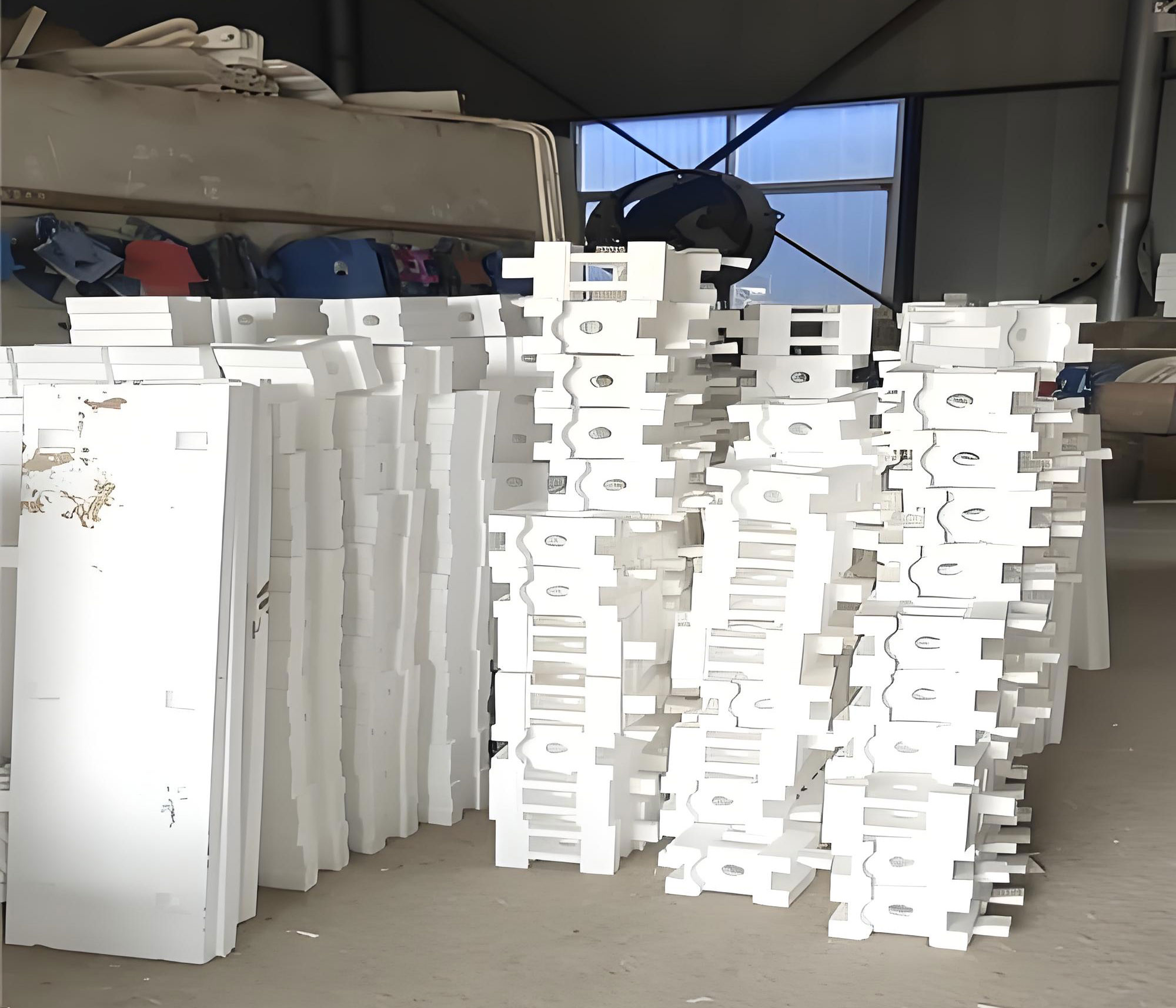
The effectiveness of the lost foam casting process hinges on the interplay of fluid dynamics, heat transfer, and foam degradation. To quantify the filling behavior, one can consider the momentum equation for metal flow in the gating system, accounting for the counter-pressure from foam decomposition. The pressure drop ( $\Delta P$ ) across the gating system can be approximated using the Bernoulli equation with losses:
$$ P_1 + \frac{1}{2}\rho v_1^2 + \rho g h_1 = P_2 + \frac{1}{2}\rho v_2^2 + \rho g h_2 + \Delta P_{loss} $$
where subscripts 1 and 2 denote two points in the flow path, and $\Delta P_{loss}$ includes friction and form losses. In the lost foam casting process, an additional term for foam degradation pressure ( $P_{foam}$ ) must be considered at the metal-foam interface. The rate of foam decomposition can be modeled by an Arrhenius-type equation:
$$ \frac{dm}{dt} = A e^{-E_a / (R T)} $$
where $m$ is the mass of foam degraded, $A$ is a pre-exponential factor, $E_a$ is the activation energy, $R$ is the gas constant, and $T$ is the local temperature. Ensuring that the metal advance is synchronized with foam degradation minimizes gas entrapment. The optimized gating reduces $v_m$ by increasing the number of ingates while decreasing individual ingate area, thus balancing the equation $v_m \approx v_f$.
Experimental validation of the optimized system was conducted over multiple production batches. The results demonstrated a dramatic reduction in defects. Shrinkage porosity was virtually eliminated due to improved thermal gradients and directional solidification toward the ingates. Gas holes became sporadic and negligible, attributed to better venting through the coating and reduced engulfment. Misruns disappeared as the central gating ensured uniform filling of thin sections. Statistical data from X-ray inspection are summarized below:
| Defect Type | Frequency in Bottom Gating (%) | Frequency in Step Gating (%) | Frequency in Optimized Gating (%) | Remarks |
|---|---|---|---|---|
| Shrinkage Porosity | 45 | 20 | <2 | Mostly in isolated thick zones |
| Gas Holes | 15 | 35 | <3 | Random distribution previously |
| Misruns | 25 | 10 | 0 | Especially in thin ribs and edges |
| Overall Rejection Rate | >70 | >70 | <15 | Pass rate exceeded 85% |
The enhanced performance can be further analyzed through solidification modeling. The Chvorinov’s rule estimates solidification time ( $t$ ) as:
$$ t = B \left( \frac{V}{A} \right)^n $$
where $V$ is volume, $A$ is surface area, $B$ is a mold constant, and $n$ is an exponent (typically ~2). For the optimized gating, the modulus ( $V/A$ ) of feeding paths was increased toward the ingates, promoting progressive solidification. Additionally, the thermal modulus ( $M_t$ ) can be defined as:
$$ M_t = \frac{\text{Heat content}}{\text{Cooling surface area}} $$
By positioning ingates at the heaviest sections, the thermal moduli are balanced, reducing isolated hot spots. The success of this central gating approach underscores its suitability for complex, thin-walled components in the lost foam casting process. It aligns with the fundamental principle that gating should facilitate rapid, tranquil, and directional filling while maintaining adequate thermal gradients for feeding.
In conclusion, the optimization of the gating system for this aluminum alloy transmission housing exemplifies a systematic engineering approach within the lost foam casting process. By reorienting the casting, implementing a central sprue with multiple radial ingates, and carefully calibrating cross-sectional ratios, defects such as shrinkage porosity, gas holes, and misruns were substantially mitigated, elevating the non-destructive testing pass rate from below 30% to over 85%. This case study reinforces that for intricate components with varying wall thicknesses and internal reinforcements, a center-gated design often yields superior results in the lost foam casting process. Future work could integrate computational fluid dynamics (CFD) simulations to further refine gating parameters and explore the effects of different foam densities and coating formulations. The continuous evolution of the lost foam casting process remains pivotal for expanding its application to high-integrity automotive and aerospace components.
The principles derived here—emphasizing balanced filling, controlled metal velocity, and strategic feeding—are broadly applicable. For instance, the relationship between ingate area and foam degradation rate can be generalized as a design criterion: the ratio of total ingate area ( $A_i$ ) to sprue area ( $A_s$ ) should be optimized based on the foam’s thermal properties and desired fill time. A proposed heuristic formula for the lost foam casting process is:
$$ A_i = k \cdot A_s \cdot \frac{\rho_f \cdot L_f}{\rho_m \cdot C_p \cdot \Delta T} $$
where $k$ is an empirical constant, $\rho_f$ and $L_f$ are foam density and latent heat of decomposition, $\rho_m$ is metal density, $C_p$ is specific heat, and $\Delta T$ is the superheat. Such formulas, combined with rigorous experimentation, pave the way for more robust and repeatable lost foam casting process implementations, ultimately driving quality and efficiency in modern foundries.