
In my extensive experience within the foundry industry, I have consistently focused on enhancing the reliability and performance of gray iron castings. These components are critical across various sectors, including automotive and machinery, due to their excellent machinability, damping capacity, and cost-effectiveness. However, achieving defect-free gray iron castings remains a persistent challenge, often plagued by issues such as shrinkage porosity, slag inclusions, and sand holes. This article delves into a comprehensive case study where computer-aided engineering (CAE) simulation was leveraged to diagnose and rectify quality defects in a specific gray iron casting—a pressure plate. Through a first-person narrative, I will detail the analytical process, implementation of corrective measures, and the resultant improvements, emphasizing the iterative role of CAE in refining foundry practices for gray iron castings.
The pressure plate in question is a disk-shaped gray iron casting with a diameter of approximately 338 mm and a maximum thickness of 35 mm, weighing around 12.3 kg. Manufactured from HT250 gray iron, it serves as a clutch component in heavy-duty vehicles, demanding high integrity with no defects on friction surfaces after machining. Historically, production yields were unsatisfactory, with rejection rates often exceeding 20% due to shrinkage cavities near the riser and slag-sand inclusions on critical faces. This prompted a thorough investigation into the existing gating and feeding system, followed by CAE-assisted modifications.
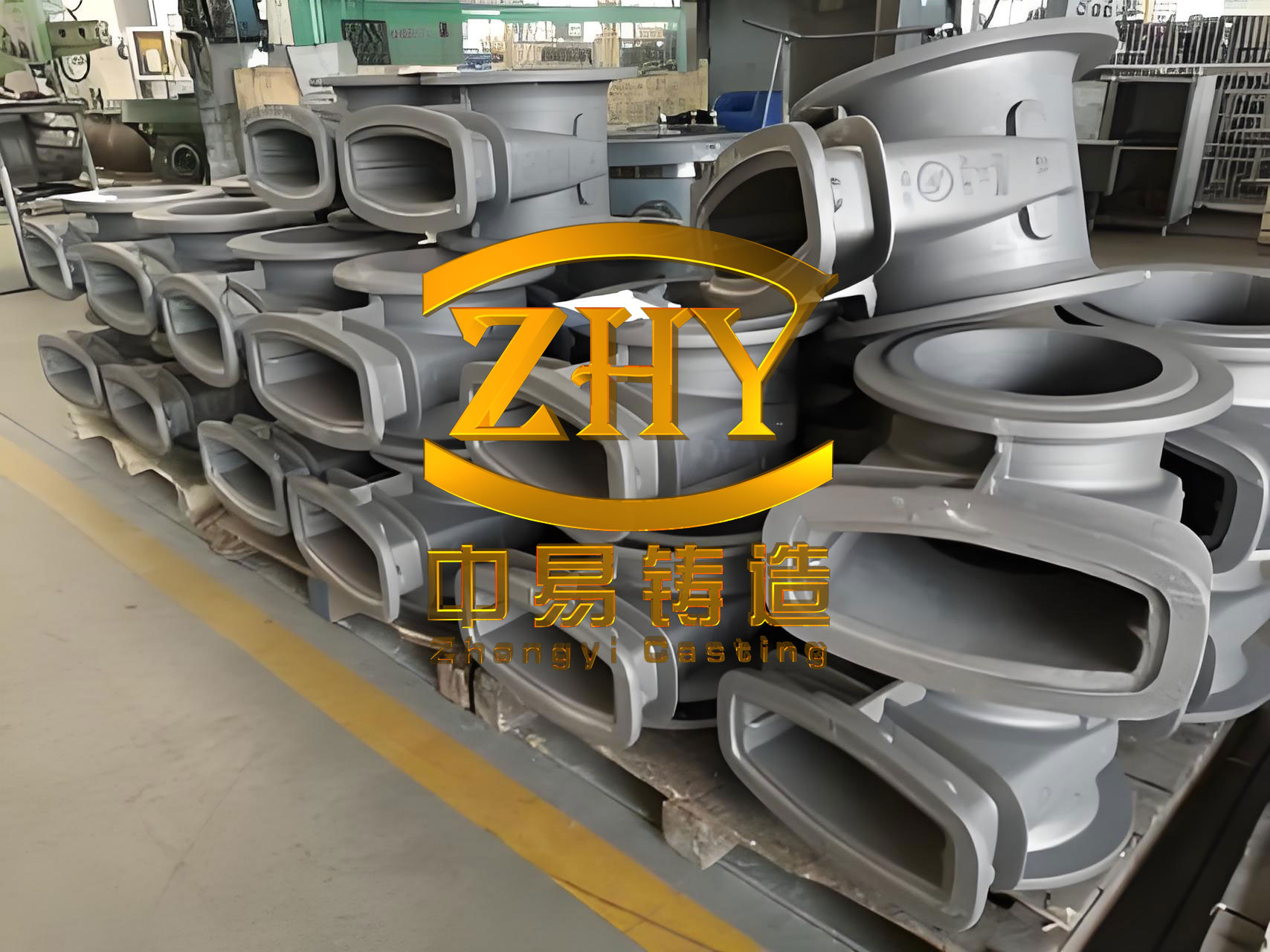
Initially, the casting process employed a conventional gating system, characterized as semi-closed, with a single ingate positioned at the bottom lateral side of the pressure plate. The system comprised a pouring cup, sprue, runner, ingate, and a cold riser. The cross-sectional area ratios were set at 1.0:1.5:1.2 for the runner, sprue, and ingate, respectively. Production utilized a DISA vertical molding line, with melting conducted in medium-frequency induction furnaces and pouring via bottom-pour systems at temperatures between 1480°C and 1500°C. A summary of the original process parameters is presented in Table 1.
| Parameter | Value | Unit |
|---|---|---|
| Casting Material | HT250 Gray Iron | – |
| Pouring Temperature | 1480-1500 | °C |
| Gating System Type | Semi-closed | – |
| Runner: Sprue: Ingate Ratio | 1.0: 1.5: 1.2 | – |
| Riser Type | Cold Riser | – |
| Molding Method | Vertical Sand Molding | – |
Despite these standardized parameters, quality assessments revealed persistent defects. Visual inspection and machining often exposed shrinkage cavities adjacent to the riser neck and dispersed slag-sand inclusions on the friction surface. To quantitatively understand these issues, I initiated a CAE simulation using Intecast CAE software, which models filling and solidification phenomena. The simulation confirmed a high propensity for shrinkage porosity near the riser, attributable to inadequate feeding, and turbulent flow during filling that promoted slag entrapment. The governing equations for solidification in gray iron castings can be expressed through Fourier’s law and the heat transfer equation:
$$ \frac{\partial T}{\partial t} = \alpha \nabla^2 T $$
where \( T \) is temperature, \( t \) is time, and \( \alpha \) is thermal diffusivity. For gray iron castings, the solidification process involves graphite precipitation, which influences shrinkage behavior. The volumetric shrinkage \( \Delta V \) can be estimated as:
$$ \Delta V = V \cdot \beta \cdot (T_{\text{liquidus}} – T_{\text{solidus}}) $$
Here, \( V \) is the volume of the casting, \( \beta \) is the volumetric shrinkage coefficient, and \( T_{\text{liquidus}} \) and \( T_{\text{solidus}} \) are the liquidus and solidus temperatures, respectively. In the original design, the riser’s insufficient thermal capacity led to premature solidification, failing to compensate for this shrinkage.
Further analysis identified root causes. The single ingate caused localized overheating, resulting in micro-shrinkage and erosion of mold sand, which contributed to sand holes. The semi-closed gating system lacked effective slag-trapping mechanisms, allowing inclusions to enter the cavity. Additionally, the cold riser with a narrow neck (5 mm thick) created a choked feeding channel, exacerbating shrinkage defects. Molten metal quality was another factor; insufficient holding and slag removal procedures introduced impurities into the gray iron castings.
To address these issues, I redesigned the gating and feeding system based on simulation insights. The key modifications included implementing a step-gating system, converting to a hot riser with a padding, and incorporating filters. The new gating system features three layers of ingates arranged in a stepped configuration, promoting bottom-up filling and reducing turbulence. The ingate area ratio from bottom to top was set at 2:2:1, with the top layer directly feeding the riser. This design ensures progressive solidification and minimizes thermal gradients. The filling process can be modeled using Bernoulli’s principle for incompressible flow:
$$ P + \frac{1}{2} \rho v^2 + \rho gh = \text{constant} $$
where \( P \) is pressure, \( \rho \) is density, \( v \) is velocity, \( g \) is gravity, and \( h \) is height. By controlling velocity through stepped ingates, turbulent kinetic energy is reduced, decreasing slag entrainment. Table 2 contrasts the original and modified gating systems for these gray iron castings.
| Aspect | Original System | Modified System |
|---|---|---|
| Gating Type | Semi-closed, single ingate | Step-gating, multiple ingates |
| Ingate Ratio | 1.2 (single) | 2:2:1 (bottom to top) |
| Riser Type | Cold riser | Hot riser with padding |
| Slag Control | Minimal | Included ceramic filter |
| Filling Pattern | Turbulent, localized | Laminar, progressive |
The riser was redesigned as a hot riser, where the top ingate directly supplies hot metal, enhancing feeding efficiency. A padding was added at the riser neck to enlarge the feeding channel, compensating for the thin section of the casting. This padding increases the modulus \( M \), defined as the volume-to-surface area ratio \( M = V/A \), which governs solidification time. The required riser size can be calculated using Chvorinov’s rule:
$$ t = C \left( \frac{V}{A} \right)^2 $$
where \( t \) is solidification time and \( C \) is a constant dependent on mold material. By increasing \( M \) at the neck, solidification is delayed, allowing better feeding. Additionally, a ceramic filter was installed in the pouring cup to trap slag and inclusions, purifying the molten iron before it enters the mold cavity. This is particularly crucial for gray iron castings, where impurities can degrade mechanical properties.
Melting practices were also refined. I introduced superheating to 1550°C followed by a holding period with flux cover to facilitate slag removal and degassing. This improves the metallurgical quality of gray iron castings by reducing oxide inclusions and gas content. The effectiveness of these changes was validated through CAE simulation. The modified design showed a significant reduction in shrinkage propensity and more uniform temperature distribution during solidification. Figure 7 from the simulation indicated no shrinkage defects within the casting body, confirming the efficacy of the hot riser and padding.
Upon implementation in production, the results were striking. The rejection rate for shrinkage and slag-sand defects dropped dramatically, raising the overall qualification rate of gray iron castings to over 93%. Machined surfaces exhibited dense structures free from imperfections, meeting stringent customer specifications. To quantify the improvement, I analyzed key performance indicators, as summarized in Table 3.
| Metric | Before Optimization | After Optimization |
|---|---|---|
| Rejection Rate Due to Shrinkage | ~20% | <5% |
| Rejection Rate Due to Slag-Sand Inclusions | Up to 18% | <3% |
| Overall Qualification Rate | ~75% | >93% |
| Machining Yield on Friction Surface | Low, variable | High, consistent |
The success of this project underscores the importance of integrating CAE simulation into the development cycle of gray iron castings. By simulating filling and solidification, potential defects can be identified and mitigated proactively, reducing costly trial-and-error iterations. The step-gating system, in particular, offers a robust solution for flat or disk-shaped gray iron castings by ensuring sequential filling and controlled solidification. Furthermore, the use of filters and improved melting practices enhances metal cleanliness, which is vital for high-integrity gray iron castings.
From a broader perspective, these optimizations can be adapted to other types of gray iron castings. For instance, the principles of progressive solidification and slag control are universally applicable. The economic impact is substantial, as higher qualification rates translate to reduced scrap, lower energy consumption, and improved profitability. In my ongoing work, I continue to employ CAE tools to refine processes for various gray iron castings, exploring advanced techniques such as pressurized gating systems and optimized inoculant additions.
In conclusion, the quality of gray iron castings can be significantly enhanced through a systematic approach combining CAE simulation, gating system redesign, and process control. This case study demonstrates that by addressing root causes like turbulent flow and inadequate feeding, defects such as shrinkage and inclusions can be minimized. The iterative use of simulation allows for precise adjustments, ensuring that gray iron castings meet the demanding standards of modern applications. As foundry technology evolves, the integration of digital tools will remain pivotal in advancing the reliability and efficiency of gray iron castings production worldwide.