
In the realm of aluminum extrusion molding, the persistent challenge of aluminum-iron adhesion severely compromises模具 longevity and product quality. At elevated temperatures, the significant mutual solubility between aluminum and iron facilitates the formation of iron-aluminum solid solutions, leading to pitting and substantial material transfer—reported to reach up to 10.99 g/m². This degradation necessitates the development of advanced模具 materials that combine high-temperature mechanical integrity with inherent anti-adhesion characteristics. Traditional nodular cast iron, renowned for its self-lubricating properties due to spherical graphite nodules, presents a promising baseline. However, its insufficient high-temperature strength and hardness preclude direct application in demanding extrusion processes. To bridge this gap, I initiated a comprehensive study focusing on the alloying and heat treatment of nodular cast iron, incorporating elements like chromium, molybdenum, and vanadium to enhance its performance. This article details my investigation into the effects of solution-aging treatments on the microstructure, mechanical properties, and tribological behavior of alloyed nodular cast iron, aiming to establish a viable material solution for aluminum extrusion molds.
The foundation of this work lies in the strategic composition design inspired by hot work die steels and iron-based high-temperature alloys. I prepared a chromium-molybdenum-vanadium alloyed nodular cast iron using horizontal continuous casting technology, ensuring uniform microstructure and controlled graphite nodulation. The chemical composition, crucial for achieving desired properties, is summarized in the table below.
| Element | Content (wt%) |
|---|---|
| Carbon (C) | 3.7 |
| Silicon (Si) | 2.9 |
| Aluminum (Al) | 1.3 |
| Chromium (Cr) | 0.4 |
| Molybdenum (Mo) | 2.9 |
| Vanadium (V) | 0.9 |
| Nickel (Ni) | 1.9 |
| Manganese (Mn) | ≤0.1 |
| Phosphorus (P) | ≤0.1 |
| Magnesium (Mg) | 0.075 |
| Cerium (Ce) | 0.04 |
| Sulfur (S) | ≤0.02 |
| Iron (Fe) | Balance |
The addition of carbide-forming elements like Mo, Cr, and V is intended to improve red hardness, wear resistance, and thermal stability, while elements such as Si, Al, and Ni promote graphite formation to maintain adequate nodule count for self-lubrication. After casting, samples were extracted from near the surface to avoid segregation effects and subjected to a series of heat treatments. The heat treatment parameters were varied systematically to explore their influence, as outlined in the following table.
| Solution Temperature (°C) | Solution Time (h) | Aging Temperature (°C) | Aging Time (h) | Cooling Method | Additional Notes |
|---|---|---|---|---|---|
| 930 | 1 | 500 | 1 | Water quench | Single aging |
| 970 | 1 | 500 | 1 | Water quench | Single aging |
| 1010 | 1 | 500 | 1 | Water quench | Single aging |
| 1050 | 1 | 500 | 1 | Water quench | Single aging |
| 1050 | 3 | 500 | 1 | Water quench | Single aging |
| 1050 | 6 | 500 | 1 | Water quench | Single aging |
| 1050 | 12 | 500 | 1 | Water quench | Single aging |
| 1050 | 1 | 450 | 1 | Air cool | Single aging |
| 1050 | 1 | 500 | 1 | Air cool | Single aging |
| 1050 | 1 | 550 | 1 | Air cool | Single aging |
| 1050 | 1 | 600 | 1 | Air cool | Single aging |
| 1050 | 1 | 500 | 1 | Air cool | Double aging (2 cycles) |
| 1050 | 1 | 500 | 1 | Air cool | Triple aging (3 cycles) |
All solution treatments were performed in vacuum furnaces to prevent oxidation, followed by quenching or air cooling as specified. For characterization, I employed optical microscopy (OM) and scanning electron microscopy (SEM) for microstructural analysis, X-ray diffraction (XRD) for phase identification, Rockwell hardness testing for room-temperature hardness, and high-temperature compression tests at 500°C to simulate service conditions. Friction and wear tests were conducted using a reciprocating ball-on-disk setup with GCr15 steel balls under varying loads to evaluate the lubricating behavior imparted by graphite nodules in the nodular cast iron.
The initial state of the material after stress relief annealing revealed a microstructure typical of alloyed nodular cast iron, comprising ferrite, residual austenite, spherical graphite nodules, pearlite, and alloy carbides. Quantitative analysis indicated a graphite nodule count of approximately 330 ± 30 nodules per mm² with an average diameter of 14.48 µm. This nodule density is critical for ensuring effective self-lubrication during friction, as graphite can exude to the surface to form a protective film. The alloy carbides, primarily rich in molybdenum and vanadium, exhibited a elongated morphology and were often associated with pearlite colonies along grain boundaries. XRD patterns confirmed the presence of ferrite (α-Fe) peaks along with minor austenite (γ-Fe) peaks, reflecting the metastable nature of the as-cast structure.
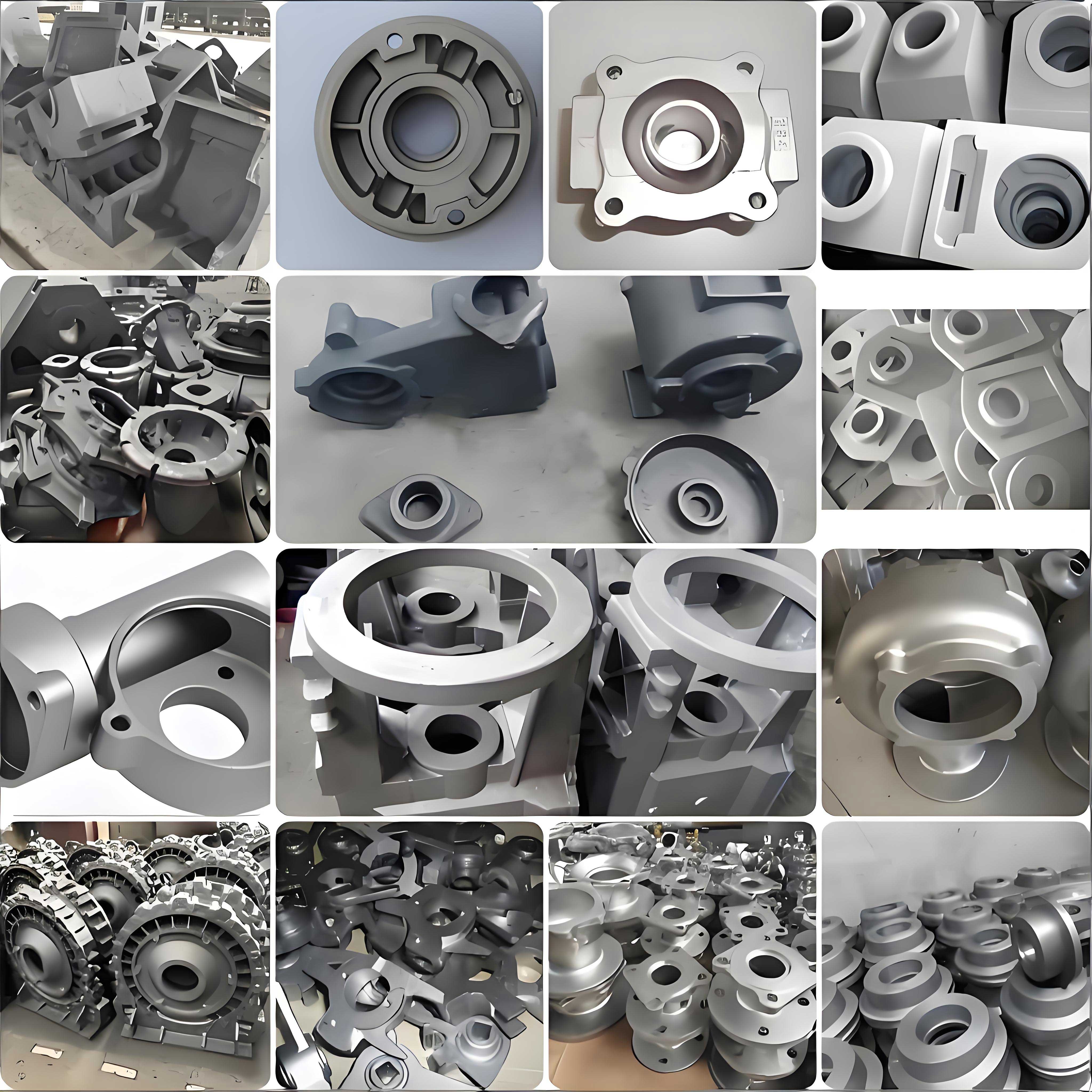
The image above exemplifies the typical appearance of a nodular cast iron casting, highlighting the spherical graphite morphology that is fundamental to its self-lubricating capability. In my study, preserving this graphite structure while strengthening the metallic matrix was a key objective.
Solution treatment aimed to dissolve primary carbides and homogenize alloying elements into the austenitic matrix. My experiments varied solution temperature from 930°C to 1050°C, with holding times from 1 to 12 hours. Microstructural observations showed that at 930°C, incomplete austenitization occurred, evidenced by layered structures in the matrix. At 970°C, full austenitization was achieved, but significant primary carbides remained undissolved. Raising the temperature to 1010°C and 1050°C progressively promoted carbide decomposition, with the most effective dissolution observed at 1050°C for 1 hour, where carbides transformed from elongated networks to fragmented particles. However, even at 1050°C, some stable MC-type carbides persisted, indicating their high thermal stability. Prolonging solution time to 12 hours at 1050°C led to the formation of fine graphite particles within the matrix, attributed to carbon segregation due to reduced solid solubility, which could compromise subsequent aging response. Thus, I identified 1050°C for 1 hour as the optimal solution parameters, maximizing carbide dissolution and carbon saturation in austenite without excessive graphite precipitation.
The effectiveness of solution treatment can be quantified by the degree of carbide dissolution, which influences the supersaturation of alloying elements. I propose a simplified model to estimate the volume fraction of undissolved carbides, \( f_c \), after solution treatment:
$$ f_c = f_{c0} \cdot e^{-k(T – T_0)t} $$
where \( f_{c0} \) is the initial carbide volume fraction, \( k \) is a rate constant dependent on carbide type, \( T \) is the solution temperature, \( T_0 \) is a reference temperature, and \( t \) is the solution time. For the alloyed nodular cast iron, higher \( T \) and optimal \( t \) minimize \( f_c \), enhancing the potential for precipitation hardening during aging.
Following solution treatment, aging was conducted to precipitate fine carbides and stabilize the microstructure. I investigated aging temperatures ranging from 450°C to 600°C, along with multiple aging cycles at 500°C. The resulting microstructures consisted primarily of tempered martensite, residual austenite, undissolved primary carbides, and newly formed aging carbides. At lower aging temperatures (450-500°C), fine, dispersed precipitates dominated, identified as M₃C and M₂C types via XRD. As aging temperature increased to 550-600°C, precipitate coarsening occurred, and M₂C carbides became more prevalent, accompanied by a reduction in residual austenite content. The presence of metastable martensite-austenite (M/A) islands was noted, particularly after single aging, and these diminished with multiple aging cycles. The evolution of carbide types with aging temperature significantly impacts mechanical properties, as M₂C carbides offer superior thermal stability compared to M₃C.
To systematically evaluate mechanical performance, I measured Rockwell hardness and conducted high-temperature compression tests at 500°C. The results are consolidated in the tables below.
| Aging Temperature (°C) | Rockwell Hardness (HRC) | Yield Strength at 500°C (MPa) | Compressive Strength at 500°C (MPa) | Compression Rate (%) |
|---|---|---|---|---|
| 450 | 57.1 ± 0.8 | 1956.3 | 2000.2 | 20.1 |
| 500 | 55.9 ± 0.4 | 2068.3 | 2144.6 | 23.5 |
| 550 | 54.2 ± 1.1 | 2031.5 | 2084.6 | 22.7 |
| 600 | 46.5 ± 3.8 | 1540.4 | 1652.2 | 25.8 |
The data indicate that aging at 500°C yields the best combination of high compressive strength (2144.6 MPa) and respectable hardness (55.9 HRC). The decrease in hardness at 600°C correlates with overtempering effects, where carbide coarsening and matrix softening prevail. The high-temperature strength can be modeled using a superposition of strengthening mechanisms:
$$ \sigma_y = \sigma_0 + \sigma_{ss} + \sigma_{gb} + \sigma_{p} $$
where \( \sigma_0 \) is the lattice friction stress, \( \sigma_{ss} \) is solid solution strengthening, \( \sigma_{gb} \) is grain boundary strengthening, and \( \sigma_{p} \) is precipitation strengthening. For the alloyed nodular cast iron, \( \sigma_{p} \) plays a dominant role, calculable via the Orowan mechanism for bypass of precipitates by dislocations:
$$ \sigma_p = \frac{Gb}{2\pi \sqrt{1-\nu}} \cdot \frac{\ln(2r/b)}{\lambda} $$
Here, \( G \) is the shear modulus, \( b \) is the Burgers vector, \( \nu \) is Poisson’s ratio, \( r \) is the precipitate radius, and \( \lambda \) is the inter-precipitate spacing. Fine, closely spaced carbides from aging at 500°C maximize \( \sigma_p \), explaining the peak compressive strength.
Multiple aging cycles at 500°C (double and triple aging) were explored to further reduce metastable phases. The results showed a slight improvement in compressive strength (to about 2200 MPa) but negligible change in hardness compared to single aging. This suggests that while M/A islands are somewhat diminished, the core strengthening mechanisms remain similar. Therefore, single aging is deemed sufficient for practical applications, simplifying the heat treatment process for nodular cast iron components.
Friction and wear behavior is paramount for模具 materials in aluminum extrusion. I evaluated the friction coefficients under loads of 15 N, 20 N, and 30 N for samples subjected to single and triple aging at 500°C. The average steady-state friction coefficients are presented below.
| Load (N) | Single Aging Friction Coefficient | Triple Aging Friction Coefficient |
|---|---|---|
| 15 | 0.59 | 0.68 |
| 20 | 0.68 | 0.69 |
| 30 | 0.57 | 0.61 |
Single aging consistently resulted in lower friction coefficients, attributed to better retention of matrix hardness, which provides stronger support for graphite nodules, enabling more effective lubricant film formation. Interestingly, under higher loads (30 N), the friction coefficient decreased, indicating enhanced graphite exudation and film stability. This behavior is beneficial for extrusion conditions where high pressures are encountered. The friction coefficient \( \mu \) can be empirically related to load \( L \) and hardness \( H \) for nodular cast iron:
$$ \mu = \alpha \cdot L^{-\beta} + \gamma \cdot H^{-1} $$
where \( \alpha \), \( \beta \), and \( \gamma \) are material constants. The inverse relationship with hardness underscores the importance of a strong matrix to utilize graphite lubrication effectively.
XRD analysis provided insights into phase transformations. After solution treatment, peaks corresponding to austenite (γ-Fe) showed shifts due to lattice strain from dissolved atoms. Aging introduced distinct carbide peaks: M₃C at lower temperatures, M₂C at higher temperatures, and persistent MC from primary carbides. The volume fraction of different phases influences overall properties. For instance, the residual austenite content \( V_\gamma \) affects toughness and dimensional stability. I estimated \( V_\gamma \) using integrated intensity ratios from XRD patterns:
$$ V_\gamma = \frac{I_\gamma}{I_\gamma + K I_\alpha} $$
where \( I_\gamma \) and \( I_\alpha \) are intensities of selected austenite and ferrite/martensite peaks, and \( K \) is a calibration constant. Lower \( V_\gamma \) after higher aging temperatures correlates with improved thermal stability.
In summary, my investigation demonstrates that alloyed nodular cast iron, through careful composition design and optimized heat treatment, can achieve exceptional high-temperature mechanical properties while retaining self-lubricating characteristics. The optimal parameters—solution at 1050°C for 1 hour followed by aging at 500°C for 1 hour—yield a material with Rockwell hardness of 55.9 HRC and compressive strength of 2144.6 MPa at 500°C, surpassing conventional nodular cast iron and rivaling tool steels like H13 in hardness. The friction behavior, advantageous under high loads, coupled with the inherent graphite lubrication, positions this alloyed nodular cast iron as a promising candidate for aluminum extrusion molds. Future endeavors could explore variations in alloying element ratios to further refine the balance between graphite nodule count and matrix strength, potentially tailoring the material for specific extrusion conditions. This work underscores the potential of advanced nodular cast iron in overcoming adhesion challenges and extending模具 service life in high-temperature forming processes.