
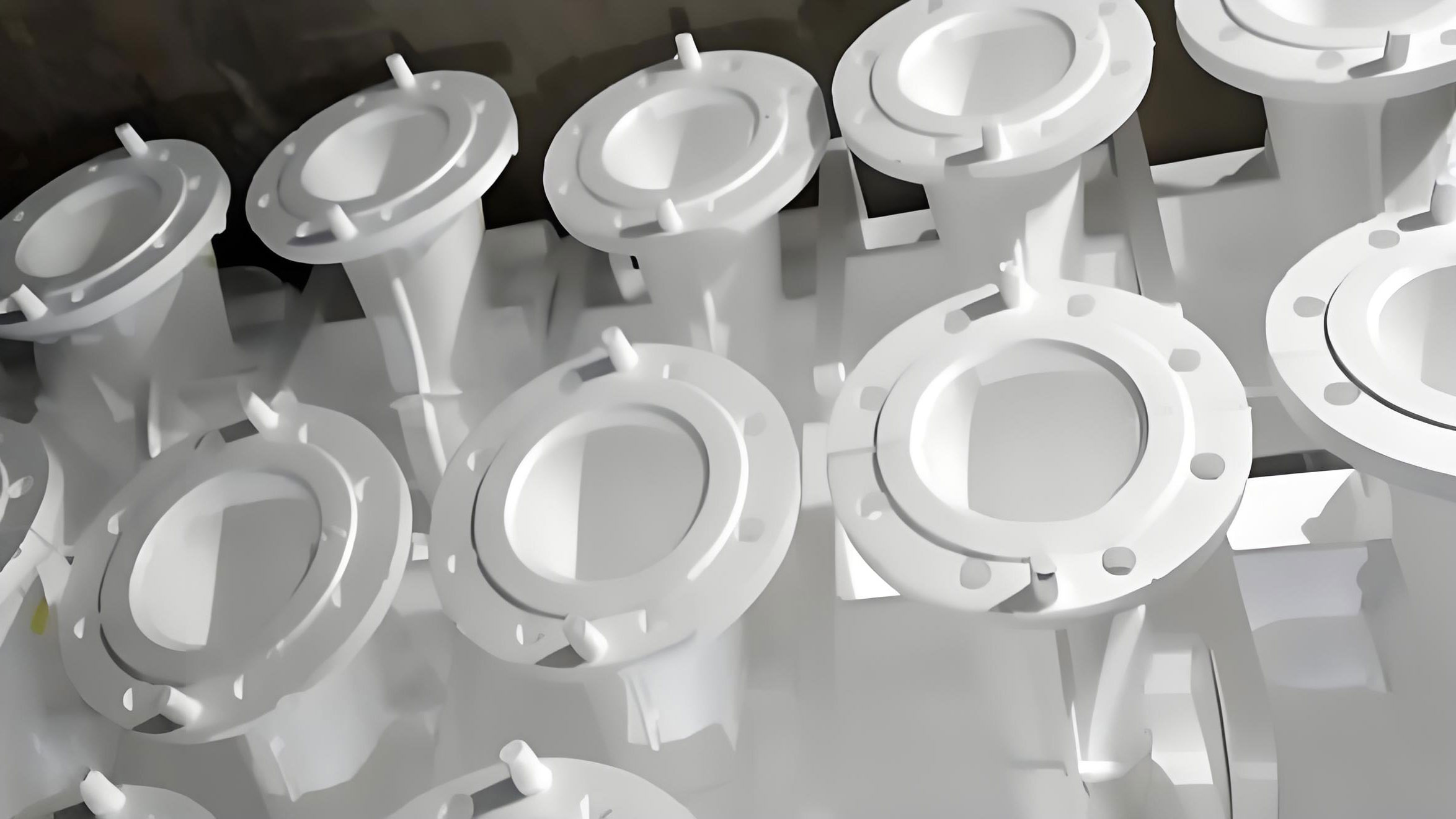
The efficacy and final quality of components produced via the lost foam casting process are critically dependent on the performance of the refractory coating applied to the expendable foam pattern. Unlike conventional mold coatings, this layer is directly applied to the foam surface and must fulfill a multifaceted role: it must provide sufficient mechanical strength to the fragile pattern during handling, ensure high permeability to facilitate the rapid escape of pyrolysis gases during metal pouring, withstand the thermal and mechanical冲击 of molten metal, and ultimately produce a defect-free casting surface. This study focuses on the systematic development and optimization of a water-based coating specifically designed for steel castings in lost foam casting.
The coating formulation is a complex composite typically consisting of refractory fillers, binders, carriers, suspending agents, and various additives. For this investigation, the refractory skeleton was composed of a blend of 80 wt% quartz flour and 20 wt% zircon flour. Distilled water served as the carrier. The key additives under investigation, selected based on their known functions, were: Sodium Bentonite (suspension and thickening agent), Sodium Carboxymethyl Cellulose – CMC (suspension and rheology modifier), Silica Sol (high-temperature inorganic binder), Phenolic Resin (low-to-medium temperature organic binder), and a proprietary adhesive labeled ‘801 Glue’ (introduced to potentially modify gas permeability and carbon pick-up behavior compared to conventional PVA glues). Minor amounts of surfactant, defoamer, and preservative were also added in fixed quantities.
Experimental Methodology and Design
To optimize the coating’s properties efficiently, a Taguchi orthogonal array design was employed. A five-factor, four-level L16 (45) orthogonal experiment was designed. The five factors were the aforementioned additives: Sodium Bentonite (Factor A), CMC (Factor B), Silica Sol (Factor C), Phenolic Resin (Factor D), and 801 Glue (Factor E). The fixed base composition for all trials included 200g of the quartz-zircon blend and 200g of water. The variable additive levels are presented in Table 1.
| Experiment No. | A: Sodium Bentonite | B: CMC | C: Silica Sol | D: Phenolic Resin | E: 801 Glue |
|---|---|---|---|---|---|
| 1 | 4 | 4 | 6 | 2 | 2 |
| 2 | 6 | 6 | 8 | 4 | 4 |
| 3 | 8 | 8 | 10 | 6 | 6 |
| 4 | 10 | 10 | 12 | 8 | 8 |
| 5 | 4 | 6 | 10 | 8 | 4 |
| 6 | 6 | 4 | 12 | 6 | 2 |
| 7 | 8 | 10 | 6 | 4 | 2 |
| 8 | 10 | 8 | 8 | 2 | 4 |
| 9 | 4 | 8 | 12 | 4 | 6 |
| 10 | 6 | 10 | 10 | 2 | 8 |
| 11 | 8 | 4 | 8 | 8 | 6 |
| 12 | 10 | 6 | 6 | 6 | 8 |
| 13 | 4 | 10 | 8 | 6 | 8 |
| 14 | 6 | 8 | 6 | 8 | 6 |
| 15 | 8 | 6 | 12 | 2 | 4 |
| 16 | 10 | 4 | 10 | 4 | 2 |
The performance of coatings from each experimental run was evaluated based on two main categories: Working Properties and Process Properties.
Working Properties of the Lost Foam Casting Coating
The working properties are those that define the coating’s behavior during the critical metal-pouring stage of lost foam casting. They include permeability (at room temperature and high temperature), surface strength (green strength), and high-temperature strength.
Permeability Measurement
Permeability is paramount in lost foam casting for the egress of foam degradation products. It was measured using standard cylindrical sand specimens (50mm diameter x 50mm height) coated with a uniform layer of the trial coating and dried. Permeability was determined using a standard sand permeability tester. High-temperature permeability was measured after placing the coated specimen in a furnace at 900°C for 2 minutes, then testing immediately. The permeability value (K) is calculated based on the airflow through the sample.
Surface Strength (Green Strength)
The coating must be robust enough to resist abrasion during sand filling and compaction. Surface strength was assessed using a sand abrasion test. A dried coating sample was subjected to a continuous stream of standard 212μm quartz sand falling from a height of 500mm. The test concluded when the abrasive stream penetrated the coating to create a 1mm-diameter pit. The mass (Mabrade) of the sand consumed is a direct indicator of the coating’s resistance, where a higher mass denotes greater surface strength.
High-Temperature Strength
This property indicates the coating’s resistance to cracking and spalling under thermal shock from molten steel. Coated specimens were heated to 900°C, held for 2 minutes, and then examined. A semi-quantitative rating scale was assigned: Rating 3 (excellent, no cracks), Rating 2 (good, minor micro-cracks), Rating 1 (poor, visible cracking).
The measured working properties for all 16 experimental coatings are summarized in Table 2.
| Exp. No. | RT Permeability (cm³/g·min) | HT Permeability (cm³/g·min) | Surface Strength (g sand) | HT Strength Rating |
|---|---|---|---|---|
| 1 | 1285 | 3216 | 407 | 1 |
| 2 | 1680 | 2821 | 745 | 2 |
| 3 | 1556 | 2215 | 1865 | 3 |
| 4 | 1048 | 3062 | 2512 | 1 |
| 5 | 955 | 1994 | 565 | 2 |
| 6 | 853 | 1452 | 803 | 2 |
| 7 | 1041 | 1917 | 1803 | 1 |
| 8 | 662 | 1802 | 2480 | 3 |
| 9 | 1893 | 2811 | 457 | 2 |
| 10 | 2146 | 3506 | 817 | 1 |
| 11 | 863 | 2498 | 2057 | 2 |
| 12 | 1105 | 3495 | 3250 | 2 |
| 13 | 1231 | 3651 | 343 | 1 |
| 14 | 859 | 3157 | 1315 | 3 |
| 15 | 967 | 3753 | 1965 | 2 |
| 16 | 1392 | 4048 | 2996 | 1 |
The orthogonal analysis involves calculating the mean response for each factor at each level (K1, K2, K3, K4) and then determining the range (R) between the maximum and minimum mean values. The factor with the largest range (R) has the greatest influence on that particular property. The results of the range analysis for the working properties are presented in Table 3.
| Influencing Factor | RT Permeability | HT Permeability | Surface Strength | HT Strength |
|---|---|---|---|---|
| A: Sodium Bentonite | 624.0 | 1861.0 | 272.5 | 0.25 |
| B: CMC | 377.8 | 506.0 | 2366.5 | 0.50 |
| C: Silica Sol | 268.3 | 537.8 | 262.5 | 1.75 |
| D: Phenolic Resin | 439.8 | 253.3 | 287.5 | 0.25 |
| E: 801 Glue | 570.3 | 391.5 | 195.0 | 0.50 |
The analysis reveals distinct primary influencers:
- Permeability: Sodium Bentonite content is the overwhelmingly dominant factor for both Room Temperature (RT) and High Temperature (HT) permeability in this lost foam casting coating system. Its plate-like structure significantly affects the packing density and pore structure of the dried coating layer. The relationship can be conceptually modeled as affecting the effective pore radius (re) in a simplified capillary model: $$K \propto \frac{r_e^2}{τ \cdot L}$$ where K is permeability, τ is tortuosity, and L is coating thickness. Bentonite content critically modifies re and τ.
- Surface Strength (Green Strength): CMC is the most significant factor. As a high-molecular-weight polymer, it forms a dense, flexible network upon drying, providing exceptional binding strength at room temperature. Its effect can be related to the cohesive energy density of the polymer matrix.
- High-Temperature Strength: Silica Sol is the key factor. Upon heating, the colloidal silica undergoes sintering, forming strong silicate bonds (Si-O-Si) that create a continuous, refractory skeletal network, thereby enhancing the coating’s hot strength. The strengthening effect can be considered proportional to the sintered bond area formed.
Process Properties of the Lost Foam Casting Coating
Process properties determine how the coating behaves during application to the foam pattern in a lost foam casting production line. These include coating ability (dip-coat quality), drippage behavior, suspension stability, leveling, and viscosity.
Coating Ability (Dip-Coating Quality)
A foam strip was dipped into the slurry, withdrawn, and inspected. Quality was rated: 3 (uniform, smooth coating), 2 (slight rippling), 1 (visible ripples/unevenness).
Drippage Rate
This measures the coating’s tendency to sag or run after dipping, which affects final coating thickness uniformity. A 40mm x 40mm stainless steel plate was weighed (G1), dipped, hung, and allowed to drip for 30 seconds. The plate with adhering coating was re-weighed (G2), and the collected drippings were weighed (G3). The drippage rate (η) is calculated as:
$$η = \frac{G_3}{G_3 + (G_2 – G_1)} \times 100\%$$
A lower η indicates better anti-sag properties.
Suspension Stability, Leveling, and Viscosity
Suspension rate was measured by the sediment volume in a graduated cylinder after 24h. Leveling was assessed by allowing coating to flow from a funnel onto a marked plate; the final spread diameter indicates leveling quality. Viscosity was measured with a rotary viscometer at a fixed spindle speed. For all formulations, suspension stability was excellent (100% suspension after 24h) and viscosity was relatively stable (~667 mPa·s), allowing focus on coating ability, drippage, and leveling. Process property results are in Table 4.
| Exp. No. | Coating Ability (Rating) | Drippage Rate, η (%) | Leveling Diameter (mm) |
|---|---|---|---|
| 1 | 1 | 55.95 | 100.53 |
| 2 | 3 | 47.18 | 92.15 |
| 3 | 2 | 37.81 | 87.03 |
| 4 | 1 | 31.39 | 84.26 |
| 5 | 2 | 46.28 | 94.03 |
| 6 | 2 | 58.00 | 103.88 |
| 7 | 1 | 53.06 | 99.38 |
| 8 | 1 | 41.01 | 103.13 |
| 9 | 3 | 21.48 | 89.16 |
| 10 | 3 | 15.74 | 88.19 |
| 11 | 2 | 45.99 | 88.44 |
| 12 | 1 | 35.94 | 80.81 |
| 13 | 3 | 39.11 | 92.13 |
| 14 | 3 | 60.23 | 89.56 |
| 15 | 2 | 49.36 | 82.06 |
| 16 | 2 | 27.49 | 84.19 |
The range analysis for the key process properties is shown in Table 5.
| Influencing Factor | Coating Ability | Drippage Rate (%) | Leveling (mm) |
|---|---|---|---|
| A: Sodium Bentonite | 1.00 | 19.80 | 13.46 |
| B: CMC | 1.50 | 14.77 | 5.87 |
| C: Silica Sol | 0.75 | 12.03 | 7.00 |
| D: Phenolic Resin | 0.75 | 19.47 | 5.60 |
| E: 801 Glue | 0.50 | 8.67 | 4.41 |
The analysis of process properties indicates:
- Coating Ability: CMC is the primary factor. Its role as a thickener and film-former ensures a viscous but shear-thinning slurry that adequately wets and uniformly coats the hydrophobic foam surface, a critical step in lost foam casting.
- Drippage Rate: Interestingly, 801 Glue shows the smallest range, suggesting its effect on post-dip flow is less variable than other binders. However, Bentonite and Phenolic Resin show larger influences on drippage, related to their impact on slurry rheology and early-stage drying.
- Leveling: Sodium Bentonite is the most influential factor. Its thixotropic nature greatly affects the slurry’s ability to flow and then stop flowing, determining the final smoothness of the applied coating before drying commences.
Optimal Coating Formulation and Validation
Synthesizing the results from both working and process property analyses, the optimal level for each factor was selected to achieve a balanced, high-performance coating suitable for steel lost foam casting. The goal was to maximize permeability, strength (green and hot), coating quality, and minimize drippage.
- Sodium Bentonite (A): Level 4 (10g) was selected. While it slightly reduces RT permeability, it provides the highest HT permeability (crucial for gas escape) and the best leveling behavior.
- CMC (B): Level 3 (8g) was chosen. This provides excellent surface strength (green strength) and good coating ability without making the slurry excessively viscous.
- Silica Sol (C): Level 3 (10g) was selected to ensure superior high-temperature strength through effective sintering.
- Phenolic Resin (D): Level 3 (6g) was chosen as a compromise to contribute to intermediate temperature strength without adversely affecting other properties.
- 801 Glue (E): Level 4 (8g) was selected. Although its influence on drippage was minimal in the range analysis, a higher level was chosen based on the premise of its intended function to potentially modify pyrolysis product evacuation.
The predicted optimal formulation is therefore: A4B3C3D3E4 (i.e., 10g Bentonite, 8g CMC, 10g Silica Sol, 6g Phenolic Resin, 8g 801 Glue per 200g water/refractory base).
A new batch of coating was prepared according to this optimized recipe and its properties were measured. The results confirmed the optimization:
| Property | Value | Assessment |
|---|---|---|
| RT Permeability | 1106 cm³/g·min | Good |
| HT Permeability | 3364 cm³/g·min | Excellent |
| Surface Strength | 3057 g sand | Excellent |
| High-Temp Strength | Rating 3 (No cracks) | Excellent |
| Coating Ability | Rating 3 (Uniform) | Excellent |
| Drippage Rate (η) | 25.19 % | Good (Low) |
| Suspension (24h) | 100 % | Excellent |
| Leveling Diameter | 95.32 mm | Good |
| Viscosity | ~668 mPa·s | Stable & Workable |
The optimized coating demonstrated a synergistic combination of high permeability (especially at temperature), outstanding strength at all stages, and excellent application characteristics. This balance is essential for successful lost foam casting of steel, where conflicting requirements must be met simultaneously.
Conclusion
Through a systematic orthogonal experimental approach, a water-based refractory coating for steel lost foam casting was successfully optimized. The study quantitatively identified the primary influencing factors for key coating properties:
- Sodium Bentonite is the dominant factor controlling permeability (both RT and HT) and the leveling behavior of the slurry.
- Carboxymethyl Cellulose (CMC) is the most critical component for achieving high green (surface) strength and good coating ability on the foam pattern.
- Silica Sol is the key factor in determining the high-temperature strength and crack resistance of the coating layer.
The optimal formulation derived from the analysis consists of 10g Sodium Bentonite, 8g CMC, 10g Silica Sol, 6g Phenolic Resin, and 8g of 801 Glue per standard batch with 200g water and the quartz-zircon refractory base. This formulation delivers a balanced set of working and process properties: high permeability for gas evacuation, robust strength for pattern handling and metal冲击, and excellent application characteristics for uniform coating. This methodological approach to coating design provides a valuable framework for developing and refining coatings for the demanding lost foam casting process, ultimately contributing to the production of high-integrity steel castings free from surface defects such as gas holes and slag inclusions.