
In modern manufacturing, the lost foam casting process has emerged as a pivotal technology due to its high efficiency, cost-effectiveness, and suitability for mass production of complex components. As a researcher focused on advancing casting methodologies, I have extensively studied this process to address common defects such as porosity, slag inclusion, shrinkage porosity, and shrinkage cavities, which often compromise the quality and yield of castings. This article presents a comprehensive investigation into the design and numerical simulation of the lost foam casting process for grey cast iron end caps, aiming to enhance process reliability and product integrity. Through detailed analysis of gating systems, process parameters, and simulation outcomes, I seek to provide actionable insights for optimizing the lost foam casting process in industrial applications.
The lost foam casting process involves using expandable polystyrene (EPS) foam patterns that vaporize upon contact with molten metal, leaving a precise cavity that forms the final casting. However, the interaction between the foam and metal during filling and solidification introduces unique challenges, including gas evolution and thermal degradation, which can lead to defects if not properly managed. My research focuses on grey cast iron end caps, which are critical components in mechanical systems requiring high dimensional accuracy and mechanical properties. By leveraging numerical simulation tools, I aim to predict and mitigate these defects, thereby improving the qualified rate and process yield of castings produced via the lost foam casting process.
To begin, I designed the casting based on standard grey cast iron HT200, with chemical composition as shown in Table 1. This alloy is chosen for its excellent castability and strength, making it ideal for end cap applications. The composition ensures adequate fluidity and shrinkage characteristics during the lost foam casting process.
| Element | Content (wt.%) |
|---|---|
| C | 3.3–3.5 |
| Si | 1.9–2.3 |
| Mn | 0.6–0.8 |
| P | ≤0.30 |
| S | ≤0.12 |
The end cap geometry, as illustrated in the design phase, has dimensions of 120 mm × 240 mm × 240 mm with a minimum wall thickness of 9 mm and a rough weight of 9.259 kg. This structure presents challenges in ensuring uniform filling and solidification, particularly in thick sections where shrinkage defects are prone to occur. To address this, I developed three gating system schemes—top gating, middle gating, and bottom gating—each evaluated for its effectiveness in the lost foam casting process. The design principles for these systems are rooted in hydraulic calculations to determine optimal cross-sectional areas, ensuring efficient metal flow and minimal turbulence.
For the gating system design, I applied standard formulas used in the lost foam casting process. The relationship between the cross-sectional areas of the ingate, runner, and sprue in a closed gating system is given by:
$$ \sum F_{\text{ingate}} : \sum F_{\text{runner}} : \sum F_{\text{sprue}} = 1 : 1.2 : 1.4 $$
This ratio ensures a balanced flow that minimizes air entrapment and promotes steady filling. The cross-sectional area of the ingate is calculated using the hydraulic formula:
$$ \sum F_{\text{ingate}} = \frac{G}{0.31 \mu t \sqrt{H_p}} $$
where \( G \) is the mass of liquid alloy flowing through the ingate (in kg), \( \mu \) is the total flow loss coefficient, \( H_p \) is the average static pressure head height (in cm), and \( t \) is the pouring time (in s). The pouring time is derived from:
$$ t = K_t \left( \sqrt[3]{G} + \sqrt{G} \right) $$
Here, \( K_t \) is a correction factor, typically taken as 0.85 for lost foam casting under vacuum conditions. Based on these calculations, I determined the cross-sectional areas for each gating scheme, as summarized in Table 2. These designs aim to optimize the lost foam casting process by reducing defects and enhancing metal delivery.
| Gating Scheme | Ingate (mm²) | Runner (mm²) | Sprue (mm²) |
|---|---|---|---|
| Top Gating | 7 × 24 | 9 × 24 | 24 × 24 |
| Bottom Gating | 10 × 35 | 12 × 35 | 35 × 35 |
| Middle Gating | 11 × 11 | 11 × 27 | 27 × 27 |
Following the design phase, I proceeded to numerical simulation using ProCAST software to analyze the filling and solidification behaviors of each gating scheme in the lost foam casting process. The simulation setup involved meshing the casting and gating systems with a surface mesh size of 10 mm and the sandbox with 20 mm, followed by volume mesh generation. Key parameters were defined to replicate real-world conditions, including material properties, heat transfer coefficients, and boundary conditions specific to the lost foam casting process.
In the simulation, I assigned the grey cast iron alloy EN-GJL-200 to the sprue and initial runner sections, while the foam pattern was modeled with EPS properties: density of 22 kg/m³, thermal conductivity of 0.15 W/(m·K), specific heat capacity of 3.7 kJ/(kg·K), latent heat of 100 kJ/kg, melting temperature of 350°C, and glass transition temperature of 330°C. The sand mold was characterized as permeable sand to account for gas evolution during the lost foam casting process. Heat transfer coefficients were set at 500 W/(m²·K) between the casting and mold, and 100 W/(m²·K) between the foam and mold, ensuring accurate thermal interactions. Boundary conditions included a pouring temperature of 1360°C and a vacuum pressure of 0.04 MPa, which are typical for the lost foam casting process to enhance filling and reduce defects.
The filling process for each gating scheme was simulated to observe metal flow dynamics. For top gating, the metal flow aligned with gravity, resulting in a rapid filling time of approximately 10.9492 s but with noticeable splashing and air entrapment due to turbulent flow. The middle gating scheme, with four ingates per casting, showed similar filling times around 11.7197 s but exhibited flow convergence that could lead to turbulence and gas inclusion. In contrast, the bottom gating scheme demonstrated a slower, more controlled filling sequence of 12.969 s, characterized by an initial slow phase due to high gas pressure from foam decomposition, followed by accelerated flow as gas dissipation improved, and a final slow phase as metal reached distant regions. This pattern promoted平稳 filling, reducing the risk of slag and wrinkle defects in the lost foam casting process.
To quantify these observations, I analyzed the porosity volumes predicted by the simulation for each scheme. The results, presented in Table 3, indicate that while top and middle gating had lower porosity volumes, they exhibited significant shrinkage cavities at the top of the castings, rendering them defective. Bottom gating, despite a slightly higher porosity volume of 3.13 cm³, showed dispersed porosity without major shrinkage, making it preferable for the lost foam casting process.
| Gating Scheme | Porosity Volume (cm³) | Key Observations |
|---|---|---|
| Top Gating | 1.50 | Large shrinkage cavities at top |
| Middle Gating | 2.38 | Shrinkage cavities at top |
| Bottom Gating | 3.13 | Dispersed porosity, no major shrinkage |
The solidification process further reinforced these findings. For top and middle gating, solidification times were around 416.2 s, with early solidification of the gating system limiting its ability to feed shrinkage in thick sections, leading to top shrinkage cavities. Bottom gating exhibited a longer solidification time of 556.224 s, but the gating system remained liquid longer, providing effective feeding and minimizing defects. This underscores the importance of gating design in controlling thermal gradients and solidification patterns in the lost foam casting process.
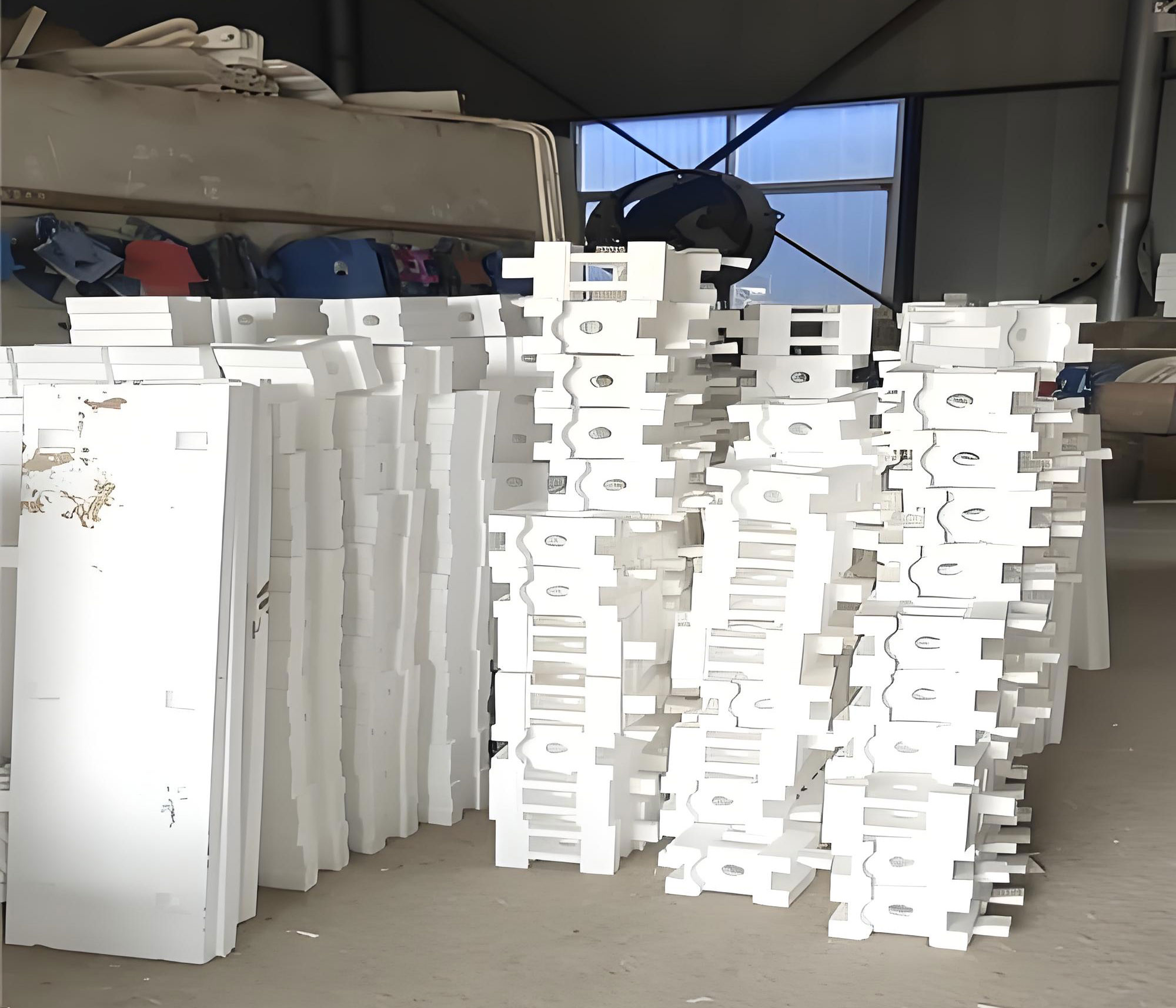
Building on these results, I selected the bottom gating scheme for further optimization through orthogonal experiments. The goal was to determine the optimal combination of pouring temperature and vacuum pressure—two critical parameters in the lost foam casting process that influence foam decomposition, metal fluidity, and defect formation. I designed a two-factor, three-level orthogonal array with factors A (pouring temperature) and B (vacuum pressure), as shown in Table 4. This approach allows for efficient exploration of parameter effects on porosity volume, a key metric for quality in the lost foam casting process.
| Level | Factor A: Pouring Temperature (°C) | Factor B: Vacuum Pressure (MPa) |
|---|---|---|
| 1 | 1360 | 0.02 |
| 2 | 1390 | 0.04 |
| 3 | 1420 | 0.06 |
The orthogonal experiment comprised nine trials, with porosity volume measured from simulations for each combination. The results are summarized in Table 5, revealing variations in defect severity across different parameter sets. To analyze these data, I performed range analysis, calculating the sum of porosity volumes for each factor level (\(K\)) and the range (\(R\)) to assess the influence of pouring temperature and vacuum pressure on the lost foam casting process outcomes.
| Trial | Pouring Temperature (°C) | Vacuum Pressure (MPa) | Porosity Volume (cm³) |
|---|---|---|---|
| 1 | 1360 | 0.02 | 4.728 |
| 2 | 1360 | 0.04 | 3.128 |
| 3 | 1360 | 0.06 | 2.930 |
| 4 | 1390 | 0.02 | 3.492 |
| 5 | 1390 | 0.04 | 3.128 |
| 6 | 1390 | 0.06 | 3.517 |
| 7 | 1420 | 0.02 | 3.321 |
| 8 | 1420 | 0.04 | 3.578 |
| 9 | 1420 | 0.06 | 3.005 |
From the range analysis, I computed the \(K\) and \(R\) values for each factor. For factor A (pouring temperature), \(K_1 = 10.786\), \(K_2 = 10.137\), \(K_3 = 9.904\), and \(R_A = 0.882\). For factor B (vacuum pressure), \(K_1 = 11.541\), \(K_2 = 9.834\), \(K_3 = 9.447\), and \(R_B = 2.094\). The larger range for vacuum pressure (\(R_B > R_A\)) indicates that it has a more significant impact on porosity volume in the lost foam casting process compared to pouring temperature. This aligns with the physics of the lost foam casting process, where vacuum pressure directly affects foam degradation and gas removal, thereby influencing defect formation. The optimal parameters were identified as \(A_3B_3\), corresponding to a pouring temperature of 1420°C and vacuum pressure of 0.06 MPa, which yielded the lowest porosity volume of 3.005 cm³ in Trial 9.
To validate these findings, I conducted a production trial using the optimized bottom gating scheme with the recommended parameters. The casting quality was assessed through microstructure examination and mechanical testing, confirming that the end caps met the required specifications for grey cast iron HT200. The process yield, calculated as the ratio of casting weight to total poured metal weight, was 77.7%, demonstrating the efficiency of the optimized lost foam casting process. This outcome highlights the practical value of integrating numerical simulation and orthogonal experiments in refining the lost foam casting process for industrial applications.
Further analysis of the lost foam casting process reveals that defect mechanisms are closely tied to thermal and fluid dynamics. The foam decomposition during filling can be modeled using the energy equation:
$$ \rho C_p \frac{\partial T}{\partial t} = \nabla \cdot (k \nabla T) + Q_{\text{foam}} $$
where \( \rho \) is density, \( C_p \) is specific heat, \( k \) is thermal conductivity, \( T \) is temperature, and \( Q_{\text{foam}} \) is the heat source from foam pyrolysis. This equation helps predict temperature gradients that influence metal flow and solidification in the lost foam casting process. Additionally, the pressure drop due to foam resistance can be expressed as:
$$ \Delta P = \frac{\mu L v}{A} + \rho g h $$
with \( \mu \) as viscosity, \( L \) as flow length, \( v \) as velocity, \( A \) as cross-sectional area, \( \rho \) as density, \( g \) as gravity, and \( h \) as height. Optimizing these parameters through simulation reduces trial-and-error in the lost foam casting process.
In discussing the broader implications, the lost foam casting process offers advantages over traditional casting methods, such as reduced machining and improved surface finish. However, its success hinges on precise control of process variables. My research demonstrates that bottom gating, combined with elevated pouring temperature and high vacuum pressure, mitigates defects by promoting steady filling and effective feeding. This approach can be extended to other cast iron components, enhancing the versatility of the lost foam casting process in manufacturing.
To further elaborate on the simulation methodology, I employed ProCAST’s lost foam module to account for EPS vaporization and gas flow. The governing equations for fluid flow and heat transfer include the Navier-Stokes equations for incompressible flow:
$$ \nabla \cdot \mathbf{v} = 0 $$
$$ \rho \left( \frac{\partial \mathbf{v}}{\partial t} + \mathbf{v} \cdot \nabla \mathbf{v} \right) = -\nabla p + \mu \nabla^2 \mathbf{v} + \rho \mathbf{g} $$
and the energy equation coupled with phase change for solidification. These equations were solved iteratively to simulate the lost foam casting process, with results visualized to identify potential defect zones. The integration of such numerical tools into the lost foam casting process design reduces development time and material waste, aligning with sustainable manufacturing goals.
In conclusion, my investigation into the lost foam casting process for grey cast iron end caps underscores the critical role of gating design and process parameter optimization. Through numerical simulation and orthogonal experiments, I have shown that bottom gating with a pouring temperature of 1420°C and vacuum pressure of 0.06 MPa minimizes porosity and shrinkage defects, achieving a process yield of 77.7%. These findings provide a robust framework for optimizing the lost foam casting process in similar applications, contributing to improved casting quality and efficiency. Future work could explore advanced materials or real-time monitoring to further enhance the lost foam casting process.