
In modern manufacturing, the demand for high-precision, complex-shaped components, particularly for applications like industrial robotics, has driven the adoption of advanced casting techniques. Among these, lost wax investment casting stands out as a near-net-shape forming technology capable of producing intricate, thin-walled parts with excellent dimensional accuracy and surface finish. The process involves creating a wax pattern, coating it with a ceramic shell, melting out the wax, and pouring molten metal into the cavity. However, achieving defect-free castings, especially with alloys like ZL101A aluminum, remains challenging due to issues such as shrinkage porosity and hot tears. In this study, I explore how numerical simulation with ProCAST software can optimize the lost wax investment casting process for an industrial robot base part, focusing on mitigating defects through parameter adjustments. The integration of simulation reduces trial-and-error, saving time and resources while enhancing quality.
The lost wax investment casting process is renowned for its ability to fabricate components with complex geometries that are difficult to achieve through conventional casting methods. For aluminum alloys like ZL101A, which offer good castability, fluidity, and low hot-cracking tendency, this technique is widely used in aerospace, automotive, and robotics industries. However, the presence of uneven wall thicknesses, as seen in parts with bosses or ribs, often leads to localized solidification issues, resulting in shrinkage defects. These defects compromise mechanical integrity, making parts unsuitable for load-bearing applications. Therefore, optimizing process parameters—such as pouring temperature, mold preheat temperature, and gating design—is critical. Numerical simulation tools like ProCAST enable a virtual analysis of filling and solidification, predicting defect locations and guiding process improvements. This article details my approach to simulating and optimizing the lost wax investment casting of a robot part, employing ProCAST to identify root causes and validate solutions.
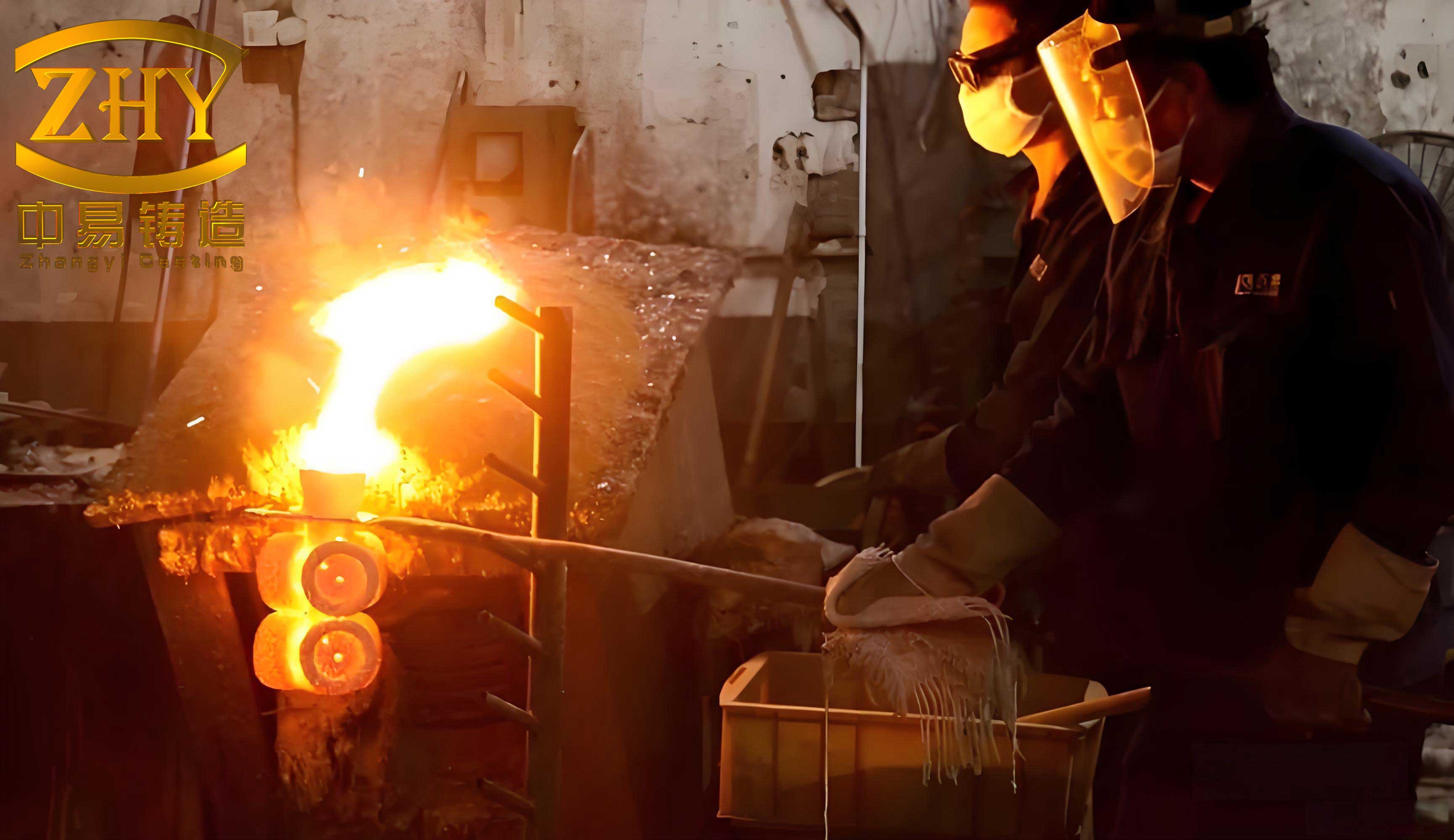
To understand the defect formation in lost wax investment casting, it is essential to model the thermal and fluid dynamics during casting. ProCAST uses finite element analysis to solve governing equations for heat transfer, fluid flow, and solidification. The energy equation for transient heat conduction during solidification can be expressed as:
$$ \rho C_p \frac{\partial T}{\partial t} = \nabla \cdot (k \nabla T) + Q_L $$
where \( \rho \) is density, \( C_p \) is specific heat, \( T \) is temperature, \( t \) is time, \( k \) is thermal conductivity, and \( Q_L \) represents the latent heat release due to phase change. For fluid flow during filling, the Navier-Stokes equations are applied, considering the molten metal as an incompressible Newtonian fluid. The continuity and momentum equations are:
$$ \nabla \cdot \mathbf{u} = 0 $$
$$ \rho \left( \frac{\partial \mathbf{u}}{\partial t} + \mathbf{u} \cdot \nabla \mathbf{u} \right) = -\nabla p + \mu \nabla^2 \mathbf{u} + \rho \mathbf{g} $$
Here, \( \mathbf{u} \) is velocity vector, \( p \) is pressure, \( \mu \) is dynamic viscosity, and \( \mathbf{g} \) is gravitational acceleration. In lost wax investment casting, the ceramic shell properties significantly influence heat extraction, so boundary conditions must account for shell-mold interactions. ProCAST incorporates these physics to simulate solidification fraction, temperature gradients, and potential defect sites like shrinkage porosity.
The industrial robot part under study is a shell structure made of ZL101A aluminum alloy, with overall dimensions of 150 mm × 130 mm × 160 mm. Most sections have a uniform thickness of 5 mm, but a central boss features uneven thickness, ranging from 10 mm to 15 mm, creating a thermal mass disparity. Initial trials using a top-gating system at a pouring temperature of 740°C and mold shell temperature of 300°C resulted in severe shrinkage porosity and holes on the boss surfaces, as shown in preliminary experiments. To analyze this, I developed a 3D model of the part with its gating system (including sprue and runners) and ceramic shell. The mesh was generated with sufficient refinement, especially at thick sections, to capture thermal gradients accurately. Key material properties for ZL101A and the ceramic shell are summarized in Table 1.
| Material | Density (kg/m³) | Thermal Conductivity (W/m·K) | Specific Heat (J/kg·K) | Latent Heat (kJ/kg) | Solidus Temperature (°C) | Liquidus Temperature (°C) |
|---|---|---|---|---|---|---|
| ZL101A Aluminum | 2680 | 120 (liquid), 150 (solid) | 900 | 390 | 555 | 615 |
| Ceramic Shell | 2400 | 1.2 | 1000 | N/A | N/A | N/A |
Simulating the initial lost wax investment casting process revealed critical insights. The filling was completed within 5 seconds, but solidification analysis indicated problematic areas. At 1207 seconds into solidification, an isolated liquid pool formed in the boss region (labeled Area A), surrounded by nearly solidified metal. This occurred due to slower cooling in the thicker boss compared to adjacent thin walls, creating a thermal hotspot. The solidification fraction \( f_s \) in Area A lagged, as described by:
$$ f_s = \frac{T_L – T}{T_L – T_S} $$
where \( T_L \) and \( T_S \) are liquidus and solidus temperatures, respectively. By 1316 seconds, Area A solidified fully, but without adequate feeding, shrinkage defects manifested. ProCAST’s defect prediction module highlighted this region as high-risk for porosity, aligning with experimental observations. The solidification time distribution showed a delay of approximately 50 seconds in the boss relative to surroundings, confirming the uneven cooling. These results underscore how lost wax investment casting of parts with variable thickness can lead to defects if not properly managed.
To optimize the lost wax investment casting process, I proposed modifications targeting improved feeding and uniform solidification. The root causes were identified as: (1) excessive thickness in the boss causing slow solidification and isolated liquid pockets, and (2) thermal radiation from the gating system exacerbating the temperature gradient. The optimization strategy involved two key changes: increasing the mold shell preheat temperature to reduce cooling rate differences, and adjusting pouring temperature to enhance fluidity and feeding. Additionally, side risers were incorporated into the gating design to provide supplemental feeding to the boss. A design of experiments (DOE) was conducted, varying pouring temperature (700°C, 720°C, 740°C) and shell preheat temperature (400°C, 500°C), totaling six simulation runs. The parameters for each run are listed in Table 2.
| Run | Pouring Temperature (°C) | Shell Preheat Temperature (°C) | Gating Design | Simulated Defect Severity (Scale 1-5) |
|---|---|---|---|---|
| 1 | 700 | 400 | Original top-gating | 4 (High porosity in boss) |
| 2 | 700 | 500 | With side risers | 3 (Moderate porosity) |
| 3 | 720 | 400 | With side risers | 1 (Minimal defects) |
| 4 | 720 | 500 | With side risers | 2 (Slight porosity in risers) |
| 5 | 740 | 400 | With side risers | 3 (Porosity in gating) |
| 6 | 740 | 500 | With side risers | 4 (High shrinkage) |
Among these, Run 3 (720°C pouring, 400°C shell preheat) yielded the best results. The simulation showed that the boss area solidified progressively without forming isolated liquid zones, thanks to improved thermal uniformity. The solidification front advanced uniformly, as modeled by the thermal gradient \( G \) and solidification rate \( R \), where a low \( G/R \) ratio minimizes shrinkage. The condition for sound casting can be expressed as:
$$ \frac{G}{\sqrt{R}} \geq K $$
where \( K \) is a material constant. In the optimized lost wax investment casting process, the increased shell temperature reduced \( G \), while the risers enhanced feeding to maintain adequate \( R \). Defect prediction indicated that shrinkage was confined to the gating system, with the boss area being defect-free. This aligns with principles of directional solidification in lost wax investment casting, where controlled cooling ensures continuous feeding from risers to thick sections.
Further analysis involved quantifying the thermal history. The temperature distribution \( T(x,y,z,t) \) was extracted from ProCAST, and the Niyama criterion, often used to predict shrinkage porosity, was evaluated. The Niyama criterion \( NY \) is given by:
$$ NY = \frac{G}{\sqrt{\dot{T}}} $$
where \( \dot{T} \) is the cooling rate. Regions with \( NY \) below a threshold (e.g., 1 °C¹/²·s¹/² for aluminum) are prone to microporosity. In the initial process, the boss area had \( NY \approx 0.5 \), indicating high risk. After optimization, \( NY \) increased to 1.8, signifying reduced porosity likelihood. This demonstrates how lost wax investment casting can be fine-tuned via simulation to meet quality standards.
To validate the simulation findings, experimental trials were conducted using the optimized parameters. The ZL101A alloy was melted in a resistance furnace, refined with C2Cl6 flux at 0.25% of melt weight, and treated with a sodium-based modifier to enhance mechanical properties. The ceramic shells were prepared via standard lost wax investment casting steps: wax pattern assembly, slurry dipping, stuccoing, and dewaxing. Shells were preheated to 400°C in a furnace, and molten metal was poured at 720°C with a pouring time of 6 seconds. Insulating sleeves were added around the sprue to prolong solidification and improve feeding. After cooling, shells were removed, and castings were inspected visually and via X-ray radiography. The results confirmed the absence of shrinkage porosity on the boss surfaces, with only negligible microporosity in the gating areas, which are machined away post-casting. This correlation between simulation and experiment underscores the reliability of ProCAST for optimizing lost wax investment casting processes.
The success of this optimization highlights broader implications for manufacturing complex parts via lost wax investment casting. By integrating numerical simulation, foundries can preemptively address defects, reduce scrap rates, and accelerate product development. For the robot part, the optimized parameters—720°C pouring temperature and 400°C shell preheat—ensured directional solidification toward the risers, eliminating thermal hotspots. The addition of side risers was crucial, as they acted as feeders, compensating for volume shrinkage described by the equation:
$$ \Delta V = V_0 \cdot \beta \cdot (T_{\text{pour}} – T_{\text{solidus}}) $$
where \( \Delta V \) is volume change, \( V_0 \) is initial volume, and \( \beta \) is volumetric shrinkage coefficient. In lost wax investment casting, proper riser design ensures \( \Delta V \) is supplied from non-critical areas. Moreover, the study reinforces that for parts with uneven thickness, higher shell preheat temperatures can balance cooling rates, though excessive heat may cause mold cracking or extended cycle times. Thus, a balanced approach, guided by simulation, is key.
In conclusion, this study demonstrates the effective use of ProCAST numerical simulation to optimize lost wax investment casting for an industrial robot component. The initial defects, stemming from uneven wall thickness in the boss, were mitigated by adjusting pouring temperature to 720°C and shell preheat temperature to 400°C, alongside gating modifications. Simulation predicted defect locations accurately, and experimental validation confirmed defect-free castings. The methodology presented here can be extended to other alloys and geometries in lost wax investment casting, promoting quality and efficiency. Future work could explore advanced feeding mechanisms or multi-objective optimization for further refinement. Ultimately, the fusion of simulation and traditional craftsmanship in lost wax investment casting paves the way for superior manufacturing outcomes in high-tech industries.
To summarize the key parameters and outcomes, Table 3 provides a comprehensive comparison of the lost wax investment casting process before and after optimization.
| Aspect | Initial Process | Optimized Process |
|---|---|---|
| Pouring Temperature | 740°C | 720°C |
| Shell Preheat Temperature | 300°C | 400°C |
| Gating Design | Top-gating only | Top-gating with side risers |
| Solidification Time in Boss | ~1316 s (delayed) | ~1300 s (synchronized) |
| Niyama Criterion in Boss | 0.5 (high porosity risk) | 1.8 (low porosity risk) |
| Predicted Defects | Severe shrinkage in boss | Minimal defects; porosity in gating |
| Experimental Outcome | Visible shrinkage holes | No defects in critical areas |
| Overall Quality | Unacceptable for load-bearing | Acceptable; meets specifications |
This table encapsulates how targeted changes in lost wax investment casting parameters, informed by simulation, can transform product quality. The iterative process of modeling, analysis, and validation exemplifies a modern approach to mastering lost wax investment casting for demanding applications like robotics.