
In the field of fluid control systems, valve bodies serve as critical components for regulating direction, pressure, and flow. Since its introduction in 1947, spheroidal graphite cast iron has revolutionized manufacturing by replacing cast and forged steels in many applications due to its superior properties. The exceptional performance of spheroidal graphite cast iron is intrinsically linked to its graphite morphology, where spherical graphite particles minimize the detrimental cutting effect on the matrix, endowing the material with high mechanical strength, excellent wear resistance, damping capacity, and machinability. This makes spheroidal graphite cast iron ideal for medium-to-low pressure valve castings operating between -30°C and 350°C, with nominal pressures up to 4.0 MPa. In this study, we focus on optimizing the material process for valve body castings conforming to the JS1020 grade under EN1563-2011 standards, specifically addressing the influence of varying wall thicknesses on microstructural uniformity and mechanical properties.
The superior characteristics of spheroidal graphite cast iron stem from its unique microstructure, which consists of graphite spheroids embedded in a metallic matrix, typically ferrite or pearlite. The spheroidization process, achieved through the addition of magnesium and rare earth elements, transforms the flake graphite common in gray iron into nodular forms, significantly enhancing toughness and ductility. The mechanical behavior can be described by relationships involving graphite parameters and matrix composition. For instance, the yield strength \(\sigma_y\) of spheroidal graphite cast iron can be approximated by considering the matrix strength and graphite effect:
$$ \sigma_y = \sigma_m \cdot (1 – f_g) + \sigma_g \cdot f_g $$
where \(\sigma_m\) is the matrix yield strength, \(\sigma_g\) is the contribution from graphite (often negligible due to low strength), and \(f_g\) is the volume fraction of graphite. The graphite nodule count \(N_v\) (number per unit volume) influences ductility, with higher counts promoting better properties:
$$ N_v = \frac{6}{\pi} \cdot \frac{f_g}{d^3} $$
where \(d\) is the average graphite nodule diameter. Optimizing these parameters is crucial for achieving the desired balance in spheroidal graphite cast iron components.
The technical requirements for the DN800 valve body casting, based on JS1020 grade, are stringent to ensure reliability in service. Key specifications include a minimum tensile strength \(R_m\) of 400 MPa, yield strength \(R_{p0.2}\) of 250 MPa, elongation \(A\) of 18.0%, hardness between 120 and 180 HBW, spheroidization rate above 90.0%, and a ferritic matrix. Additionally, the internal structure must be dense, free from shrinkage porosity, gas holes, and capable of passing pressure tests without leakage. The casting’s large dimensions—maximum outer diameter of 1080 mm, length of 1150 mm, and thickness up to 350 mm—with wall thicknesses ranging from 20 to 125 mm, pose challenges for material homogeneity, necessitating a detailed process optimization.
| Property | Specification |
|---|---|
| Tensile Strength, \(R_m\) | ≥ 400 MPa |
| Yield Strength, \(R_{p0.2}\) | ≥ 250 MPa |
| Elongation, \(A\) | ≥ 18.0% |
| Hardness | 120–180 HBW |
| Spheroidization Rate | ≥ 90.0% |
| Matrix Structure | Ferrite (minimal pearlite) |
Initially, the production of spheroidal graphite cast iron valve bodies followed a conventional approach with a chemical composition targeting 3.5–3.7% C, 2.4–2.6% Si, ≤0.60% Mn, ≤0.05% P, ≤0.03% S, 0.01–0.02% residual rare earth (RE), and 0.04–0.06% residual Mg. Raw materials included 50% scrap steel (Q235A), 10% pig iron (Q10-2), 40% returns, with 1.2–1.4% each of inoculant (SiCaBa) and spheroidizer (QRMg5RE1). Melting parameters involved a tapping temperature of 1530–1550°C, spheroidization at 1500–1515°C, pouring at 1360–1380°C, and a maximum time of 8 minutes from treatment to pouring completion. However, production results from five heats revealed shortcomings: while mechanical properties met minimum requirements, elongation and spheroidization rates were at the lower limits, with pearlite content in the matrix reaching approximately 15%, as shown in microstructural analysis. This indicated suboptimal graphitization and excessive pearlite formation, likely due to higher Mn and S levels, which stabilize pearlite and consume spheroidizing elements.
| Element/Property | Range or Value |
|---|---|
| C (%) | 3.57–3.68 |
| Si (%) | 2.41–2.56 |
| Mn (%) | 0.47–0.56 |
| P (%) | 0.017–0.020 |
| S (%) | 0.017–0.023 |
| RE (%) | 0.011–0.014 |
| Mg (%) | 0.033–0.047 |
| \(R_m\) (MPa) | 470–490 |
| \(R_{p0.2}\) (MPa) | 303–328 |
| \(A\) (%) | 18.0–19.5 |
| Hardness (HBW) | 170–174 |
| Spheroidization Rate (%) | 90.28–91.01 |
| Pearlite Content (%) | 10–15 |
The presence of pearlite, a harder phase, contributed to higher tensile strength but reduced ductility. The graphite nodule size was assessed at level 5 (according to standards), indicating fewer and larger nodules, which can detrimentally affect toughness. To quantify the impact, the ductility reduction can be related to pearlite volume fraction \(f_p\) through an empirical relation:
$$ A \approx A_0 – k \cdot f_p $$
where \(A_0\) is the elongation for fully ferritic spheroidal graphite cast iron and \(k\) is a constant. For spheroidal graphite cast iron, minimizing pearlite is essential for high toughness applications.
To address these issues, we optimized the process based on metallurgical principles. Carbon and silicon are key graphitizers; increasing their content promotes ferrite formation and improves spheroidization efficiency. Manganese, a pearlite stabilizer, should be minimized, while sulfur, a strong anti-spheroidizing element, must be reduced to lower Mg and RE consumption. The optimized chemical composition ranges were set as shown in Table 3, alongside adjustments in raw material grades to achieve lower Mn and S inputs. Specifically, scrap steel was changed to Q235B (S ≤ 0.045%), pig iron to Q10-1 (Mn ≤ 0.20%), and spheroidizer to QRMg7RE1 (higher Mg content) to enhance nodularization. Charge composition was modified to 50% scrap steel, 20% pig iron, and 30% returns, with spheroidizer addition reduced to 1.0–1.2% and inoculant maintained at 1.2–1.4%, plus 0.1% instant inoculant added during pouring to refine microstructure.
| Element | Target Range (wt%) | Rationale |
|---|---|---|
| C | 3.6–3.8 | Enhances graphitization, increases ferrite, improves Mg absorption |
| Si | 2.6–2.8 | Promotes graphite formation, optimizes strength and ductility |
| Mn | ≤ 0.40 | Reduces pearlite stabilization for better toughness |
| P | ≤ 0.05 | Minimizes embrittlement |
| S | ≤ 0.03 | Lowers anti-spheroidizing effect, reduces slag inclusions |
| RE | 0.01–0.02 | Aids nodularization without excessive fading |
| Mg | 0.04–0.06 | Ensures effective graphite spheroidization |
The melting parameters remained largely unchanged, but the addition of instant inoculant aimed to increase eutectic cell count, refine the matrix, and foster spherical graphite formation. The effectiveness of spheroidal graphite cast iron production often hinges on controlling cooling rates and inoculation; the instant inoculant provides nucleation sites, which can be modeled by the increase in nodule count \(\Delta N_v\):
$$ \Delta N_v = C_i \cdot I $$
where \(C_i\) is a constant and \(I\) is the inoculant addition rate. This refinement directly improves mechanical properties, particularly elongation.
After implementing the optimized scheme, five heats of valve body castings were produced, with Y-block samples poured from the same iron for testing. Chemical analysis confirmed the desired shifts: higher C and Si, lower Mn and S, as summarized in Table 4. Mechanical and metallographic results demonstrated significant improvements: tensile strength decreased to a more optimal range, yield strength remained adequate, elongation increased substantially, hardness stabilized within the mid-range, spheroidization rates rose above 92%, and pearlite content dropped to around 5%. These outcomes validate the optimization strategy for enhancing the toughness of spheroidal graphite cast iron.
| Element/Property | Range or Value |
|---|---|
| C (%) | 3.65–3.75 |
| Si (%) | 2.68–2.76 |
| Mn (%) | 0.32–0.38 |
| P (%) | 0.012–0.018 |
| S (%) | 0.008–0.010 |
| RE (%) | 0.010–0.012 |
| Mg (%) | 0.051–0.058 |
| \(R_m\) (MPa) | 429–445 |
| \(R_{p0.2}\) (MPa) | 285–297 |
| \(A\) (%) | 22.5–25.0 |
| Hardness (HBW) | 151–157 |
| Spheroidization Rate (%) | 92.01–94.28 |
| Pearlite Content (%) | ≈5 |
The improvement in elongation can be attributed to the combined effects of reduced pearlite, better spheroidization, and refined graphite structure. Using a linear model, the elongation increase \(\Delta A\) correlates with changes in pearlite content \(\Delta f_p\) and spheroidization rate \(\Delta S_r\):
$$ \Delta A = \alpha \cdot (-\Delta f_p) + \beta \cdot \Delta S_r $$
where \(\alpha\) and \(\beta\) are positive constants. For spheroidal graphite cast iron, achieving over 90% spheroidization with minimal pearlite is key to meeting high ductility demands.
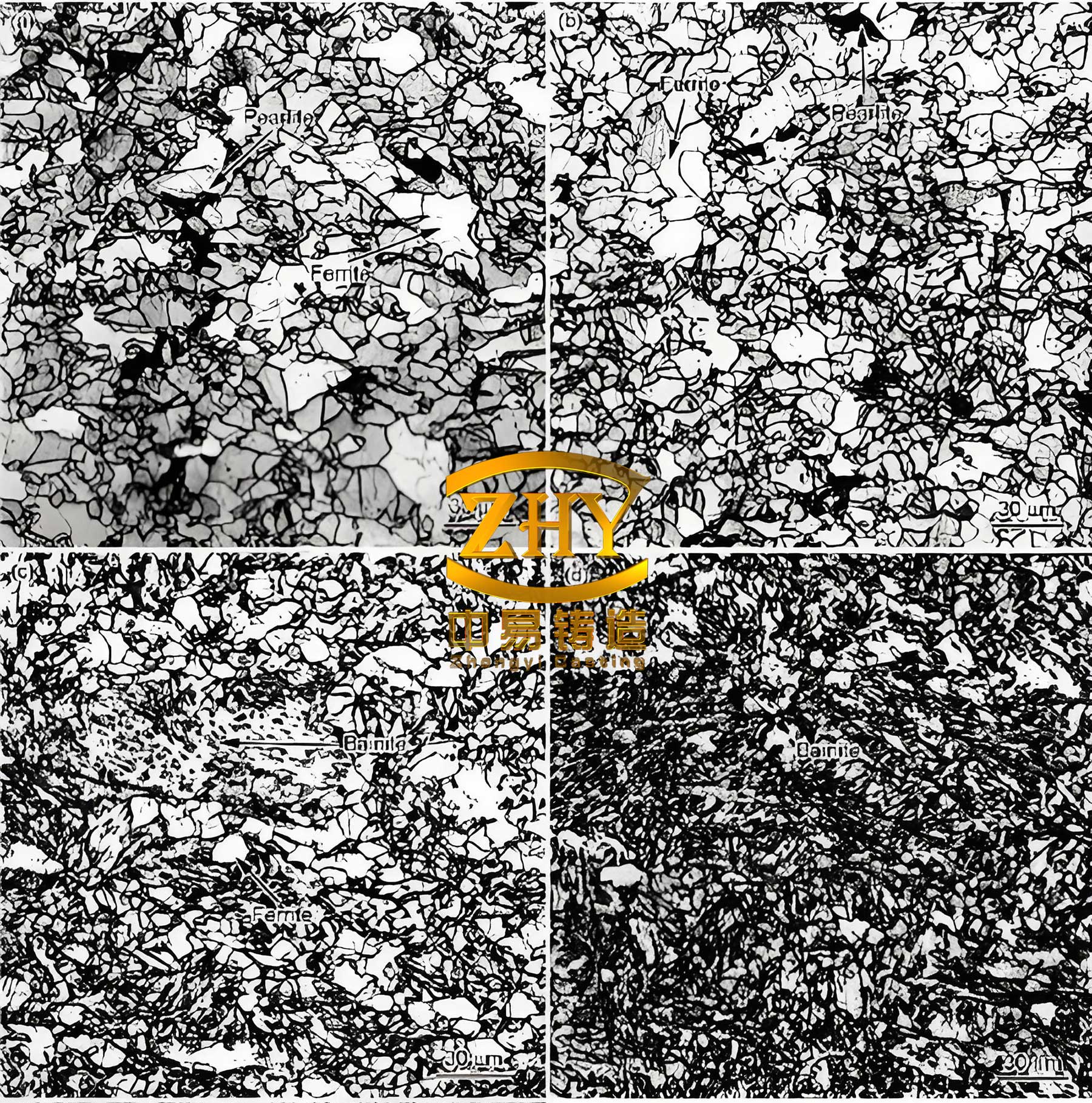
To assess material uniformity across varying wall thicknesses—a critical aspect for large castings like the DN800 valve body—we employed step-block testing, a method endorsed by classification societies such as DNV GL for validating spheroidal graphite cast iron properties. Step-blocks with thicknesses of 15, 30, 50, 75, 100, and 125 mm were poured from the same heat (QT18-044) after casting the valve body and Y-blocks. Samples were extracted from the thermal center of each step for hardness and metallographic examination. Results, presented in Table 5, show minimal variation: hardness ranged from 151 to 155 HBW, spheroidization rates from 91.03% to 93.53%, and pearlite content consistently around 5%. This indicates excellent homogeneity, with wall thickness having negligible impact on spheroidization and matrix structure in this spheroidal graphite cast iron grade.
| Step Thickness (mm) | Hardness (HBW) | Spheroidization Rate (%) | Matrix Structure (Pearlite + Ferrite) |
|---|---|---|---|
| 15 | 151 | 91.03 | ≈5% P + F |
| 30 | 153 | 92.64 | ≈5% P + F |
| 50 | 154 | 92.20 | ≈5% P + F |
| 75 | 153 | 92.82 | ≈5% P + F |
| 100 | 153 | 93.53 | ≈5% P + F |
| 125 | 155 | 93.51 | ≈5% P + F |
The uniformity in properties across different sections can be explained by the optimized cooling conditions and inoculation. For spheroidal graphite cast iron, the cooling rate \( \dot{T} \) influences graphite nodule size and matrix formation, but with proper inoculation, the effect diminishes. The relationship between hardness \(H\) and cooling rate can be expressed as:
$$ H = H_0 + m \cdot \log(\dot{T}) $$
where \(H_0\) and \(m\) are material constants. The consistent hardness values suggest that the process controls mitigated cooling rate variations, ensuring uniform spheroidal graphite cast iron characteristics.
Further analysis involves statistical evaluation of the data. For the optimized heats, we computed mean and standard deviation for key properties to underscore consistency. As shown in Table 6, the low standard deviations confirm the reproducibility of the optimized process for spheroidal graphite cast iron production.
| Property | Mean | Standard Deviation |
|---|---|---|
| \(R_m\) (MPa) | 436.2 | 6.3 |
| \(R_{p0.2}\) (MPa) | 292.2 | 5.1 |
| \(A\) (%) | 23.7 | 1.1 |
| Hardness (HBW) | 154.2 | 2.3 |
| Spheroidization Rate (%) | 93.18 | 0.9 |
The success of this optimization hinges on a deep understanding of spheroidal graphite cast iron metallurgy. Carbon equivalent (CE) plays a vital role in defining castability and microstructure. For spheroidal graphite cast iron, CE is calculated as:
$$ \text{CE} = \%\text{C} + \frac{\%\text{Si} + \%\text{P}}{3} $$
In our optimized composition, CE ranges from 4.4 to 4.6, which is suitable for ferritic grades, reducing chilling tendency and promoting graphite formation. Additionally, the ratio of Mg to S is critical for effective spheroidization; a higher Mg/S ratio ensures sufficient residual Mg for graphite nodularization. The optimized process achieved a Mg/S ratio above 5, compared to below 3 in the original scheme, explaining the improved spheroidization rates.
In conclusion, the optimization of high toughness spheroidal graphite cast iron for valve body castings involved precise chemical adjustments, raw material upgrades, and process refinements. Key findings include: (1) Controlling C at 3.6–3.8%, Si at 2.6–2.8%, Mn below 0.40%, and S below 0.015% effectively reduces pearlite and enhances spheroidization in spheroidal graphite cast iron. (2) Using QRMg7RE1 spheroidizer at 1.0–1.2% with 0.1% instant inoculant promotes superior nodularization and microstructure refinement. (3) Material uniformity across varying wall thicknesses is excellent, with hardness and spheroidization showing minimal variation, underscoring the robustness of spheroidal graphite cast iron for complex castings. This study demonstrates that through systematic optimization, spheroidal graphite cast iron can achieve high toughness and consistency, meeting stringent industrial standards for critical components. Future work could explore dynamic loading behavior or further enhancements in low-temperature applications of spheroidal graphite cast iron.