
In the field of modern manufacturing, aluminum alloy shell castings are widely used due to their lightweight nature, high strength, and excellent formability. These shell castings are critical components in industries such as automotive, aerospace, and electronics, where structural integrity and precision are paramount. As a manufacturing engineer specializing in casting processes, I have extensively worked on optimizing permanent mold casting for aluminum alloy shell castings to enhance quality and efficiency. Permanent mold casting, also known as gravity die casting, offers advantages like high production rates, dimensional accuracy, and fine surface finish, making it ideal for medium to high-volume production of shell castings. However, the high cost of mold fabrication necessitates meticulous process design to avoid defects and reduce trial-and-error cycles. In this article, I will share my insights and methodologies for optimizing the permanent mold casting process for aluminum alloy shell castings, leveraging simulation tools, theoretical analyses, and practical validations to achieve superior results.
The journey begins with a thorough analysis of the structural characteristics of aluminum alloy shell castings. Shell castings often feature complex geometries with varying wall thicknesses, deep internal channels, and interconnected sections that pose challenges for solidification and feeding. For instance, in a typical shell casting used for pressure applications, the wall thickness distribution can lead to hot spots at junctions, which are prone to shrinkage porosity and voids if not properly addressed. I use computational tools to map the wall thickness and identify potential thermal nodes. Below is a table summarizing the wall thickness analysis for a representative aluminum alloy shell casting:
| Section of Shell Casting | Wall Thickness (mm) | Thermal Node Risk |
|---|---|---|
| Main Body | 5-8 | Low |
| Deep Channel Junctions | 12-15 | High |
| Flange Areas | 6-10 | Medium |
| Internal Ribs | 3-5 | Low |
From this analysis, I deduce that the junctions of deep channels are critical hot spots requiring targeted feeding. The solidification behavior in these regions can be modeled using thermal dynamics principles. The rate of heat transfer in a permanent mold for shell castings is governed by Fourier’s law, and the solidification time \( t_s \) can be estimated using Chvorinov’s rule:
$$ t_s = C \left( \frac{V}{A} \right)^n $$
where \( V \) is the volume of the casting section, \( A \) is the surface area, \( C \) is a mold constant, and \( n \) is an exponent typically around 2. For shell castings, a higher modulus \( \frac{V}{A} \) indicates slower solidification, necessitating risers or chills. By calculating the modulus for different sections, I prioritize feeding design to ensure directional solidification toward the risers.
Based on the structural analysis, I design multiple gating and risering schemes for the aluminum alloy shell castings. The initial scheme involves a conventional top-gating system with multiple ingates and side risers, aimed at feeding the hot spots. However, simulation using AnyCasting software reveals shortcomings in this approach. The temperature field distribution shows that the side risers, located at the flow end, provide insufficient thermal gradient for effective feeding, leading to shrinkage defects in the shell castings. To quantify this, I employ the residual melt modulus method, which predicts defect probability based on the remaining liquid metal during solidification. The defect probability \( P_d \) is expressed as:
$$ P_d = 1 – \exp\left(-\frac{M_r}{M_c}\right) $$
where \( M_r \) is the residual melt modulus and \( M_c \) is a critical modulus threshold. For the initial scheme, \( P_d \) exceeds 0.8 at the hot spots, indicating high risk. This prompts a redesign toward a tilt-pouring system with top risers, which enhances thermal gradients and reduces turbulence. The following table compares the key parameters of three different gating schemes for shell castings:
| Scheme | Gating Type | Riser Placement | Predicted Defect Probability | Yield Rate (%) |
|---|---|---|---|---|
| Scheme 1 | Top Gating | Side Risers | High (0.85) | 45.2 |
| Scheme 2 | Tilt Pouring | Top Risers with Direct Sprue | Low (0.15) | 49.3 |
| Scheme 3 | Tilt Pouring | Top Risers without Direct Sprue | Very Low (0.05) | 60.3 |
Scheme 3 emerges as the optimal choice, as it not only minimizes defects but also improves yield by eliminating unnecessary sprue sections. The tilt-pouring process for shell castings involves rotating the mold during filling to achieve laminar flow, which reduces air entrapment and oxide formation. The fluid dynamics during tilt pouring can be described by the Navier-Stokes equations, simplified for incompressible flow:
$$ \rho \left( \frac{\partial \mathbf{v}}{\partial t} + \mathbf{v} \cdot \nabla \mathbf{v} \right) = -\nabla p + \mu \nabla^2 \mathbf{v} + \mathbf{f} $$
where \( \rho \) is density, \( \mathbf{v} \) is velocity, \( p \) is pressure, \( \mu \) is viscosity, and \( \mathbf{f} \) is body force. For shell castings, this results in a fill time \( t_f \) approximated by:
$$ t_f = \frac{V_c}{A_g \cdot v_g} $$
with \( V_c \) as casting volume, \( A_g \) as ingate area, and \( v_g \) as gate velocity. In my simulations, I set \( v_g \leq 0.5 \, \text{m/s} \) to maintain laminar conditions for shell castings, ensuring defect-free surfaces.
The optimization process heavily relies on simulation outputs, such as solidification temperature fields and defect probability distributions. For shell castings, I analyze the temperature gradient \( \nabla T \) across the casting, which drives feeding flow. A higher gradient toward risers promotes directional solidification. The thermal field is solved using the heat conduction equation:
$$ \frac{\partial T}{\partial t} = \alpha \nabla^2 T $$
where \( \alpha \) is thermal diffusivity. In the optimized scheme for shell castings, the gradient exceeds \( 10 \, \text{K/cm} \) in critical regions, ensuring soundness. Additionally, I use the Niyama criterion to predict shrinkage porosity, where a value below a threshold indicates risk. The Niyama criterion \( Ny \) is given by:
$$ Ny = \frac{G}{\sqrt{\dot{T}}} $$
with \( G \) as temperature gradient and \( \dot{T} \) as cooling rate. For aluminum alloy shell castings, I aim for \( Ny > 1 \, \text{K}^{1/2} \cdot \text{s}^{1/2} \cdot \text{cm}^{-1} \) to avoid microporosity. Simulation results confirm that Scheme 3 meets this criterion throughout the shell castings, validating its efficacy.
Another critical aspect for shell castings is venting design in permanent molds, as non-vented molds can cause gas defects. Based on simulation of air pressure distribution during filling, I identify high-pressure zones requiring vents. The air pressure \( P_a \) in the mold cavity correlates with fill velocity and can be estimated using Bernoulli’s principle modified for porous media:
$$ P_a = P_0 – \frac{1}{2} \rho v^2 – \Delta P_v $$
where \( P_0 \) is atmospheric pressure and \( \Delta P_v \) is pressure drop across vents. For shell castings, I place vent plugs at locations where \( P_a > 1.2 \, \text{atm} \), as shown in the simulation. This, combined with strategic use of core inserts and machining slots, enhances排气 for flawless shell castings.
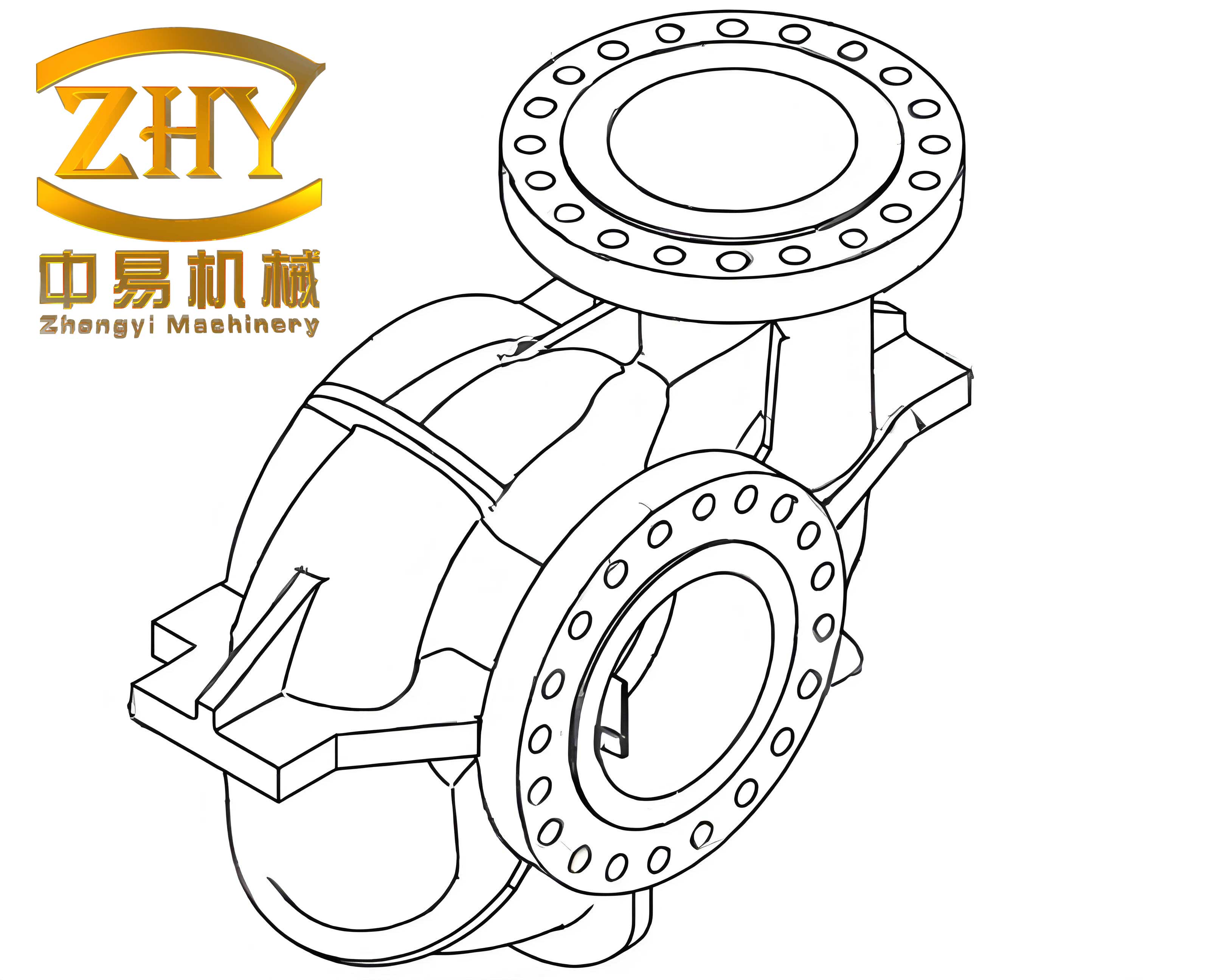
The mold design for aluminum alloy shell castings incorporates the optimized gating and venting systems. I use H13 steel for the permanent mold to withstand thermal cycling, with water-cooling channels to control solidification rates. The cores for deep channels are made of copper alloys for rapid chilling, and coatings like graphite are applied to lubricate and insulate as needed. For instance, risers are coated with insulating wash to retain heat, while cores use graphite for easy ejection. The mold assembly includes hydraulic cylinders for long-stroke core pulling and manual or automated systems for side cores, depending on production volume. During trials, I monitor parameters like pour temperature (700-720°C for A356 alloy) and tilt speed (2-5°/s) to ensure consistency. The table below summarizes key mold design parameters for shell castings:
| Mold Component | Material | Coating Type | Function |
|---|---|---|---|
| Main Mold | H13 Steel | Ceramic Wash | Heat Resistance |
| Cores | Copper Alloy | Graphite | Rapid Chilling |
| Risers | H13 Steel | Insulating Wash | Feeding Enhancement |
| Vents | Porous Steel | None | Gas Escape |
Production validation confirms the success of the optimized process for shell castings. The castings are subjected to T6 heat treatment (solutionizing at 540°C, quenching, and aging at 160°C) to improve mechanical properties. Non-destructive testing and sectioning reveal no shrinkage or gas defects in the shell castings, with pressure tests exceeding 1.03 MPa requirements. The yield rate improves to over 60%, reducing material waste. Furthermore, the development cycle shortens from weeks to days, demonstrating the power of simulation-driven optimization for shell castings.
To generalize the findings, I derive a set of best practices for permanent mold casting of aluminum alloy shell castings. First, always conduct a detailed wall-thickness analysis to identify hot spots. Second, use tilt pouring for complex shell castings to ensure laminar flow and better feeding. Third, simulate multiple schemes with criteria like defect probability and yield rate. Fourth, incorporate vents based on air pressure simulations to avoid gas defects. Lastly, tailor mold coatings and cooling to control solidification. These principles can be applied to various shell castings, from automotive housings to electronic enclosures. For quantitative decision-making, I often use multi-objective optimization functions, such as minimizing defect risk while maximizing yield, expressed as:
$$ \text{Objective} = w_1 \cdot P_d + w_2 \cdot \frac{1}{Y} $$
where \( w_1 \) and \( w_2 \) are weights, and \( Y \) is yield rate. For shell castings, I set \( w_1 = 0.7 \) and \( w_2 = 0.3 \) to prioritize quality.
In conclusion, the optimization of permanent mold casting for aluminum alloy shell castings is a multifaceted process that blends simulation, theoretical analysis, and practical expertise. Through this approach, I have achieved high-integrity shell castings with reduced lead times and costs. The key lies in understanding the unique challenges of shell castings, such as thermal management and feeding, and leveraging tools like CFD and thermal simulations to iterate designs efficiently. As industries demand lighter and stronger components, such methodologies will become increasingly vital for producing reliable shell castings. I encourage fellow engineers to adopt similar strategies, continually refining processes to push the boundaries of what’s possible with aluminum alloy shell castings.