
As a practitioner deeply involved in the foundry industry, I have dedicated significant effort to the research and optimization of manufacturing processes for critical railway components. The development of the K6 swing bolster represents a quintessential challenge in the realm of heavy-section steel castings. This component is integral to the suspension system of freight cars, demanding exceptional structural integrity, dimensional accuracy, and fatigue resistance. The initial trial production phases were fraught with persistent defects, primarily surface sand inclusions and misruns, particularly in complex sections like the side bearing boxes. These issues not only compromised quality but also led to substantial rework costs and production delays. This document details a comprehensive, first-person account of the analytical approach and innovative solutions implemented to overcome these challenges, significantly enhancing the manufacturability and reliability of these essential steel castings.
The K6 bolster is a large, complex steel casting characterized by its arc-box structure. Its intricate geometry, featuring uneven wall thickness, internal ribbing, and several assembly-critical surfaces (e.g., spring seats, wedge mounting faces, side bearing boxes), presents a formidable casting challenge. Key dimensions and characteristics are summarized below:
| Parameter | Specification |
|---|---|
| Overall Dimensions (approx.) | 2492 mm (L) × 440 mm (W) × 350 mm (H) |
| Weight (As-cast) | 640 kg |
| Primary Material | B+ Grade Steel (ZG25MnCrNi) |
| Key Challenge Areas | Side bearing boxes, thick-thin transitions, internal cores. |
The successful production of such steel castings hinges on meeting stringent technical specifications. The material, ZG25MnCrNi, must conform to precise chemical and mechanical property ranges as dictated by railway standards.
| Element | Requirement (wB / %) |
|---|---|
| C | ≤ 0.29 |
| Si | ≤ 0.50 |
| Mn | ≤ 1.00 |
| P | ≤ 0.030 |
| S | ≤ 0.020 |
| Cr | ≤ 0.50 |
| Ni | ≥ 0.20 |
| Cu | ≤ 0.30 |
| Property | Minimum Requirement |
|---|---|
| Tensile Strength (Rm) | 550 MPa |
| Yield Strength (ReL or Rp0.2) | 345 MPa |
| Elongation (A) | 24% |
| Reduction of Area (Z) | 36% |
| Impact Energy (KV2 at -7°C) | 20 J |
The production environment utilizes an ester-hardened sodium silicate sand system, known for its environmental benefits, on an automated molding line. Melting and pouring are conducted using a 25-ton bottom-pour ladle furnace (LF). The original process employed a conventional sand-molded gating system with a central down-sprue. This setup proved inadequate, leading to the aforementioned defects. The root cause analysis pinpointed several key issues:
- Turbulence and Erosion: The high static pressure head from the large ladle caused high-velocity metal flow, leading to turbulence in the sand-formed runners. This turbulence resulted in air entrainment and erosion of the sand mold, causing sand inclusions in the final steel castings.
- Slow Filling & Venting Issues: The original gating cross-sectional area was insufficient, leading to prolonged mold filling times. Concurrently, gases generated from the sand molds and cores, especially in the elevated side bearing boxes, could not escape efficiently. This combination led to back-pressure, preventing complete filling and causing misruns.
- Operational Inconsistencies: Reliance on manually drilled vent holes in the side bearing boxes was prone to human error (omission) and allowed loose sand to fall into the cavity during handling.
The filling time ($t_f$) in a gating system can be approximated by:
$$ t_f \approx \frac{V_c}{A_g \cdot v_g} $$
where $V_c$ is the cavity volume, $A_g$ is the effective choke area, and $v_g$ is the flow velocity. A small $A_g$ leads to large $t_f$, exacerbating thermal loss and gas evolution problems.
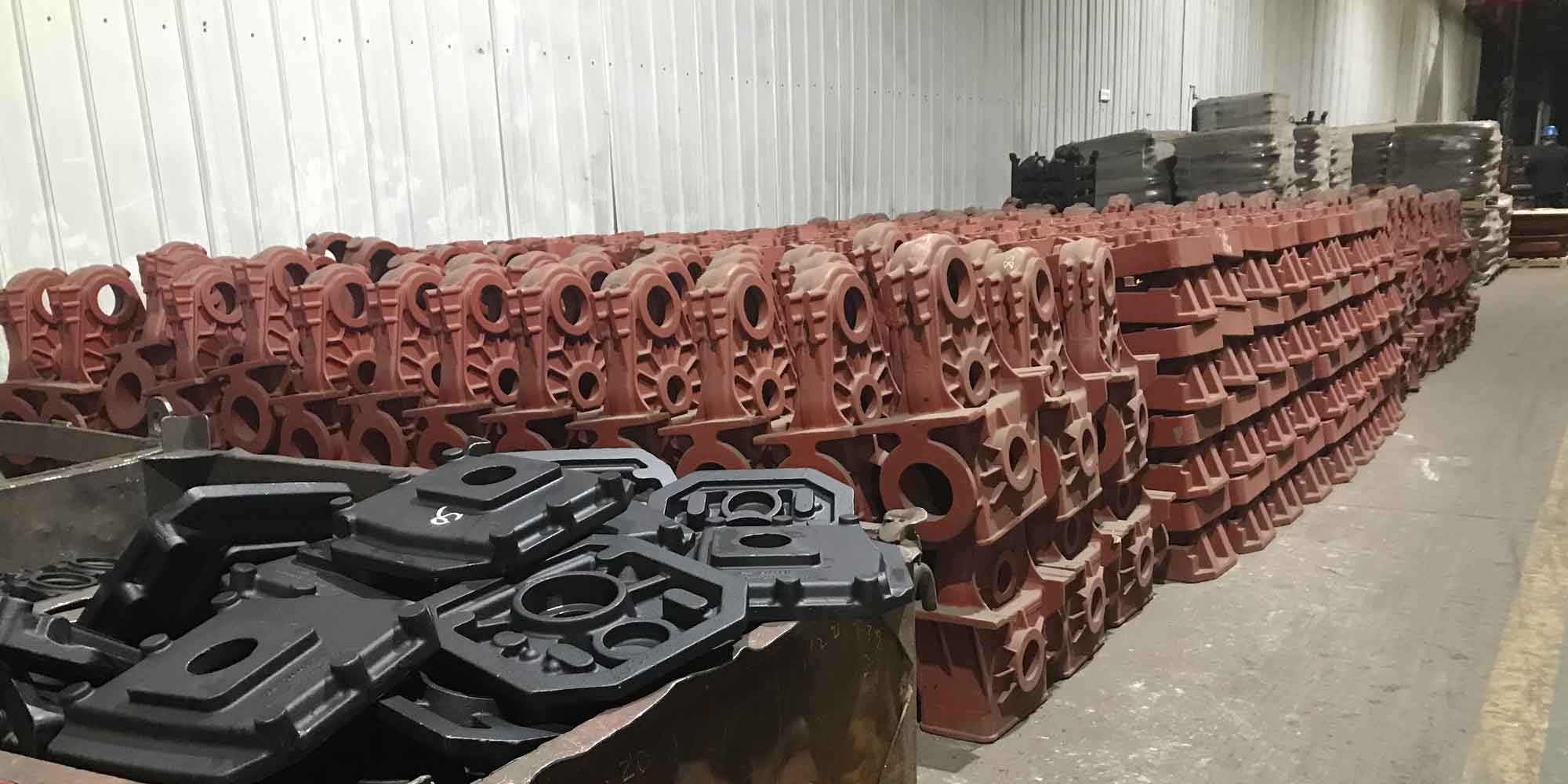
The core of our process innovation involved a holistic redesign of the filling and venting systems for these large steel castings.
1. Integrated, Pre-fabricated Three-Way Gating System
We replaced the entirely sand-molded gating with a system constructed from refractory brick components. This system features a spliced three-way runner design positioned at the end of the casting, effectively creating a bottom-gating scheme. Pre-formed refractory tubes were embedded within the core assembly to connect the runner to the ingates at the bolster’s ends.
| Design Feature | Advantage |
|---|---|
| Refractory Material | Eliminates sand erosion, providing a smooth, consistent flow channel. |
| Spliced Three-Way Runner | Reduces runner length, minimizes flow resistance and turbulence. |
| Bottom Gating via Pre-set Tubes | Promotes laminar, upward filling of the cavity, reducing splashing and oxide formation. |
| Increased Cross-sectional Area | Significantly reduces fill time ($t_f$), allowing metal to reach distant sections before losing too much heat. |
The improved flow dynamics can be partially described by modifying the Bernoulli equation for a real fluid, where the pressure loss due to turbulence ($P_{turb}$) is greatly reduced:
$$ P_1 + \frac{1}{2}\rho v_1^2 + \rho g h_1 = P_2 + \frac{1}{2}\rho v_2^2 + \rho g h_2 + \Delta P_{friction} + \Delta P_{turb} $$
In the new design, $\Delta P_{turb} \rightarrow min$, leading to a more stable and controllable pour.
2. Dedicated Exhaust Bracket for Side Bearing Boxes
To solve the chronic venting issue, we designed a dedicated sand tool—an exhaust bracket. This tool is positioned on the pattern over the side bearing box locations. During molding, sand is compacted around it. After compaction, the bracket is simply withdrawn, leaving behind perfectly formed, clean vent channels that connect the mold cavity directly to the atmosphere.
The volumetric flow rate of evolved gas ($Q_{gas}$) must be matched by the venting capacity to prevent pressure buildup ($\Delta P_{gas}$):
$$ Q_{gas} = k \cdot A_{core} \cdot e^{-E/(RT)} $$
$$ \Delta P_{gas} \propto \frac{Q_{gas}}{n \cdot A_{vent} \cdot C_d} $$
where $A_{vent}$ is the vent area, $n$ is the number of vents, and $C_d$ is the discharge coefficient. The exhaust bracket provides optimal, consistent $A_{vent}$ and $C_d \approx 1$, ensuring $\Delta P_{gas}$ remains negligible.
| Aspect | Original Method | Exhaust Bracket Method |
|---|---|---|
| Vent Creation | Manual drilling post-molding. | Automatic formation during molding. |
| Consistency & Reliability | Prone to omission and variation. | Guaranteed, identical vents every time. |
| Sand Contamination Risk | High (loose sand from drilling). | Very Low (clean withdrawal). |
| Labor Intensity | High (24 holes per mold). | Minimal (simple tool extraction). |
3. High-Temperature Ceramic Venting Plates
Traditional sand risers on non-feeding sections like the wedge mounts were replaced with porous ceramic venting plates. These plates allow gases to escape while preventing sand grains from falling back into the cavity. They also eliminate the metal waste and potential cutting damage associated with removing small risers from the finished steel castings.
4. Optimized Tooling and Box Design
The entire tooling package, including patterns and flasks, was redesigned to accommodate the new systems. The upper flask was redesigned to clear the new exhaust bracket and gating system locations, allowing for a reduction in its height. This directly reduces the volume of sand used per mold, which in turn reduces the total gas generated during pouring—a critical factor for the quality of large steel castings. The gas generation mass ($m_{gas}$) is proportional to sand mass ($m_{sand}$):
$$ m_{gas} = \alpha \cdot m_{sand} $$
where $\alpha$ is a gas yield coefficient. Reducing $m_{sand}$ linearly reduces $m_{gas}$, easing the demand on the venting system.
The optimized process was put through rigorous validation. Initial trial batches showed immediate and dramatic improvements. Visual inspection confirmed complete filling, especially of the side bearing boxes, and a notable absence of surface sand inclusions. A systematic sampling and destructive testing plan was executed according to the relevant standards.
Internal soundness was verified by sectioning sample castings at prescribed locations. Macroscopic examination revealed no shrinkage porosity, cavities, or major inclusions, confirming the thermal and feeding dynamics were now well-controlled. The table below summarizes the validation results from a significant production run:
| Validation Metric | Method/Standard | Result |
|---|---|---|
| Ultrasonic Testing (Side Bearings) | CTS-9006Plus Ultrasonic Flaw Detector | 0 misruns detected in 120 castings. |
| Dimensional Accuracy (Critical Walls) | DC-2030B Ultrasonic Thickness Gauge | All measured thicknesses within drawing tolerance. |
| Mechanical Properties | Tensile, Impact, Fatigue Testing per TB/T 3012 | All sampled castings met or exceeded B+ grade requirements. |
| Defect Rate (Surface) | Visual & Dye Penetrant Inspection | Reduction in sand inclusion defects >95%. |
The process has demonstrated robust repeatability and has been fully integrated into standard operating procedures for the production of K6 bolster steel castings.
The journey to perfect the casting process for the K6 swing bolster underscores the importance of systematic problem-solving in heavy steel foundry practice. The key conclusions are:
- The adoption of an integrated refractory three-way gating system fundamentally transformed the fluid dynamics of the pour. By ensuring laminar, rapid filling, it virtually eliminated turbulence-related defects such as sand wash and air entrainment, directly enhancing the surface and internal quality of these critical steel castings.
- The introduction of dedicated tooling-based venting solutions—the exhaust bracket and ceramic plates—provided a reliable, repeatable method for gas evacuation. This directly addressed the root cause of misruns in isolated sections and removed a significant source of operational variation and potential defect introduction.
- The holistic approach, encompassing gating, venting, and tooling redesign, created a synergistic effect. Faster filling reduced heat loss, while better venting reduced back-pressure, and less sand reduced total gas load. This integrated solution proved far more effective than addressing any single factor in isolation.
- This development project successfully established a reliable and efficient production pathway for high-integrity railway steel castings. The methodologies developed, particularly regarding controlled filling and guaranteed venting, provide a valuable framework for the development and optimization of other complex, heavy-section cast steel components across the industry.
The successful resolution of these challenges highlights that even in mature casting processes, significant gains in quality, yield, and cost-effectiveness are achievable through targeted engineering innovation and a deep understanding of the underlying physical principles governing the production of large steel castings.