
In the field of metal casting, resin sand casting has emerged as a prominent method due to its ability to produce complex shapes with high dimensional accuracy and surface finish. As a researcher focused on advancing foundry techniques, I embarked on a project to design and optimize the resin sand casting process for a specific aluminum alloy casting. This article details my comprehensive approach, combining traditional casting design principles with advanced numerical simulation to address defects such as shrinkage porosity and cavities. The goal was to enhance the quality of the casting by refining the gating system, riser design, and overall process parameters, ensuring that the final product meets stringent industrial standards. Throughout this work, the term “resin sand casting” is central, as it refers to the use of furan resin-bonded sand molds, which offer excellent high-temperature strength and low thermal deformation, making them ideal for aluminum alloys like ZL201A.
The casting under study is a medium-sized aluminum alloy component with intricate geometries, including varying wall thicknesses and reinforcing ribs. Its maximum dimensions are 1300 mm in length, with an average wall thickness of 34 mm and a volume of approximately 9.763 × 10³ cm³, weighing around 27.532 kg. Such components are critical in aerospace and automotive applications, where defects like shrinkage cavities, porosity, and inclusions can compromise structural integrity. Therefore, optimizing the resin sand casting process is essential to minimize these issues. The material selected was ZL201A, an aluminum-copper-manganese alloy known for its good mechanical properties and castability. Its chemical composition, as per standard specifications, is summarized in Table 1.
| Element | Cu | Mn | Ti | Fe | Si | Mg | Ni | Zn | Impurities | Al |
|---|---|---|---|---|---|---|---|---|---|---|
| Content | 4.5-5.3 | 0.6-1.0 | 0.15-0.35 | ≤0.15 | ≤0.1 | ≤0.05 | ≤0.05 | ≤0.1 | ≤0.4 | Balance |
In resin sand casting, the mold is made from furan resin-bonded sand, which provides several advantages: it reduces gas evolution during pouring, minimizes veining defects, and offers better collapse characteristics after solidification. The design of the gating system is crucial in resin sand casting to ensure smooth metal flow, minimize turbulence, and facilitate effective feeding. For this casting, I adopted an open gating system with a bottom-pouring arrangement, which is commonly used for non-ferrous alloys to prevent oxidation and inclusion formation. The gating ratio was set as \( F_{\text{直}}:F_{\text{横}}:F_{\text{内}} = 1:2:4 \), where \( F \) represents the cross-sectional area of the sprue, runner, and ingate, respectively. Based on empirical calculations for a 28 kg casting, the sprue diameter was chosen as 30 mm, yielding \( F_{\text{直}} = 6 \, \text{cm}^2 \), \( F_{\text{横}} = 12 \, \text{cm}^2 \), and \( F_{\text{内}} = 24 \, \text{cm}^2 \). The runner was designed with a trapezoidal shape, while six ingates of diameter 12 mm were incorporated. Additionally, seven risers of varying sizes were placed to aid feeding, as detailed in Table 2.
| Riser Type | Neck Diameter (mm) | Base Diameter (mm) | Height (mm) | Quantity |
|---|---|---|---|---|
| Large | 35 | 70 | 100 | 3 |
| Medium | 15 | 60 | 80 | 2 |
| Small | 20 | 60 | 80 | 2 |
To predict potential defects in the resin sand casting process, I utilized ViewCast software, a finite-volume-based simulation tool that models filling and solidification phases. The casting’s 3D geometry was converted to an STL file and imported into ViewCast, ensuring proper alignment with the software’s coordinate system. The simulation parameters included a pouring temperature of 720°C and mold properties typical of furan resin sand. The filling process was simulated first, revealing a smooth and progressive filling sequence without significant turbulence or air entrapment. As shown in the temperature field plots, metal flow initiated through the sprue at 2.5 s, gradually filling the cavity by 11.2 s. This validated the gating design for minimizing flow-related defects in resin sand casting.
However, the solidification simulation exposed critical issues. The temperature field evolution indicated that thin sections solidified rapidly, while thicker regions, such as reinforcing ribs and junctions, remained liquid for longer periods. This led to isolated hot spots and insufficient feeding, resulting in shrinkage porosity and cavities. The solidification time \( t \) can be estimated using Chvorinov’s rule:
$$ t = B \left( \frac{V}{A} \right)^n $$
where \( V \) is the volume of the casting section, \( A \) is its surface area, \( B \) is a mold constant, and \( n \) is an exponent typically around 2 for sand molds. For thick sections with high \( V/A \) ratios, solidification times are prolonged, increasing the risk of shrinkage if feeding is inadequate. In the initial resin sand casting design, the risers solidified prematurely, failing to compensate for volumetric shrinkage in the critical zones. The defect prediction map from ViewCast highlighted severe shrinkage concentrated in the thick ribs and junctions, with porosity levels exceeding acceptable limits. This necessitated a comprehensive optimization of the resin sand casting process.
The optimization strategy focused on modifying the gating system, enhancing riser design, and incorporating insulating materials to control solidification patterns. Key changes included enlarging the runner and ingate dimensions to improve feeding pressure, adding more risers, and repositioning them to target hot spots effectively. Specifically, I introduced insulating sleeves around some risers to delay their solidification, ensuring they remain liquid longer to feed the casting. Additionally, chill plates were placed near thin sections to promote directional solidification toward the risers. The revised gating ratio was adjusted to \( F_{\text{直}}:F_{\text{横}}:F_{\text{内}} = 1:2.5:5 \), with the sprue diameter increased to 35 mm to enhance metal delivery. The optimized riser configuration included a combination of conventional and insulating risers, as summarized in Table 3.
| Riser Type | Neck Diameter (mm) | Base Diameter (mm) | Height (mm) | Insulation | Quantity |
|---|---|---|---|---|---|
| Large Insulated | 40 | 80 | 120 | Yes | 4 |
| Medium Edge | 20 | 70 | 90 | No | 3 |
| Small Conventional | 25 | 65 | 85 | No | 2 |
The thermal dynamics in resin sand casting can be described by the heat conduction equation, which governs temperature distribution during solidification:
$$ \frac{\partial T}{\partial t} = \alpha \nabla^2 T + \frac{L}{C_p} \frac{\partial f_s}{\partial t} $$
where \( T \) is temperature, \( t \) is time, \( \alpha \) is thermal diffusivity, \( L \) is latent heat of fusion, \( C_p \) is specific heat, and \( f_s \) is the solid fraction. By optimizing riser placement and insulation, I aimed to manipulate \( \frac{\partial T}{\partial t} \) to ensure progressive solidification from thin to thick sections, minimizing thermal gradients that cause shrinkage. The ViewCast simulation of the optimized resin sand casting process showed a marked improvement. The filling remained smooth, and the solidification sequence became more controlled, with risers staying liquid until after the critical sections solidified. The defect prediction map indicated a significant reduction in shrinkage porosity, with most defects confined to non-critical areas and within acceptable limits.
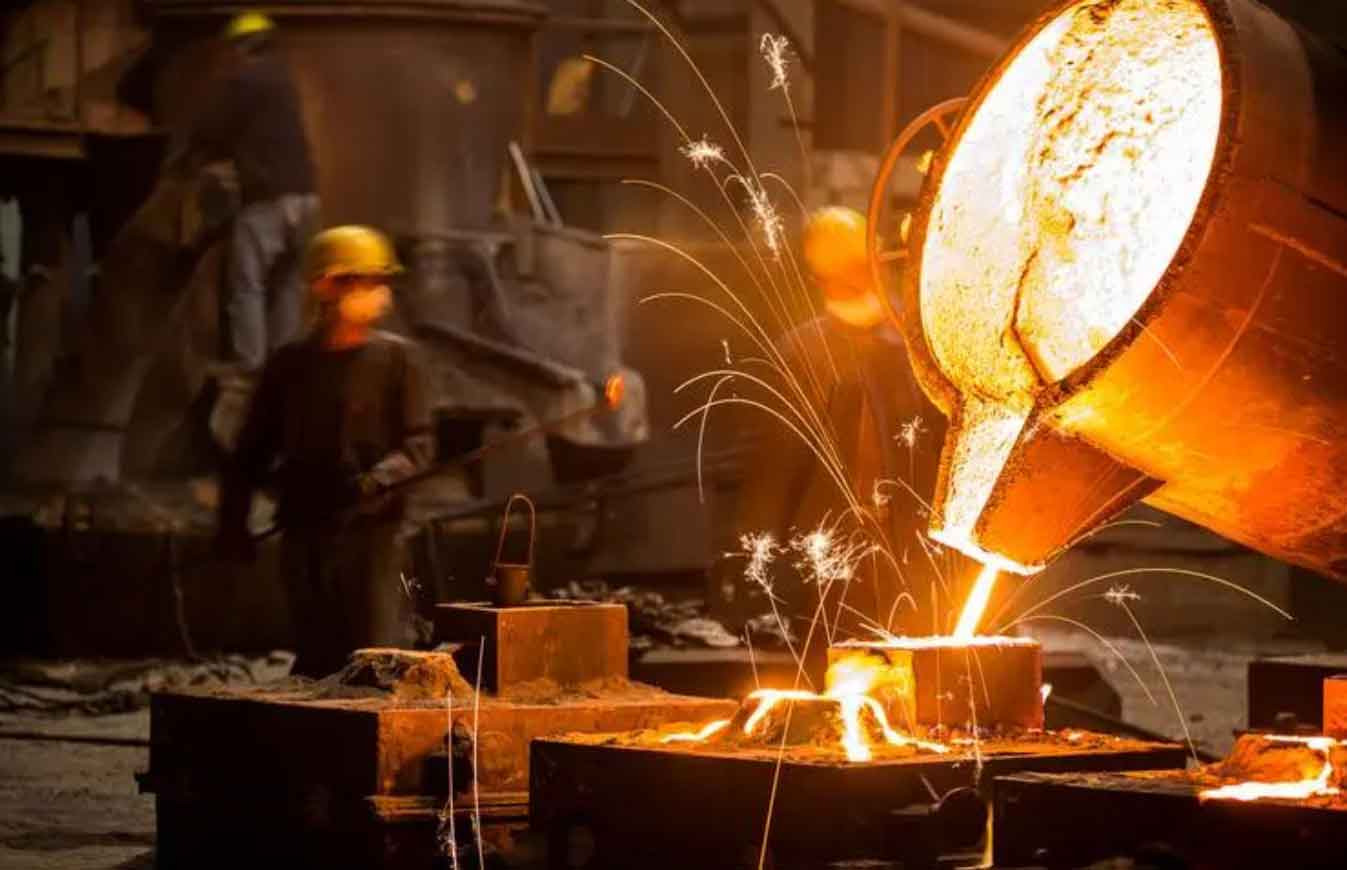
To further illustrate the practical aspects of resin sand casting, it is helpful to visualize the setup. Below is an image depicting a typical sand casting manufacturing environment, which aligns with the processes discussed in this optimization study.
The effectiveness of the optimized resin sand casting process was validated through actual production trials. Castings produced using the revised design exhibited minimal defects, with critical sections free from shrinkage cavities and porosity. Mechanical testing confirmed that the properties met the required standards for ZL201A alloy. This success underscores the importance of integrating simulation tools like ViewCast into the resin sand casting workflow, as it allows for preemptive identification and mitigation of defects, reducing scrap rates and improving cost-efficiency. Moreover, the use of furan resin sand proved advantageous due to its low thermal conductivity, which helps in controlling cooling rates and reducing stress concentrations.
In summary, this project demonstrates a systematic approach to optimizing the resin sand casting process for aluminum alloy castings. By combining empirical design rules with numerical simulation, I was able to address inherent challenges such as shrinkage defects. The key modifications—enlarging the gating system, adding and insulating risers, and employing chills—collectively enhanced feeding efficiency and solidification control. The resin sand casting method, with its versatility and performance, remains a cornerstone in foundry operations for complex aluminum components. Future work could explore advanced materials for molds or machine learning algorithms to further refine simulation accuracy. Ultimately, this optimization not only improved product quality but also contributed to sustainable manufacturing by minimizing material waste in resin sand casting processes.
From a broader perspective, the principles applied here are transferable to other alloys and casting geometries. The resin sand casting process, when properly designed, can achieve high yields and excellent mechanical properties. For instance, the feeding capacity of a riser can be quantified using the modulus method, where the modulus \( M \) is defined as the volume-to-surface area ratio:
$$ M = \frac{V}{A} $$
To ensure effective feeding, the riser modulus should exceed that of the casting section it feeds. In this optimization, I calculated moduli for critical sections and designed risers accordingly. For example, a thick rib with \( M = 0.8 \, \text{cm} \) required a riser with \( M \geq 1.0 \, \text{cm} \), which was achieved through the insulated designs. This mathematical approach complements simulation data, providing a robust framework for resin sand casting optimization.
Additionally, the role of pouring temperature and speed in resin sand casting cannot be overstated. Higher pouring temperatures can improve fluidity but may exacerbate shrinkage, while faster pouring can reduce temperature gradients. In this study, I maintained a pouring temperature of 720°C and a moderate speed to balance these factors. The thermal interaction between the metal and resin sand mold is complex, involving transient heat transfer that can be modeled using finite element methods. The overall heat flux \( q \) across the mold-metal interface is given by:
$$ q = h (T_m – T_s) $$
where \( h \) is the heat transfer coefficient, \( T_m \) is the metal temperature, and \( T_s \) is the mold surface temperature. Optimizing this interface in resin sand casting through mold coatings or sand additives could further enhance performance, though it was beyond the scope of this project.
In conclusion, the iterative process of design, simulation, and refinement is essential for advancing resin sand casting technologies. By leveraging tools like ViewCast and adhering to sound metallurgical principles, foundries can produce high-integrity aluminum castings efficiently. The keyword “resin sand casting” encapsulates this holistic approach, from mold preparation to final quality assessment. As industries demand lighter and stronger components, continued innovation in resin sand casting will play a pivotal role in meeting these challenges, ensuring that this traditional method remains relevant in modern manufacturing landscapes.