
In my years of experience working with high manganese steel casting, I have consistently faced the challenge of producing defect-free components, particularly for coniform parts like crusher jaws and concaves used in mining equipment. These high manganese steel casting components are critical for their wear resistance and toughness, but their casting process is fraught with issues such as shrinkage porosity and linear defects, which compromise service life. The design of risers plays a pivotal role in mitigating these defects, and through extensive experimentation and analysis, I have developed optimized approaches that leverage the unique solidification characteristics of high manganese steel. This article delves into the intricacies of riser design for high manganese steel casting, focusing on the application of orthogonal testing to refine side riser neck parameters, ultimately enhancing the quality and reliability of these castings.
High manganese steel, typically containing around 13% manganese, exhibits distinct solidification behavior that directly impacts casting integrity. From the Fe-Mn-C ternary phase diagram with 13% Mn, it is evident that the alloy has a wide freezing range, promoting volumetric solidification. This leads to the formation of coarse, dendritic equiaxed grains that interconnect early in the solidification process, isolating liquid pools and resulting in dispersed microshrinkage or porosity. The as-cast structure consists of austenite and carbides, which can further affect mechanical properties if not properly controlled. In high manganese steel casting, this solidification tendency makes it difficult to eliminate internal linear defects, necessitating careful thermal management during casting. The modulus method, commonly used for steel castings, calculates the modulus \( M \) as the ratio of volume \( V \) to surface area \( S \):
$$ M = \frac{V}{S} $$
For a typical high manganese steel casting part, such as a concave with volume \( V = 118930 \, \text{cm}^3 \) and surface area \( S = 37650 \, \text{cm}^2 \), the modulus \( M_{\text{casting}} = 3.15 \, \text{cm} \). Based on carbon steel design principles, risers with modulus \( M_{\text{riser}} = 3.63 \, \text{cm} \) might be employed, but in high manganese steel casting, this often proves insufficient due to the alloy’s peculiar solidification dynamics. The thermal conductivity of high manganese steel is relatively low, exacerbating temperature gradients and contributing to defect formation. To address this, I have explored various riser configurations, initially using top risers but encountering persistent shrinkage at the riser necks and internal flaws. This prompted a shift toward side risers with adaptive neck designs, which I will elaborate on.
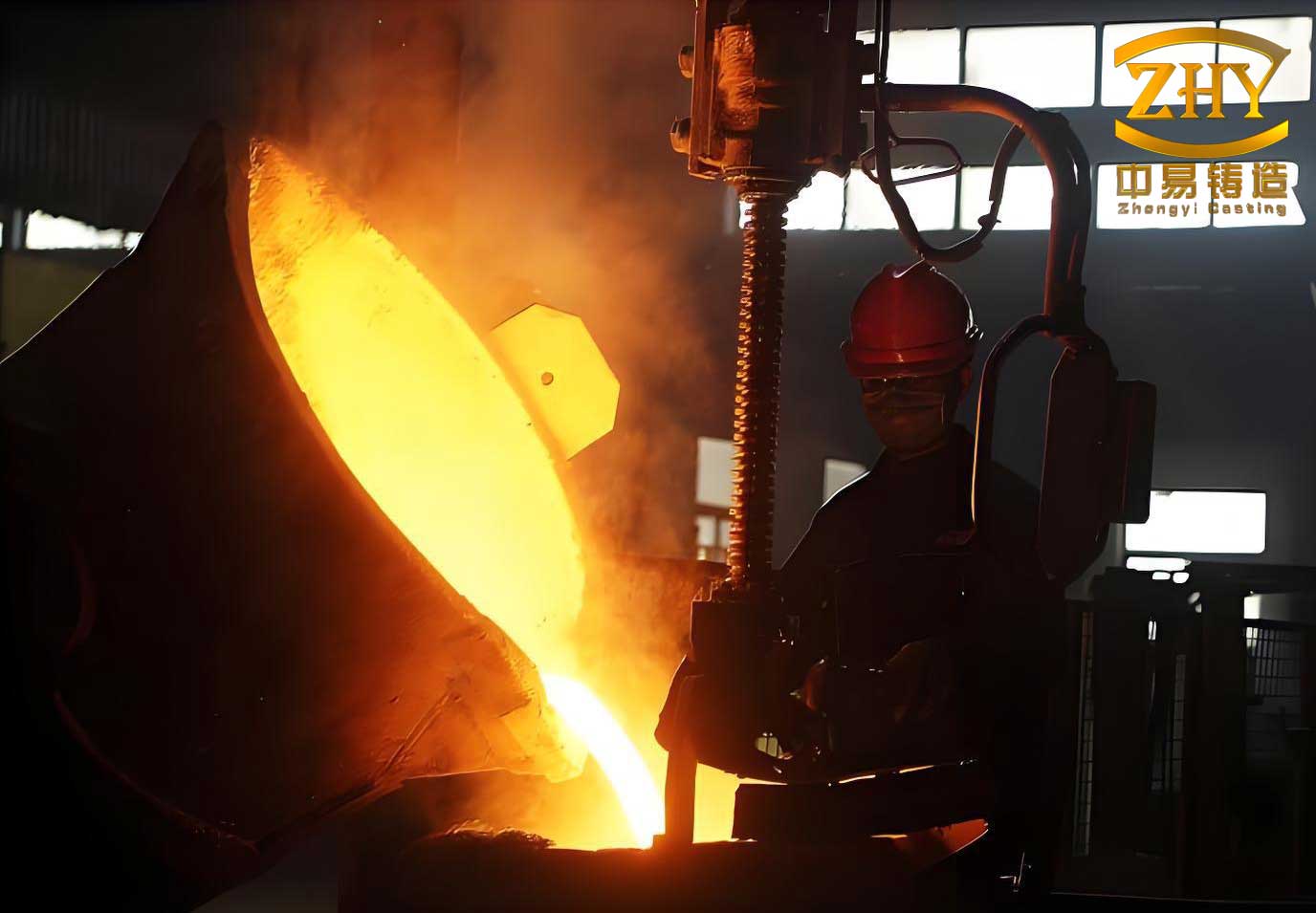
The image above illustrates a typical high manganese steel casting component, highlighting the complex geometry that necessitates precise riser placement. In my work, I have found that for coniform high manganese steel casting parts like crusher liners, which have uniform wall thicknesses ranging from 40 mm to 120 mm with smooth transitions, the choice between top and side risers is crucial. Top risers, while seemingly adequate in size and number, often lead to issues such as cracking during cutting due to prolonged thermal exposure and the precipitation of harmful carbides. In contrast, side risers, especially those with “short, thin, wide” necks, offer an adaptive regulation mechanism. This design allows molten metal to cool slightly in the neck while remaining fluid, enabling continuous feeding during liquid contraction and minimizing thermal interference with the casting. For high manganese steel casting, this is advantageous because it reduces the risk of defects on the functional surfaces, which are critical for performance. The adaptive action can be described by considering the heat transfer dynamics: the neck dimensions influence the solidification time \( t_s \), which can be approximated using Chvorinov’s rule:
$$ t_s = k \cdot \left( \frac{V}{A} \right)^n $$
where \( k \) is a constant dependent on the mold material, \( V \) is the volume, \( A \) is the surface area, and \( n \) is an exponent typically around 2. For a “short, thin, wide” neck, the high surface-area-to-volume ratio promotes rapid solidification after feeding ceases, isolating the riser from the casting. To quantify this, I conducted a series of experiments focused on optimizing the neck parameters for high manganese steel casting components.
My approach centered on orthogonal testing, a statistical method that efficiently explores multiple factors and levels. For a representative high manganese steel casting part with a wall thickness of 95 mm, I identified four key factors influencing riser neck performance: neck thickness (A), front width (B), length (C), and seat height (D). Each factor was assigned three levels, as summarized in the table below. The objective was to minimize the shrinkage cavity area, a common defect in high manganese steel casting.
| Factor | Level 1 | Level 2 | Level 3 |
|---|---|---|---|
| Neck Thickness (A) / mm | 55 | 65 | 75 |
| Front Width (B) / mm | 400 | 440 | 480 |
| Neck Length (C) / mm | 20 | 40 | 60 |
| Seat Height (D) / mm | 115 | 130 | 145 |
Using an L9 (3^4) orthogonal array, I designed nine experimental trials for high manganese steel casting, each with specific combinations of the factors. Other process parameters were kept constant: external chills were placed on functional surfaces, the mold was coated with magnesia-based paint, and six insulated risers of Φ200 mm × 300 mm were used. The pouring temperature was maintained between 1450°C and 1470°C, with a 24-hour holding time before shakeout. The results, measured as the average shrinkage cavity area per riser, are presented in the following table.
| Trial No. | Neck Thickness (A) / mm | Front Width (B) / mm | Neck Length (C) / mm | Seat Height (D) / mm | Shrinkage Cavity Area / mm² |
|---|---|---|---|---|---|
| 1 | 55 | 400 | 20 | 115 | 1250 |
| 2 | 55 | 440 | 40 | 130 | 1400 |
| 3 | 55 | 480 | 60 | 145 | 3000 |
| 4 | 65 | 400 | 40 | 145 | 0 |
| 5 | 65 | 440 | 60 | 115 | 1325 |
| 6 | 65 | 480 | 20 | 130 | 0 |
| 7 | 75 | 400 | 60 | 130 | 2000 |
| 8 | 75 | 440 | 20 | 145 | 180 |
| 9 | 75 | 480 | 40 | 115 | 375 |
To analyze the data, I calculated the sum of results for each level of every factor and the range (R), which indicates the factor’s influence. The analysis is summarized in the table below. For high manganese steel casting, this statistical breakdown helps identify optimal parameters.
| Statistic | Factor A (mm²) | Factor B (mm²) | Factor C (mm²) | Factor D (mm²) |
|---|---|---|---|---|
| Sum for Level 1 (ΣⅠ) | 5650 | 3250 | 1430 | 2950 |
| Sum for Level 2 (ΣⅡ) | 1325 | 2905 | 1775 | 3400 |
| Sum for Level 3 (ΣⅢ) | 2555 | 3375 | 6325 | 3180 |
| Total | 9530 | 9530 | 9530 | 9530 |
| Range (R) | 4325 | 470 | 4895 | 450 |
From this analysis, it is clear that for high manganese steel casting, neck length (Factor C) has the greatest impact on shrinkage, as indicated by its large range of 4895 mm². The optimal levels were determined: A2 (65 mm) for neck thickness, B1 (400 mm) for front width (though B2 was close, B1 minimizes machining), C2 (40 mm) for neck length (balancing defect reduction and cutting safety), and D1 (115 mm) for seat height. Thus, the recommended combination is A2B1C2D1. I validated this by conducting additional trials on high manganese steel casting parts, which showed minimal defects, confirming the effectiveness of the optimized design. The adaptive regulation of the “short, thin, wide” neck can be modeled using a heat flow equation. The temperature gradient \( \nabla T \) in the neck region influences feeding efficiency:
$$ \nabla T = \frac{T_{\text{riser}} – T_{\text{casting}}}{L} $$
where \( T_{\text{riser}} \) is the riser temperature, \( T_{\text{casting}} \) is the casting temperature at the neck interface, and \( L \) is the neck length. For a short neck, \( L \) is small, promoting a steep gradient that enhances fluid flow during solidification. Additionally, the solidification fraction \( f_s \) as a function of time \( t \) can be described by:
$$ f_s(t) = 1 – \exp\left(-k’ t^m\right) $$
where \( k’ \) and \( m \) are material constants. In high manganese steel casting, with its wide freezing range, \( m \) tends to be lower, indicating a more gradual solidification front, which the adaptive neck helps manage by maintaining feeding channels open longer.
The implementation of this optimized riser design in production has yielded significant improvements for high manganese steel casting. Previously, shrinkage porosity rates exceeded 65%, but after adopting the “short, thin, wide” side riser necks tailored through orthogonal testing, the defect rate dropped to below 17%. This enhancement in densification directly translates to better wear resistance and extended service life for high manganese steel casting components. Moreover, the use of external chills in conjunction with these risers further reduces thermal hotspots at the neck junctions, ensuring sound casting surfaces. In my practice, I have applied these principles to various high manganese steel casting parts with different wall thicknesses, deriving a set of neck parameters that accommodate geometric variations. The table below provides a generalized guideline for high manganese steel casting riser neck dimensions based on wall thickness.
| Wall Thickness Range (mm) | Neck Thickness (mm) | Front Width (mm) | Neck Length (mm) | Seat Height (mm) |
|---|---|---|---|---|
| 40-60 | 50-60 | 350-400 | 20-30 | 100-120 |
| 60-80 | 55-65 | 380-420 | 30-40 | 110-130 |
| 80-100 | 60-70 | 400-450 | 35-45 | 115-140 |
| 100-120 | 65-75 | 420-480 | 40-50 | 120-150 |
These parameters are derived from empirical data and solidification theory specific to high manganese steel casting. The adaptive nature of the design ensures that during the liquid contraction phase, molten metal flows efficiently from the riser to compensate for shrinkage, while the rapid solidification of the neck post-feeding prevents back-feeding and thermal damage. For high manganese steel casting, this is crucial because the alloy’s tendency to form carbides at elevated temperatures can be mitigated by reducing the time the casting is exposed to heat from the riser. The economic impact is substantial: reduced scrap rates, lower repair costs, and improved product consistency in high manganese steel casting production.
In conclusion, the optimization of riser design for high manganese steel casting, particularly coniform components, hinges on understanding the alloy’s solidification behavior and leveraging statistical methods like orthogonal testing. The “short, thin, wide” side riser neck offers an adaptive regulation mechanism that minimizes shrinkage defects and enhances casting integrity. Through my work, I have demonstrated that factors such as neck length and thickness are critical, and their optimal combination can significantly reduce porosity rates in high manganese steel casting. This approach not only improves quality but also supports the reliable performance of high manganese steel casting parts in demanding applications. Future directions may involve computational modeling to simulate fluid flow and solidification in high manganese steel casting, further refining riser designs. Nonetheless, the principles outlined here provide a robust foundation for advancing high manganese steel casting technology.