
As a researcher in the field of foundry engineering, I have always been fascinated by the complexities of sand casting, especially for artistic and functional components like bronze bells. The advent of numerical simulation tools has revolutionized our approach to sand casting, allowing for precise prediction and mitigation of defects. In this article, I will share my experience using ProCAST software to optimize the sand casting process for a large bronze bell, focusing on reducing shrinkage porosity and improving overall quality. Sand casting is a versatile and widely used method, but it poses significant challenges when dealing with intricate designs and stringent performance requirements, such as those needed for bronze bells that must produce specific acoustic properties. Through this work, I aim to demonstrate how numerical simulation can enhance traditional sand casting techniques, leading to more efficient and reliable production.
The bronze bell in question has a height of 2,700 mm, a maximum bottom diameter of 2,100 mm, and a mass of approximately 6.85 tons. Its design includes detailed surface patterns and must meet high standards of strength and impact toughness, in addition to acoustic performance. These requirements make sand casting particularly demanding, as defects like shrinkage cavities, porosity, and incomplete filling can compromise both structural integrity and sound quality. In sand casting, the mold is made from bonded sand, which offers flexibility but also introduces variables in heat transfer and metal flow. To address this, I conducted a thorough process analysis, considering factors such as gating system design, cooling rates, and material properties. The goal was to achieve directional solidification, minimize thermal gradients, and ensure proper feeding during the sand casting process.
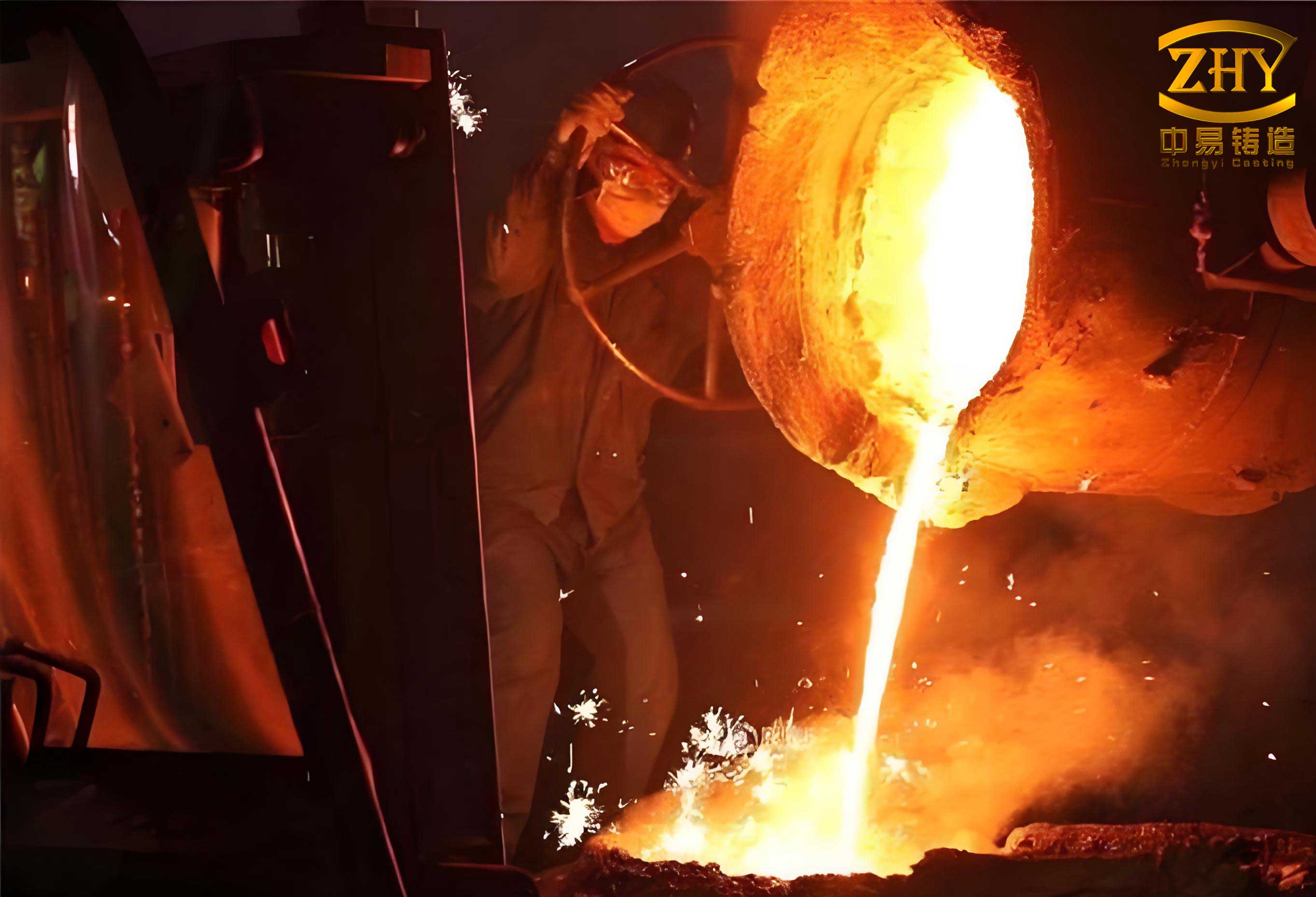
In the initial sand casting process design, I adopted a semi-closed gating system with a top-pouring shower type to facilitate slag trapping and filling capability. The gating system dimensions were calculated using empirical formulas specific to sand casting. The key parameters for the gating system are derived from the following equations, which are commonly used in sand casting design to determine the choke cross-sectional area and pouring time:
$$ F_{choke} = \frac{G}{0.31 \mu t \sqrt{H_P}} $$
$$ t = S_1 \delta \sqrt{G} $$
Here, \( F_{choke} \) is the minimum cross-sectional area of the gating system in cm², \( G \) is the total mass of metal flowing through the choke section in kg, \( \mu \) is the total flow loss coefficient, \( t \) is the pouring time in seconds, \( H_P \) is the average static head in cm, \( \delta \) is the wall thickness of the casting in mm, and \( S_1 \) is a constant typically set to 2. For this bronze bell, with a casting mass \( G_{casting} = 6,850 \, \text{kg} \), I took \( G = 1.45 \times G_{casting} = 9,933 \, \text{kg} \), \( \delta = 50 \, \text{mm} \), \( \mu = 0.22 \), and \( H_P = 48 \, \text{cm} \). Using these values, the pouring time \( t \) was calculated as 158 seconds, and the choke area \( F_{choke} \) was approximately 133 cm². The gating ratio was set as \( F_{sprue} : F_{runner} : F_{ingate} = 1.2 : 1.5 : 1.0 \), resulting in a runner cross-sectional area of 200 cm² and a sprue diameter of 70 mm. The ingates consisted of 16 channels with dimensions of 100 mm × 8 mm. Additionally, to promote directional solidification in sand casting, two risers were placed at the top, each with an upper diameter of 200 mm and a lower diameter of 150 mm, and six layers of chills were arranged around the thicker sections, with each layer containing 48 chills of size 180 mm × 50 mm × 30 mm.
To simulate this sand casting process, I used ProCAST software, which enables numerical modeling of filling and solidification phases. The simulation involved several steps: creating a 3D solid model of the bell and gating system using Pro/ENGINEER, meshing with MeshCAST module, setting material properties and boundary conditions in PreCAST, and analyzing results in ViewCAST. The mesh consisted of 3,447,030 elements and 641,953 nodes. The material properties and process parameters are summarized in the tables below, which are critical for accurate simulation in sand casting.
| Material | Casting | Chill | Mold | Temperature (°C) | Interfacial Heat Transfer Coefficient (W·m⁻²·K⁻¹) | Pouring Time (s) |
|---|---|---|---|---|---|---|
| Type | C90300 Tin Bronze | H13 Steel | Furan Resin Sand | Pouring: 1050-1080; Mold: 25; Chill: 20 | Sand-Casting: 500; Chill-Casting: 1000 | 140-160 |
| Material | Thermal Conductivity (W·m⁻¹·K⁻¹) | Density (kg·m⁻³) | Specific Heat Capacity (J·kg⁻¹·K⁻¹) | Liquidus Temperature (°C) | Solidus Temperature (°C) | Latent Heat of Fusion (kJ·kg⁻¹) | Porosity (%) |
|---|---|---|---|---|---|---|---|
| Tin Bronze (C90300) | 48 | 7.9 × 10³ | 377 | 1001 | 807 | 218 | – |
| Furan Resin Sand | 0.72 | 1.5 × 10³ | 733 | – | – | – | 43 |
The simulation results for the initial sand casting process revealed several insights. During the filling stage, the metal flowed from the sprue into the runners and ingates, then entered the mold cavity in multiple streams, gradually filling the bell shape and risers. The solidification time distribution showed that the thickest regions, particularly the lower lip area, had longer solidification times compared to thinner sections, leading to significant thermal gradients. This is a common issue in sand casting due to variations in wall thickness. The predicted shrinkage porosity and cavities were concentrated in the lip area, as illustrated by the simulation output. The solidification time \( t_s \) can be expressed using the Chvorinov’s rule for sand casting:
$$ t_s = k \left( \frac{V}{A} \right)^2 $$
where \( t_s \) is the solidification time, \( k \) is a constant dependent on mold material and casting conditions, \( V \) is the volume of the casting, and \( A \) is the surface area. For the bronze bell, the volume-to-area ratio was higher in the lip region, causing slower solidification and increased risk of shrinkage defects. The simulation clearly indicated that the initial gating system, while functional, did not adequately address these thermal disparities in sand casting.
Based on this analysis, I optimized the sand casting process by modifying the gating system from a single-layer shower type to a three-layer step gating system. This change aimed to improve metal distribution and feeding during the sand casting process. The optimized design included additional circular runners and 32 ingates, with ingate dimensions adjusted to 80 mm × 4 mm, while other parameters remained unchanged. The rationale behind this optimization is to enhance sequential solidification and reduce the temperature differences between thick and thin sections in sand casting. The new gating system promotes more uniform filling and better thermal management, which is crucial for minimizing defects in sand casting.
I then performed a second simulation with ProCAST to evaluate the optimized sand casting process. The mesh was refined to 3,974,999 elements and 743,572 nodes to capture detailed effects. The filling process showed that metal first entered the bottom ingates, then the middle layer, and finally the upper layer, resulting in a more stable and controlled fill compared to the initial design. The solidification time distribution demonstrated reduced disparities, with the lip area cooling more uniformly relative to other regions. This improvement is quantified by the reduction in the solidification time difference \( \Delta t_s \), which can be calculated as:
$$ \Delta t_s = t_{s,\text{max}} – t_{s,\text{min}} $$
where \( t_{s,\text{max}} \) and \( t_{s,\text{min}} \) are the maximum and minimum solidification times, respectively. In the optimized sand casting process, \( \Delta t_s \) decreased significantly, leading to a marked reduction in shrinkage porosity and cavities, as shown in the simulation results. The step gating system effectively provided additional feeding paths, compensating for volumetric shrinkage during solidification in sand casting. This highlights the importance of gating design in controlling thermal gradients and defect formation in sand casting.
To validate the optimized sand casting process, I oversaw the actual production of the bronze bell using the parameters derived from the simulation. The casting was performed in a sand casting foundry with furan resin sand molds, and the bell was poured at a temperature of 1,080°C. The resulting casting exhibited no visible defects such as shrinkage cavities or porosity, confirming the effectiveness of the optimization. The bell met all acoustic and mechanical requirements, demonstrating that numerical simulation can reliably guide process improvements in sand casting. This success underscores the value of integrating ProCAST into the sand casting workflow for complex components.
In conclusion, the use of ProCAST software for numerical simulation has proven invaluable in optimizing the sand casting process for a large bronze bell. By transitioning from a single-layer shower gating system to a three-layer step gating system, I was able to reduce thermal gradients and minimize shrinkage defects, thereby enhancing the quality of the final product. This case study illustrates how advanced simulation tools can address the inherent challenges of sand casting, such as controlling solidification patterns and ensuring defect-free castings. The key takeaway is that sand casting, when combined with numerical analysis, can achieve higher precision and reliability, even for demanding applications like artistic bronze bells. Future work could explore further refinements, such as adaptive mesh techniques or multi-physics simulations, to continue advancing sand casting methodologies.
Throughout this project, I emphasized the role of sand casting as a foundational manufacturing process and leveraged simulation to overcome its limitations. The tables and formulas presented here provide a framework for similar optimizations in sand casting. For instance, the gating design equations and material property data can be adapted for other sand casting applications. By consistently applying these principles, foundries can improve efficiency and reduce waste in sand casting operations. I encourage practitioners to embrace numerical simulation as a standard tool in sand casting, as it offers a proactive approach to quality control and process design. In doing so, the sand casting industry can continue to innovate and meet evolving technical and artistic demands.