
In my role as a casting process engineer, I have extensively worked on improving the production of medium-sized machine tool tables, which are critical sand casting products in the manufacturing industry. These sand casting products are typically made from gray iron, such as HT300, and are produced in small to medium batches. The primary goal is to ensure high-quality castings, particularly surface hardness on the table face, while also considering practical applicability, process simplicity, and economic efficiency. Through optimization using CAE software like Huazhu CAE, I have developed a robust sand casting process that addresses common defects like shrinkage porosity, gas holes, misruns, and hot tearing, thereby achieving high-quality, efficient, and low-cost production of these sand casting products.
Medium-sized machine tool tables are generally gray iron sand casting products, with production focusing on small to medium batches. The key requirement is to maintain the quality of the table surface, especially its hardness. Traditionally, many process designs orient the large flat surface of the table downward to achieve this. However, based on my analysis of specific casting geometries, such as the one discussed here, this approach can lead to issues like hot cracks at junction points of thin ribs (e.g., 15 mm thick), difficulties in feeding the lower large plane causing shrinkage defects, and complexities in mold assembly requiring core hanging. This results in low efficiency and high production costs for these sand casting products. Therefore, I undertook a comprehensive optimization of the casting process to achieve superior quality, efficiency, and cost-effectiveness for these sand casting products.
Initially, I evaluated two primary casting orientation schemes for these sand casting products. In Scheme A, the table surface is placed downward in the mold. While this can enhance surface hardness, it positions the entire casting in the upper mold, making core placement difficult and necessitating吊芯 (hanging cores). The solidification sequence is challenging to control, with long feeding paths requiring large risers, leading to low yield. Additionally, thin ribs may solidify first, inducing high thermal stresses and hot tears during contraction of thicker sections. In Scheme B, the table surface is oriented upward. This simplifies the process, allows for directional solidification from bottom to top, enables smaller risers for higher yield, but risks defects like gas porosity and inclusions on the table surface, potentially requiring larger machining allowances and compromising hardness. Both schemes have merits and drawbacks, necessitating detailed simulation and optimization for these sand casting products.
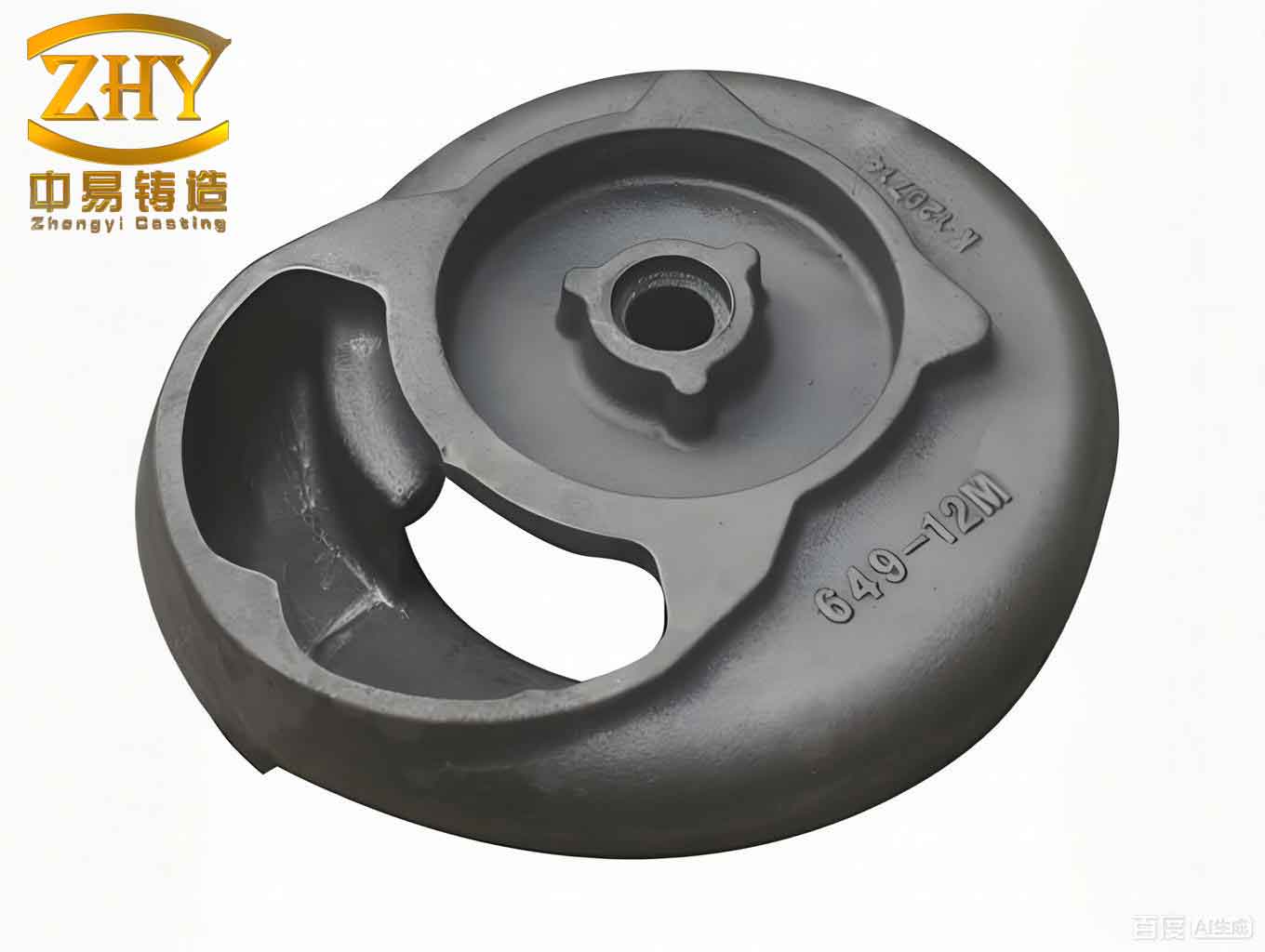
To systematically compare these schemes for sand casting products, I employed Huazhu CAE software for numerical simulation. Using a virtual mold model for gray iron sand castings, I set simulation parameters with sufficiently large virtual flask dimensions and adiabatic boundary conditions to minimize computational errors. The analysis focused on mold filling and solidification defects, key aspects in producing high-quality sand casting products.
Process Optimization Analysis
First, I analyzed the mold filling process for both orientations. For Scheme A (bottom gating with large plane down), the designed filling time was 10 s, and the simulated time was 8.67 s, indicating good agreement. The metal flow, driven by gravity, entered the cavity smoothly through the gating system, with the liquid surface rising gradually from bottom to top. The simulation showed complete filling without defects like air entrainment or sand washing, ensuring no misruns for these sand casting products. For Scheme B (top gating with large plane up), the designed filling time was 9 s, and simulated time was 8.72 s. Similarly, the filling was complete and defect-free, demonstrating that both gating systems are viable for filling these sand casting products.
To quantify filling behavior, I used fluid dynamics principles. The volume flow rate \( Q \) in the gating system can be expressed as:
$$ Q = A \cdot v $$
where \( A \) is the cross-sectional area and \( v \) is the flow velocity. For sand casting products, ensuring moderate velocities is crucial to avoid mold erosion. In Scheme A, the overall fluid velocity was around 50 cm/s, with local maxima up to 100 cm/s, indicating minimal冲击 on the mold. In Scheme B, velocities averaged 40 cm/s with similar local peaks, also within acceptable limits for sand casting products. These results are summarized in Table 1.
| Parameter | Scheme A (Bottom Gating) | Scheme B (Top Gating) |
|---|---|---|
| Designed Filling Time (s) | 10 | 9 |
| Simulated Filling Time (s) | 8.67 | 8.72 |
| Average Flow Velocity (cm/s) | 50 | 40 |
| Maximum Local Velocity (cm/s) | 100 | 100 |
| Filling Completeness | Complete, no defects | Complete, no defects |
Next, I examined solidification defects using simulation. For Scheme A, due to the larger volume at the bottom, solidification was slower, creating hot spots. The top regions, though thinner, solidified later and were prone to shrinkage porosity and cavities. In contrast, for Scheme B, the bottom sections solidified quickly with minimal hot spots, but the middle and top thicker areas solidified later, leading to significant shrinkage defects. This highlights the importance of directional solidification control in sand casting products.
To analyze solidification, I applied Chvorinov’s rule for solidification time \( t \):
$$ t = B \left( \frac{V}{A} \right)^n $$
where \( V \) is volume, \( A \) is surface area, \( B \) is a mold constant, and \( n \) is an exponent (typically ~2 for sand molds). For sand casting products, optimizing the modulus \( \frac{V}{A} \) is key. In Scheme A, the bottom has a high modulus, leading to longer solidification times and potential shrinkage. In Scheme B, the top has a higher modulus, similar issues arise. Therefore, I introduced risers and chills to modify solidification. The feeding requirement can be estimated using:
$$ V_r = \frac{V_c \cdot \alpha}{ \eta } $$
where \( V_r \) is riser volume, \( V_c \) is casting volume, \( \alpha \) is shrinkage rate (for gray iron ~1-2%), and \( \eta \) is riser efficiency. For these sand casting products, with \( V_c \approx 0.05 \, \text{m}^3 \), \( \alpha = 0.015 \), and \( \eta = 0.2 \), \( V_r \approx 0.00375 \, \text{m}^3 \).
Based on simulation, Scheme B showed more severe shrinkage, but with proper riser design, it could be mitigated. The defect analysis results are in Table 2.
| Aspect | Scheme A (Bottom Gating) | Scheme B (Top Gating) |
|---|---|---|
| Hot Spots | Present at bottom thick sections | Minimal at bottom, present at top/middle |
| Shrinkage Porosity Risk | High in top regions | High in top and middle regions |
| Feeding Path Length | Long, requiring large risers | Shorter, allowing smaller risers |
| Process Complexity | High (core hanging needed) | Low (simple mold assembly) |
Considering practical factors, I focused on Scheme B for further optimization because it offers simpler operation and higher yield potential. By integrating chills at critical junctions and designing open risers at the top, I aimed to achieve directional solidification from bottom to top. The chills accelerate cooling in thicker bottom areas, while risers feed the top sections. This approach balances quality and efficiency for sand casting products.
To model heat transfer, I used the Fourier equation for transient conduction in the casting-mold system:
$$ \frac{\partial T}{\partial t} = \alpha \nabla^2 T $$
where \( T \) is temperature, \( t \) is time, and \( \alpha \) is thermal diffusivity. For gray iron sand casting products, \( \alpha \approx 1.4 \times 10^{-5} \, \text{m}^2/\text{s} \). By simulating temperature fields, I optimized chill placement to ensure sequential solidification.
In the optimized design for sand casting products, the large plane is oriented upward. Metal enters via a top gating system with a sprue, runner, and ingates. Open risers are placed on the top thick sections, and chills are installed at the bottom thin rib junctions. This setup promotes steady filling, with risers aiding排气 and feeding. The solidification sequence is controlled from bottom to top, minimizing defects. The工艺出品率 (yield) improves as riser size reduces. For instance, with optimized risers, the yield increased from ~65% in Scheme A to ~75% in Scheme B for these sand casting products.
The final casting process parameters are summarized in Table 3.
| Parameter | Optimized Value |
|---|---|
| Casting Material | HT300 Gray Iron |
| Mold Type | Sand Mold (Green Sand) |
| Pouring Temperature | 1350°C |
| Gating System | Top Gating with Multiple Ingates |
| Riser Design | Open Riser on Top Thick Sections |
| Chill Usage | Iron Chills at Bottom Rib Junctions |
| Simulated Solidification Time | Approx. 300 s |
| Estimated Yield | 75% |
| Defect Prediction | No shrinkage, gas holes, or hot tears |
Through this optimization, I have validated that the large-plane-up orientation, combined with chills and risers, ensures defect-free sand casting products. The process is straightforward for operators, involving easy core setting, mold closing, and pouring. Actual浇注 trials confirmed that castings meet all quality standards, with table surface hardness achieved through controlled cooling and minimal machining allowance. This approach underscores the value of CAE simulation in enhancing sand casting products.
In conclusion, the optimization of sand casting process for medium-sized machine tool tables demonstrates how systematic analysis and simulation can lead to superior sand casting products. By comparing orientations, analyzing fluid flow and solidification, and integrating risers and chills, I developed a process that ensures high quality, efficiency, and cost-effectiveness. This methodology can be extended to other sand casting products in the machinery sector, contributing to advanced manufacturing practices. The key takeaway is that for sand casting products, balancing orientation, feeding, and cooling is essential, and CAE tools like Huazhu CAE are invaluable for achieving optimal designs without costly trial-and-error. As sand casting products continue to evolve, such optimizations will play a pivotal role in meeting industry demands for precision and reliability.