
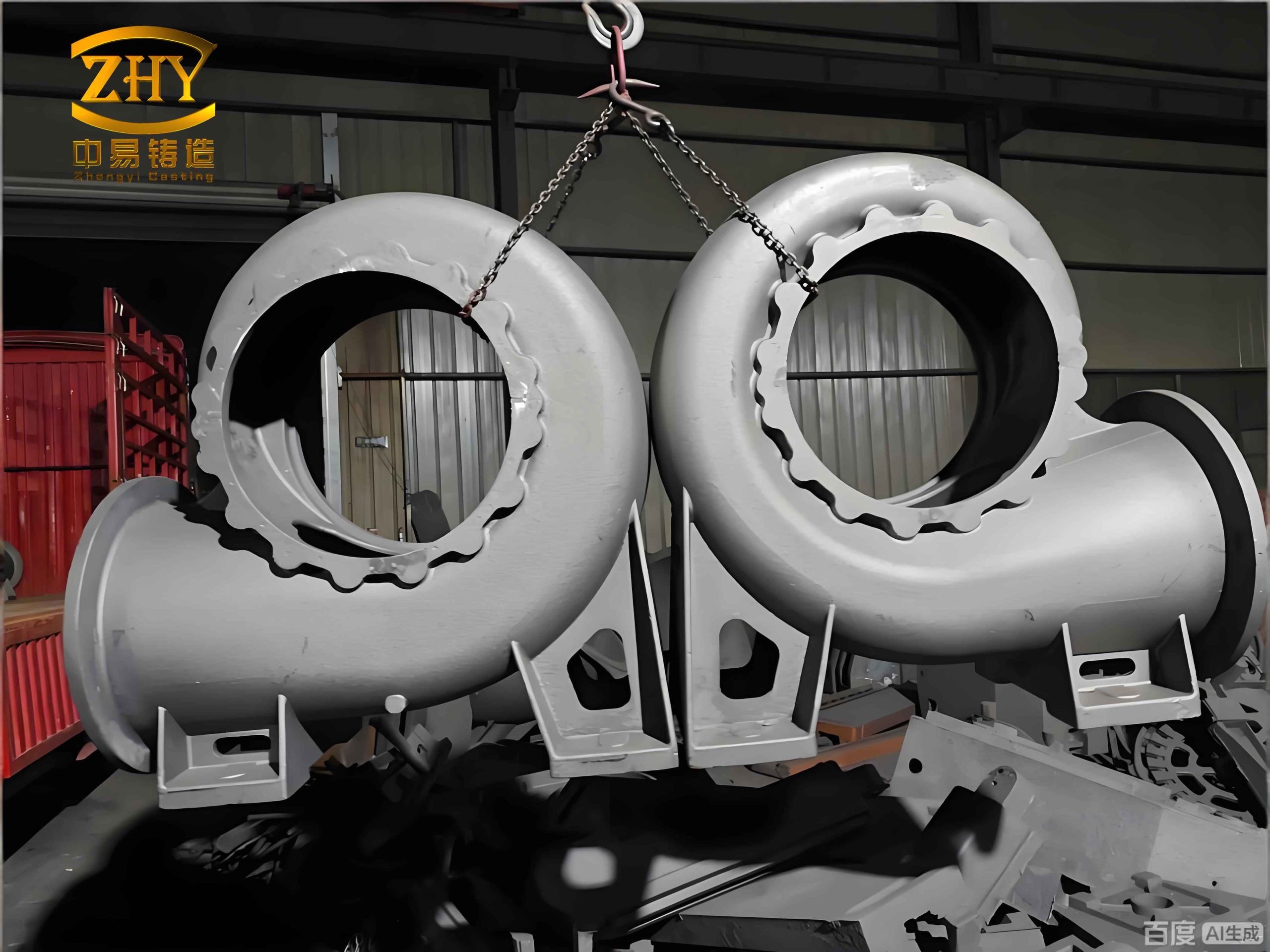
In the realm of wind turbine systems, the gearbox plays a pivotal role in transmitting and amplifying rotational speed to meet generator requirements. The gearbox housing, as a critical structural component, must possess substantial strength to withstand operational loads and mitigate vibrations. As a manufacturing engineer specializing in foundry processes, I have extensively worked on producing such high-integrity components. Sand casting stands out as the preferred method for fabricating these housings due to its exceptional versatility, applicability across various alloys, and suitability for medium to large-scale production. The inherent flexibility and cost-effectiveness of sand casting make it ideal for creating complex geometries like gearbox housings. This article delves into a detailed case study on the process optimization for a ZL101 aluminum alloy gearbox housing using numerical simulation and practical validation, highlighting how advanced techniques can elevate the quality of sand casting products.
The core material selected was ZL101, an Al-Si-Mg series cast aluminum alloy known for its excellent castability, including good fluidity, low shrinkage, and resistance to hot tearing. Its chemical composition is fundamental to achieving desired mechanical properties, as summarized in Table 1. This alloy is particularly suitable for sand casting products that require subsequent heat treatment for strength enhancement.
| Si | Mg | Ti | Zn | Mn | Cu | Al |
|---|---|---|---|---|---|---|
| 6.5–7.5 | 0.25–0.45 | 0.08–0.20 | ≤0.10 | ≤0.10 | ≤0.10 | Bal. |
The gearbox housing dimensions were approximately 874 mm × 490 mm × 366 mm with a mass of 131.25 kg. For mold production, resin-bonded sand was chosen due to its ability to produce high-definition surfaces, reduce labor intensity, and lower overall costs—key factors in manufacturing premium sand casting products. Initial process parameters included a casting tolerance grade of CT11, a weight tolerance grade of MT11, machining allowance H, and a linear shrinkage rate of 1%. The gating system was initially designed as an open-bottom-pouring type to ensure smooth metal filling, with a cross-sectional area ratio of sprue:runner:gate set at 1:2:4. Riser design employed exothermic insulating risers coupled with chills to address the wide solidification range and limited feeding distance of aluminum alloys. The sprue diameter was 45 mm, runner dimensions were 80 mm × 40 mm, and gate diameter was 25 mm.
To predict and eliminate potential defects, numerical simulation is indispensable. The governing equations for fluid flow and heat transfer during casting are critical. The continuity and momentum equations (Navier-Stokes) for incompressible flow are:
$$
\nabla \cdot \mathbf{u} = 0
$$
$$
\rho \left( \frac{\partial \mathbf{u}}{\partial t} + \mathbf{u} \cdot \nabla \mathbf{u} \right) = -\nabla p + \mu \nabla^2 \mathbf{u} + \rho \mathbf{g}
$$
where $\mathbf{u}$ is velocity, $p$ is pressure, $\rho$ is density, $\mu$ is dynamic viscosity, and $\mathbf{g}$ is gravity. The energy equation incorporating phase change is:
$$
\rho c_p \frac{\partial T}{\partial t} + \rho c_p \mathbf{u} \cdot \nabla T = \nabla \cdot (k \nabla T) – \rho L \frac{\partial f_s}{\partial t}
$$
Here, $T$ is temperature, $c_p$ is specific heat, $k$ is thermal conductivity, $L$ is latent heat, and $f_s$ is solid fraction. Solidification time can be estimated using Chvorinov’s rule:
$$
t_f = k \left( \frac{V}{A} \right)^2
$$
where $t_f$ is local solidification time, $V$ is volume, $A$ is surface area, and $k$ is a mold constant. These principles underpin the simulation software used in this study.
The initial process design was modeled in 3D and simulated using dedicated casting software. The mesh was set to 2 million elements to balance accuracy and computational efficiency. Parameters included a pouring temperature of 750°C, mold preheat at 25°C, and chill temperature at 25°C. Filling simulation revealed a total fill time of 20.78 seconds, with a stable, non-turbulent flow without air entrapment. However, solidification simulation indicated premature freezing of the gating system before the casting, severely hindering feeding. Defect prediction, based on temperature gradient and solidification sequence, highlighted significant shrinkage porosity and cavities in the thick sections of the housing, as the risers were ineffective. This was confirmed by practical casting and X-ray inspection, showing defects like shrinkage, sand inclusion, and segregation, rendering the initial sand casting products unsuitable for service.
Detailed analysis pinpointed the causes. The bottom-gating system, while stable, led to unfavorable thermal gradients with hotter metal at the bottom, impairing directional solidification. The gating dimensions caused early freezing, cutting off feed metal. The riser design, despite using exothermic sleeves, lacked sufficient thermal efficiency to compensate for the massive thermal centers. The feeding distance, $d_f$, for aluminum alloys in sand molds can be expressed as:
$$
d_f = C \sqrt{t_f}
$$
where $C$ is an alloy-dependent constant. In our case, $d_f$ was exceeded in the thick sections. To optimize, a multi-faceted approach was adopted. The gating system was changed to a stepped design, combining advantages of bottom and top pouring. This promotes layered filling, reduces oxidation, and places hotter metal atop for better feeding. The cross-sectional area ratio was maintained at 1:2:4, but dimensions were increased: sprue diameter to 60 mm, runner to 40 mm × 70 mm, and gate diameter to 40 mm. The riser system was enhanced with optimized exothermic insulating risers strategically placed over thermal junctions, supplemented by chills to accelerate solidification in adjacent areas. Pouring temperature remained at 750°C to balance fluidity and shrinkage. Key optimized parameters are listed in Table 2.
| Parameter | Value |
|---|---|
| Gating System Type | Stepped |
| Sprue:Runner:Gate Area Ratio | 1:2:4 |
| Sprue Diameter (mm) | 60 |
| Runner Dimensions (mm) | 40 × 70 |
| Gate Diameter (mm) | 40 |
| Riser Type | Exothermic Insulating |
| Chill Usage | Yes, at thick sections |
| Pouring Temperature (°C) | 750 |
| Mold Material | Resin Sand |
Simulation of the optimized process showed remarkable improvement. Filling completed in 13.6 seconds with smooth, layered metal advancement and no turbulence. Solidification simulation demonstrated progressive freezing from chills towards the risers, with risers remaining liquid longest to effectively feed shrinkage. The temperature gradient, $\nabla T$, was more favorable, satisfying the feeding criterion:
$$
\frac{\nabla T}{v_s} \geq \frac{G_c}{v_c}
$$
where $v_s$ is solidification velocity, and $G_c$ and $v_c$ are critical gradient and velocity, respectively. Defect prediction indicated that shrinkage was now confined to the risers and gating system, with the casting itself virtually free of major defects. This predictive outcome underscores the power of simulation in refining processes for high-quality sand casting products.
To validate, actual pours were conducted using the optimized parameters. The resulting castings were inspected via X-ray, revealing nearly defect-free components, meeting all quality specifications. Mechanical properties were evaluated on separately cast test bars subjected to T6 heat treatment (solution treatment and artificial aging). The results, compared to standards, are in Table 3. The properties exceed the minimum requirements, demonstrating that the optimized process yields sand casting products with superior integrity and performance.
| Sample | Tensile Strength (MPa) | Elongation (%) | Hardness (HBS) |
|---|---|---|---|
| 1 | 318 | 4.0 | 99.5 |
| 2 | 317 | 5.5 | 89.2 |
| 3 | 308 | 5.0 | 99.5 |
| GB/T 1173-2013 Requirement | ≥225 | ≥1 | ≥70 |
The success of this optimization hinges on several factors. First, the stepped gating system improved thermal distribution. The modified dimensions ensured the gating remained open longer than the casting’s solidification time, $t_{gate} > t_{casting}$, which is crucial for feeding. Using exothermic risers increased their efficiency by providing additional heat, extending feeding duration. The riser volume, $V_r$, was designed based on the required feed metal volume, $V_f$, estimated from the shrinkage volume, $\beta V_c$, where $\beta$ is the volumetric shrinkage coefficient (about 0.06 for ZL101) and $V_c$ is casting volume. Thus:
$$
V_r \geq \frac{\beta V_c}{\eta}
$$
where $\eta$ is riser efficiency (higher for exothermic types). Combined with chills, this setup ensured directional solidification toward the risers. Furthermore, the pouring temperature of 750°C was optimal; too low would risk mistruns, too high would increase shrinkage and gas porosity. This holistic approach significantly enhances the reliability of sand casting products for demanding applications.
In conclusion, through integrated numerical simulation and practical experimentation, the sand casting process for a ZL101 gearbox housing was successfully optimized. Key changes included adopting a stepped gating system, optimizing riser and chill design, and fine-tuning process parameters. The final process produced defect-free castings with excellent mechanical properties, fully meeting operational demands. This case study exemplifies how modern simulation tools, coupled with fundamental casting principles, can transform the manufacturing of complex sand casting products, ensuring high quality, reducing trial-and-error costs, and accelerating time-to-market. The methodologies applied here are widely applicable to other aluminum alloy castings, reinforcing sand casting’s position as a versatile and advanced manufacturing route.