
In modern manufacturing, the lost foam casting process has emerged as a pivotal technique for producing high-precision, complex-shaped castings with advantages such as high productivity, reduced environmental impact, and minimal post-processing requirements. As a researcher focused on metal casting technologies, I have extensively investigated the application of this process for critical components like wheel cores, which are integral to machinery operating under demanding conditions. The lost foam casting process involves using a foam pattern that vaporizes upon contact with molten metal, but it introduces challenges like shrinkage defects and carbon slag formation due to heat absorption during decomposition. This article delves into a comprehensive study aimed at optimizing the lost foam casting process for wheel core castings through numerical simulation and iterative design improvements, ensuring defect-free production.
The wheel core, a ring-shaped structural part with flanges of varying thickness, requires high mechanical strength to withstand vibrational loads. In the initial lost foam casting process design, the component was oriented with the large flange facing downward, coupled with a bottom-gating system to promote smooth filling. However, preliminary simulations and trial productions revealed severe shrinkage porosity and cavities in the thick sections, particularly near the inner flange. This aligned with known issues in the lost foam casting process where uneven cooling and premature solidification can block feeding paths. To address this, I employed ProCAST numerical simulation software to analyze the solidification behavior and systematically refine the process parameters, ultimately achieving a robust solution.
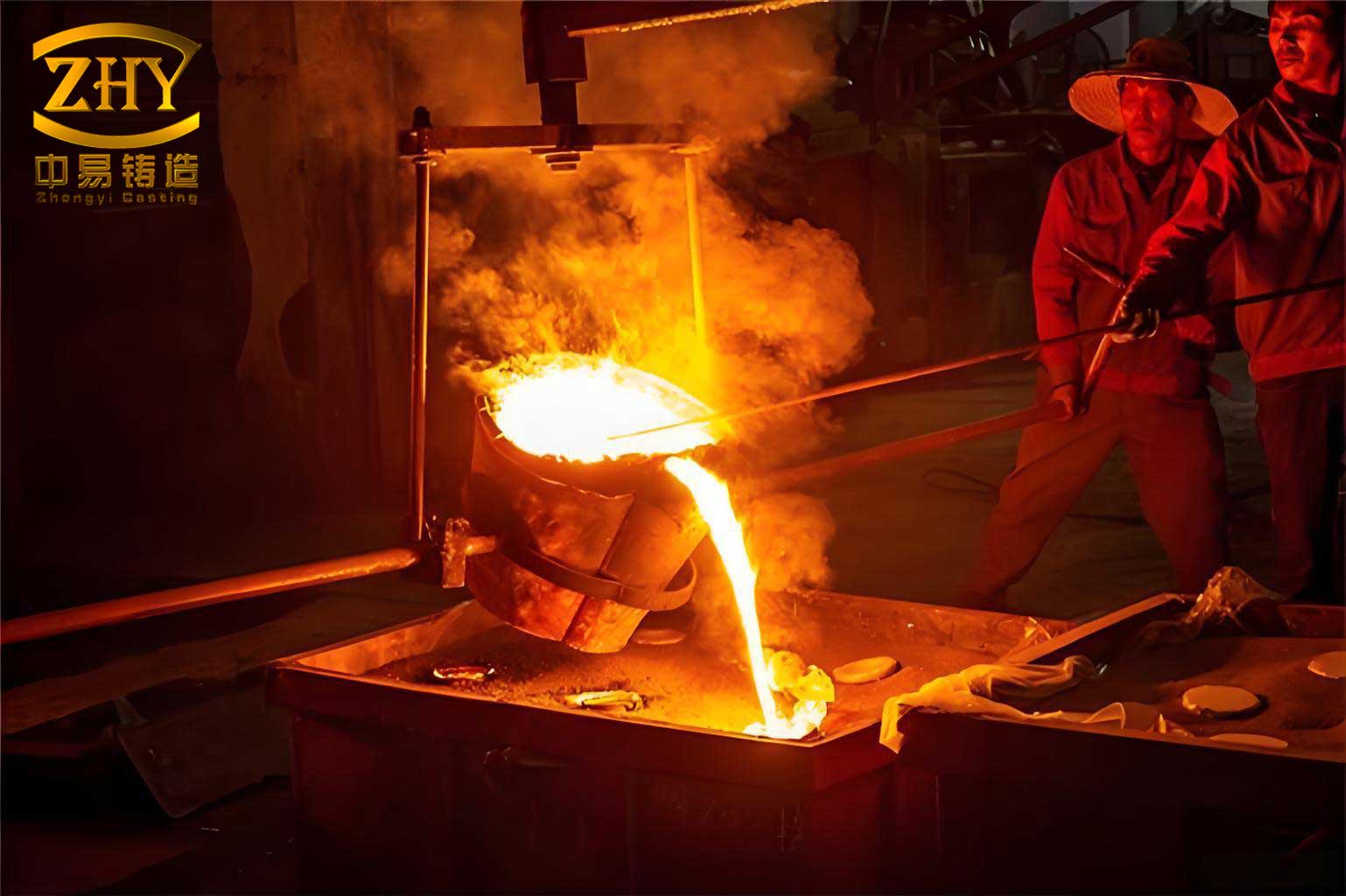
Numerical simulation is a cornerstone of modern lost foam casting process optimization, allowing for virtual experimentation without costly physical trials. For this study, I configured the ProCAST software with parameters tailored to the lost foam casting process. The casting material was ZG270-500 steel, with chemical composition detailed in Table 1. The simulation type was set to “Lost Foam,” accounting for foam decomposition and gas evolution. Key process variables included a pouring temperature of 1545°C ± 15°C, a liquidus temperature of 1489°C, a pouring speed of 21 kg/s, and a coating interfacial heat transfer coefficient of 500 W/(m²·K). The mold coating was modeled as sand-permeable foam, with a vacuum pressure of 0.06 MPa at the coating surface and 0.13 MPa at the gating system to replicate real-world conditions.
| Element | Content (wt%) |
|---|---|
| C | 0.30–0.40 |
| Si | 0.20–0.45 |
| Mn | 0.50–0.90 |
| S | ≤0.35 |
| P | ≤0.35 |
| Fe | Balance |
The initial lost foam casting process scheme positioned the wheel core with the flange downward, as illustrated in the analysis model. The gating system featured a cross-section of 30 mm × 50 mm, and a riser of φ200 mm × 230 mm was attached to facilitate feeding. The mesh comprised over 1.5 million tetrahedral elements to ensure accuracy. Solidification analysis via the solid fraction field revealed critical insights: thin sections solidified rapidly, isolating liquid pockets in thick regions and hindering riser feeding. The solid fraction evolution over time can be described by the Chvorinov’s rule approximation for solidification time, but in the lost foam casting process, the additional heat sink from foam decomposition modifies this. The solid fraction \( f_s \) at a given time \( t \) can be related to the local cooling rate, governed by the heat transfer equation:
$$ \frac{\partial T}{\partial t} = \alpha \nabla^2 T + Q_{foam} $$
where \( T \) is temperature, \( \alpha \) is thermal diffusivity, and \( Q_{foam} \) represents the heat absorption due to foam degradation—a key factor in the lost foam casting process. At 196.84 seconds, the solid fraction reached 19.5%, with early solidification at the thin zones. By 466.84 seconds, an isolated liquid zone formed in the thick flange area (solid fraction 39.9%), and by 1446.84 seconds, complete solidification in thin sections blocked feeding, leading to shrinkage defects. The simulated defect distribution matched trial production results, confirming the reliability of the lost foam casting process simulation.
To mitigate these defects in the lost foam casting process, I implemented a series of optimizations. First, the wheel core orientation was reversed, placing the flange upward to enable directional solidification from the bottom to the top, with the riser providing adequate feeding. This adjustment in the lost foam casting process significantly reduced shrinkage, as shown by a comparative analysis of defect volumes. The solidification sequence was improved, with the riser remaining liquid longer to compensate for shrinkage. However, minor porosity persisted in thick sections, and slag traps on the flange solidified too quickly to effectively capture carbon residues—a common issue in the lost foam casting process due to premature cooling.
| Process Scheme | Defect Volume (mm³) | Key Changes |
|---|---|---|
| Original (flange down) | 1250 | Bottom gating, large riser |
| Optimized (flange up) | 280 | Reversed orientation, slag traps |
| Final (with chills) | 0 | Chills added, flange angled |
Further refinement of the lost foam casting process involved strategic placement of chills and design modifications. I added external and internal chills made of HT200 iron, with dimensions tailored to the flange geometries, to accelerate cooling in thick zones. The external chill measured φ430 mm outer diameter, φ304 mm inner diameter, and 40 mm height, while the internal chill was φ208 mm outer diameter, φ108 mm inner diameter, and 30 mm height. Additionally, the horizontal flange face was changed to a 30° incline to promote buoyant removal of foam residues into the riser, enhancing slag elimination in the lost foam casting process. These changes were simulated in ProCAST, with the mesh updated to over 2.3 million elements to account for chill interactions.
The enhanced lost foam casting process demonstrated a complete elimination of shrinkage defects. Solidification analysis showed that chills effectively moderated thermal gradients, preventing isolated liquid zones. The solid fraction progression followed a more uniform pattern, with the riser solidifying last. The thermal dynamics can be summarized using Fourier’s law of heat conduction, where the heat flux \( q \) is proportional to the temperature gradient:
$$ q = -k \nabla T $$
Here, \( k \) is thermal conductivity, and in the lost foam casting process, chills increase \( k \) locally, speeding up heat extraction. The modified flange angle facilitated slag flotation, reducing carbon defects. The final simulation indicated zero shrinkage porosity in the casting, with all defects confined to the riser—a hallmark of an optimal lost foam casting process design.
In discussing the results, it’s evident that the lost foam casting process is highly sensitive to geometric and thermal factors. The use of numerical simulation in the lost foam casting process allows for precise control over these variables. For instance, the cooling rate \( \dot{T} \) in thick sections with chills can be approximated by:
$$ \dot{T} = \frac{T_{pour} – T_{solidus}}{t_{chill}} $$
where \( t_{chill} \) is the effective chilling time, reduced by chill placement. This accelerates solidification and aligns with the principle of directional solidification critical in the lost foam casting process. Moreover, the foam decomposition effect, quantified by the energy absorption term \( Q_{foam} \), was mitigated through higher pouring temperatures and optimized gating, though this study focused on geometric adjustments. The lost foam casting process thus benefits from a holistic approach integrating simulation, orientation changes, and auxiliary cooling.
To summarize the key parameters influencing the lost foam casting process, Table 3 lists critical factors and their optimized values based on this study. These parameters are essential for replicating the lost foam casting process for similar ring-shaped components.
| Parameter | Optimized Value | Role in Lost Foam Casting Process |
|---|---|---|
| Orientation | Flange upward | Promotes directional solidification and feeding |
| Chill Material | HT200 iron | Enhances cooling in thick sections to prevent shrinkage |
| Flange Angle | 30° incline | Facilitates slag removal and reduces carbon defects |
| Pouring Temperature | 1545°C ± 15°C | Compensates for heat loss from foam decomposition |
| Vacuum Pressure | 0.06 MPa at coating | Improves mold stability and metal flow |
| Riser Design | 170 mm × 180 mm × 100 mm | Provides adequate feeding volume and slag collection |
In conclusion, this research underscores the effectiveness of iterative simulation-driven optimization in the lost foam casting process. By reorienting the wheel core, incorporating chills, and modifying the flange design, I successfully eliminated shrinkage and slag defects, yielding a robust lost foam casting process for high-integrity components. The lost foam casting process, when coupled with tools like ProCAST, enables predictive defect analysis and cost-effective production. Future work could explore advanced materials or dynamic pouring strategies to further enhance the lost foam casting process for diverse applications. Ultimately, this study contributes to the broader adoption of the lost foam casting process in industries requiring precision castings, demonstrating that meticulous design can overcome inherent challenges.
The lost foam casting process continues to evolve, and this case study highlights the importance of integrating thermal management with geometric considerations. Through continuous refinement, the lost foam casting process can achieve near-net-shape production with minimal defects, reinforcing its value in modern manufacturing. As I reflect on this investigation, the synergy between simulation and practical adjustments in the lost foam casting process proves indispensable for advancing casting technology and meeting stringent quality standards.