
Throughout my extensive career in the foundry industry, I have witnessed and participated in the continuous evolution of sand casting processes. The journey from traditional, often inefficient methods to today’s optimized, high-yield production is defined by a deep understanding of metallurgical principles and a commitment to systematic design. Sand casting remains the most versatile and widely used metal casting process, but its success hinges on moving beyond treating the mold and sand as passive elements. The resin-bonded sand is not a “fool-proof” material; it demands respect and precise control. In this article, I will share key insights and technical strategies, drawing from my hands-on experience, to overcome common defects and enhance the efficiency and quality of sand casting production. We will explore fundamental theories like balanced solidification and delve into the meticulous optimization of critical tooling such as core assembly jigs.
The core challenge in any sand casting process is managing the volumetric changes of the metal as it cools and solidifies. Traditional approaches often rely heavily on large feeder heads (risers) to compensate for shrinkage, which can lead to poor yield, as low as 60-70%, and introduce sensitivity to chemical composition and pouring temperature fluctuations. I have seen scrap rates hover around 30% in such scenarios. The breakthrough comes from applying the theory of Balanced Solidification. This principle is not merely about adding mass for feeding; it is about dynamically coordinating the timing of shrinkage and expansion. For ferrous alloys like ductile iron, the graphite precipitation during solidification causes a significant expansion. The goal is to engineer the cooling process so that this expansion actively compensates for the liquid and solidification shrinkage occurring within the casting itself.
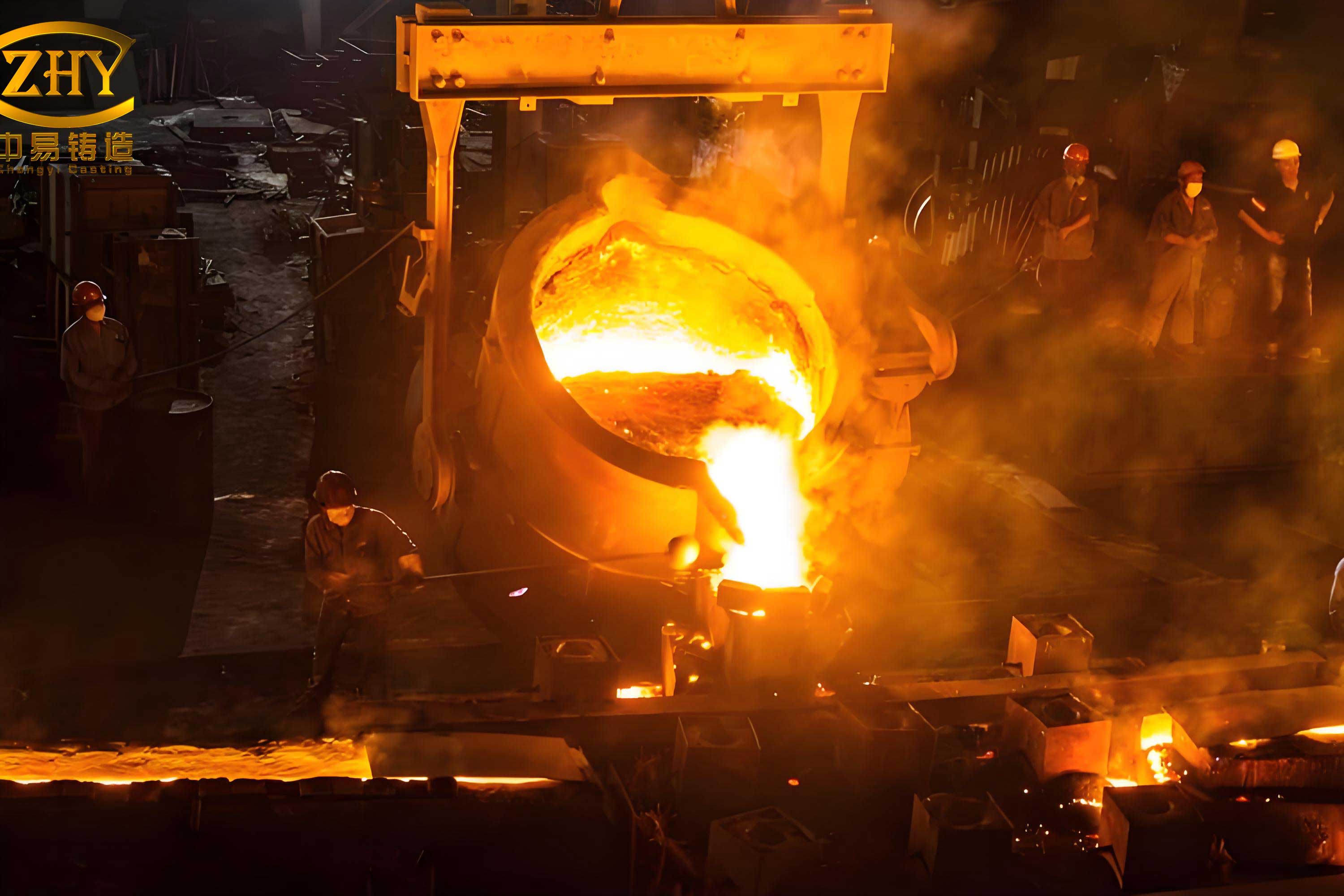
This can be mathematically framed. The total volume change ($\Delta V_{total}$) during casting solidification is the sum of liquid contraction ($\Delta V_{lc}$), solidification shrinkage ($\Delta V_{ss}$), and graphite expansion ($\Delta V_{ge}$):
$$\Delta V_{total} = \Delta V_{lc} + \Delta V_{ss} + \Delta V_{ge}$$
In an ideal balanced state, the expansion offsets the shrinkage, minimizing the external feeding requirement:
$$\Delta V_{ss} + \Delta V_{lc} \approx – \Delta V_{ge}$$
The practical implementation involves several synergistic techniques:
- Riser Design: Transitioning from large, hot risers to smaller, non-feeding risers or even riser-less designs. The riser neck is designed to freeze early, isolating the casting from the riser and forcing the internal expansion to work within the mold cavity.
- Gating System: Adopting a top-pouring, shower-gate system. This promotes a favorable temperature gradient and allows for a more controlled fill. The small, dispersed ingates prevent the formation of new thermal nodes.
- Chill Application: Strategic placement of chills (metal inserts) in heavy sections (hot spots) is paramount. Chills accelerate local cooling, eliminate thermal gradients that cause shrinkage porosity, and critically, enhance the overall mold rigidity. A rigid mold is essential to contain and utilize the internal graphite expansion pressure for self-feeding.
The quantitative outcome of applying this balanced approach to a complex component like a ductile iron gear wheel is dramatic. The following table contrasts the key performance indicators before and after the process optimization:
| Performance Indicator | Traditional Process (Large Hot Riser) | Optimized Balanced Process |
|---|---|---|
| Process Yield | 60% – 70% | > 90% |
| Overall Scrap Rate | ~30% | < 3% |
| Major Defect | Shrinkage porosity at hub/rim junctions | Effectively Eliminated |
| Feeding Mechanism | Heavy reliance on external riser | Internal self-feeding aided by small risers/chills |
This philosophy extends beyond the metallurgical process to the very tooling that enables complex sand casting. The assembly of sand cores for intricate castings like engine cylinder blocks is a pivotal step where precision dictates final part quality. An optimized core assembly jig is not just a holder; it is a precision fixture that ensures dimensional accuracy, core stability, and operator efficiency. Based on my work, I advocate for a design approach grounded in principles of ergonomics, structural efficiency (informed by concepts like the Golden Ratio for proportion), and performance theory.
Let’s consider the design of a jig for a cylinder block. The primary objectives are rigidity to prevent deflection, ease of core placement and clamping, and longevity under production conditions. The structural optimization can be broken down into its major components:
| Jig Component | Traditional/Non-Optimized Design | Optimized Design Principles | Key Benefit |
|---|---|---|---|
| Main Frame (Bed) | Heavy, solid-plate construction or complex cast iron frame. | Welded steel frame with strategic lightening holes. Pillar height and placement designed using ergonomic data for operator comfort. | Reduced weight, improved stiffness-to-weight ratio, easier operator handling, faster fabrication. |
| Main Core Support Frame | Single, large welded steel structure prone to welding distortion. | Modular cast iron (e.g., HT250) sections bolted together. Cast iron offers better damping and stability. | Minimized distortion, enhanced rigidity, simplified machining of individual modules. |
| Sliding Support for Water Jacket Cores | Bulky block with minimal consideration for stress distribution. | Cast frame with wall thickness optimized using performance theory. Boss dimensions for linear bearings designed for optimal load paths. | High “specific strength,” reduced material usage, lower inertial mass for sliding components. |
| Locating Pin & Bushing Housing | Solid cylindrical stock with large mounting flange, fully machined. | Combination of precision tubing for the bore and a separate, simple mounting flange. High material utilization. | Material savings of 50-55%, significantly reduced machining time and cost. |
| Fasteners & Details | Assorted standard hex bolts and nuts protruding above surfaces. | Systematic use of counterbored holes and socket head cap screws (SHCS). Flush or recessed installations. | Clean, safe aesthetic; reduced snag points; easier cleaning; streamlined maintenance. |
The choice of materials is critical. For frames subject to static loads, cast iron provides superior vibrational damping and stability compared to welded steel, which can harbor residual stresses. The design of sliding mechanisms must account for wear. Using standard linear bearings and hardened guide rods is far more reliable and maintainable than homemade slide ways. The guiding principle is to design for “ease of use” and “ease of maintenance.” Every bolt should be accessible with a standard set of tools, and components subject to wear should be easily replaceable without dismantling the entire fixture.
The mathematical consideration for jig design often revolves around stiffness and deflection. For a simple beam-like element in the jig frame, the deflection ($\delta$) under a centralized load ($P$) is given by:
$$\delta = \frac{P L^3}{48 E I}$$
Where $L$ is the length, $E$ is the modulus of elasticity of the material, and $I$ is the area moment of inertia of the cross-section. The optimization process involves manipulating the cross-section (increasing $I$) through intelligent geometric design—like adding ribs or creating box sections—rather than merely increasing mass. This is where the concept of “specific stiffness” ($E/\rho$, where $\rho$ is density) and efficient cross-sectional design (high $I$ per unit area) becomes paramount.
Returning to the sand casting process itself, the success of both the optimized feeding technique and the precision core assembly is ultimately locked in by the quality of the mold and core materials. The “three hardware, one software” rule is indispensable:
- Pattern Equipment: Must be dimensionally accurate, have an excellent surface finish, and incorporate proper draft. For core boxes, precise venting is non-negotiable to ensure complete and uniform curing of resin-bonded cores.
- Base Sand: The quality of the raw silica sand (or alternative like zircon) is fundamental. It must have consistent grain size distribution (AFS GFN), be low in impurities (especially alkalis), and have a controlled, low moisture content. The formula for calculating the surface area of sand grains, which influences resin demand, is conceptually important.
- Coating: A high-quality refractory coating (zircon, graphite-based) is applied to the mold and core surfaces. Its viscosity, density, and application thickness must be strictly controlled to prevent metal penetration and ensure a clean casting surface. The coating’s ability to withstand the thermal shock of molten metal is critical.
- Process Management (The Software): This is the overarching system that controls everything: the mixing ratios of resin and catalyst (with tolerances often within ±0.2%), the mixing time and efficiency, the strip time of molds/cores, the baking of coatings, and the environmental control (temperature, humidity) in the foundry. Without rigorous, documented process control, all the optimal hardware designs are rendered ineffective.
In conclusion, advancing sand casting technology is a holistic endeavor. It requires a synergistic application of foundational metallurgical science, like Balanced Solidification, to manage the internal behavior of the metal. Simultaneously, it demands an engineering mindset toward the tooling and processes that shape the sand mold itself. By viewing the mold assembly fixture as a precision device worthy of optimization for stiffness, ergonomics, and maintainability, we can achieve the dimensional consistency required for complex castings. Finally, none of this is possible without treating the sand system—the very namesake of the sand casting process—with the scientific rigor it demands. It is through this integrated approach, combining theory, mechanical design, and stringent process control, that we can consistently produce high-integrity castings with exceptional yield and reliability, truly unlocking the potential of this ancient yet perpetually modern manufacturing method.