
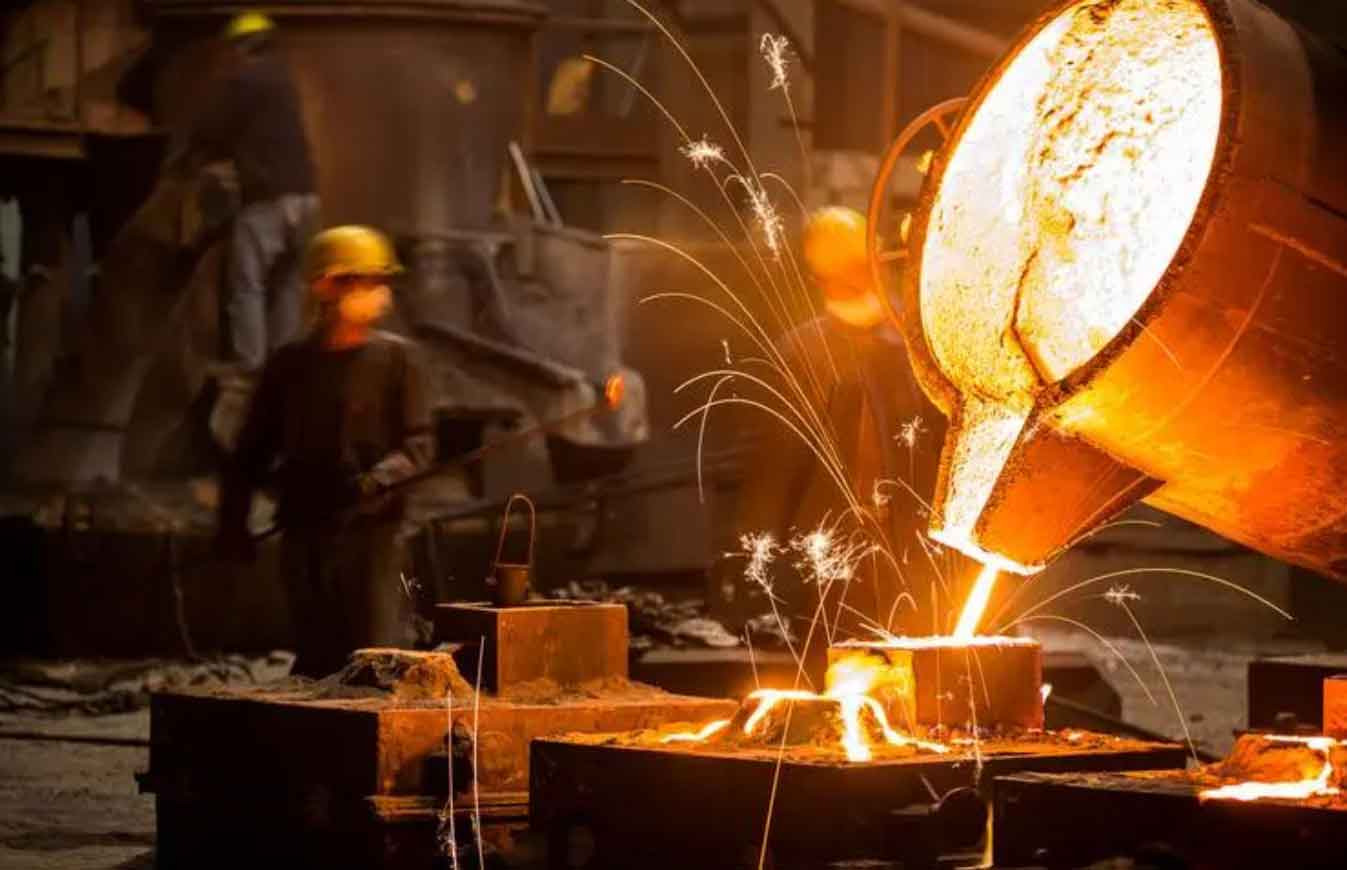
In magnesium alloy sand casting processes, resin-bonded sand formulations significantly influence casting quality and production efficiency. This study investigates the synergistic effects of furan resin, catalyst, flame retardant, and silane additives through systematic parameter optimization and performance testing.
1. Experimental Design for Sand Casting Materials
The resin sand system comprised silica sand (AFS 55-60) with the following additive composition ranges:
| Component | Function | Weight Percentage |
|---|---|---|
| Furan Resin | Binder | 0.8-2.0% |
| Phosphoric Acid Catalyst | Curing Agent | 25-50% of resin |
| Boron-based Flame Retardant | Combustion Suppression | 1-3% |
| Aminosilane Coupling Agent | Interfacial Modification | 0.2-0.5% |
The hardening kinetics of resin sand can be modeled using modified Arrhenius equation:
$$ t_c = A \cdot e^{\frac{E_a}{RT}} \cdot \left(\frac{[C]}{[R]}\right)^n $$
Where:
$t_c$ = Curing time (min)
$[C]$/[R] = Catalyst-resin ratio
$E_a$ = Activation energy (kJ/mol)
2. Performance Optimization in Sand Casting Systems
Key parameters for sand casting process control were established through response surface methodology:
| Parameter | Optimal Range | Quality Impact |
|---|---|---|
| Bench Life | 35-45 min | Molding Efficiency |
| Stripping Time | 55-65 min | Pattern Integrity |
| 24h Compressive Strength | 0.7-0.9 MPa | Mold Stability |
| High-Temperature Collapse | >85% @700°C | Shakeout Performance |
The strength development follows the curing progression equation:
$$ \sigma(t) = \sigma_{\infty} \left(1 – e^{-kt}\right) + \sigma_0 $$
Where:
$\sigma_{\infty}$ = Ultimate strength
$k$ = Curing rate constant
$\sigma_0$ = Initial green strength
3. Gas Defect Mitigation in Sand Casting
Reducing gas-related defects requires balancing binder chemistry and process parameters:
| Factor | Control Method | Defect Reduction |
|---|---|---|
| Resin:N Ratio | Maintain <1.5:1 | ↓ N-induced porosity |
| Free Methanol | <0.5% in resin | ↓ Gas evolution |
| Sand Temperature | 25±5°C | ↑ Curing uniformity |
The gas generation potential can be estimated using:
$$ Q_g = \alpha R^{0.8}C^{1.2}e^{\beta T} $$
Where:
$Q_g$ = Gas volume (mL/g)
$R$ = Resin content (%)
$C$ = Catalyst ratio
4. Economic and Environmental Considerations
Optimized formulations demonstrate significant advantages in sand casting operations:
| Parameter | Baseline | Optimized | Improvement |
|---|---|---|---|
| Resin Consumption | 1.8% | 1.2% | 33% Reduction |
| VOC Emissions | 2.1 kg/t | 1.4 kg/t | 33% Reduction |
| Core Production Rate | 45 cores/hr | 58 cores/hr | 29% Increase |
The cost-benefit relationship follows:
$$ C_{total} = C_m + C_e + C_d $$
Where:
$C_m$ = Material costs
$C_e$ = Energy consumption
$C_d$ = Defect-related costs
5. Process Window Optimization
The operational envelope for magnesium sand casting was established through design of experiments:
| Variable | Lower Limit | Upper Limit |
|---|---|---|
| Resin Content (%) | 0.9 | 1.5 |
| Catalyst Ratio | 30% | 45% |
| Silane Addition | 0.3% | 0.5% |
| Mixing Time (s) | 25 | 40 |
These parameters ensure optimal sand casting performance while maintaining process stability and repeatability in industrial applications.