
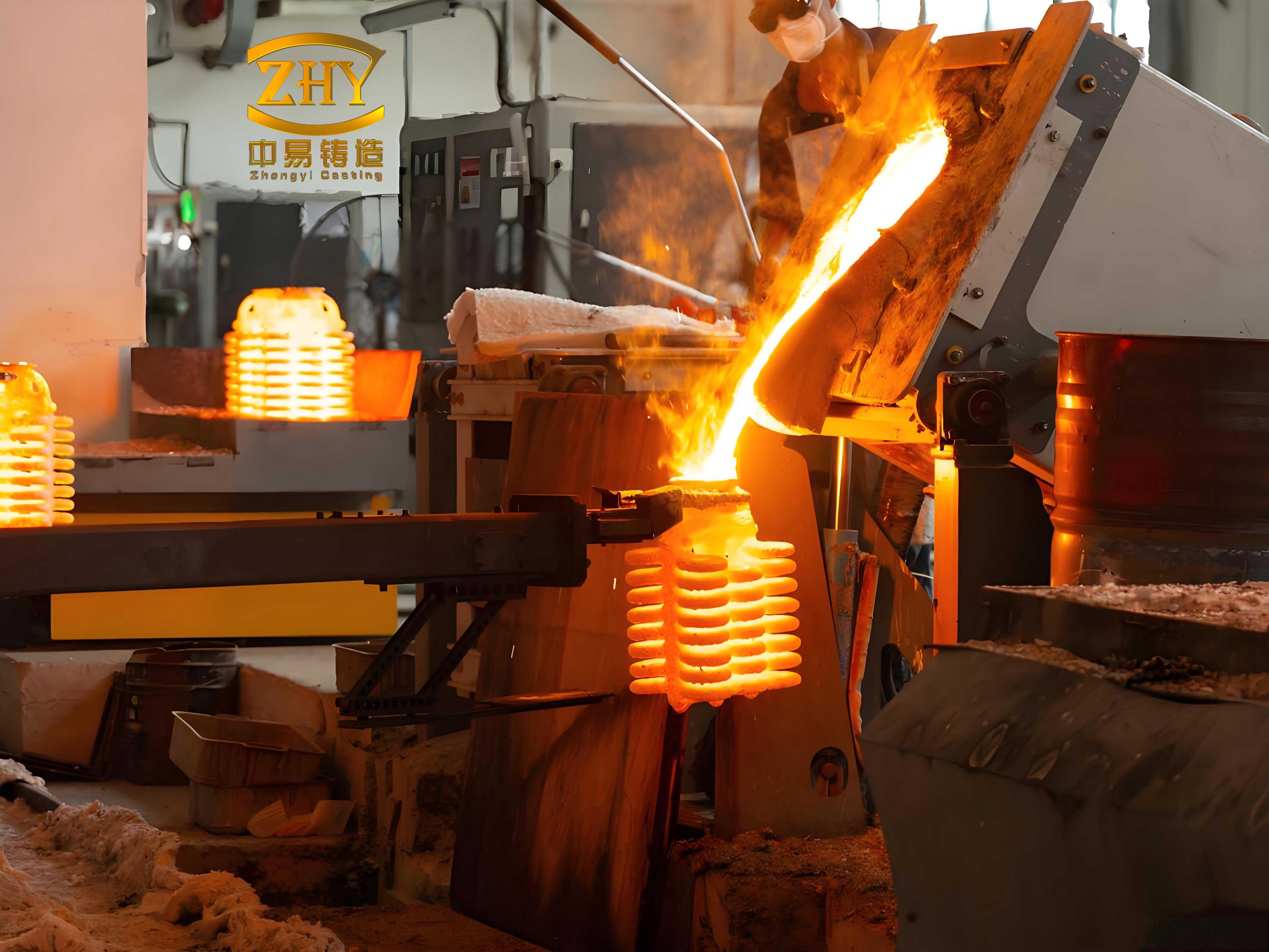
In my extensive experience with the investment casting process, I have consistently observed that achieving high-integrity castings free from defects like shrinkage porosity and cavities requires meticulous attention to both process parameters and, crucially, the inherent design of the casting itself. Unlike conventional sand casting, where foundry engineers can liberally employ external and internal chills, multiple risers, and extensive gating systems, the investment casting process imposes unique constraints. The very nature of the process—where patterns are assembled into clusters or “trees” and a single, often substantial, central sprue serves the dual purpose of a pouring basin and a feeding riser for the entire assembly—limits the traditional arsenal of corrective measures. This fundamental characteristic of the investment casting process makes the initial casting geometry a paramount factor in determining final quality. Therefore, I advocate that one of the most effective and straightforward pathways to superior castings is through strategic modification of the casting’s structural design to enhance its inherent castability. This approach often proves more efficient than complex gating redesigns, leading to improved yield, reduced finishing labor, and consistently sound components.
The core challenge in the investment casting process, as in all casting, is managing solidification shrinkage. Metal contracts as it transitions from liquid to solid, and if this volumetric loss is not continuously fed with molten metal from a reservoir (the riser or sprue), shrinkage defects form. The key is to establish a directional solidification pattern, where the section farthest from the feeder solidifies first, and the feeder itself solidifies last. Any interruption in this sequence, often caused by premature freezing of a thin section acting as a “feeding path,” leads to isolated hot spots and internal shrinkage. The investment casting process, with its ceramic shell acting as an excellent insulator, can sometimes exacerbate local hot spots, making design-driven solutions even more critical.
One of the most powerful techniques I frequently employ is the judicious addition of feeding or padding ribs. These are not structural ribs in the traditional sense but are sacrificial geometries added solely to ensure a robust thermal pathway for feeding. Consider a typical valve cover casting. The initial design featured a lower hub with a significant thermal mass (a hot spot of approximately φ20.5 mm) and an upper flange connected by a thin annular section of only 9.5 mm thickness. In the investment casting process setup with a top feeder, this thin section would freeze rapidly, isolating the lower hub from the feeding source. The result was a predictable annular shrinkage cavity in the hub. The solution was not to add more metal to the feeder—which reduces yield—but to modify the design. By strategically enlarging two of the existing small radius ribs (from R3.15 mm to R9.5 mm) connecting the hub to the flange, we effectively created dedicated feeding channels. These “feeding ribs” have a cross-section comparable to the hot spot they are intended to feed, thereby maintaining an open feeding path for a significantly longer period during solidification. This simple redesign leveraged the existing investment casting process setup without alteration and eliminated the defect entirely.
The effectiveness of a feeding rib can be rationalized by considering the solidification time, governed by Chvorinov’s rule. The solidification time \( t_f \) for a section is proportional to the square of its volume-to-surface area ratio, the modulus \( m \):
$$ t_f = k \cdot m^2 = k \cdot \left( \frac{V}{A} \right)^2 $$
where \( k \) is the mold constant specific to the investment casting process shell material and metal being poured. For a feeding rib to remain open longer than the hot spot it feeds, its modulus must be equal to or greater than that of the hot spot. For a cylindrical hot spot of diameter \( D_h \), the modulus is approximately \( D_h / 6 \) if we consider it as a sphere or a short cylinder. For a rib with a semicircular cross-section of radius \( R_r \), the modulus calculation is more complex, but the design goal is to ensure \( m_{rib} \geq m_{hotspot} \). This principle guides the sizing of such features within the investment casting process framework.
| Design Feature | Original Design | Modified Design | Key Parameter Change | Effect on Solidification Sequence |
|---|---|---|---|---|
| Connecting Rib Radius | R3.15 mm | R9.5 mm | Radius increased by ~200% | Modulus increased, extending feeding path life, enabling directional solidification from hub to feeder. |
| Thermal Center (Hot Spot) | φ20.5 mm hub | φ20.5 mm hub | Unchanged | Now effectively fed through high-modulus ribs, preventing isolated shrinkage. |
| Process Intervention | None required to the standard investment casting process tree assembly or shell building. Design change integrated into the wax pattern. | |||
Another common scenario in the investment casting process involves castings with multiple, separated hot spots where adding external ribs is geometrically impossible or aesthetically unacceptable. Here, the solution often lies within strategically increasing machining allowances. I recall a pressure-rated valve cover where a thin wall (7.5 mm) between two heavier sections acted as a barrier to feeding. The lower section consistently exhibited shrinkage. The external profile could not be altered per customer specifications. However, the adjacent surface was a machined face with a nominal 0.5 mm allowance. By negotiating an increase of this allowance—effectively increasing the wall thickness from 7.5 mm to 11.5 mm—we transformed that barrier into a reliable feeding channel. This modification served a dual purpose: it provided a path for feeder metal to reach the lower hot spot, and it also marginally increased the cross-sectional area of the feeder channel itself, enhancing its feeding efficiency. The solidification pattern was successfully steered towards a directional one, and all castings passed stringent radiographic inspection. This approach underscores a key synergy between design for manufacture (DFM) and the investment casting process, where designated stock allowance can be optimized not just for finishing but for casting soundness.
A more extreme but equally valid application of this principle is encountered with small, deep internal features. In one instance, a valve cover with a very small internal diameter exhibited severe shrinkage on the inner bore surface. The small bore, once filled with ceramic shell, created an insulated core that retained heat, exacerbating the hot spot. While increasing the wall thickness around it was an option, it would have made the already small hole even smaller, complicating shell drainage and core removal in the investment casting process. The most effective solution was to design the part as a solid block for casting and subsequently drill the required hole. This eliminated the problematic internal thermal mass altogether, simplified the investment casting process, and guaranteed a sound casting. The cost of a secondary drilling operation was far outweighed by the elimination of scrap and the assurance of quality.
The following table summarizes the economic and technical rationale for using increased machining allowances versus other methods in the investment casting process.
| Strategy | Typical Application | Impact on Casting Yield | Impact on Finishing Labor | Process Complexity | Key Consideration |
|---|---|---|---|---|---|
| Add External Feeding Ribs | External hot spots with accessible geometry | Minimal decrease (ribs are often small) | Increase (ribs must be removed if not part of design) | Low (wax pattern modification) | Must be approved by customer if altering external shape. |
| Increase Machining Allowance | Sections that are already machined, acting as feeding barriers | Negligible to slight decrease | Increase (more material to machine) | Very Low | Requires customer agreement on revised drawing. Optimal balance between added metal and scrap reduction. |
| Fill Internal Cavities (Cast Solid) | Small, deep holes or complex internal passages that act as major hot spots | Significant decrease (more metal cast) | Significant increase (drilling/ machining required) | Reduces casting process complexity | Overall cost-benefit analysis needed. Often the only reliable solution for soundness in complex investment casting process parts. |
| Redesign Gating/Riser System | General approach when design change is not possible | Can significantly decrease (larger feeders) | Increase (larger feeders to cut and grind) | High (new tooling trials, shell tree redesign) | First resort when design is frozen, but often less efficient than a smart design change. |
A third critical aspect of casting design for the investment casting process is the management of junction geometry and fillet radii. Sharp corners and improperly sized fillets are notorious for creating localized heat concentration, leading to shrinkage porosity, hot tears, and surface sinks. A classic example is a drain base casting where a horizontal flange met vertical walls at a junction. The original design specified a small upper fillet (R5) and an identical lower fillet (R5) where the walls met. This configuration created two problems: first, the small upper fillet did little to mitigate the sharp thermal corner between the walls and the flange, creating a zone of slow heat dissipation. Second, the combination of the two R5 fillets effectively created a hidden, bulky thermal mass at the junction—a hot spot larger than the nominal wall thickness—with no possibility of direct feeding. The result was shrinkage porosity and surface depression in the flange above this junction.
The redesign focused on thermal geometry management. The upper fillet was increased to R8, promoting a gentler, more progressive junction that improves heat transfer away from the corner and reduces stress concentration. More importantly, the lower fillet was dramatically increased to R18, made concentric with the new upper fillet. This transformation changed the geometry from one with a hidden hot spot to one where the connecting walls now formed a near-uniform cross-section transition. The local modulus was equalized, eliminating the isolated thermal center. The governing principle here can be related to the concept of the “inscribed circle” method for identifying hot spots. The diameter \( D_{ic} \) of the largest circle that can be inscribed at a junction is a direct indicator of the thermal mass. For a T-junction of equal wall thickness \( T \), with fillet radii \( R \), the inscribed circle diameter can be approximated. The modification aimed to minimize \( D_{ic} \) or, more accurately, to integrate the junction’s mass into a continuous, feedable section. The relationship between wall thickness \( T \), fillet radius \( R \), and the effective thermal diameter \( D_{eff} \) can be conceptualized as:
$$ D_{eff} \propto T + 2R – \sqrt{(2R)^2 – (T/2)^2} \quad \text{(for illustrative purposes)} $$
While the exact formula is geometry-specific, the design intent is clear: increase \( R \) to smooth the thermal gradient and integrate the junction into the overall feeding system. This redesign, implemented within the standard investment casting process, virtually eliminated the defects.
The success of these design modifications is deeply rooted in the fundamental physics of solidification within the investment casting process. To generalize the approach, we can model the feeding requirement. The total volumetric shrinkage \( V_{shrink} \) that must be fed is a product of the casting volume \( V_{casting} \) and the alloy’s shrinkage factor \( \beta \):
$$ V_{shrink} = \beta \cdot V_{casting} $$
For steel, \( \beta \) is typically around 3-6%. The feeder(s) must provide this volume. However, the feeder can only deliver this metal if a liquid pathway exists. The critical factor is the feeding path length \( L_{fp} \), which is the distance from the edge of the feeder to the point being fed through a section of modulus \( m_{path} \). A rule of thumb for soundness is that the solidification time of the path must be longer than that of the section it feeds. Using Chvorinov’s rule, this translates to:
$$ \left( \frac{V}{A} \right)_{path} \geq \left( \frac{V}{A} \right)_{hotspot} $$
Therefore, when we modify a design by adding a feeding rib or thickening a wall, we are directly increasing the \( (V/A) \) ratio of the feeding path to meet or exceed that of the hot spot. This is the quantitative foundation for the empirical successes described. The investment casting process, with its precise replication of wax patterns, is exceptionally well-suited to implementing these subtle but critical geometrical changes.
Furthermore, the sequential nature of the investment casting process—pattern assembly, shell building, dewaxing, firing, pouring—means that any design change is embedded at the very first stage (pattern making) and propagates flawlessly through the entire chain. This contrasts with sand casting, where mold assembly variations can introduce inconsistencies. Therefore, a design-based solution in investment casting process is exceptionally reliable and repeatable.
In conclusion, through years of practice and problem-solving, I have found that proactive collaboration between the foundry engineer and the product designer at the earliest stages yields the greatest rewards in the investment casting process. Rather than resorting to complex and yield-reductive gating solutions as a first step, we should exhaustively analyze the casting geometry for inherent castability. The strategic addition of feeding ribs, the intelligent specification of machining allowances to serve dual purposes, and the careful design of junctions and fillets are powerful tools in our arsenal. These modifications align the component’s geometry with the natural laws of solidification, harnessing the precision of the investment casting process to produce reliably sound, high-quality castings. This philosophy not only improves quality but also enhances overall manufacturing efficiency, reducing scrap, minimizing finishing work, and ensuring that the full potential of the investment casting process is realized for every component we produce.