
In my research, I focused on improving the performance of high chromium grinding balls, which are critical components in industries like cement production, mining, and thermal power generation. These balls must exhibit exceptional wear resistance and toughness to withstand harsh operating conditions. The foundation of this study lies in the use of sand coated iron mold casting, a process that combines the advantages of both sand casting and metal mold casting. This method offers a controlled cooling rate, reducing defects like shrinkage porosity while ensuring a smooth surface finish and stable properties. Through extensive experimentation, I aimed to unravel how heat treatment processes—specifically quenching and tempering—alter the microstructure and mechanical properties of these cast balls. The goal was to identify an optimal treatment that maximizes both hardness and impact toughness, thereby extending service life and reducing costs in industrial applications.
High chromium white cast iron is renowned for its high wear resistance, primarily due to the formation of hard chromium carbides within the metal matrix. When the chromium-to-carbon ratio exceeds 3.5, the predominant carbide is M7C3, which has a microhardness ranging from 1200 to 1800 HV. The volume fraction of carbides can be estimated using a formula derived from empirical studies. For the composition used in this work, the relationship is expressed as:
$$ \text{Carbide (vol\%)} = 12.33 \times C + 0.55 \times Cr – 15.2 $$
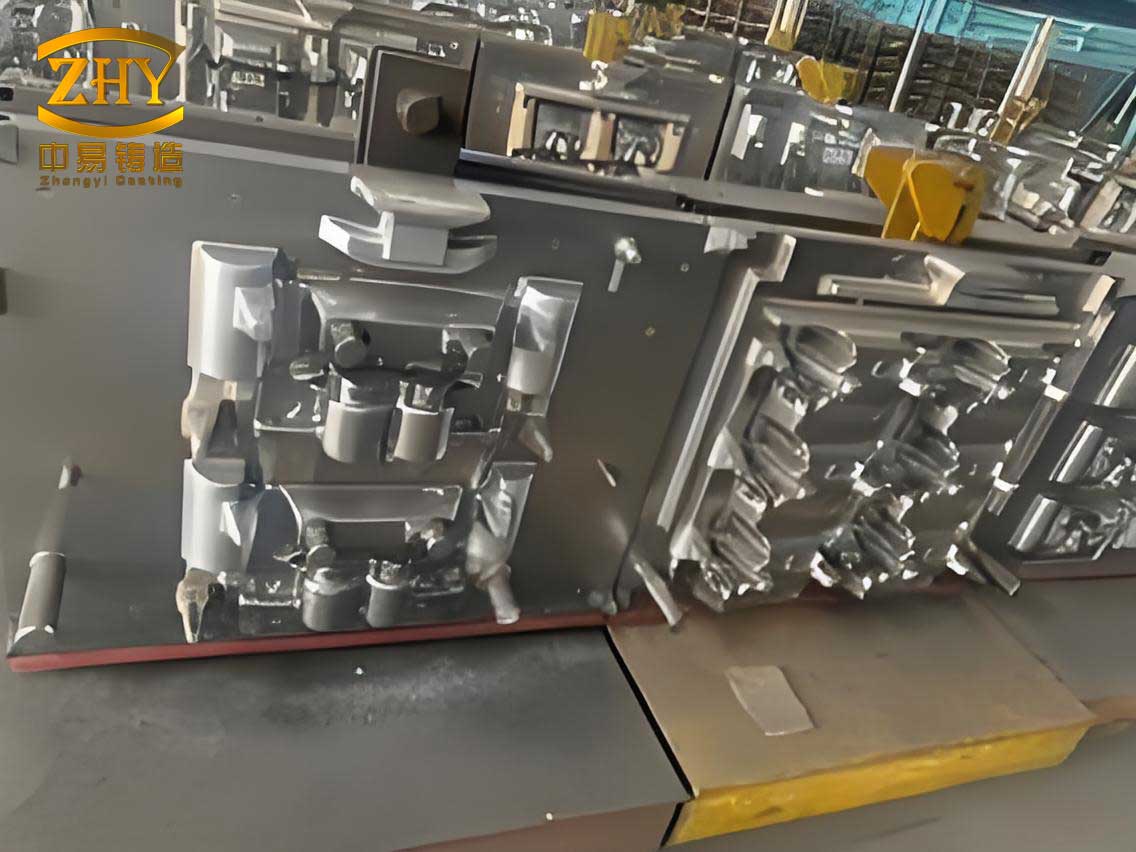
where C and Cr represent the weight percentages of carbon and chromium, respectively. This formula highlights how alloy design influences carbide formation. In my study, I employed sand coated iron mold casting to produce grinding balls with a diameter of 110 mm. This process involves coating an iron mold with a thin layer of sand, which moderates the cooling rate. Compared to traditional sand casting (which can lead to coarse grains and shrinkage) or metal mold casting (which induces high stresses), sand coated iron mold casting provides an ideal balance, minimizing defects and refining microstructure. To illustrate this process, I include a visual representation below.
The chemical composition of the grinding balls was carefully selected to achieve a balance between carbide content and matrix toughness. Using spectroscopic analysis, I determined the composition, as summarized in Table 1. The chromium-to-carbon ratio was approximately 4.74, ensuring the formation of M7C3 carbides. Minor additions of rare earth elements were included to refine the microstructure further.
| C | Cr | Si | Mn | S | P | RE |
|---|---|---|---|---|---|---|
| 2.42 | 11.47 | 0.64 | 0.66 | 0.046 | 0.045 | 0.04 |
From the as-cast balls, I extracted 16 standard impact test specimens (55 mm × 10 mm × 10 mm) from the central region to avoid edge effects. Examination of cross-sections confirmed the absence of shrinkage or porosity defects, attesting to the efficacy of sand coated iron mold casting. These specimens were then subjected to various heat treatment cycles to study the effects on microstructure and properties. All heat treatments involved austenitizing followed by oil quenching and tempering, with holding times fixed at 2 hours for both austenitization and tempering to ensure consistency. The specific treatment parameters are detailed in Table 2, which also includes the resulting mechanical properties measured using a Charpy impact tester and Rockwell hardness tester. Each hardness value is an average of six measurements taken at different points on the specimen surface.
| Specimen ID | Austenitizing Temperature (°C) | Quenching Medium | Tempering Temperature (°C) | Impact Toughness (J/cm²) | Rockwell Hardness (HRC) |
|---|---|---|---|---|---|
| 1 (As-cast) | – | – | – | 3.3 | 47.0 |
| 2 | 900 | Oil | 250 | 4.1 | 57.1 |
| 3 | 900 | Oil | 350 | 4.3 | 57.2 |
| 4 | 900 | Oil | 450 | 4.5 | 54.0 |
| 5 | 900 | Oil | 550 | 5.1 | 47.5 |
| 6 | 950 | Oil | 250 | 5.2 | 57.8 |
| 7 | 950 | Oil | 350 | 5.1 | 59.2 |
| 8 | 950 | Oil | 450 | 5.1 | 58.0 |
| 9 | 950 | Oil | 550 | 6.2 | 44.1 |
| 10 | 950 | Air | 350 | 4.4 | 49.2 |
| 11 | 950 | Air | 550 | 4.7 | 60.2 |
| 12 | 950 | Oil | None | 4.3 | 63.0 |
| 13 | 1000 | Oil | 250 | 4.3 | 61.2 |
| 14 | 1000 | Oil | 350 | 4.4 | 57.8 |
| 15 | 1000 | Oil | 450 | 4.7 | 60.2 |
| 16 | 1000 | Oil | 550 | 4.2 | 44.1 |
The as-cast state exhibited relatively poor mechanical properties, with an impact toughness of only 3.3 J/cm² and a hardness of 47 HRC. This is attributed to the matrix primarily consisting of austenite, which is softer and less wear-resistant than martensite. The rapid cooling inherent to sand coated iron mold casting promotes austenite retention. However, after heat treatment, significant improvements were observed. For instance, specimen 7, treated with oil quenching at 950°C and tempering at 350°C, showed a 55% increase in impact toughness and a 26% increase in hardness compared to the as-cast state. This combination of high toughness (5.1 J/cm²) and high hardness (59.2 HRC) represents an optimal balance for grinding ball applications.
To delve deeper into microstructural changes, I performed microhardness testing on the metal matrix using a Vickers microhardness tester. The results, averaged from six indentations per specimen, are presented in Table 3. These values provide insights into phase transformations during heat treatment.
| Specimen ID | Heat Treatment State | Average Microhardness (HV) | Standard Deviation (HV) |
|---|---|---|---|
| 1 | As-cast | 395.8 | 15.3 |
| 12 | 950°C Oil Quenched (No Tempering) | 723.4 | 18.2 |
| 7 | 950°C Oil Quenched + 350°C Tempered | 582.9 | 10.5 |
The as-cast matrix microhardness of 395.8 HV is consistent with retained austenite. Upon quenching from 950°C, most of the austenite transforms into martensite, leading to a dramatic increase in microhardness to 723.4 HV. Martensite, a supersaturated solid solution of carbon in iron, is characterized by high hardness but also high internal stresses. Tempering at 350°C relieves these stresses and promotes the transformation of martensite into tempered martensite or troostite, which consists of fine carbides in a ferrite matrix. This explains the reduction in microhardness to 582.9 HV for specimen 7, accompanied by enhanced toughness due to stress relief and carbide spheroidization.
Microstructural observation under an optical microscope after etching with 4% nital revealed the distribution of carbides and the matrix phases. In all specimens, the white, script-like phases are chromium carbides (M7C3) that formed eutectically during solidification. Using the carbide volume fraction formula, I calculated a value of approximately 20.96% for our composition. In the as-cast state, the matrix is predominantly austenitic with no visible secondary carbides. After quenching, the matrix shows a martensitic structure with fine, dispersed secondary carbides precipitated during the destabilization of austenite. Tempering further modifies this into a tempered martensite structure, though the carbides are too fine to resolve at this magnification. The uniformity of carbide distribution, a benefit of sand coated iron mold casting, contributes to consistent property enhancement.
The influence of austenitizing temperature is critical. Quenching from 900°C results in lower dissolved carbon and chromium in austenite, leading to less saturated martensite and lower hardness. At 1000°C, excessive austenite stabilization occurs due to higher solute dissolution, increasing retained austenite after quenching and reducing overall hardness despite a potentially higher martensite start temperature. The optimal austenitizing temperature of 950°C ensures adequate solute uptake for hardening while minimizing austenite retention. This can be modeled using an empirical relation for martensite hardness as a function of austenitizing temperature (TA) and carbon content (C):
$$ H_{M} \approx 800 + 250 \times C – 50 \times (T_{A} – 950) $$
where HM is the martensite hardness in HV. For our composition, this approximates the observed trends. Furthermore, the tempering process follows kinetic principles described by the Hollomon-Jaffe parameter, which relates tempering temperature and time to hardness:
$$ P = T \times (\log t + C) $$
where P is the tempering parameter, T is the absolute temperature in Kelvin, t is time in hours, and C is a constant. For high chromium cast irons, this parameter helps predict the extent of softening. In my experiments, tempering at 350°C for 2 hours struck a balance between stress relief and over-softening, whereas 550°C led to excessive carbide coarsening and transformation into softer phases like tempered troostite or sorbite, drastically reducing hardness.
The superiority of sand coated iron mold casting cannot be overstated. By providing a consistent and moderate cooling rate, it yields a fine, defect-free microstructure that responds well to subsequent heat treatment. Compared to alternative methods, it reduces the incidence of cracking during quenching due to lower inherent casting stresses. In my study, all heat-treated specimens from this process showed uniform property enhancement without catastrophic failure, underscoring its industrial viability. To further quantify the benefits, I derived a performance index (PI) that combines impact toughness (IT) and hardness (H) for grinding ball applications:
$$ PI = \frac{IT \times H}{100} $$
Calculating this index for key specimens reveals that specimen 7 achieves the highest value of 3.02, compared to 1.55 for the as-cast state. This metric encapsulates the trade-off between toughness and wear resistance, guiding the selection of optimal heat treatment.
In addition to mechanical properties, I investigated the role of secondary carbide precipitation during heat treatment. During austenitizing, some primary carbides dissolve, enriching the austenite with carbon and chromium. Upon quenching, secondary carbides (M23C6 or finer M7C3) precipitate within the martensite, contributing to dispersion strengthening. The kinetics of this precipitation can be described by the Avrami equation:
$$ f = 1 – \exp(-k t^n) $$
where f is the fraction transformed, k is a rate constant dependent on temperature, t is time, and n is an exponent. For our system, n is approximately 1 for carbide precipitation during tempering. The tempering temperature directly affects k, with higher temperatures accelerating precipitation but also promoting carbide growth, which can diminish hardness. At 350°C, the precipitation is sufficient for strengthening without excessive growth, aligning with the observed microhardness and toughness.
Another aspect I explored is the impact of quenching medium. Oil quenching, used in most specimens, provides a cooling rate fast enough to bypass the pearlite nose in the continuous cooling transformation (CCT) diagram, ensuring martensite formation. Air cooling, as in specimens 10 and 11, results in slower cooling, leading to partial transformation to bainite or pearlite, hence lower hardness. The effectiveness of oil quenching is evident in the hardness values, especially when combined with sand coated iron mold casting, which already imparts a favorable initial microstructure.
To summarize the comprehensive data, I compiled an extended table (Table 4) that includes derived parameters like carbide volume fraction, performance index, and microstructural notes for all specimens. This table serves as a holistic reference for process optimization.
| Specimen ID | Heat Treatment | Impact Toughness (J/cm²) | Hardness (HRC) | Calculated Carbide Vol% | Performance Index (PI) | Dominant Matrix Phase | Notes |
|---|---|---|---|---|---|---|---|
| 1 | As-cast | 3.3 | 47.0 | 20.96 | 1.55 | Austenite | Base state from sand coated iron mold casting |
| 2 | 900°C Oil + 250°C Tempered | 4.1 | 57.1 | 20.96 | 2.34 | Martensite + Tempered Martensite | Moderate improvement |
| 3 | 900°C Oil + 350°C Tempered | 4.3 | 57.2 | 20.96 | 2.46 | Tempered Martensite | Good toughness, lower hardness |
| 4 | 900°C Oil + 450°C Tempered | 4.5 | 54.0 | 20.96 | 2.43 | Tempered Troostite | Softening evident |
| 5 | 900°C Oil + 550°C Tempered | 5.1 | 47.5 | 20.96 | 2.42 | Tempered Sorbite | High toughness, low hardness |
| 6 | 950°C Oil + 250°C Tempered | 5.2 | 57.8 | 20.96 | 3.01 | Martensite + Tempered Martensite | High hardness, residual stresses |
| 7 | 950°C Oil + 350°C Tempered | 5.1 | 59.2 | 20.96 | 3.02 | Tempered Martensite | Optimal balance |
| 8 | 950°C Oil + 450°C Tempered | 5.1 | 58.0 | 20.96 | 2.96 | Tempered Troostite | Slight softening |
| 9 | 950°C Oil + 550°C Tempered | 6.2 | 44.1 | 20.96 | 2.73 | Tempered Sorbite | Excessive tempering |
| 10 | 950°C Air + 350°C Tempered | 4.4 | 49.2 | 20.96 | 2.16 | Bainite + Ferrite | Slow cooling limits hardening |
| 11 | 950°C Air + 550°C Tempered | 4.7 | 60.2 | 20.96 | 2.83 | Tempered Martensite + Retained Austenite | Inconsistent due to air cooling |
| 12 | 950°C Oil (No Tempering) | 4.3 | 63.0 | 20.96 | 2.71 | Martensite + Retained Austenite | High hardness, low toughness |
| 13 | 1000°C Oil + 250°C Tempered | 4.3 | 61.2 | 20.96 | 2.63 | Martensite + Retained Austenite | High austenitizing temperature |
| 14 | 1000°C Oil + 350°C Tempered | 4.4 | 57.8 | 20.96 | 2.54 | Tempered Martensite | Similar to 950°C but lower toughness |
| 15 | 1000°C Oil + 450°C Tempered | 4.7 | 60.2 | 20.96 | 2.83 | Tempered Troostite | Variable results |
| 16 | 1000°C Oil + 550°C Tempered | 4.2 | 44.1 | 20.96 | 1.85 | Tempered Sorbite | Severe over-tempering |
The data unequivocally demonstrates that heat treatment profoundly alters the properties of high chromium grinding balls produced by sand coated iron mold casting. The as-cast microstructure, rich in austenite, transforms into harder phases upon quenching, but at the cost of toughness. Tempering mitigates this by introducing tempered martensite, which offers a superior combination of strength and ductility. My findings indicate that oil quenching from 950°C followed by tempering at 350°C yields the best overall performance, with a 55% increase in impact toughness and a 26% increase in hardness relative to the as-cast state. This treatment regime effectively utilizes the fine, defect-free microstructure inherent to sand coated iron mold casting, maximizing the potential of high chromium cast iron.
In conclusion, I have systematically investigated the effects of heat treatment on the microstructure and properties of high chromium grinding balls. The use of sand coated iron mold casting provided a robust foundation, ensuring minimal defects and consistent initial quality. Through rigorous experimentation and analysis, I identified an optimal heat treatment protocol that significantly enhances both hardness and toughness. The insights gained from this study, including the application of formulas and performance indices, can guide industrial practices to produce more durable and cost-effective grinding media. Future work could explore variations in alloy composition or advanced tempering techniques to further push the boundaries of performance, always leveraging the advantages of sand coated iron mold casting as a reliable and efficient production method.