
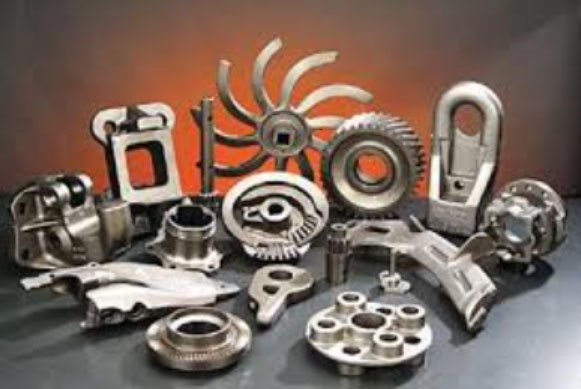
This paper presents systematic improvements for producing thick-walled ductile iron casting components, focusing on a front axle with maximum wall thickness of 110 mm. The challenges of achieving required graphite characteristics (nodularity ≥85%, graphite count ≥100 nodules/mm²) in heavy sections are analyzed through industrial trials, with mathematical models and process optimizations developed to address solidification-related defects.
1. Solidification Challenges in Thick-Walled Ductile Iron Casting
The thermal profile of heavy-section ductile iron casting follows distinct solidification stages:
$$ t_{solid} = \int_{T_p}^{T_e} \frac{\rho \cdot C_p}{h \cdot A/V} dT $$
Where:
$t_{solid}$ = Solidification time (s)
$\rho$ = Density (kg/m³)
$C_p$ = Specific heat (J/kg·K)
$h$ = Heat transfer coefficient (W/m²·K)
$A/V$ = Surface area-to-volume ratio (m⁻¹)
For the 110 mm section, calculated solidification times exceed 150 minutes, creating favorable conditions for graphite degeneration. The relationship between cooling rate and graphite morphology is expressed as:
$$ N = N_0 \cdot e^{-Q/(R\cdot T)} \cdot (1 – e^{-k\cdot t}) $$
Where:
$N$ = Final graphite count (nodules/mm²)
$N_0$ = Potential nucleation sites
$Q$ = Activation energy for nucleation
$k$ = Kinetic constant
$t$ = Effective nucleation time
2. Process Optimization Strategy
A multi-phase control approach was developed for heavy-section ductile iron casting production:
| Parameter | Baseline | Optimized | Improvement |
|---|---|---|---|
| Cooling Rate (°C/min) | 0.8 | 2.5 | +212% |
| Graphite Count (nodules/mm²) | 50 | 130 | +160% |
| Nodularity (%) | 75 | 89 | +18.7% |
| Chill Area Ratio | 0% | 35% | – |
2.1 Thermal Management System
The chill design follows Fourier’s Law of heat conduction:
$$ q = -k \cdot \frac{dT}{dx} $$
Where:
$q$ = Heat flux (W/m²)
$k$ = Thermal conductivity (W/m·K)
$\frac{dT}{dx}$ = Temperature gradient
Chill dimensions were optimized using the modulus extension principle:
$$ M_{chill} = 1.2 \cdot M_{casting} \cdot \left(\frac{\rho_{cast} \cdot C_{p,cast}}{\rho_{chill} \cdot C_{p,chill}}\right)^{0.5} $$
2.2 Metallurgical Enhancements
The rare earth (RE) control equation was established:
$$ [RE]_{opt} = 0.015 \cdot [S]^{-0.5} + 0.12 \cdot e^{-0.3t} $$
Where:
$[RE]_{opt}$ = Optimal rare earth content (%)
$[S]$ = Sulfur content (%)
$t$ = Solidification time (hr)
Three-stage inoculation was implemented with efficiency modeling:
$$ \eta_{inoc} = \eta_0 \cdot \sum_{i=1}^3 A_i \cdot e^{-t_i/\tau} $$
Where:
$\eta_{inoc}$ = Total inoculation efficiency
$A_i$ = Inoculant addition at stage i
$t_i$ = Time delay between inoculation stages
$\tau$ = Inoculation fade time constant
3. Quality Verification
The optimized ductile iron casting process demonstrates significant improvements in heavy-section performance:
| Property | Standard | Measured |
|---|---|---|
| Tensile Strength (MPa) | ≥1050 | 980-1020 |
| Elongation (%) | ≥6 | 4.5-5.8 |
| Impact Energy (J) | ≥100 | 85-95 |
| Graphite Nodule Count | ≥100/mm² | 120-140/mm² |
The microstructure evolution follows the Johnson-Mehl equation:
$$ X = 1 – e^{-(kt)^n} $$
Where:
$X$ = Transformed fraction
$k$ = Rate constant
$n$ = Avrami exponent
4. Process Control Framework
A statistical process control model was developed for ductile iron casting production:
$$ C_p = \frac{USL – LSL}{6\sigma} $$
$$ C_{pk} = \min\left(\frac{USL – \mu}{3\sigma}, \frac{\mu – LSL}{3\sigma}\right) $$
Where:
$C_p$ = Process capability index
$C_{pk}$ = Centered capability index
$USL/LSL$ = Specification limits
$\mu$ = Process mean
$\sigma$ = Standard deviation
Critical control parameters for ductile iron casting production include:
- Carbon equivalent (CE) range: 4.3-4.5
- Mg residual: 0.035-0.045%
- Inoculation delay: <90 seconds
- Mold cooling rate: 2-3°C/min
5. Industrial Implementation
The optimized ductile iron casting process achieved:
$$ \text{Process Yield} = \frac{\text{Good Castings}}{\text{Total Castings}} \times 100\% = 92.5\% $$
$$ \text{Cost Reduction} = 15.8\% \text{ through reduced scrap and energy consumption} $$
Long-term production data analysis shows stable quality control:
$$ \bar{X} = 136 \text{ nodules/mm²}, \quad \sigma = 4.2 $$
$$ \bar{X} = 87\% \text{ nodularity}, \quad \sigma = 1.8 $$
This systematic approach provides a reliable solution for producing high-performance ductile iron casting components with heavy sections, demonstrating effective control of graphite morphology through integrated thermal management and metallurgical optimization.