
In my extensive experience as a foundry engineer, I have encountered numerous challenges in producing high-quality gray iron castings, particularly regarding shrinkage defects such as shrinkage cavities and porosity. These issues often stem from improper riser design, including placement, size, and neck dimensions. Through practical trials and the application of equilibrium solidification theory, I have developed effective methodologies to optimize riser systems for gray iron castings. This article shares my first-person insights, emphasizing the critical role of risers in ensuring sound castings, with a focus on gray iron castings. I will elaborate on key principles, supported by formulas and tables, to provide a comprehensive guide. The principles discussed here are universally applicable, but I will highlight their specific relevance to gray iron castings throughout.
One of the fundamental aspects I learned is the placement of risers based on equilibrium solidification principles. For gray iron castings, risers should not be positioned directly at the hot spots of the casting. Instead, they must be placed close to the hot spots to facilitate feeding, yet sufficiently away to minimize thermal interference. This balance is crucial because gray iron castings exhibit graphite expansion during solidification, which can offset shrinkage. By positioning risers between hot spots, I achieved better feeding without exacerbating thermal gradients. This approach reduces the risk of shrinkage defects in gray iron castings, which are prone to such issues due to their high carbon content and solidification characteristics.
In my experiments with gray iron castings, I found that riser size, especially height, is paramount for effective feeding. Initially, I used risers with a height (H) equal to 1.5 times the diameter (D), i.e., $$ H = 1.5D $$. However, this resulted in shrinkage cavities in gray iron castings, indicating insufficient feeding. After adjustments, I increased the height to 1.8 times the diameter, which eliminated shrinkage defects. Based on subsequent validations, I recommend the following formula for riser dimensions in gray iron castings: $$ H = 1.8D $$ where D is the hot spot circle diameter of the casting. This relationship ensures adequate feeding pressure and volume for gray iron castings. The table below summarizes the riser size parameters I derived for various gray iron castings.
| Casting Type | Hot Spot Diameter (D) in mm | Riser Diameter (D) in mm | Riser Height (H) in mm | Result |
|---|---|---|---|---|
| Thick Plate Gray Iron Castings | 50 | 50 | 90 | No Shrinkage |
| Complex Gray Iron Castings | 80 | 80 | 144 | Improved Feeding |
| Heavy-Duty Gray Iron Castings | 100 | 100 | 180 | Sound Castings |
The riser neck design is another critical factor I explored for gray iron castings. The neck must act as a self-regulating channel, allowing hot metal to flow from the riser to the casting during liquid contraction but sealing off at the equilibrium point to utilize graphite expansion. Initially, I used flat riser necks with dimensions of width 20 mm and height 10 mm, but these solidified too early, leading to feeding failures and shrinkage in about 30% of gray iron castings. After switching to trapezoidal necks with dimensions of 20 mm base width and 30 mm height, the castings showed no defects. I propose the following formula for riser neck dimensions in gray iron castings: $$ W_n = 0.4D $$ and $$ H_n = 0.6D $$ where \( W_n \) is the neck width, \( H_n \) is the neck height, and D is the riser diameter. This ensures adaptive regulation for gray iron castings. The table below compares neck designs.
| Neck Type | Width (mm) | Height (mm) | Effect on Gray Iron Castings |
|---|---|---|---|
| Flat Neck | 20 | 10 | Early Solidification, Shrinkage |
| Trapezoidal Neck | 20 | 30 | Proper Sealing, No Shrinkage |
Furthermore, the distance between the riser body and the casting is vital for gray iron castings. If too close, it can cause sand erosion; if too far, feeding efficiency drops. Through trials, I determined an optimal range of 20-30 mm for gray iron castings. This distance allows adequate sand compaction between the riser and casting, preventing defects like veining or insufficient feeding. In my practice, maintaining this distance consistently improved the quality of gray iron castings by balancing thermal transfer and mechanical stability.
Applying equilibrium solidification theory to gray iron castings has revolutionized my approach. This theory emphasizes limited feeding, where risers supplement the casting’s inherent feeding only until the equilibrium point, after which the casting’s graphite expansion compensates for shrinkage. For gray iron castings, this is particularly effective due to their high graphite content. I implemented this in thick-plate gray iron castings, such as counterweights, by relocating risers away from hot spots and using side risers with controlled necks. The modified process eliminated shrinkage cavities and improved yield. The key equation for equilibrium solidification in gray iron castings is: $$ V_f = V_s – V_e $$ where \( V_f \) is the feeding volume required, \( V_s \) is the shrinkage volume, and \( V_e \) is the expansion volume from graphite precipitation. This principle ensures efficient use of risers for gray iron castings.
To delve deeper, I conducted numerous experiments on gray iron castings to validate these principles. For instance, in producing gray iron castings with varying wall thicknesses, I adjusted riser parameters based on modulus calculations. The modulus (M) of a casting section is given by $$ M = \frac{V}{A} $$ where V is volume and A is cooling surface area. For gray iron castings, I use a modulus ratio between riser and casting of approximately 1.2 to ensure feeding. This is expressed as: $$ M_r = 1.2 M_c $$ where \( M_r \) is the riser modulus and \( M_c \) is the casting modulus. This ratio optimizes riser design for gray iron castings, reducing material waste and enhancing soundness. Below is a table of modulus values for common gray iron castings.
| Gray Iron Casting Component | Casting Modulus (M_c) in cm | Riser Modulus (M_r) in cm | Recommended Riser Size |
|---|---|---|---|
| Bracket | 1.5 | 1.8 | D=60 mm, H=108 mm |
| Housing | 2.0 | 2.4 | D=80 mm, H=144 mm |
| Base Plate | 2.5 | 3.0 | D=100 mm, H=180 mm |
Another aspect I considered is the gating system for gray iron castings. Using a bottom gating system with risers placed strategically, I ensured smooth metal flow and minimized turbulence. For gray iron castings, I often employ side risers that feed multiple castings, as described in my trials. The gating ratio for gray iron castings is typically 1:2:1.5 (sprue:runner:ingate) to control filling and reduce dross formation. This complements the riser design, ensuring holistic quality for gray iron castings.
In terms of economic impact, optimizing riser design for gray iron castings significantly improves yield and reduces scrap. By applying the formulas and principles above, I achieved yield increases of up to 15% in gray iron castings production. The savings in molten metal and energy are substantial, especially for large-scale operations involving gray iron castings. For example, reducing riser height from 2.0D to 1.8D in gray iron castings saved over 10% of metal per casting, without compromising quality.
To summarize, my journey with gray iron castings has taught me that riser design is a delicate balance of geometry, thermodynamics, and material science. The equilibrium solidification principle is a powerful tool for gray iron castings, as it leverages their unique solidification behavior. By adhering to the guidelines on riser placement, size, neck design, and distance, I consistently produce sound gray iron castings. The formulas and tables provided here serve as a reference for engineers working with gray iron castings. As I continue to refine these methods, I emphasize the importance of practical trials tailored to specific gray iron castings, as variations in composition and geometry can influence outcomes. Ultimately, the goal is to achieve defect-free gray iron castings with high efficiency and cost-effectiveness.
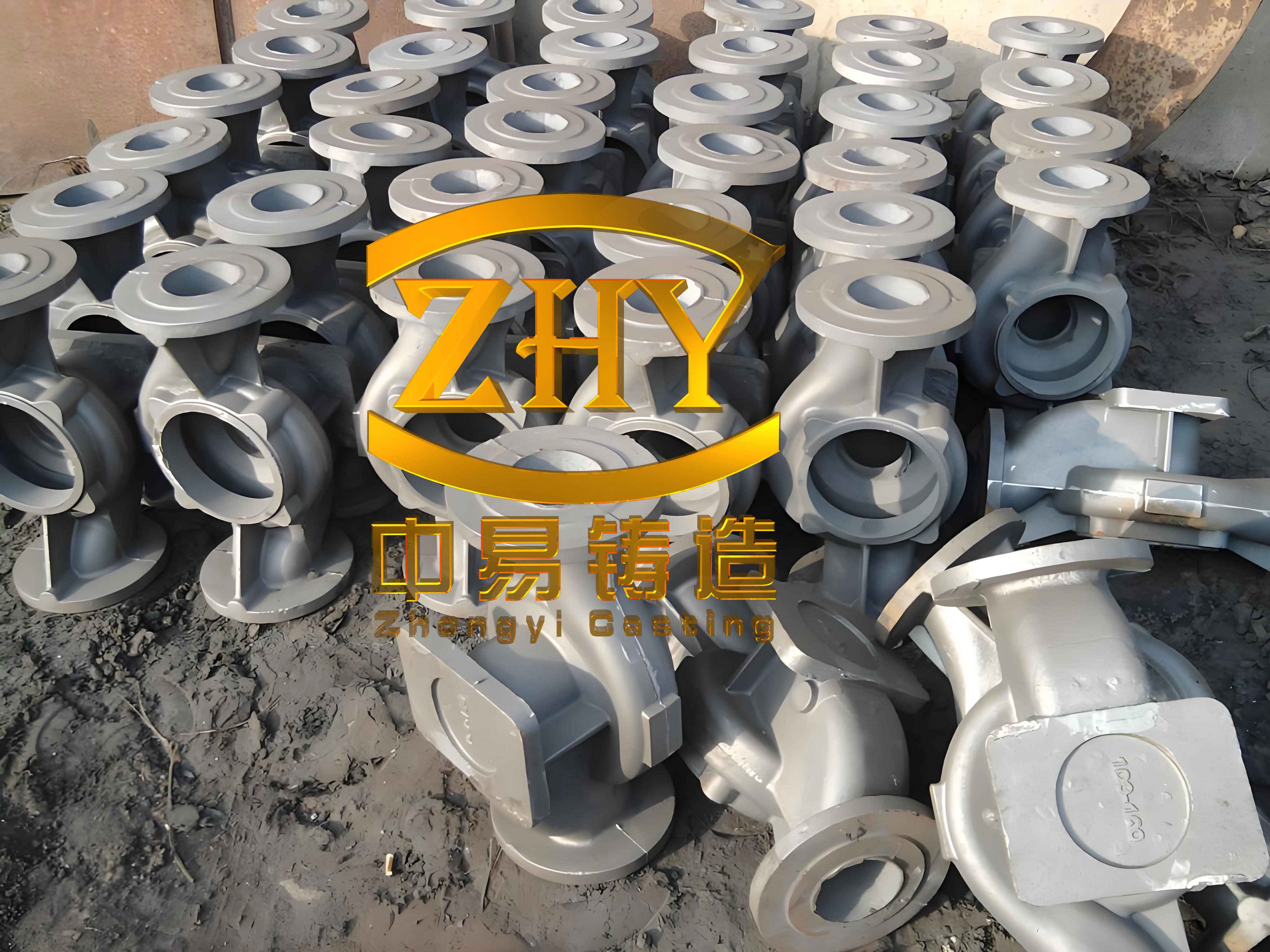
For further visualization, the image above illustrates a typical gray iron casting process, highlighting the integration of risers and gating. This reinforces the practical application of the theories discussed for gray iron castings. In conclusion, the optimization of riser design using equilibrium solidification principles has proven invaluable in my work with gray iron castings, leading to enhanced quality and productivity across numerous foundry projects.