
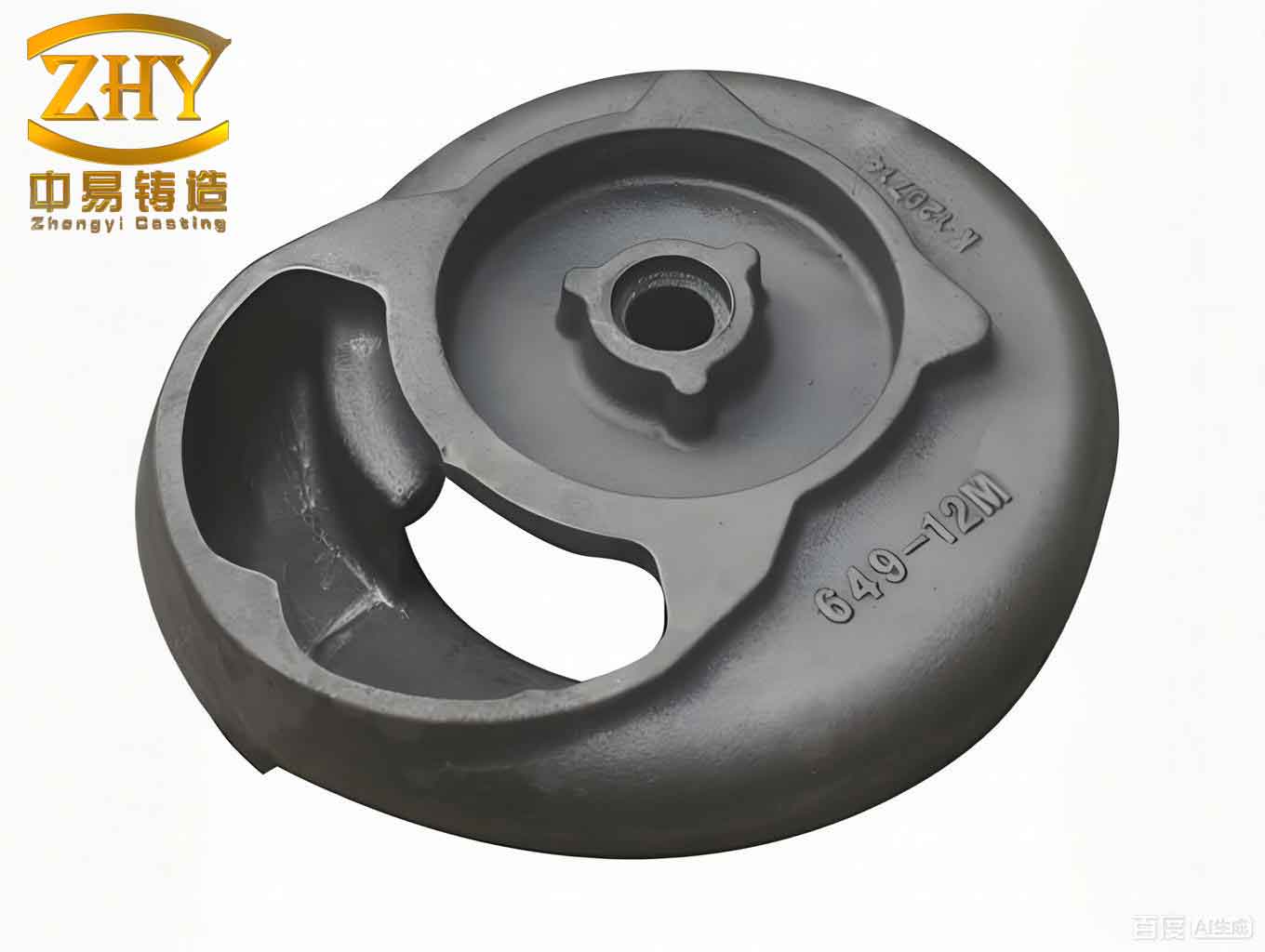
The manufacturing landscape, particularly for industries producing complex, high-mix-low-volume items, is undergoing a profound transformation driven by digitalization and intelligent systems. In the context of sand casting foundries, this evolution is critical for enhancing competitiveness. The final quality and delivery time of sand casting products are heavily influenced by post-casting processes, with grinding being one of the most labor-intensive and skill-dependent stages. Effective scheduling of grinding tasks directly impacts workshop efficiency, resource utilization, and overall production cost.
Traditionally, the dispatch of grinding tasks for sand casting products relies on manual planning by foremen. This method, while leveraging human experience, often leads to significant inefficiencies. Common issues include an unbalanced distribution of workload among workers, the accumulation of unfinished castings at specific workstations, and a mismatch between the complexity of a task and the skill level of the assigned operator. These problems create bottlenecks, delay orders, and increase operational costs. Therefore, developing a scientific, automated scheduling method for the grinding process is a vital step toward intelligent manufacturing in foundries.
This scheduling challenge can be formally described as an Unrelated Parallel Machine Scheduling (UPMS) problem. In this model, a set of n sand casting products (jobs) must be processed on a set of m workers (machines). Each sand casting product can be processed by any eligible worker, but the “processing time” is not measured in hours; instead, it is quantified by a composite Grinding Coefficient that reflects the task’s difficulty and required effort. The workers are grouped by skill level (e.g., High-skill Group H and Low-skill Group L). Certain high-precision sand casting products (e.g., Class D requiring the finest surface finish) can only be handled by high-skill workers, while others can be processed by anyone. The core decision is: which worker should grind which sand casting product?
The primary objectives are twofold: first, to balance the total grinding workload (sum of coefficients) across all workers; second, to balance the number of sand casting products assigned to each worker, preventing physical pile-up. To achieve this, we first define the calculation rule for the Grinding Coefficient $F_j$ for a sand casting product j:
$$F_j = F_w \times F_r \times F_m \times F_p$$
Where:
- $F_w$ is the weight factor.
- $F_r$ is the surface roughness requirement factor (with classes A-D).
- $F_m$ is the material factor (e.g., steel, iron, aluminum).
- $F_p$ is the pickling requirement factor.
This coefficient effectively standardizes the diverse attributes of sand casting products into a single metric representing the grinding effort.
The mathematical model for the Grinding Task Scheduling Problem is formulated with the following notation and objectives:
| Symbol | Definition |
|---|---|
| $i = 1, …, m$ | Index for workers/machines. |
| $j = 1, …, n$ | Index for sand casting products/jobs. |
| $F_j$ | Grinding coefficient of job j. |
| $F_i$ | Total grinding coefficient sum for worker i (including previous backlog). |
| $S_i$ | Total number of sand casting products assigned to worker i (including backlog). |
| $G_{ij} \in \{0,1\}$ | Decision variable (1 if job j is assigned to worker i). |
The optimization model aims to minimize the following composite objective function $f$:
$$f = T_1 \cdot \sqrt{\frac{1}{m} \sum_{i=1}^{m} (F_i – \bar{F})^2} + T_2 \cdot \sqrt{\frac{1}{m} \sum_{i=1}^{m} (S_i – \bar{S})^2}$$
where $\bar{F} = \frac{1}{m}\sum_{i=1}^{m} F_i$ and $\bar{S} = \frac{1}{m}\sum_{i=1}^{m} S_i$ are the average grinding coefficient sum and average job count, respectively. $T_1$ and $T_2$ are weight factors prioritizing the two balance objectives.
Subject to:
$$\sum_{i=1}^{m} G_{ij} = 1, \quad \forall j$$
$$S_i \leq S^{max}, \quad F_i \leq F^{max}, \quad \forall i$$
(Where $S^{max}$ and $F^{max}$ are practical limits on backlog count and workload for any worker).
To solve this complex combinatorial optimization problem, we propose an Improved Discrete Artificial Bee Colony (IDABC) algorithm. The standard Artificial Bee Colony (ABC) algorithm, inspired by honeybee foraging behavior, is effective for continuous optimization but requires significant adaptation for discrete scheduling problems. Our IDABC incorporates four key enhancements tailored for scheduling sand casting products.
1. Discrete Encoding & Heuristic Decoding: A solution (food source) is represented as a permutation of job IDs, e.g., [2, 6, 1, 3, …]. This sequence defines the priority for assignment. A dedicated decoder then assigns each job, in the order of the sequence, to the eligible worker who currently has the smallest accumulated grinding coefficient sum $F_i$. This greedy heuristic embedded in the decoding process guides the search toward balanced solutions from the outset.
2. Fitness Calculation: The fitness of a solution is the inverse of its objective function value:
$$\text{Fitness} = \frac{1}{f}$$
A higher fitness indicates a better, more balanced schedule for the batch of sand casting products.
3. Employed Bee Phase with Crossover: In this phase, each employed bee modifies its current solution. Instead of continuous perturbation, we perform a crossover operation between the current solution and a randomly selected partner. To avoid “inbreeding” which stagnates search, crossover is only performed if the fitness difference between the two solutions exceeds a threshold $\Delta$. We use a Two-Point Order Crossover (TP) operator to generate new offspring sequences.
4. Onlooker Bee Phase with Mutation: Onlooker bees select solutions probabilistically (using roulette wheel selection based on fitness) for further refinement. They apply one of three mutation operators with equal probability: Swap (exchange two random jobs), Insertion (move a job to a new random position), or Inversion (reverse the order of a subsequence). This maintains population diversity.
5. Scout Bee Phase Enhanced by Tabu Search: If a solution’s fitness does not improve for a predetermined number of cycles (limit), the employed bee abandons it. Instead of generating a purely random new solution, the scout bee initiates a short, intense Tabu Search (TS) using the abandoned solution as the starting point. This TS explores the neighborhood via the same mutation operators while using a tabu list to avoid recent cycles, effectively performing a focused local search to escape local optima. The best solution found by TS replaces the abandoned one.
The overall workflow of the IDABC algorithm for scheduling sand casting products is summarized below:
| Phase | Agent | Action (IDABC) | Purpose |
|---|---|---|---|
| Initialization | – | Generate NP random job permutations. | Create initial population. |
| Employed Bee | Employed Bee | Perform conditional crossover with a partner solution. | Explore neighborhood via recombination. |
| Onlooker Bee | Onlooker Bee | Select fit solution; apply random mutation operator. | Exploit good solutions, maintain diversity. |
| Scout Bee | Scout Bee | Trigger Tabu Search on stagnant solutions. | Escape local optima with intensified search. |
To validate the performance of the proposed IDABC, we conducted computational experiments using simulated datasets based on real-world parameters from a medium-scale sand casting foundry. We generated five datasets (p1 to p5) with increasing numbers of sand casting products (10 to 50 jobs). The algorithm parameters were set as follows:
| Parameter | Symbol | Value |
|---|---|---|
| Colony Size | NP | 60 |
| Maximum Iterations | MaxIter | 100 |
| Limit for Scout | limit | 10 |
| Objective Weights | $T_1, T_2$ | 0.7, 0.3 |
We compared IDABC against the standard ABC (using continuous coding adapted for the problem) and a standard Genetic Algorithm (GA). Each algorithm was run 10 times independently on each dataset. The results, measured by the average objective value ($Avg.$), standard deviation ($Std.$), and average run time ($T_{avg}$), are presented below:
| Dataset (Size) | Algorithm | $Avg. \downarrow$ | $Std. \downarrow$ | $T_{avg}$ (s) |
|---|---|---|---|---|
| p1 (n=10) | GA | 0.9151 | 0.0038 | 1.627 |
| ABC | 0.9142 | 0.0007 | 1.637 | |
| IDABC | 0.9164 | 0.0009 | 1.693 | |
| p2 (n=20) | GA | 1.5771 | 0.0821 | 1.702 |
| ABC | 1.5817 | 0.0792 | 1.902 | |
| IDABC | 1.6033 | 0.0737 | 1.807 | |
| p3 (n=30) | GA | 2.0395 | 0.2466 | 1.832 |
| ABC | 2.2192 | 0.2713 | 1.814 | |
| IDABC | 2.2963 | 0.1882 | 1.749 | |
| p4 (n=40) | GA | 2.8427 | 0.5132 | 2.416 |
| ABC | 2.8321 | 0.5462 | 2.426 | |
| IDABC | 3.2362 | 0.5308 | 2.325 | |
| p5 (n=50) | GA | 3.1305 | 0.6924 | 1.971 |
| ABC | 3.5675 | 0.7113 | 1.883 | |
| IDABC | 3.9781 | 0.4944 | 1.803 |
Analysis of the results shows that for smaller problems (p1, p2), all algorithms perform similarly. However, as the problem scale increases with more sand casting products (p3 to p5), the advantages of IDABC become clear. While the absolute $Avg.$ value is context-dependent, the key metric is the $Std.$ (standard deviation). IDABC consistently achieves a lower $Std.$ than both ABC and GA on larger datasets (p3, p5), demonstrating superior solution stability across multiple runs. Furthermore, the run time of IDABC remains competitive and even becomes faster than the others for the largest dataset (p5), proving its computational efficiency for scaling up. The convergence curves also confirm that IDABC reaches stable, high-quality solutions within 30 iterations, showcasing robust search capability.
The ultimate test was a one-month field comparison in a foundry specializing in multi-variety, small-batch sand casting products. The existing manual scheduling method was compared against schedules generated by the proposed IDABC model. The key performance indicators (KPIs) from the actual production data are contrasted below:
| Performance Indicator | Manual Scheduling | IDABC-assisted Scheduling | Improvement |
|---|---|---|---|
| Std. Dev. of Grinding Coeff. Sum | High | Significantly Lower | Better workload balance. |
| Std. Dev. of Job Count per Worker | High | Significantly Lower | Better task count balance. |
| Max. Backlog of Sand Casting Products at a Station | Frequent pile-up | Drastically Reduced | Avoided physical congestion. |
| Max. % of Low-Skill Tasks assigned to High-Skill Workers | Relatively High | Reduced | Better skill-task matching. |
The field results conclusively demonstrate that the IDABC-assisted scheduling model effectively addresses the core pain points of manual planning. It creates a more equitable and scientific distribution of sand casting products among grinders, optimizes the use of high-skill labor for complex tasks, and smoothes the workflow to prevent bottlenecks. This leads to more predictable lead times, improved resource utilization, and ultimately, higher overall workshop productivity for manufacturing sand casting products.
In conclusion, this work presents a practical and effective solution to the grinding scheduling problem in sand casting foundries. By formulating the problem with a novel Grinding Coefficient and developing an Improved Discrete Artificial Bee Colony algorithm with specialized operators and embedded Tabu Search, we have created a tool that significantly outperforms both standard algorithms and traditional manual methods. The successful application in a real production environment validates its potential for enhancing operational efficiency and supporting the intelligent transformation of the sand casting industry. Future work may focus on integrating dynamic factors like worker learning/fatigue effects, hybridizing with other metaheuristics for even greater performance, and ultimately developing a fully integrated smart scheduling system within a broader foundry management platform.