
The production of high-integrity, complex geometry castings, particularly large-scale components like machinery bases and transmission parts, presents significant challenges in foundry engineering. Defects such as shrinkage porosity and cavities are prevalent in thick sections and thermal centers, compromising the mechanical performance, pressure tightness, and dimensional stability of the final product. For critical sand casting products like the upper rotary disc analyzed here, which serves as a load-bearing and guiding element in machine tools, ensuring internal soundness is paramount. Traditional trial-and-error methods for process development are costly, time-consuming, and often suboptimal. The integration of numerical simulation into the casting process design workflow offers a powerful alternative, enabling virtual prototyping, defect prediction, and systematic optimization before any metal is poured.
Numerical simulation leverages computational fluid dynamics and heat transfer principles to model the filling and solidification of a casting. For sand casting products, this involves solving the governing equations for fluid flow, energy conservation, and species transport within the metal and the surrounding mold. A key output is the prediction of shrinkage defects, which are governed by the thermal gradients and feeding paths during solidification. The shrinkage volume \( V_{sh} \) in a region can be conceptually related to the volumetric contraction of the metal and the adequacy of feeding, as expressed in simplified form:
$$ V_{sh} \approx V_{cast} \cdot \beta \cdot (1 – f_s) – V_{fed} $$
Where \( V_{cast} \) is the volume of the casting section, \( \beta \) is the volumetric shrinkage coefficient of the alloy (typically 4-6% for gray iron), \( f_s \) is the solid fraction, and \( V_{fed} \) is the volume of liquid metal fed from risers or adjacent sections. Simulation software like ProCAST or MAGMA can visualize areas where \( V_{fed} \) is insufficient, pinpointing potential defect locations.
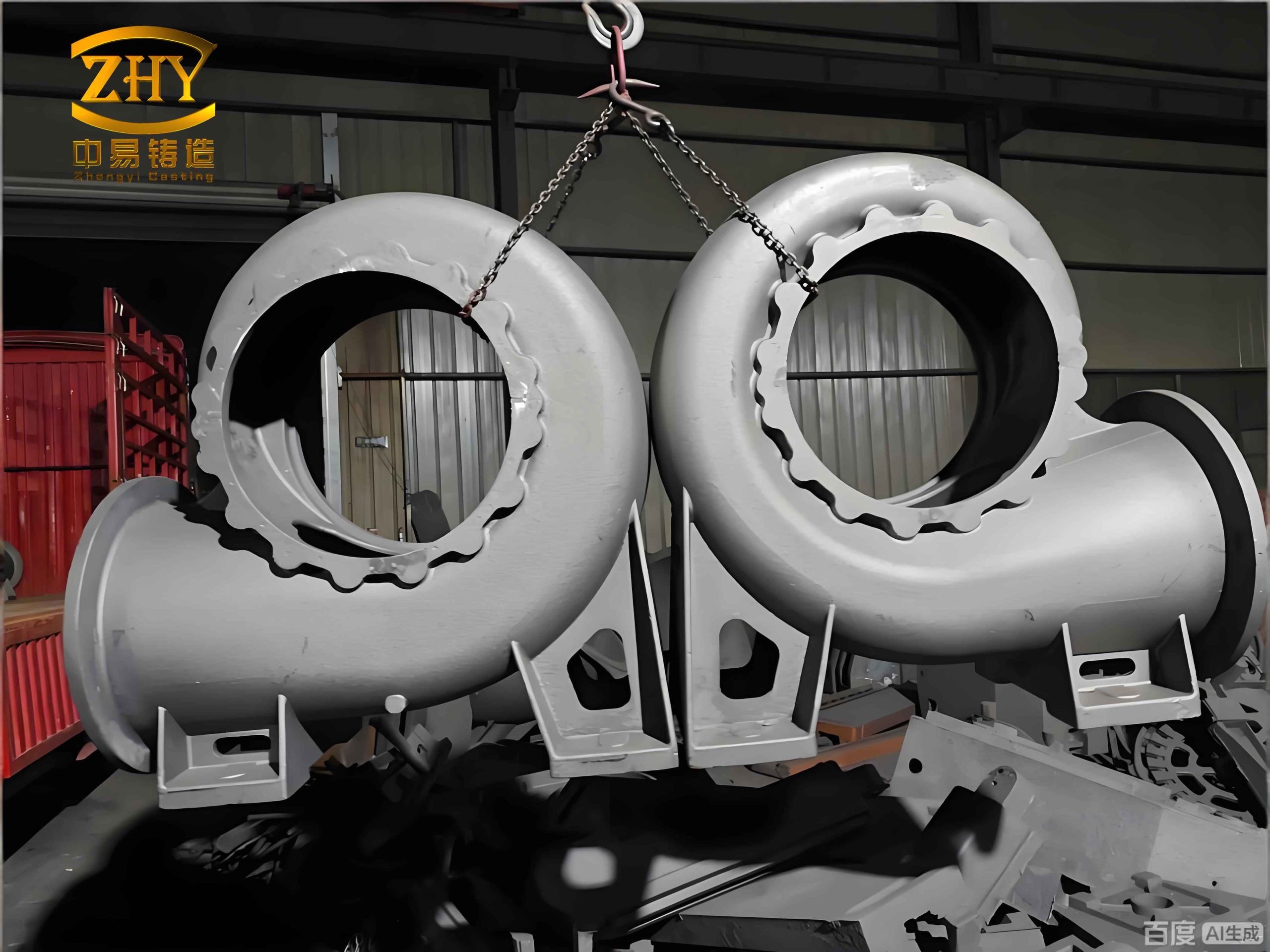
This article details the application of such numerical simulation techniques to optimize the manufacturing process for a challenging gray iron (HT300) upper rotary disc, a quintessential example of high-value sand casting products. The component’s intricate geometry with varying wall thicknesses makes it prone to shrinkage defects. The methodology involves an initial process design based on casting principles, followed by simulation to identify weaknesses, and iterative optimization to achieve a robust and reliable production-ready process.
Component Analysis and Initial Process Design
The upper rotary disc is a large, plate-like component with numerous bosses, ribs, and holes. Its primary function demands high strength, wear resistance, and dimensional stability under load. The material specified is gray iron grade HT300, known for its good castability, damping capacity, and strength. The chemical composition requirements are summarized in Table 1.
| Element | C | Si | Mn | P | S |
|---|---|---|---|---|---|
| Content | 2.80-3.10 | 1.10-1.40 | 1.00-1.20 | <0.15 | ≤0.12 |
A 3D model revealed critical dimensions of approximately 1281 mm x 1270 mm x 101 mm and an estimated weight of 502 kg. The wall thickness varies significantly, from 15 mm in thin sections to 113 mm in thick bosses and the central hub. This non-uniformity creates isolated thermal masses or “hot spots” that are last to solidify and most susceptible to shrinkage defects if not properly fed.
Based on standard foundry practice for such sand casting products, an initial gravity sand casting process was designed. A furan resin sand mold was selected for its good dimensional accuracy and collapsibility. To promote directional solidification towards feeders and minimize turbulence, a bottom-gating system was chosen. The system consisted of one sprue, two runners, and seven ingates, designed with a choke area at the sprue base. The key initial process parameters are listed in Table 2.
| Parameter | Value | Remarks |
|---|---|---|
| Pouring Temperature | 1370 °C | Typical for HT300 |
| Estimated Pouring Time | 47 s | Based on gating system design |
| Gating Ratio (Sprue:Runner:Ingate) | 1.15 : 1.1 : 1 | Pressurized system |
| Mold Material | Furan Resin Sand | – |
| Core Material | Furan Resin Sand | – |
Numerical Simulation of the Initial Process
The 3D model of the casting, along with the gating system, was imported into ProCAST software for simulation. The mesh was generated, resulting in over 300,000 volume elements to ensure accurate resolution of thermal gradients. The necessary thermophysical properties for HT300 and furan sand were assigned from the software’s material database. Boundary conditions, including interfacial heat transfer coefficients (HTC) between metal-mold and mold-chill, were defined. The initial filling analysis confirmed a relatively smooth fill pattern over approximately 45 seconds, with no severe surface turbulence or air entrapment predicted.
The critical analysis focused on the solidification sequence and shrinkage prediction. The results, visualized in Figure X, revealed significant areas of concern. Major shrinkage porosity was predicted in the thick central hub and several large bosses on the top surface. These regions solidified last, forming isolated liquid pools that could not be fed by the existing gating system alone. The lack of sufficient thermal gradient and feeding mechanism confirmed the inadequacy of the initial design for producing sound sand casting products of this geometry. The simulation quantified the risk, showing that defect volumes were concentrated in critical load-bearing areas, which would likely lead to part rejection or premature failure in service.
Process Optimization Strategy Based on Simulation Results
The simulation clearly identified the root cause: the absence of effective thermal control and liquid metal reservoirs (risers) to compensate for solidification shrinkage in the hot spots. The optimization strategy, therefore, centered on introducing risers to create controlled thermal gradients and feed paths. The goal was to redesign the thermal geometry of the casting-riser system so that the risers themselves became the last points to solidify, drawing shrinkage porosity into them and away from the casting body.
For the thick central hub and major bosses, cylindrical blind risers (with insulating sleeves to enhance feeding efficiency) were designed. The riser dimensions (diameter \( D_r \) and height \( H_r \)) were determined using modulus method principles, where the modulus \( M \) (volume \( V \) to cooling surface area \( A \) ratio) of the riser must exceed that of the casting section it feeds:
$$ M_{riser} = \frac{V_{riser}}{A_{riser}} > M_{casting\_section} $$
For a cylindrical side riser, \( M = D/6 \) for \( H = 1.5D \). Applying this to the central hub hot spot guided the riser sizing. Furthermore, the gating system was reconsidered. While bottom-gating offered calm filling, it resulted in unfavorable temperature distribution for the chosen riser placement on the top face. The metal arriving first at the bottom would be cooler, hindering the efficiency of top risers. Therefore, the system was switched to a top-gating approach. This creates a favorable temperature gradient, with the hottest metal rising to the top where the risers are located, thereby prolonging their liquid state and feeding ability. The optimized layout incorporated one sprue, one runner, and four ingates, with risers strategically placed over all major hot spots. The revised parameters are shown in Table 3.
| Parameter | Optimized Value / Design | Purpose |
|---|---|---|
| Riser Configuration | 5 Top Risers (Neckless) & 5 Blind Side Risers | Feed central hub and major bosses |
| Riser Sizing Example | Neckless: D=180mm, H=300mm; Blind: D=80mm, H=180mm | Modulus > Casting Section Modulus |
| Gating System | Top-Gating (1 Sprue, 1 Runner, 4 Ingates) | Create favorable thermal gradient for top risers |
| Gating Areas | Sprue: 38.5 cm², Runner: 33.0 cm², Ingate: 31.7 cm² | Control fill time and metal distribution |
Validation Through Simulation of the Optimized Process
The optimized process model was simulated under identical conditions as the initial run. The filling simulation showed a rapid and complete fill from the top. More importantly, the solidification simulation demonstrated a radically improved sequence. The solidification fronts now progressed from the thinner sections of the casting towards the strategically placed risers. The risers remained liquid significantly longer than the casting hot spots they were intended to feed.
The final shrinkage prediction results confirmed the success of the optimization. As shown in Figure Y, the previously extensive shrinkage zones within the casting body were virtually eliminated. The predicted shrinkage defects were successfully relocated entirely into the volumes of the risers. Since risers are subsequently removed during machining, this represents an ideal outcome. The casting itself is predicted to be sound, meeting the stringent internal quality requirements for such high-duty sand casting products. This virtual validation significantly de-risks the physical production, saving the cost and time associated with multiple physical trials.
Conclusion and Implications for Foundry Practice
This case study exemplifies the transformative role of numerical simulation in modern foundry engineering, particularly for complex sand casting products. The journey from an initial, defect-prone process to an optimized, robust design was efficiently guided by virtual analysis. Key conclusions are:
- Defect Prediction and Root Cause Analysis: Simulation accurately identified shrinkage porosity in thick sections of the initial design, highlighting the inadequacy of relying solely on gating for feeding.
- Effective Optimization Strategy: The integration of properly sized and placed risers, combined with a gating system that establishes a favorable thermal gradient (top-gating), is crucial for managing solidification shrinkage in gray iron castings with variable sections.
- Quantitative and Visual Validation: The optimized process was virtually proven to transfer shrinkage defects from the casting into the risers, ensuring the internal soundness of the final component.
The methodology outlined provides a general framework for optimizing sand casting products. It moves the industry away from empirical guesswork towards a science-based, first-time-right approach. This leads to reduced scrap rates, shorter development cycles, lower production costs, and consistently higher quality castings. For components like the upper rotary disc, where performance is non-negotiable, such simulation-driven process assurance is not just beneficial but essential.