
As a professional deeply involved in the design and implementation of smart foundry systems, I have witnessed firsthand the critical role that sand treatment plays in modern sand casting manufacturers. The advent of 3D printing technology has revolutionized sand casting processes, but it also demands more sophisticated and efficient sand handling systems. For sand casting manufacturers, achieving high-quality castings while minimizing costs and environmental impact hinges on a well-designed sand treatment system. This article delves into the intricacies of such systems tailored for 3D printing智能铸造工厂, emphasizing key processes, equipment, and innovations that benefit sand casting manufacturers globally.
The foundation of any sand casting operation lies in the preparation and reuse of molding sand. In traditional foundries, sand treatment often involves manual handling and less integrated processes. However, with 3D printing, where sand and binder are layered precisely to form molds and cores, the sand treatment system must be more automated, precise, and闭环. For sand casting manufacturers, this shift is not just a technological upgrade but a strategic necessity to stay competitive. The system I describe here encompasses everything from raw material input to sand regeneration, ensuring that every grain of sand is optimized for reuse, thereby reducing waste and enhancing sustainability—a key concern for forward-thinking sand casting manufacturers.
At its core, the sand treatment system for 3D printing智能铸造工厂 involves a series of interconnected steps: preparation of raw materials, handling of used sand, and regeneration for reuse. The goal is to provide consistent, high-quality sand to the 3D printers, which directly impacts the dimensional accuracy and surface finish of castings. For sand casting manufacturers, this consistency translates to fewer defects and higher productivity. Let me outline the entire workflow, which can be summarized in a comprehensive process diagram. The flow begins with new sand addition and progresses through sand recycling, with multiple stages of treatment to remove impurities and restore sand properties.
The process starts with the introduction of new sand. Depending on its quality, new sand can be added at different points—either at the shakeout stage or after thermal regeneration. If the new sand contains impurities or high moisture, it may be introduced early to undergo full system processing, including drying and screening. This flexibility is crucial for sand casting manufacturers who source sand from various suppliers, as it allows them to maintain quality standards. For instance, if sand has contaminants, adding it at the shakeout ensures it passes through magnetic separation and破碎, aligning with the needs of meticulous sand casting manufacturers. Conversely, high-quality sand can be injected post-regeneration, bypassing intensive treatment and saving energy. This decision matrix can be expressed with a simple formula for cost optimization: $$ C_{\text{total}} = C_{\text{new}} + C_{\text{process}} \times t_{\text{path}} $$ where \( C_{\text{total}} \) is the total cost per ton of sand, \( C_{\text{new}} \) is the cost of new sand, \( C_{\text{process}} \) is the processing cost per stage, and \( t_{\text{path}} \) is the number of treatment stages based on sand quality. For sand casting manufacturers, minimizing \( C_{\text{total}} \) is essential.
After 3D printing, the molds are cured and used for casting. During handling, spilled sand can be collected and returned to the printer hopper for reuse, reducing binder consumption—a significant cost saver for sand casting manufacturers. Post-casting, the molds are cooled and transferred to a shakeout machine. Here, the castings are separated from the sand molds. The remaining sand lumps, containing debris like metal scraps and broken pipes, are conveyed via vibrating conveyors to a bucket elevator. Simultaneously, suspended magnetic separators extract large ferrous items such as iron chunks and burrs. This step is vital for sand casting manufacturers to prevent equipment damage and ensure sand purity. The sand lumps are then stored temporarily in a shakeout sand silo.
From the silo, sand is fed through vibrating feeders into crushers, where lumps are broken down into fine particles. A drum magnetic separator further removes small iron beans and chips. The crushed sand is pneumatically conveyed to a破碎 sand silo for storage. When thermal regeneration is required, sand from this silo is discharged via screw feeders, passed through linear vibrating screens, and fed into a thermal regeneration furnace. In the furnace, organic binders on the sand surface are decomposed at high temperatures, restoring the sand to a near-virgin state. This regenerated sand is then elevated to a regeneration silo, screened through方形摇摆筛 to remove impurities, and finally sent to the printer缓存砂斗. There, it is mixed with binders in a混砂机 and supplied to the 3D printer. This闭环 system exemplifies efficiency for sand casting manufacturers, as it maximizes sand reuse and minimizes new sand intake.
To better visualize the material flow and decision points, I present a table summarizing the key stages and their functions. This is particularly useful for sand casting manufacturers planning to upgrade their facilities.
| Process Stage | Key Function | Impact on Sand Casting Manufacturers |
|---|---|---|
| New Sand Addition | Introduces raw sand based on quality; optional paths for cost control. | Reduces material costs by optimizing treatment routes. |
| Shakeout and Magnetic Separation | Separates castings from sand; removes large ferrous contaminants. | Prevents equipment wear and improves sand quality for reuse. |
| Crushing and Screening | Breaks sand lumps into particles; removes fine impurities. | Ensures uniform sand粒度, critical for 3D printing accuracy. |
| Thermal Regeneration | Burns off binders at high temperatures; restores sand properties. | Lowers binder consumption and environmental waste, boosting sustainability. |
| Sand Storage and Conveying | Temporarily holds sand; transports it between stages via mechanical or pneumatic means. | Enables continuous operation, reducing downtime for sand casting manufacturers. |
The efficiency of sand regeneration can be quantified using a formula that sand casting manufacturers often rely on: $$ \eta_{\text{reg}} = \frac{m_{\text{reclaimed}}}{m_{\text{total input}}} \times 100\% $$ where \( \eta_{\text{reg}} \) is the regeneration efficiency, \( m_{\text{reclaimed}} \) is the mass of sand successfully regenerated, and \( m_{\text{total input}} \) is the total sand mass entering the system. High \( \eta_{\text{reg}} \) values indicate effective recycling, directly benefiting sand casting manufacturers through cost savings.
Now, let’s delve into the key equipment that forms the backbone of this system. Each piece is selected for its reliability and suitability to 3D printing demands, which are higher than traditional methods due to the strength of printed molds. For sand casting manufacturers, investing in robust equipment is non-negotiable.
The shakeout machine is the starting point for sand recovery. In 3D printing智能铸造工厂, printed molds have superior strength, necessitating heavy-duty shakeout machines. Vibratory shakeout machines are commonly used, where periodic vibrations cause the molds to fracture, separating castings from sand. The energy required can be approximated by: $$ E_{\text{shake}} = k \cdot A \cdot f^2 \cdot t $$ where \( E_{\text{shake}} \) is the energy, \( k \) is a material constant, \( A \) is the amplitude, \( f \) is the frequency, and \( t \) is the time. For sand casting manufacturers, optimizing these parameters ensures efficient separation without damaging castings.
Magnetic separation equipment is indispensable for removing ferrous contaminants. Suspended magnetic separators are used initially for large items, while drum magnetic separators handle finer particles. The effectiveness of magnetic separation can be expressed as: $$ \text{Removal Rate} = 1 – \frac{C_{\text{out}}}{C_{\text{in}}} $$ where \( C_{\text{in}} \) and \( C_{\text{out}} \) are the contaminant concentrations before and after separation. Sand casting manufacturers must maintain high removal rates to protect downstream equipment and ensure sand purity.
Thermal regeneration equipment is a game-changer for sand casting manufacturers, especially those using resin-bonded sands. The furnace heats sand to temperatures around 800°C, decomposing organic binders. The heat transfer involved can be modeled using: $$ Q = m \cdot c_p \cdot \Delta T $$ where \( Q \) is the heat input, \( m \) is the sand mass, \( c_p \) is the specific heat capacity of sand, and \( \Delta T \) is the temperature change. This process not only reclaims sand but also enhances its thermal stability, leading to better casting quality for sand casting manufacturers.
Screening devices, such as vibrating screens and swinging screens, classify sand by particle size. The screening efficiency \( \eta_{\text{screen}} \) is given by: $$ \eta_{\text{screen}} = \frac{\text{Mass of correctly sized particles}}{\text{Total mass fed}} \times 100\% $$ For sand casting manufacturers, consistent particle size distribution is crucial for 3D printing, as it affects binder distribution and mold strength.
Conveying equipment links all stages together. The choice between mechanical and pneumatic conveying depends on factors like distance, capacity, and material characteristics. Below is a comparative table that sand casting manufacturers can use for selection.
| Conveying Type | Key Features | Benefits for Sand Casting Manufacturers |
|---|---|---|
| Bucket Elevator | Vertical transport; simple design; high lift capacity. | Ideal for elevating sand between floors in compact foundries. |
| Belt Conveyor | High capacity; long-distance; low power consumption. | Cost-effective for linear, continuous flow in large facilities. |
| Vibrating Conveyor | Fast transport; simple structure; but noisy and prone to wear. | Suitable for abrasive materials like sand, though maintenance is key. |
| Screw Conveyor | Enclosed design; good for powders; but can clog with wet sand. | Useful for controlled feeding in processing stages. |
| Pneumatic Conveying | Closed pipes; dust-free; flexible routing; but not for large chunks. | Reduces environmental contamination and allows multi-point discharge, enhancing layout flexibility. |
The integration of these equipment types into a seamless system is what sets modern smart foundries apart. For sand casting manufacturers, this integration means higher automation, real-time monitoring, and data-driven optimization. For instance, the mass flow rate in pneumatic conveying can be calculated using: $$ \dot{m} = \rho \cdot A \cdot v $$ where \( \dot{m} \) is the mass flow rate, \( \rho \) is the sand density, \( A \) is the pipe cross-sectional area, and \( v \) is the velocity. Monitoring this helps sand casting manufacturers maintain consistent supply to printers.
In the context of a smart factory, the sand treatment system is often equipped with sensors and IoT devices to track parameters like sand temperature, moisture content, and particle size. This data can be analyzed to predict maintenance needs and optimize processes. For example, the optimal regeneration temperature can be derived from an Arrhenius-type equation: $$ k = A e^{-E_a/(RT)} $$ where \( k \) is the binder decomposition rate, \( A \) is a pre-exponential factor, \( E_a \) is the activation energy, \( R \) is the gas constant, and \( T \) is the temperature. By adjusting \( T \), sand casting manufacturers can maximize decomposition while minimizing energy use.
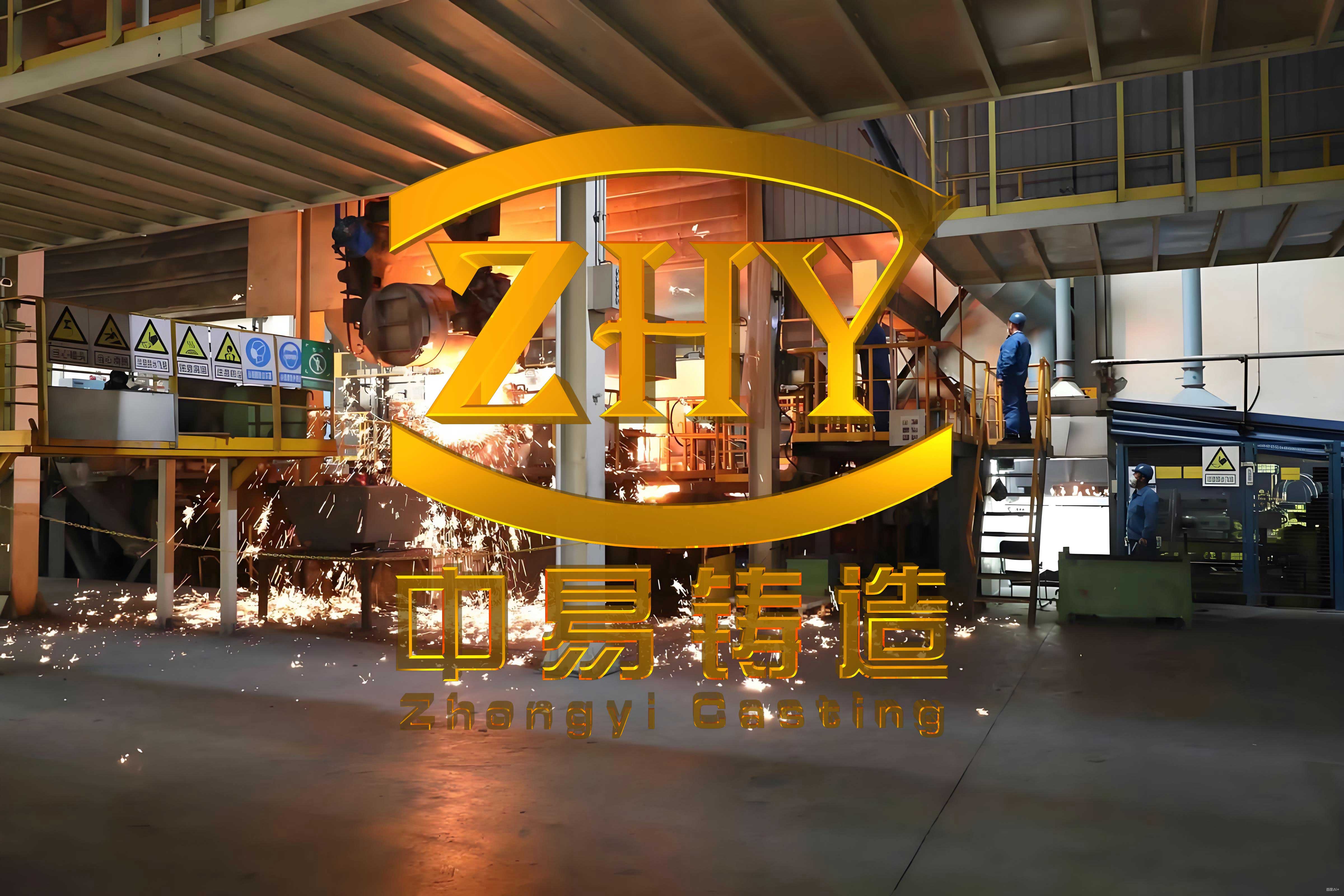
This image exemplifies the advanced infrastructure that sand casting manufacturers are adopting, showcasing a modern foundry with integrated systems. It highlights the scale and precision required in today’s competitive landscape, where every component, from shakeout to regeneration, contributes to overall efficiency.
Another critical aspect for sand casting manufacturers is the economic analysis of sand treatment. The total cost of ownership (TCO) for the system includes capital investment, operating costs, and savings from sand reuse. A simplified TCO model is: $$ \text{TCO} = I + \sum_{t=1}^{n} \frac{O_t – S_t}{(1+r)^t} $$ where \( I \) is the initial investment, \( O_t \) is the operating cost in year \( t \), \( S_t \) is the savings from reduced new sand and binder purchases, \( r \) is the discount rate, and \( n \) is the system lifespan. For sand casting manufacturers, a lower TCO justifies the upfront investment in advanced sand treatment.
Environmental considerations are also paramount. Sand casting manufacturers face increasing pressure to reduce waste and emissions. The sand treatment system I’ve described minimizes废砂排量 by regenerating up to 90% of used sand. The environmental benefit can be quantified as: $$ \text{Waste Reduction} = m_{\text{sand landfilled}} – m_{\text{sand regenerated}} $$ where a negative value indicates net reduction. This aligns with global sustainability goals, making such systems attractive for eco-conscious sand casting manufacturers.
Looking ahead, innovations like AI-driven predictive maintenance and digital twins are poised to further enhance sand treatment systems. For sand casting manufacturers, this means even higher uptime and efficiency. For example, a digital twin can simulate sand flow and predict blockages using computational fluid dynamics (CFD) equations: $$ \frac{\partial \rho}{\partial t} + \nabla \cdot (\rho \mathbf{v}) = 0 $$ $$ \rho \left( \frac{\partial \mathbf{v}}{\partial t} + \mathbf{v} \cdot \nabla \mathbf{v} \right) = -\nabla p + \mu \nabla^2 \mathbf{v} + \mathbf{f} $$ where \( \rho \) is density, \( \mathbf{v} \) is velocity, \( p \) is pressure, \( \mu \) is viscosity, and \( \mathbf{f} \) is body force. By leveraging such models, sand casting manufacturers can optimize conveyor designs and reduce energy consumption.
In conclusion, the sand treatment system for 3D printing智能铸造工厂 is a complex yet vital component that directly impacts the success of sand casting manufacturers. From raw material handling to advanced regeneration, every step is designed to ensure high-quality sand supply, reduce costs, and promote sustainability. By embracing automated equipment, data analytics, and闭环 processes, sand casting manufacturers can achieve superior casting quality while minimizing their environmental footprint. The future of foundries lies in smart integration, and as someone involved in this field, I am confident that continued innovation in sand treatment will drive the industry forward, benefiting sand casting manufacturers worldwide. The key takeaway is that a robust sand treatment system is not an expense but an investment in longevity and competitiveness for any sand casting manufacturer.