
In 1999, our company entered a joint venture with Deutz AG to produce the 226B diesel engine, fully adopting the German company’s machining lines and casting tooling. Within a few years, we achieved an annual output of 15,000 units and prepared for an increase to 25,000 units. The cylinder head, a critical component, demands high dimensional accuracy, excellent appearance, superior air tightness, and overall structural strength. Any deviation in quality directly affects engine performance and production cost. Throughout this journey, we encountered various sand casting defect issues, which we systematically analyzed and resolved. This article describes our experience in diagnosing and eliminating these defects, focusing on the most prominent problem: gas porosity.
The Initial Casting Process for 226B Cylinder Heads
Iron Melt Composition and Pouring Temperature
The 226B cylinder head is specified as GG30Cu, requiring a tightly controlled melt chemistry. The target composition is shown in Table 1.
| Element | C | Si | Mn | S | P | Cu | Cr | Mo |
|---|---|---|---|---|---|---|---|---|
| Content (wt.%) | 3.35 – 3.45 | 1.9 – 2.1 | 0.7 – 0.9 | ≤0.1 | ≤0.1 | 0.8 – 1.0 | 0.2 – 0.3 | 0.3 – 0.4 |
Through extensive trials, we identified that the pouring temperature is a critical factor influencing the sand casting defect rate. For thin-walled castings like the 226B cylinder head (the thinnest internal wall is only 4 mm) with high material requirements, a pouring temperature below 1400°C led to a noticeable increase in defects. In production, we controlled the pouring temperature between 1400°C and 1420°C, achieving optimal results.
Molding and Core Assembly Process
The original tooling for the 226B cylinder head was imported from Deutz and then adapted to our factory’s existing Vertically-Parted Flaskless (VPF) molding line (often called “shot-squeeze” line). We produced four castings per mold. A core assembly technique was employed: every two castings formed a group, each group requiring a total of nine cores – one large outer skin core (cold-box), two upper water jacket cores (hot-box), two lower water jacket cores (hot-box), two exhaust port cores (hot-box), and two intake port cores (hot-box). After assembling these cores together, we dipped the entire assembly in a water-based coating and dried it in an oven. The gating system was an open side-gating design with a single sprue. The upper mold was a green sand mold, and we added vent rods at core prints and on the casting itself to facilitate gas escape. The assembled core set was placed on a dedicated storage rack, then manually lowered into the lower mold of the VPF line before closing and pouring. The original process schematic is described conceptually (no figure number referenced).
Analysis of Sand Casting Defects
Gas Porosity – The Dominant Sand Casting Defect
Gas porosity is a common sand casting defect for all cylinder head models, but it was especially severe for the 226B. Because the casting uses many cores – nine per group – core venting becomes a major challenge. During pouring, all cores except the large outer skin core are completely surrounded by molten iron. Large volumes of gas generated from the cores must escape through core prints and the iron itself. The 226B cylinder head has a very compact geometry, small volume, thin internal walls (only 4 mm at the thinnest), and only one side with process holes. This restricted gas evacuation, causing a large amount of gas to be trapped in the iron before solidification of the casting and vent rods. The gas finally accumulated at the junction between the casting and the vent rods, forming blowholes. Gas porosity accounted for up to 90% of the total scrap loss. The typical location of these blowholes was at the bolt holes on the side without process holes, visible after removing the vent rods.
Other Sand Casting Defects
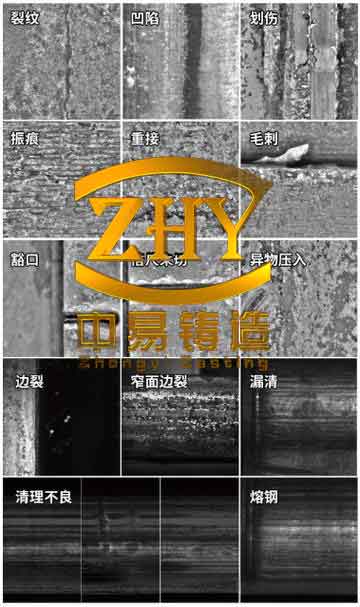
Besides gas porosity, we observed several other types of sand casting defect:
- Sand inclusions (sand holes): caused when sand was knocked off from the mold or cores during the mold closing operation and subsequently embedded in the iron.
- Fins (flash) inside the water jacket: the core binder between the upper and lower water jacket cores melted and decomposed under the high pouring temperature, allowing iron to penetrate the gap, forming fin-like protrusions that degraded cooling performance.
- Broken cores: due to buoyancy forces from the molten iron during pouring, some cores (especially the thin water jacket cores) fractured or shifted.
- Excessive flash at core prints and parting lines: because the imported tooling had been in service for many years, clearances had enlarged, leading to poor surface quality and increased grinding work.
Systematic Solutions to Sand Casting Defects
With the increasing production volume of the 226B diesel engine and the rising cost of alloying elements (copper, chromium, molybdenum), the defect problem became economically unacceptable. The scrap rate was around 10%, raising the per-ton cost of castings and limiting both quality improvement and market competitiveness. We therefore implemented a series of process modifications, which proved highly effective.
Adding a Top Core (Cover Core)
After thoroughly analyzing the production conditions, we decided to add an additional core – a top core (cover core) – to address both gas porosity and sand knock-off issues. The revised process schematic is described conceptually (no figure number referenced). The top core was produced on a L20 core shooter, two cavities per box. This core was coated separately with a refractory wash. It was positioned on the large outer skin core using locating core prints. The top core and the assembled lower core set could be pre-assembled, but care was taken to prevent loose sand from falling into the cavity through the vent holes of the top core. On the upper mold, we added a small riser (feeder) exactly at the vent rod locations prone to blowholes, shifting the thermal center upward. This simple modification delivered remarkable results:
- Gas porosity was virtually eliminated because the top core provided additional venting paths and the riser allowed gas to escape more easily.
- Sand knock-off during mold closing was eliminated because the top core protected the underlying cores and molds from direct contact.
- Excessive flash at core prints and parting lines was greatly reduced, as the top core stabilized the assembly, reducing shifting.
- Surface quality improved significantly, reducing the grinding and cleaning workload, and better meeting the stringent dimensional tolerances required by the machining line.
Developing a Specialized Core Binder
The original binder used for assembling the upper and lower water jacket cores was a commercial sodium silicate adhesive. At locations near the ingates, the binder would melt and decompose under the high temperature of the molten iron, allowing iron to penetrate between the two cores, creating fins inside the water jacket cavity. These fins hindered coolant flow and degraded the cooling efficiency of the cylinder head. After many experiments, we formulated our own dedicated adhesive. The new binder was more refractory and remained intact even at pouring temperatures, sealing the joint effectively. After adopting this customized binder, the occurrence of internal fins decreased dramatically, and the overall core assembly quality improved.
Strict Process Discipline
We reinforced operator training on the molding line. Before mold closing, every vent hole on the mold and core had to be pierced and cleared to ensure unobstructed gas escape. A layer of sealing compound (paste) was applied on top of the top core, but with careful instructions: the paste should be spread uniformly and kept away from the vent rod holes. This prevented the paste from being squeezed into the vent holes during mold closing, which would block the vents. Each vent hole was individually checked for free passage.
Quantitative Results and Discussion
The combination of these improvements – adding the top core, using the proprietary binder, and enforcing strict venting procedures – produced a dramatic reduction in sand casting defect rates. Table 2 summarizes the scrap types and their reduction before and after the improvements.
| Defect Type | Before Improvement (%) | After Improvement (%) | Reduction Factor |
|---|---|---|---|
| Gas porosity | ~9.0 | ~2.0 | 4.5× |
| Sand inclusions (knocked-off sand) | ~0.5 | ~0.1 | 5× |
| Internal fins (water jacket) | ~0.3 | ~0.05 | 6× |
| Broken cores | ~0.2 | ~0.05 | 4× |
| Excessive flash | ~0.5 | ~0.2 | 2.5× |
| Total scrap rate | ~10.5 | ~2.4 | ~4.4× |
After the changes, the overall scrap rate dropped from about 10% to around 4–5% initially, and further stabilized at approximately 2.4% after fine-tuning. We also tested the process during the summer months, when humidity can aggravate gas defects due to higher moisture in cores and molds. The results remained consistent, confirming the robustness of the new approach.
Cost-Benefit Analysis
Adding the top core increased the per-casting consumable cost (core sand, binder, and coating). However, the savings from reduced scrap, lower inspection costs, less rework, and reduced grinding more than compensated. We can express the net economic benefit using a simple formula:
Let \(C_{\text{add}}\) be the additional cost per casting for the top core (including production and assembly). Let \(C_{\text{scrap\_before}}\) be the cost of scrap per good casting before improvement, and \(C_{\text{scrap\_after}}\) after improvement. The net saving per good casting is:
$$ \Delta S = C_{\text{scrap\_before}} – C_{\text{scrap\_after}} – C_{\text{add}} $$
Assuming \(C_{\text{add}} \approx 0.5\) USD per casting, and the scrap cost (including material, energy, labor, and overhead) was about 1.2 USD per casting before (10% scrap) and 0.3 USD per casting after (2.4% scrap), the saving is:
$$ \Delta S = 1.2 – 0.3 – 0.5 = 0.4 \text{ USD per good casting} $$
With an annual production of 15,000 to 25,000 units, the annual savings ranged from 6,000 to 10,000 USD, not counting the intangible benefits of improved customer satisfaction and reduced bottleneck in the cleaning shop.
Gas Porosity Mechanism and Model
To further understand the root cause, we considered the gas evolution from cores. The total gas volume \(V_{\text{gas}}\) generated from a core can be approximated by:
$$ V_{\text{gas}} = \frac{m_{\text{binder}} \cdot R \cdot T}{M \cdot P} $$
where \(m_{\text{binder}}\) is the mass of binder decomposed, \(R\) is the gas constant, \(T\) is the absolute temperature, \(M\) is the molar mass of the evolved gases, and \(P\) is the pressure. For a given core geometry, the gas must flow through the core pores and the core print. The pressure drop required for a given flow rate follows Darcy’s law:
$$ \Delta P = \frac{\mu \cdot Q \cdot L}{k \cdot A} $$
where \(\mu\) is gas viscosity, \(Q\) is volumetric flow rate, \(L\) is flow path length, \(k\) is core permeability, and \(A\) is cross-sectional area. In the original design, the effective venting area \(A\) was limited because the top of the casting was covered only by green sand, and the only vents were the small-diameter vent rods. By adding the top core, we effectively increased \(A\) (through multiple vent holes in the top core) and reduced \(L\) (shorter path to atmosphere). The riser also provided an additional low-pressure zone, helping to draw gas out. This explains the dramatic reduction in gas porosity.
Thermal Profile and Solidification
The pouring temperature window of 1400–1420°C was critical. If the temperature was too low (<1400°C), the fluidity decreased, and gas evolution might occur after a solid skin had formed, trapping bubbles. If too high (>1420°C), the core binder decomposed more aggressively and the metal shrinkage increased. The optimal temperature was determined from a thermal balance:
$$ Q_{\text{sensible}} + Q_{\text{latent}} = \int_{\text{pour}}^{T_{\text{solidus}}} c_p \cdot m \cdot dT + L_f \cdot m $$
where \(c_p\) is specific heat, \(m\) is the mass of metal, \(L_f\) is latent heat of fusion. For the thin-walled cylinder head, the solidification time was short. Using Chvorinov’s rule:
$$ t_s = K \left( \frac{V}{A} \right)^2 $$
where \(t_s\) is solidification time, \(V\) is volume, \(A\) is surface area, and \(K\) is a mold constant. The thin walls (4 mm) gave a small modulus \(V/A \approx 2\) mm, leading to rapid solidification. This meant that gas bubbles had little time to rise, so efficient venting was essential. The top core and riser effectively increased the local modulus at the bolt holes, delaying solidification there and allowing gas to escape.
Lessons Learned and Future Directions
Through this project, we learned that addressing a dominant sand casting defect often requires altering the casting geometry (by adding cores) rather than only adjusting process parameters. The addition of the top core was a simple but powerful modification that solved multiple issues simultaneously. We also realized that the quality of core assembly adhesives is often overlooked; investing in a customized binder can eliminate specific defect modes.
Moving forward, we plan to apply similar principles to other cylinder head models in our product line. For instance, we are experimenting with 3D-printed sand cores to create optimized venting channels that follow the gas flow paths naturally. Additionally, we are using computational fluid dynamics (CFD) to simulate the filling and solidification to predict sand casting defect locations before making physical tooling changes. Our ultimate goal is to achieve a scrap rate below 1% for all cylinder head castings while maintaining cost efficiency.
Conclusion
The 226B cylinder head initially suffered from a high scrap rate dominated by gas porosity, a classic sand casting defect. Other defects included sand inclusions, internal fins, broken cores, and excessive flash. By adding a top core, developing a dedicated core binder, and enforcing strict venting procedures, we reduced the total scrap rate from about 10% to less than 3%. The improvements were validated during high-humidity summer conditions, proving their robustness. The economic benefit justified the additional core cost. This case study demonstrates that systematic analysis and targeted process changes can effectively overcome even the most stubborn sand casting defect.