
In our extensive work with alloyed white cast iron, particularly those containing chromium, molybdenum, copper, titanium, and vanadium, we have encountered significant challenges related to oxidation during heat treatment. These white cast iron alloys are widely employed in critical applications such as wear-resistant components for slurry pumps, where their mechanical properties and durability are paramount. Over years of production, the heat treatment processes for small to medium-sized components have stabilized, but larger and more complex parts, like impellers for large pumps, often exhibit issues like surface decarburization, localized overheating, and severe oxidation. This article, presented from our firsthand research perspective, delves into the oxidation phenomena in white cast iron, offering detailed experimental insights, analytical data, and theoretical explanations to address these problems. We aim to provide a comprehensive resource that extends beyond initial observations, incorporating tables, formulas, and practical recommendations to enhance the heat treatment stability of white cast iron.
The oxidation problem in white cast iron is not merely a surface defect but a complex interplay of alloy composition, thermal cycles, and atmospheric interactions. White cast iron, by its nature, possesses high hardness and wear resistance due to its carbide-rich microstructure, but this very structure can be compromised during heat treatment if oxidation occurs. Our investigations began with field observations: during heat treatment of large white cast iron castings at temperatures around 900–1000°C, white-yellow flames often emanated from furnace door seams, and upon cooling, white crystalline deposits were found on the inner furnace walls. The oxidized surfaces of the castings sometimes exhibited peculiar morphologies, such as nipple-like protrusions with or without small through-holes. These signs prompted a systematic study to unravel the underlying mechanisms, focusing on the role of alloying elements like chromium and molybdenum in white cast iron.
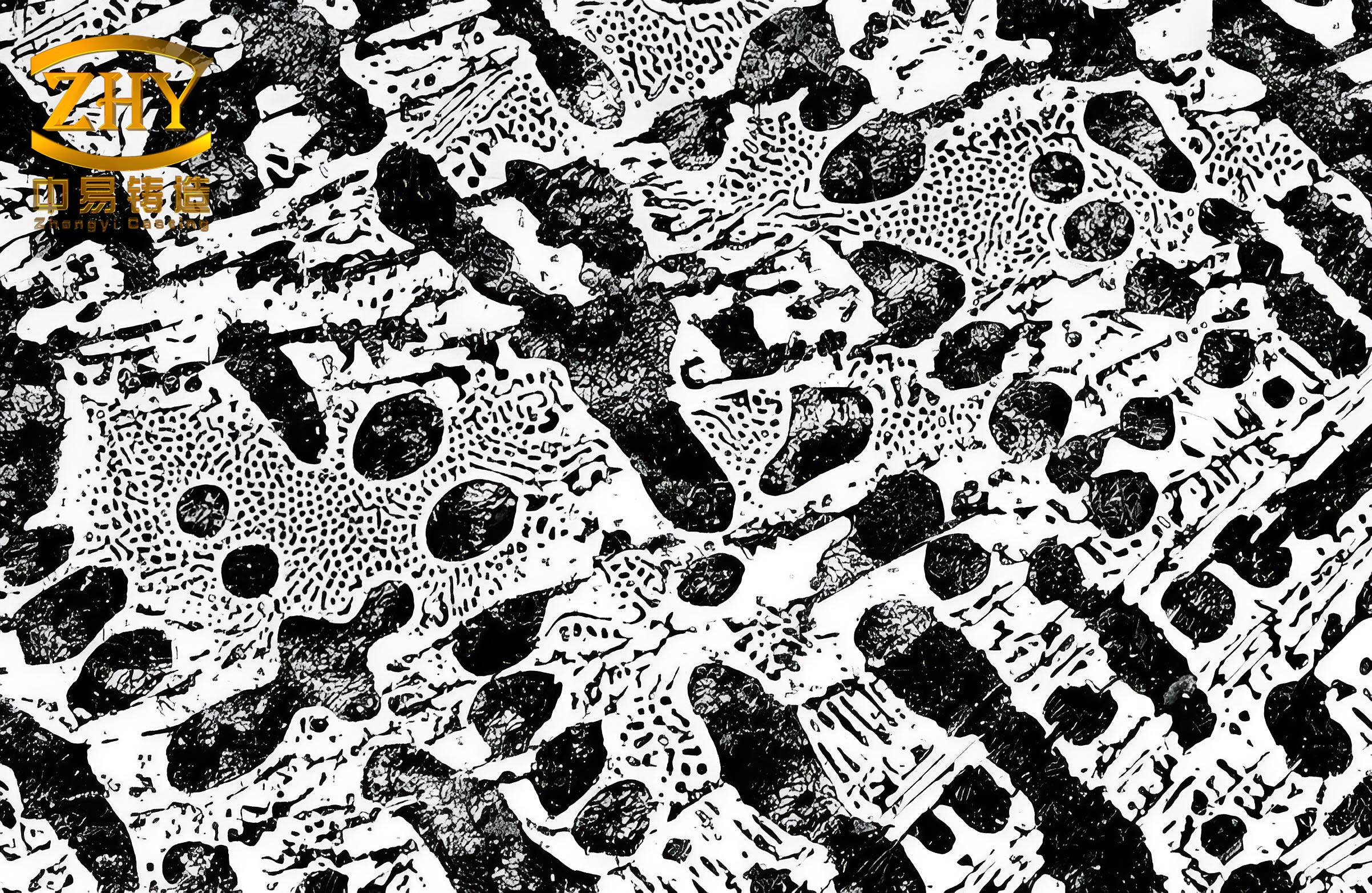
To quantify these observations, we first analyzed the white crystalline deposits. Chemical analysis revealed that these deposits were primarily molybdenum oxides, specifically molybdenum trioxide (MoO₃). The results from multiple analytical techniques, including spectroscopy and wet chemistry, are summarized in Table 1. This table compiles data from various samples collected during heat treatment cycles of white cast iron, highlighting the predominance of molybdenum-based compounds. The presence of MoO₃ is critical because it volatilizes at relatively low temperatures, contributing to the oxidative atmosphere and material loss in white cast iron.
| Sample Source | MoO₃ Content (wt%) | Other Oxides (wt%) | Moisture (wt%) |
|---|---|---|---|
| Furnace door deposits | 92.5–95.0 | 4.0–6.5 (mostly SiO₂, Fe₂O₃) | 0.5–1.0 |
| Castings surface residue | 88.0–91.0 | 8.0–11.0 (Cr₂O₃, Al₂O₃) | 0.5–1.5 |
| Laboratory-simulated oxidation | 94.2 | 5.2 (trace elements) | 0.6 |
The formation of MoO₃ can be described by the oxidation reaction of molybdenum in white cast iron. At elevated temperatures, molybdenum reacts with oxygen from the furnace atmosphere or residual oxygen within the white cast iron matrix. The reaction proceeds as: $$ \text{2 Mo} + \text{3 O}_2 \rightarrow \text{2 MoO}_3 $$ This exothermic reaction is thermodynamically favorable at temperatures above 500°C, with the Gibbs free energy change given by: $$ \Delta G^\circ = -RT \ln K $$ where \( \Delta G^\circ \) is the standard Gibbs free energy, \( R \) is the gas constant, \( T \) is the temperature in Kelvin, and \( K \) is the equilibrium constant. For white cast iron, the activity of molybdenum influences the reaction kinetics, often leading to localized oxidation hotspots. The volatility of MoO₃, with a boiling point of approximately 1155°C, means it sublimes readily during heat treatment, forming gaseous species that escape and condense as white deposits. This process not only depletes molybdenum from the white cast iron surface but also disrupts the protective oxide layers that typically form from chromium.
Next, we examined the oxide scales (oxidized layers) on the white cast iron castings. Chemical analyses of these scales, including both flat and nipple-like types, are presented in Table 2. The data indicate that the composition varies significantly with morphology: nipple-like oxides with through-holes have lower molybdenum content compared to those without holes or flat oxides. This suggests that the escape of MoO₃ vapor during oxidation creates porosity and alters the scale composition. In white cast iron, the oxide scale is a mixture of iron oxides, chromium oxides, and molybdenum oxides, but the predominance of MoO₃ in certain areas leads to non-protective, porous scales that accelerate further oxidation.
| Oxide Scale Type | Fe₂O₃ (wt%) | Cr₂O₃ (wt%) | MoO₃ (wt%) | Other (wt%) |
|---|---|---|---|---|
| Flat, uniform scale | 65.2 | 15.8 | 12.5 | 6.5 (SiO₂, CuO) |
| Nipple-like without holes | 60.5 | 18.2 | 15.0 | 6.3 (TiO₂, V₂O₅) |
| Nipple-like with through-holes | 68.0 | 14.5 | 5.8 | 11.7 (porosity-induced phases) |
The role of chromium and molybdenum in the oxidation process of white cast iron is multifaceted. Chromium, a key alloying element in white cast iron, forms a dense, adherent oxide layer (Cr₂O₃) that protects against further oxidation. The protective action can be modeled using the parabolic rate law for oxide growth: $$ x^2 = k_p t $$ where \( x \) is the oxide thickness, \( k_p \) is the parabolic rate constant, and \( t \) is time. For white cast iron with sufficient chromium, \( k_p \) is low, indicating slow oxidation. However, molybdenum interferes with this protection. When molybdenum oxidizes to MoO₃, it volatilizes and creates internal pressures within the oxide scale. The pressure buildup can be estimated using the ideal gas law: $$ P = \frac{nRT}{V} $$ where \( P \) is the pressure, \( n \) is the moles of MoO₃ gas, \( V \) is the volume of pores, and \( T \) is the temperature. In white cast iron, this pressure can exceed the cohesive strength of the Cr₂O₃ layer, causing cracking and spallation. We conducted experiments with molybdenum-rich ferroalloys heated under similar conditions to white cast iron; at 700°C, white fumes of MoO₃ were observed, confirming its volatility and oxidative influence.
To further quantify element redistribution, we analyzed the molybdenum content in the surface versus the core of severely oxidized white cast iron castings. Results are shown in Table 3. The surface consistently showed lower molybdenum levels than the core, indicating depletion due to oxidation and volatilization. This depletion weakens the white cast iron’s resistance to wear and corrosion, as molybdenum contributes to carbide stability and hardenability. The loss can be expressed as: $$ \Delta \text{Mo} = \text{Mo}_{\text{core}} – \text{Mo}_{\text{surface}} $$ where \( \Delta \text{Mo} \) represents the molybdenum loss, often ranging from 0.5% to 2.0% in affected white cast iron components.
| White Cast Iron Component | Surface Mo Content (wt%) | Core Mo Content (wt%) | Mo Loss \( \Delta \text{Mo} \) (wt%) |
|---|---|---|---|
| Impeller (large pump) | 0.85 | 2.10 | 1.25 |
| Upper cover plate | 0.92 | 2.05 | 1.13 |
| Lower cover plate | 0.88 | 2.08 | 1.20 |
| Guide vane | 0.95 | 2.12 | 1.17 |
The oxidation kinetics in white cast iron are also influenced by temperature and time. We derived an empirical model based on our data to predict oxide scale thickness \( \delta \) as a function of heat treatment parameters: $$ \delta = A \cdot \exp\left(-\frac{E_a}{RT}\right) \cdot t^n $$ where \( A \) is a pre-exponential factor, \( E_a \) is the activation energy for oxidation in white cast iron, \( t \) is time, and \( n \) is a time exponent typically around 0.5 for diffusion-controlled processes. For white cast iron with high molybdenum content, \( E_a \) decreases due to the facile formation of MoO₃, leading to thicker scales. Our experiments involved isothermal holds at temperatures from 800°C to 1050°C, with scale measurements confirming this trend. Additionally, the presence of oxygen in the white cast iron matrix, often from melting practices, exacerbates oxidation. We found that white cast iron with oxygen content above 0.008% (80 ppm) showed severe oxidation, whereas those below 0.005% remained relatively intact. This underscores the need for effective deoxidation during melting of white cast iron.
Another aspect we explored is the effect of alloying elements like copper, titanium, and vanadium in white cast iron. While these elements enhance hardness and corrosion resistance, they can modify the oxide scale composition. For instance, titanium forms stable oxides like TiO₂, which may integrate into the scale and reduce porosity. The overall oxidation resistance of white cast iron can be approximated using a weighted sum of element contributions: $$ \text{Oxidation Index} = \sum (w_i \cdot \alpha_i) $$ where \( w_i \) is the weight fraction of element \( i \) in white cast iron, and \( \alpha_i \) is its oxidation coefficient (e.g., Cr: 0.1, Mo: -0.5, Ti: 0.2, based on our data). Negative values for molybdenum indicate its detrimental effect. This index helps in designing white cast iron alloys with balanced oxidation resistance.
To mitigate oxidation in white cast iron during heat treatment, we propose several strategies. First, optimizing melting and deoxidation practices is crucial to reduce residual oxygen in white cast iron. Techniques such as vacuum melting or argon purging can lower oxygen levels below 0.005%. Second, controlling the furnace atmosphere is essential; using neutral or reducing atmospheres (e.g., nitrogen with low oxygen partial pressure) minimizes oxide formation. The oxygen partial pressure \( p_{\text{O}_2} \) should be maintained below the equilibrium pressure for MoO₃ formation, which can be calculated from: $$ \Delta G^\circ = -RT \ln \left( \frac{p_{\text{MoO}_3}}{p_{\text{O}_2}^{3/2}} \right) $$ For white cast iron, keeping \( p_{\text{O}_2} < 10^{-15} \) atm at 1000°C is ideal. Third, applying protective coatings to white cast iron castings before heat treatment can form a barrier against oxidation. Coatings based on alumina or silica have shown promise in our trials, reducing scale thickness by up to 70%. Fourth, adjusting the heat treatment cycle—such as using lower temperatures or shorter times—can limit oxidation, though this must balance with microstructural goals for white cast iron. Finally, alloy design modifications, like reducing molybdenum content or adding elements that form protective oxides (e.g., silicon or aluminum), can enhance oxidation resistance in white cast iron without compromising wear properties.
In conclusion, the oxidation problem in white cast iron during heat treatment is a complex phenomenon driven by the interplay of molybdenum volatilization, chromium oxide protection, and process parameters. Through detailed experimental analysis and theoretical modeling, we have identified key factors: the formation and escape of MoO₃, which depletes surface molybdenum and disrupts protective scales; the role of oxygen content in white cast iron; and the influence of alloy composition. Our findings emphasize that white cast iron, while excellent for wear applications, requires careful control during heat treatment to prevent oxidative degradation. By implementing deoxidation measures, atmosphere control, protective coatings, and alloy adjustments, the stability of white cast iron components, especially large and complex ones, can be significantly improved. Future work could explore advanced characterization techniques, such as in-situ microscopy, to further elucidate oxidation mechanisms in white cast iron. This research contributes to the broader understanding of white cast iron behavior under thermal stress, aiding in the development of more reliable materials for industrial applications.
To summarize the chemical interactions, we present a reaction scheme for white cast iron oxidation at high temperatures: $$ \text{Fe} + \text{Cr} + \text{Mo} + \text{O}_2 \rightarrow \text{Fe}_2\text{O}_3 + \text{Cr}_2\text{O}_3 + \text{MoO}_3 \uparrow $$ The upward arrow indicates volatilization of MoO₃, a key driver of oxidation in white cast iron. Additionally, the heat treatment window for white cast iron can be optimized using kinetic equations, such as the Arrhenius relation for scale growth: $$ k_p = k_0 \exp\left(-\frac{Q}{RT}\right) $$ where \( k_0 \) is a constant and \( Q \) is the activation energy. For typical white cast iron, \( Q \) ranges from 150 to 200 kJ/mol, depending on composition. By integrating these insights into practice, manufacturers can enhance the performance and longevity of white cast iron parts, ensuring they meet the demands of harsh operating environments. The repeated focus on white cast iron in this discussion underscores its importance in materials science and engineering, where oxidation resistance is as critical as mechanical strength.