
The pursuit of advanced engineering materials capable of withstanding extreme wear and complex service environments has driven significant research into particle-reinforced metal matrix composites (PRMMCs). These materials synergistically combine the ductility, conductivity, and machinability of a metallic matrix with the high hardness, strength, and wear resistance of ceramic reinforcements. Among the various ceramic particles available, titanium carbide (TiCp) presents particularly attractive properties for ferrous matrices, including excellent wettability with molten iron, high thermal stability (melting point ~3300 °C), exceptional hardness (~3000 HV), and a high elastic modulus (~269 GPa). The fabrication of TiCp/Fe composites, however, is often challenged by the difficulty in achieving a uniform spatial distribution of the reinforcing phase within the cast component. Agglomeration and particle settling can act as stress concentrators, severely compromising the mechanical properties and wear performance of the final product.
Conventional methods for producing PRMMCs, such as powder metallurgy, spray deposition, and liquid metal infiltration, are often cost-prohibitive or unsuitable for manufacturing large, geometrically complex castings. While stir casting is more amenable to industrial-scale production, it struggles with prolonged processing times, poor particle wettability, and inherent particle clustering. This research explores an alternative pathway: the lost foam casting process (LFC). This near-net-shape technique offers a unique advantage for composite fabrication. By coating expandable polystyrene (EPS) foam patterns with the ceramic particles prior to casting, the particles are introduced into the mold cavity in a pre-dispersed state on the vaporizing pattern surface. The dynamics of foam decomposition and molten metal front advancement then dictate the final particle distribution. In this study, I investigate the critical influence of TiCp particle size on the resulting microstructure uniformity of high-chromium cast iron matrix composites produced via the lost foam casting process.
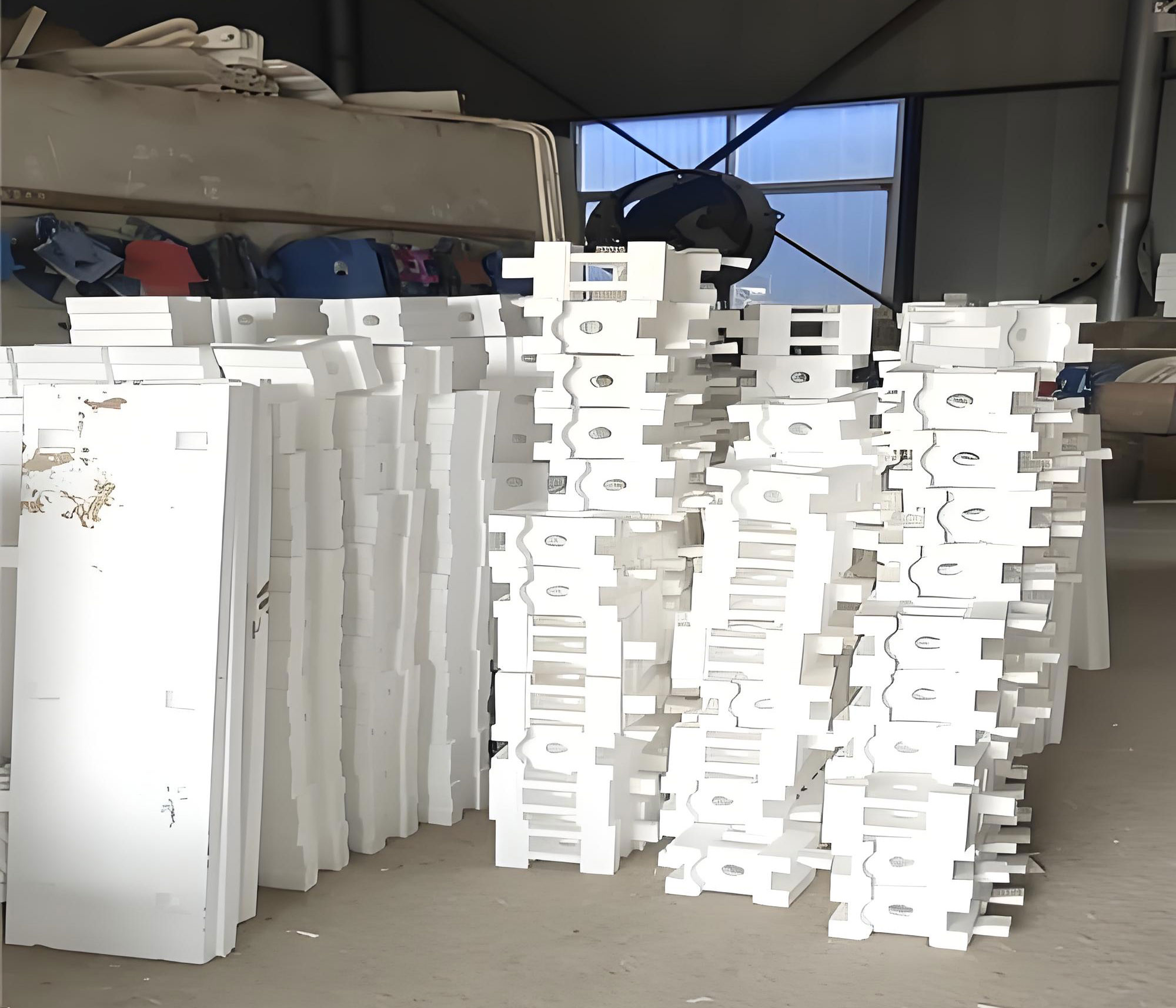
The principle of the lost foam casting process for composites hinges on the preparation of a consumable pattern. In my experimental work, EPS beads (density: 20-24 kg/m³, size: 1-2 mm) were uniformly coated with 8 vol.% of TiCp particles of four distinct nominal sizes: 600, 1000, 1500, and 2000 mesh. A binder solution was used to ensure adherence of the particles to the EPS bead surfaces. This mixture was then foamed in a pre-heated mold using steam to create a precise, three-dimensional foam pattern of a slurry pump back guard. This pattern, after being coated with a refractory wash and dried, was assembled with a gating system, embedded in unbonded sand within a flask, and subjected to a vacuum during pouring.
The matrix alloy was a high-chromium cast iron with the composition detailed in Table 1. Pouring was conducted at temperatures between 1420°C and 1470°C under a vacuum of 0.03-0.06 MPa using a top-gating system. No risers were designed, ensuring the final casting retained the intended 8 vol.% particle fraction. Post-casting, samples for microstructural analysis were extracted from four critical locations: near the gate (Position 1), at the bottom of the casting opposite the gate (Position 3), and from the two lateral sides at the mid-height (Positions 2 & 4). These samples were prepared using standard metallographic techniques and etched to reveal the microstructure. Analysis was performed using scanning electron microscopy (SEM) coupled with energy-dispersive X-ray spectroscopy (EDS). The uniformity of TiCp distribution was quantitatively assessed by calculating the standard deviation (σ) of particle counts across subdivided grids of micrographs, where a lower σ value indicates superior distribution homogeneity. The formula used is:
$$ \sigma = \sqrt{\frac{\sum_{i=1}^{N} (a_i – \bar{a})^2}{N}} $$
Here, \( a_i \) is the particle count in the i-th grid, \( \bar{a} \) is the average particle count per grid, and \( N \) is the total number of grids analyzed.
| Element | C | Si | Mn | Cr | Mo | Ni | Cu | Fe |
|---|---|---|---|---|---|---|---|---|
| wt.% | 2.2-3.2 | 0.8-1.2 | 0.8-2.0 | 20-30 | 0.9-2.5 | 1.0-3.0 | 0.2-1.2 | Bal. |
Microstructural examination of the base high-chromium iron revealed a matrix of austenite with coarse, hexagonal, and needle-shaped primary carbides. The introduction of TiCp via the lost foam casting process resulted in a significant refinement of the microstructure. The carbides became finer and more granular, distributed in a more dispersed manner. The TiCp particles themselves, observable as dark phases in the SEM micrographs, acted as heterogeneous nucleation sites, pinning grain boundaries and influencing the growth morphology of the surrounding carbides. EDS analysis confirmed the presence of Ti-rich particles within the iron matrix.
The quantitative analysis of particle distribution uniformity yielded clear trends. For each particle size grade, the lateral positions (2 and 4) consistently exhibited the lowest standard deviation, signifying the most uniform distribution at the mid-sections of the casting. Position 1 (near the gate) typically showed a higher σ, indicating particle depletion due to initial metal flow冲刷, while Position 3 (bottom) showed moderate clustering, likely due to settling effects. The most significant finding was the systematic relationship between particle size and overall uniformity.
| TiCp Particle Size (Mesh) | Average σ (Pos. 2 & 4) | Average σ (Pos. 1) | Average σ (Pos. 3) | Overall Trend |
|---|---|---|---|---|
| 600 | 1.34 | 1.81 | 1.61 | Moderate clustering, least uniform. |
| 1000 | 1.22 | 1.56 | 1.42 | Improved uniformity over 600 mesh. |
| 1500 | 1.16 | 1.44 | 1.32 | Further improvement, but onset of agglomeration visible. |
| 2000 | 1.065 | 1.26 | 1.20 | Best quantitative uniformity (lowest σ), but notable agglomeration. |
As Table 2 summarizes, the standard deviation decreased progressively with decreasing particle size, reaching a minimum value of approximately 1.065 for the 2000-mesh particles at the lateral positions. This indicates that, from a pure statistical dispersion perspective, finer particles achieved a more homogeneous distribution throughout the casting matrix when processed via the lost foam casting process. However, microstructural observation revealed a complicating factor: for the 1500 and 2000 mesh samples, visible agglomeration of TiCp particles was present, particularly in the lateral regions. This apparent contradiction—better statistical uniformity coupled with physical agglomeration—can be understood by examining the particle-EPS coating process and the physics of the lost foam casting process.
The mechanism governing particle distribution in LFC can be modeled by considering the moment a particle transitions from the air gap (formed by the advancing decomposition front of the EPS) into the molten metal. This is effectively a dynamic wetting and entrainment process. Assuming the particle is spherical and its internal energy change is negligible upon immersion, the condition for successful entry into the melt can be derived from energy conservation: the particle’s kinetic energy must be sufficient to overcome the change in surface energy associated with moving from a solid-gas interface to a solid-liquid interface.
The change in kinetic energy (\( \Delta E_k \)) for a particle of diameter \( d_p \), density \( \rho_p \), entering the melt at velocity \( u_p \) relative to the melt’s average forward velocity \( \bar{v} \) is:
$$ \Delta E_k = \frac{1}{12} \rho_p \pi d_p^3 (u_p – \bar{v})^2 $$
The change in surface energy (\( \Delta E_s \)) is:
$$ \Delta E_s = \pi d_p^2 \gamma_{LG} \cos \theta $$
where \( \gamma_{LG} \) is the liquid-gas interfacial energy and \( \theta \) is the contact angle between the melt and the particle.
For the particle to enter the melt, \( |\Delta E_k| \geq |\Delta E_s| \). Solving this inequality provides a critical condition for the particle’s entry velocity:
$$ u_p \geq \bar{v} + \left| \frac{3 \gamma_{LG} \cos \theta}{\rho_p d_p} \right|^{1/2} $$
For a given metal-pair system and processing conditions, this simplifies to highlight the inverse relationship with particle size:
$$ u_p \geq \bar{v} + \frac{K}{\sqrt{d_p}} $$
where \( K \) is a constant grouping the material properties. This relationship is pivotal: as the particle size (\( d_p \)) decreases, the required velocity for it to successfully penetrate the liquid metal front also decreases. In the context of the lost foam casting process, the smaller particles, requiring lower kinetic energy for entrainment, are more easily carried by the gaseous decomposition products and the advancing metal flow into various regions of the mold cavity, leading to a wider and more statistically uniform distribution. Larger particles may fail to be entrained effectively, leading to settling or irregular distribution.
However, the tendency for agglomeration in finer particles (1500, 2000 mesh) stems from the precursor stage. When coating EPS beads with a fixed volume fraction (8%) of extremely fine particles, the available surface area of the beads becomes densely covered, forcing particles into close proximity and promoting clusters within the coating itself. These pre-existing clusters on the foam pattern are then transcribed into the final casting. Despite this agglomeration, the clusters themselves were distributed more evenly throughout the casting volume for the 2000-mesh material, hence the lower overall σ. Furthermore, EDS analysis of the composite with 2000-mesh TiCp indicated the presence of dissolved Ti within the matrix, suggesting that a fraction of the very fine particles decomposed or partially dissolved in the high-temperature iron melt during the lost foam casting process.
The choice of binder and its concentration is another critical parameter in the lost foam casting process for composites. An effective binder must not only secure the particles to the EPS but also burn out cleanly without leaving residues that hinder wetting. Furthermore, it helps mitigate particle buoyancy in the melt. The interaction between particle size, binder effectiveness, and foam pyrolysis gases creates a complex dynamic that ultimately controls the composite microstructure.
In conclusion, my investigation into the lost foam casting process for fabricating TiCp/high-chromium iron composites demonstrates a strong correlation between reinforcement particle size and microstructural uniformity. The key findings are: Firstly, the statistical uniformity of TiCp distribution, as measured by the standard deviation of particle counts, improves consistently as particle size decreases, with the finest (2000 mesh) grade yielding the most homogeneous dispersion. Secondly, for a given particle size, the most uniform distribution is achieved at the lateral mid-sections of the casting, while areas near the gate show particle depletion. Thirdly, despite offering the best quantitative uniformity, the use of very fine particles (e.g., 1500 mesh and finer) introduces the risk of particle agglomeration during the EPS coating stage, which is replicated in the final casting. Lastly, at the extreme of fineness (2000 mesh), some degree of particle decomposition or dissolution into the iron matrix can occur. Therefore, optimizing the lost foam casting process for such composites requires a balanced selection of particle size—small enough to promote uniform entrainment and distribution via the mechanisms described, but not so small as to cause excessive agglomeration in the pattern coating or instability in the molten metal. The lost foam casting process proves to be a highly effective and controllable method for synthesizing complex-shaped PRMMCs, where the dynamics of pattern decomposition become a powerful tool for engineering the composite’s microstructure.