
The sand casting foundry industry has long relied on traditional clay-sand molding machines for producing cast iron and ductile iron components. However, conventional horizontal molding machines often suffer from inadequate speed adaptation for different mold heights, leading to high mechanical energy consumption, low production efficiency, and insufficient compactness at the parting surface. To address these challenges, our team designed a fully automatic control system for an upper-lower box dual-shot sand molding machine based on a programmable logic controller (PLC). This paper presents the overall design, hardware selection, software development, and experimental validation of the retrofitted system, demonstrating significant improvements in energy efficiency, product yield, and molding speed for a sand casting foundry.
1. System Architecture and Working Principle
The retrofitted horizontal molding machine consists of three main subsystems: a mold clamping and compaction system, a mold pushing system, and a sand barrel shooting system. The machine adopts a vertical sand shooting direction from both upper and lower sides, replacing the original single-direction lateral shooting. This change ensures that the sand is directed toward the pattern back areas, reducing the “arching effect” that often causes insufficient compactness in deep concave patterns. The compaction mechanism uses a combined approach: pre-compaction by sand shooting followed by final compaction via a pressure plate. The working cycle includes: mold closing, sand shooting, compaction, mold opening, pattern drawing, mold pushing, and core setting stages.
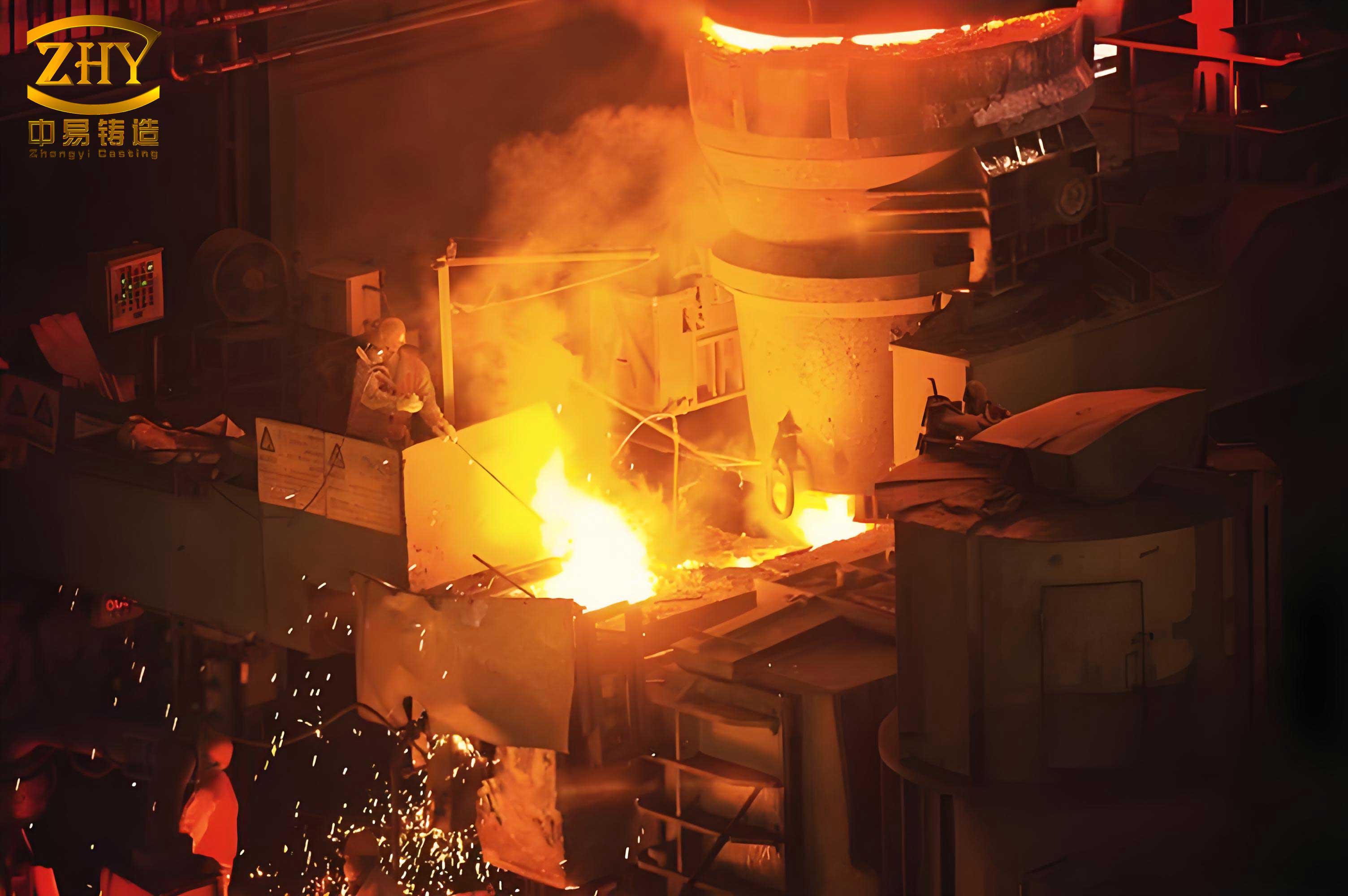
This image illustrates typical sand castings produced by the retrofitted molding system, showcasing the improved surface finish and dimensional accuracy achieved through the optimized control strategy.
2. Hydraulic Control System Design
The hydraulic system was redesigned using a servo motor-driven gear pump, replacing the original three-phase asynchronous motor with a fixed-displacement pump. The new configuration allows precise control of pressure and flow according to the molding stage. The hydraulic circuit employs cartridge valves, proportional directional valves, and solenoid-operated directional valves. The key hydraulic actuators include the clamping cylinder, upper frame cylinder, lower frame cylinder, sliding cylinder, and ejection cylinder. The system parameters are monitored by magnetostrictive displacement sensors (for position feedback) and pressure sensors (for force feedback). The servo drive receives a 0–10 V analog signal from the PLC to adjust the motor speed, enabling variable-speed operation during different phases.
The electromagnetic valve sequence is given in Table 1.
| Action Step | YD1 | YD2 | YD3 | YD4 | YD5 | YD6 | YD7 | YD8 | YD9 | YD10 | YD11 | YD12 | YD13 | YD14 | YD15 | YD16 | YD17 | YD18 |
|---|---|---|---|---|---|---|---|---|---|---|---|---|---|---|---|---|---|---|
| Clamping cylinder fast down | + | + | – | – | – | – | – | – | – | – | – | – | – | – | – | + | – | 0–10V |
| Clamping cylinder slow down | + | + | – | – | – | – | – | – | – | – | – | – | – | – | – | – | – | 0–10V |
| Clamping cylinder up | + | + | – | + | – | – | + | – | – | – | – | – | – | – | – | – | 0–10V | – |
| Clamping cylinder fast up | + | + | – | + | – | – | + | – | – | – | – | – | – | – | – | + | 0–10V | – |
| Clamping cylinder slow compact | + | + | – | + | – | – | – | – | – | – | – | – | – | + | + | – | 0–10V | – |
| Upper frame up | – | – | – | – | – | – | – | – | – | – | – | + | – | – | – | – | – | – |
| Upper frame down | – | – | – | – | – | – | – | – | – | – | – | – | + | – | – | – | – | – |
| Lower frame up | – | – | – | – | – | – | – | + | – | – | – | – | – | – | – | – | – | – |
| Lower frame down | – | – | – | – | – | – | – | – | + | – | – | – | – | – | – | – | – | – |
| Sliding cylinder out | – | – | – | – | – | – | – | – | – | – | + | – | – | – | – | – | – | – |
| Sliding cylinder return | – | – | – | – | – | – | – | – | – | + | – | – | – | – | – | – | – | – |
| Ejection cylinder out | – | – | – | – | – | + | – | – | – | – | – | – | – | – | – | – | – | – |
| Ejection cylinder return | – | – | – | – | + | – | – | – | – | – | – | – | – | – | – | – | – | – |
| Clamp start shock | – | – | + | – | – | – | – | – | – | – | – | – | – | – | – | – | – | – |
Note: “+” = energized, “–” = de-energized.
3. Control System Hardware
The control system is built around a Mitsubishi FX5U series PLC. The I/O point count is as follows: 43 digital inputs, 7 analog inputs, 50 digital outputs, and 5 analog outputs. To meet these requirements, we added one FX5-32ET/ES digital I/O module, one FX5-8EYT/ES digital output module, two FX3U-4AD analog input modules, two FX3U-4DA analog output modules, an FX-485ADP communication adapter for RS-485 communication with servo drives and temperature sensors, and an FX3-232-BD communication board for RS-232 communication with the HMI.
Position feedback is provided by BTL6-E500-M0550-PF magnetostrictive displacement sensors, while pressure sensors monitor hydraulic cylinder force. The servo drives are INOVANCE IS580 series, paired with permanent magnet synchronous motors (models ESMG1-25D20CD and ESMG1-75D17CD). The hydraulic pump is an internal gear pump selected based on calculated maximum pressure and flow requirements.
The electrical wiring diagram for the PLC terminal connections is shown conceptually in the design, with careful attention to shielding and grounding to minimize noise in the analog signals.
4. Control Software Design
4.1 Speed Regulation Control System
The speed regulation system operates in two modes: manual and automatic. In manual mode, the operator can adjust the servo pump pressure and flow through the touchscreen to run individual cylinders for maintenance or setup. In automatic mode, the PLC uses a segmented control strategy based on mold parameters (e.g., sand layer thickness) to define acceleration and deceleration zones for each action, ensuring smooth transitions and reduced peak power demand.
The flow chart of the automatic speed regulation process is:
Start → Initialize parameters → Read mold data → Determine clamping cylinder target positions and speeds → Execute fast approach → Switch to slow deceleration → Clamp and compact → Pressure holding → Open mold with variable speed → End.
4.2 Feedback Control Algorithm
To maintain precise speed and pressure control under varying loads, a closed-loop control scheme is implemented. During the fast approach and return phases, position feedback control is used, while the pressure holding phase employs pressure feedback control. The control law is a standard digital PID controller:
$$ u(t) = K_p e(t) + K_i \int_0^t e(\tau) d\tau + K_d \frac{de(t)}{dt} $$
where e(t) is the error between the setpoint (position or pressure) and the measured value. The output u(t) is converted to a 0–10 V analog signal sent to the servo drive, which adjusts the motor speed accordingly. The PID gains are tuned using the built-in autotuning function of the PLC for each stage.
The schematic of the closed-loop control system for the clamping cylinder during the compaction phase is shown below (conceptual):
Setpoint (Pressure) → + → Error → PID Controller → D/A → Servo Drive → Servo Motor → Hydraulic Pump → Clamping Cylinder → Pressure Sensor → − (feedback back to summing point).
4.3 PLC Program Architecture
The PLC program was developed using GX Works 3 software. It consists of two main routines: manual control and automatic cycle control. The automatic cycle follows the sequence: initialization → mold closing → sand shooting → compaction → mold opening → lower frame slide out → core setting → mold closing → upper frame stripping → lower frame stripping → pattern drawing → mold ejection → reset. Safety interlocks and fault diagnostics are included.
4.4 HMI Design
The human-machine interface (HMI) was designed using EasyBuilder Pro software from Weintek Labs. Three main screens were created:
- Production Monitoring Screen: displays cumulative production, cycle time, hydraulic station energy consumption, and system status.
- Parameter Setting Screen: allows modification of speeds, pressures, and position setpoints for each stage.
- Manual Control Screen: provides buttons for individual cylinder jogging and adjustment of pump pressure/flow for troubleshooting.
5. Experimental Results and Discussion
Field tests were conducted at a sand casting foundry producing clutch pressure plates (ductile iron QT450-10). The mold hardness requirement was 80–95, and the casting weight was approximately 20 kg. The foundry had experienced a high scrap rate of 57% due to shrinkage defects caused by insufficient mold compaction in the deep cavity areas. We compared the retrofitted machine with the original machine using the same batch of molding sand (moisture 3–4%, permeability 100–150, green compression strength 115–165 kPa, clay content 10–14%).
Key performance metrics are summarized in Table 2.
| Parameter | Original Machine | Retrofitted Machine |
|---|---|---|
| Product yield (%) | 77.5 | 96.5 |
| Hydraulic station energy consumption (kWh per cycle) | 16.16 | 14.18 |
| Molding cycle time (s per mold) | 41 | 37 |
| Parting surface compactness (measured) | <75 (typical) | >80 |
The retrofitted machine achieved a product yield of 96.5%, representing a 24.5% improvement over the original. Energy consumption dropped by 12.3%, and cycle time decreased by 9.8% (from 41 s to 37 s per mold). The improved compactness at the parting surface (consistently above 80) effectively eliminated the shrinkage defects, as confirmed by subsequent casting inspection.
These improvements are attributed to the following factors:
- The vertical double-shot sand shooting system ensures uniform sand filling even in deep cavities.
- The variable-speed hydraulic control reduces impact forces and allows better compaction pressure distribution.
- The closed-loop PID control maintains precise position and pressure during the critical compaction phase.
- The energy-saving servo motor reduces idle power consumption during standby.
6. Conclusion
In this study, we successfully retrofitted a traditional horizontal molding machine in a sand casting foundry with a PLC-based automatic control system featuring servo-hydraulic variable-speed regulation. The system incorporates a novel upper-lower dual-shot sand shooting mechanism, a segmented speed control strategy, and closed-loop PID feedback for both position and pressure. Field tests demonstrated a significant improvement in product yield (from 77.5% to 96.5%), a 12.3% reduction in energy consumption, and a 9.8% reduction in molding cycle time. The parting surface compactness met the required 80–95 range, solving the long-standing issue of insufficient compaction in complex castings. This retrofit provides a cost-effective and scalable solution for traditional sand casting foundries seeking modernization and higher efficiency.