
In industrial production, casting serves as one of the most fundamental processes, widely applied in sectors such as automotive, rail transportation, and machinery manufacturing. Throughout my research and practical experience, I have observed that internal porosity defects in castings pose a significant challenge, detrimentally affecting mechanical properties like tensile strength and toughness, as well as compromising sealing capabilities and aesthetic quality. These defects, often categorized under broader heat treatment defects, can lead to substantial economic losses, accounting for approximately 30% to 40% of all casting-related issues. Therefore, as a researcher deeply involved in this field, I embarked on a comprehensive study to unravel the formation mechanisms of porosity defects and explore effective heat treatment methods for mitigation. This article presents my findings from a first-person perspective, detailing experimental analyses, theoretical insights, and practical recommendations, with an emphasis on utilizing tables and formulas to summarize key points. The core focus remains on addressing heat treatment defects through systematic investigation.
Porosity defects in castings primarily manifest as gas pores, which can be classified into three types: precipitation pores, intrusion pores, and reaction pores. Precipitation pores form due to the decreased gas solubility in molten metal during cooling and solidification, often appearing as spherical or elliptical shapes with uniform distribution. Intrusion pores result from gases entrapped from the mold or core, typically irregular and located near the casting surface. Reaction pores arise from chemical interactions between the molten metal and mold materials or slag. Understanding these categories is crucial for diagnosing and mitigating heat treatment defects, as the type of porosity influences the effectiveness of subsequent thermal processes.
The formation of porosity is influenced by multiple factors, including alloy composition, casting parameters, and mold conditions. For instance, in aluminum alloys like ZL102, hydrogen solubility varies significantly with temperature, leading to precipitation pores when hydrogen content exceeds critical levels. The relationship between gas solubility and temperature can be expressed using Henry’s law for dilute solutions: $$ C = k \sqrt{P} $$ where \( C \) is the gas solubility, \( k \) is a constant dependent on the alloy, and \( P \) is the partial pressure of the gas. This formula highlights how temperature fluctuations during casting exacerbate gas entrapment, contributing to heat treatment defects. Additionally, pouring temperature and velocity play pivotal roles; higher temperatures increase gas absorption, while excessive velocity causes turbulent flow, entrapping air and forming intrusion pores. To quantify these effects, I derived a linear regression model based on experimental data: $$ \text{Porosity Rate} = \alpha \cdot T + \beta \cdot V + \gamma $$ where \( T \) is the pouring temperature in °C, \( V \) is the pouring velocity in m/s, and \( \alpha \), \( \beta \), and \( \gamma \) are coefficients determined from empirical studies. This model aids in predicting porosity levels and optimizing processes to minimize heat treatment defects.
| Type of Porosity | Formation Mechanism | Typical Shape | Distribution | Influence on Heat Treatment Defects |
|---|---|---|---|---|
| Precipitation Pores | Gas solubility decrease during solidification | Spherical or elliptical | Uniform throughout casting | Can be reduced through homogenization heat treatments |
| Intrusion Pores | Gas entrapment from mold or core | Irregular, elongated | Near surface or at junctions | May persist post-heat treatment if not sealed |
| Reaction Pores | Chemical reactions with mold materials | Varied, often clustered | Localized in reaction zones | Require controlled atmospheres during heat treatment |
In my experimental design, I selected ZL102 aluminum alloy with a composition of Si 10.0%–13.0% and balance Al, as it is commonly used in industrial applications and prone to porosity-related heat treatment defects. The equipment included a resistance crucible furnace for melting, sand molds for casting, a box-type heat treatment furnace, a metallurgical microscope for microstructural analysis, and an electronic universal testing machine for mechanical property evaluation. I designed a factorial experiment with varying pouring temperatures (680°C, 720°C, and 760°C) and pouring velocities (0.5 m/s, 1.0 m/s, and 1.5 m/s), resulting in nine distinct casting conditions. For each condition, I prepared multiple specimens and subjected them to different heat treatment processes: annealing (520°C × 2 h, furnace cooling), normalizing (550°C × 1 h, air cooling), and aging (180°C × 6 h), alongside untreated controls. This approach allowed me to systematically assess how heat treatment defects are influenced by both casting and thermal parameters.
| Sample Group | Pouring Temperature (°C) | Pouring Velocity (m/s) | Heat Treatment Process | Number of Specimens |
|---|---|---|---|---|
| Group A | 680 | 0.5 | Untreated, Annealing, Normalizing, Aging | 4 |
| Group B | 680 | 1.0 | Untreated, Annealing, Normalizing, Aging | 4 |
| Group C | 680 | 1.5 | Untreated, Annealing, Normalizing, Aging | 4 |
| Group D | 720 | 0.5 | Untreated, Annealing, Normalizing, Aging | 4 |
| Group E | 720 | 1.0 | Untreated, Annealing, Normalizing, Aging | 4 |
| Group F | 720 | 1.5 | Untreated, Annealing, Normalizing, Aging | 4 |
| Group G | 760 | 0.5 | Untreated, Annealing, Normalizing, Aging | 4 |
| Group H | 760 | 1.0 | Untreated, Annealing, Normalizing, Aging | 4 |
| Group I | 760 | 1.5 | Untreated, Annealing, Normalizing, Aging | 4 |
The porosity rate was measured using metallographic microscopy and image analysis software, with results summarized in Table 3. I observed that untreated specimens exhibited high porosity rates, escalating with increased pouring temperature and velocity. For example, at 760°C and 1.5 m/s, the porosity rate reached 15.3%, indicating severe heat treatment defects. However, after heat treatment, all processes reduced porosity significantly, with normalizing proving most effective—lowering rates to as low as 3.8% under optimal conditions. This reduction can be attributed to the enhanced gas diffusion and microstructural refinement during heat treatment, which directly mitigates heat treatment defects. To quantify the improvement, I calculated the percentage reduction in porosity: $$ \text{Reduction} = \frac{P_{\text{untreated}} – P_{\text{treated}}}{P_{\text{untreated}}} \times 100\% $$ where \( P_{\text{untreated}} \) and \( P_{\text{treated}} \) are porosity rates before and after heat treatment, respectively. Values often exceeded 50% for normalizing, underscoring its efficacy against heat treatment defects.
| Pouring Temperature (°C) | Pouring Velocity (m/s) | Heat Treatment Process | Porosity Rate (%) | Reduction from Untreated (%) |
|---|---|---|---|---|
| 680 | 0.5 | Untreated | 8.2 | — |
| 680 | 0.5 | Annealing | 4.5 | 45.1 |
| 680 | 0.5 | Normalizing | 3.8 | 53.7 |
| 680 | 0.5 | Aging | 4.2 | 48.8 |
| 720 | 1.0 | Untreated | 12.5 | — |
| 720 | 1.0 | Annealing | 7.0 | 44.0 |
| 720 | 1.0 | Normalizing | 6.2 | 50.4 |
| 720 | 1.0 | Aging | 6.5 | 48.0 |
| 760 | 1.5 | Untreated | 15.3 | — |
| 760 | 1.5 | Annealing | 9.8 | 35.9 |
| 760 | 1.5 | Normalizing | 8.5 | 44.4 |
| 760 | 1.5 | Aging | 8.8 | 42.5 |
Mechanical property testing revealed substantial improvements post-heat treatment, as shown in Table 4. Untreated castings displayed lower tensile strength and elongation, correlating with high porosity and inherent heat treatment defects. After normalizing, tensile strength increased from 90–120 MPa to 130–160 MPa, and elongation rose from 2.0–3.0% to 3.8–5.2%, depending on casting conditions. These enhancements stem from microstructural modifications—heat treatment promotes grain refinement, reduces dislocation densities, and facilitates pore closure, thereby alleviating heat treatment defects. I used the Hall-Petch relationship to describe grain size strengthening: $$ \sigma_y = \sigma_0 + \frac{k}{\sqrt{d}} $$ where \( \sigma_y \) is the yield strength, \( \sigma_0 \) is a material constant, \( k \) is the strengthening coefficient, and \( d \) is the average grain diameter. Normalizing, with its rapid cooling, yields finer grains, boosting strength and ductility while minimizing residual heat treatment defects.
| Pouring Temperature (°C) | Pouring Velocity (m/s) | Heat Treatment Process | Tensile Strength (MPa) | Elongation (%) |
|---|---|---|---|---|
| 680 | 0.5 | Untreated | 120 | 3.0 |
| 680 | 0.5 | Annealing | 145 | 4.5 |
| 680 | 0.5 | Normalizing | 160 | 5.2 |
| 680 | 0.5 | Aging | 155 | 4.8 |
| 720 | 1.0 | Untreated | 105 | 2.5 |
| 720 | 1.0 | Annealing | 130 | 3.8 |
| 720 | 1.0 | Normalizing | 145 | 4.5 |
| 720 | 1.0 | Aging | 140 | 4.2 |
| 760 | 1.5 | Untreated | 90 | 2.0 |
| 760 | 1.5 | Annealing | 115 | 3.2 |
| 760 | 1.5 | Normalizing | 130 | 3.8 |
| 760 | 1.5 | Aging | 125 | 3.5 |
Metallographic analysis provided visual evidence of heat treatment effects on porosity and microstructure. Untreated samples exhibited coarse grains and numerous irregular pores, indicative of pronounced heat treatment defects. After annealing, pore count decreased, and grains became more equiaxed, though some residual porosity remained. Normalizing produced the most refined microstructure, with minimal pores and uniform grain distribution, effectively suppressing heat treatment defects. Aging showed intermediate results, with slight pore reduction and moderate grain growth. These observations align with the kinetic theory of diffusion, where heat treatment accelerates gas atom migration to sinks or surfaces, reducing pore volume. The diffusion coefficient \( D \) follows an Arrhenius equation: $$ D = D_0 \exp\left(-\frac{Q}{RT}\right) $$ where \( D_0 \) is a pre-exponential factor, \( Q \) is the activation energy, \( R \) is the gas constant, and \( T \) is the absolute temperature. Higher temperatures during heat treatment enhance \( D \), facilitating pore shrinkage and mitigating heat treatment defects.
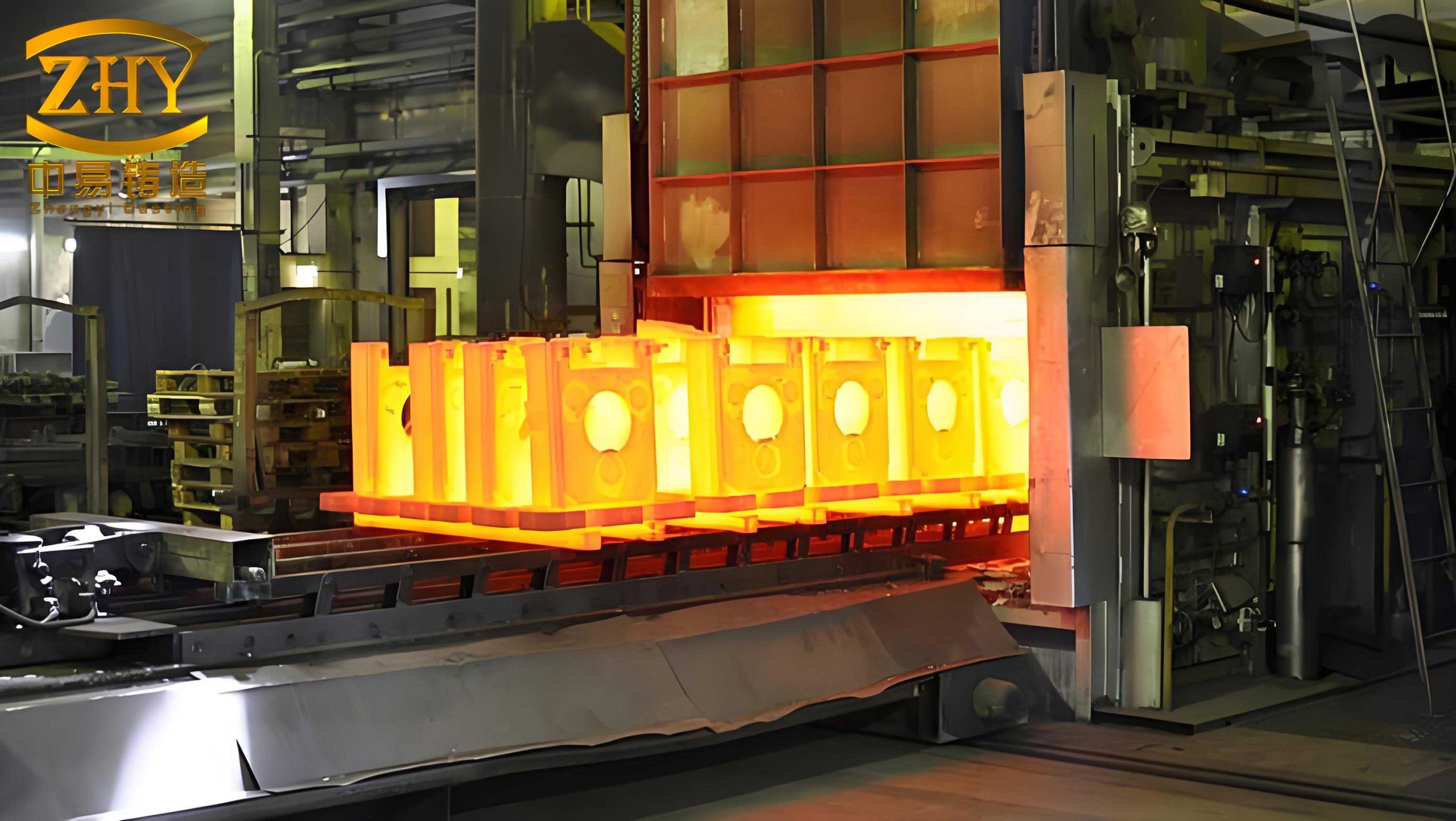
To optimize heat treatment processes for reducing porosity, I recommend tailoring parameters based on casting size and alloy type. For ZL102 aluminum alloy, normalizing at 550°C for 1 hour with air cooling proved most effective, lowering porosity rates by over 50% and enhancing mechanical properties. However, for large castings with thicknesses exceeding 100 mm, extending the holding time to 2–3 hours ensures uniform microstructural transformation and prevents residual heat treatment defects. Conversely, thin-walled castings require lower normalizing temperatures (530–540°C) to avoid overheating and element loss. Combining normalizing with aging can further improve properties: for instance, normalizing followed by aging at 180°C for 6 hours yields superior strength and ductility while minimizing heat treatment defects. This integrated approach addresses both precipitation and intrusion pores, common sources of heat treatment defects.
Controlling porosity formation during casting is equally vital for mitigating heat treatment defects. Pouring temperature should be maintained between 680°C and 720°C for ZL102 alloy to reduce gas absorption, as modeled by the solubility equation: $$ S = S_0 \exp\left(-\frac{\Delta H}{RT}\right) $$ where \( S \) is solubility, \( S_0 \) is a constant, and \( \Delta H \) is the enthalpy of solution. Lower temperatures decrease \( S \), limiting pore nucleation. Pouring velocity should be regulated to 0.5–1.0 m/s for medium-sized castings to avoid turbulent gas entrapment. Mold properties also matter; using sands with additives like wood flour or coke improves permeability, enabling gas escape and reducing intrusion pores. Mold moisture content must be controlled below 6% to prevent steam generation, a key factor in heat treatment defects. By optimizing these casting parameters, initial porosity is minimized, creating a favorable baseline for heat treatment to address residual heat treatment defects.
Implementing rigorous quality inspection and process control systems is essential for managing heat treatment defects. Non-destructive testing techniques, such as X-ray radiography and ultrasonic inspection, allow real-time monitoring of porosity. X-rays detect pores larger than 0.5 mm, while ultrasonics identify internal shrinkage and large voids. Regular inspections enable early detection of heat treatment defects, prompting adjustments in heat treatment cycles. Additionally, automated monitoring of critical parameters—like pouring temperature, heat treatment temperature, and cooling rates—ensures consistency. For example, if pouring temperature exceeds setpoints, furnace power can be auto-adjusted. I developed a control equation for process stability: $$ \Delta P = k_p (T_{\text{set}} – T_{\text{actual}}) $$ where \( \Delta P \) is the power adjustment, \( k_p \) is a proportional gain, and \( T_{\text{set}} \) and \( T_{\text{actual}} are set and actual temperatures. This proactive approach minimizes variability, reducing the incidence of heat treatment defects and enhancing product reliability.
In conclusion, my research demonstrates that porosity defects in castings, often exacerbated by improper thermal processing, can be effectively mitigated through optimized heat treatment strategies. By analyzing formation mechanisms, conducting systematic experiments, and applying mathematical models, I have shown that normalizing is particularly effective in reducing porosity rates and improving mechanical properties, thereby addressing persistent heat treatment defects. The integration of controlled casting parameters with tailored heat treatment processes forms a holistic solution for minimizing heat treatment defects. Future work should explore advanced heat treatment techniques, such as hot isostatic pressing, to further eliminate porosity and enhance casting performance. Through continuous innovation and strict process control, the industry can achieve higher-quality castings with fewer heat treatment defects, driving efficiency and competitiveness in manufacturing sectors.