
The formation of porosity in casting remains one of the most persistent and detrimental defects in metal casting processes, significantly impairing the mechanical properties, pressure tightness, and overall quality of cast components. This defect arises from the entrapment of gases within the solidifying metal or from shrinkage during the phase change from liquid to solid. The susceptibility to porosity in casting is influenced by a complex interplay of metallurgical factors, process parameters, and material properties. Understanding these interactions is crucial for developing effective mitigation strategies to control porosity in casting and enhance product performance.
A critical metallurgical factor, particularly in aluminum-silicon (Al-Si) alloys, is the iron (Fe) content. Iron, often introduced through scrap or charge materials, forms brittle intermetallic compounds with complex morphologies (like β-Al5FeSi in platelet form) which act as stress concentrators and crack initiation sites, severely reducing ductility and toughness. However, the harmful effect of iron is not absolute but is governed by a critical iron content, which itself is a function of casting geometry and cooling rate. For sand castings with relatively slow cooling rates, this critical level is typically in the range of 0.5% to 0.7% Fe. The relationship between cooling rate and the critical iron content can be conceptually expressed as:
$$ C_{Fe}^{crit} = f(\dot{T}) $$
where \( C_{Fe}^{crit} \) is the critical iron content and \( \dot{T} \) is the cooling rate. Faster cooling rates, such as those achieved in die casting, refine the microstructure and alter the morphology of iron-rich phases, thereby increasing the tolerable iron level. In die-cast Al-Si alloys, the critical iron content can be as high as approximately 1.1% Fe.
To counteract the detrimental effects of iron and manage porosity in casting related to intermetallic formation, elements like manganese (Mn), chromium (Cr), molybdenum (Mo), and cobalt (Co) are added as “neutralizers.” These elements modify the chemistry and morphology of the iron-rich phases, transforming harmful platelet structures into less detrimental Chinese script or polyhedral forms. Manganese, in particular, is commonly used, with additions greater than 0.5 times the iron content (%Mn > 0.5 x %Fe) being effective in raising the critical iron content. The combined effect of these elements is often summarized by a “neutralizer ratio.” However, it is vital to note that while these additions mitigate brittleness, they increase the total volume fraction of intermetallic compounds. The weight of these elements contributes to the formation of these phases at a significant volumetric ratio. Therefore, the overall iron content must be limited despite the use of neutralizers.
| Element | Primary Role | Typical Addition (Relative to Fe) | Impact on Intermetallic Morphology |
|---|---|---|---|
| Manganese (Mn) | Iron Neutralizer | > 0.5 x %Fe | Transforms β-phase platelets to α-phase (Al15(Fe,Mn)3Si2) Chinese script. |
| Chromium (Cr) | Iron Neutralizer | Varies | Similar to Mn, may form complex (Al,Cr,Fe)-Si compounds. |
| Molybdenum (Mo) | Iron Neutralizer | Varies | Effective modifier, often used for high-temperature alloys. |
The ongoing development of Al-Si alloys focuses on discovering new, more efficient neutralizers with fewer drawbacks. Furthermore, fundamental metallurgical research is required to fully elucidate the interactions between cooling rate, the critical iron content, and the synergistic effects of alloying elements during the formation of iron-rich phases, all of which are key to minimizing defects like porosity in casting.
Shifting focus to the foundry process itself, the issue of porosity in casting becomes particularly pronounced in resin-bonded sand molds, such as those using furan no-bake binders. Here, the sources of gas leading to porosity in casting are multifaceted, originating from the decomposition of the organic binder, moisture, coatings, and even the molten metal treatment. The visual manifestation of this porosity in casting can be categorized based on its location and morphology, which are direct clues to its root cause.
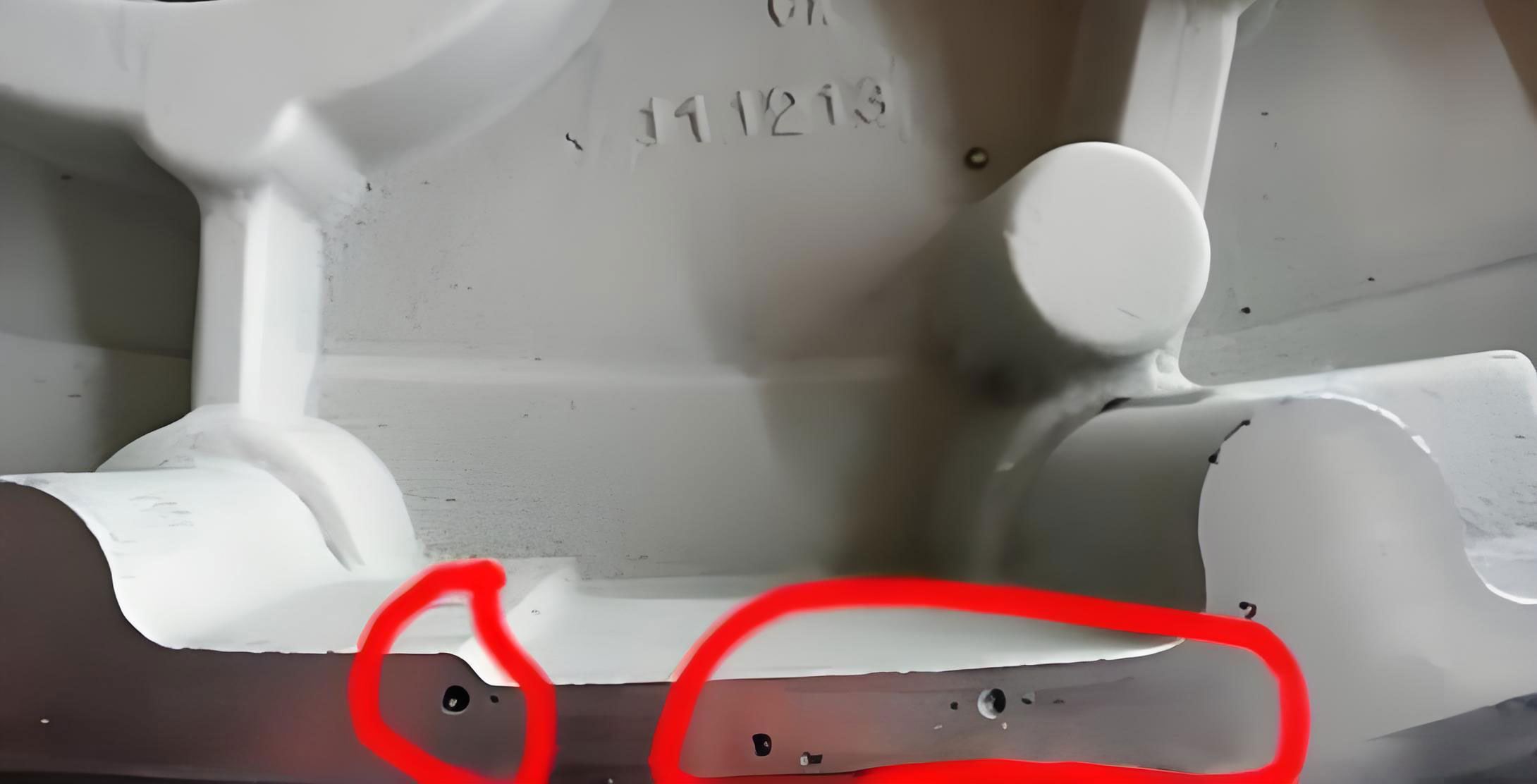
The formation mechanism involves gas generation from the mold/core, its transportation through the sand matrix, and its eventual entrapment by the solidifying metal. The pressure buildup within the mold cavity \( P_{gas} \) can be related to the gas generation rate \( \dot{G} \), the permeability of the sand \( k \), and the pouring time \( t \). A simplistic representation is that porosity in casting occurs when the local gas pressure exceeds the metallostatic pressure \( \rho g h \) plus the strength of the initial solid shell forming at the metal surface:
$$ P_{gas}(t) > \rho g h + \sigma_{shell} $$
Where \( \rho \) is the metal density, \( g \) is gravity, \( h \) is the metallostatic head, and \( \sigma_{shell} \) is the strength of the solidifying skin. Effective prevention of porosity in casting therefore relies on controlling the variables in this inequality.
Based on statistical analysis of defect occurrences, porosity in casting within resin sand molds can be classified by its primary driving factor. This classification is essential for implementing targeted corrective actions.
| Classification of Porosity in Casting | Primary Cause | Typical Morphology | Key Controlling Parameters |
|---|---|---|---|
| Mold Sand Quality-Related | High gas evolution from sand, low strength/permeability. | Superficial pinholes, large blown holes. | Resin content, LOI (Loss on Ignition) of reclaimed sand, fines content. |
| Inadequate Mold Drying | Residual moisture/solvents in mold/core surface. | Subsurface pinholes (rounded or rain-drop shaped), blown holes on cope surfaces. | Coating drying performance, core curing time, ambient humidity & temperature. |
| Poor Gating System Design | Turbulent filling or long fill time allows gas entrapment. | Blown holes, porosity near ingates or at the end of filling. | Gating ratio, pouring time \( \tau_p \), pouring temperature. |
| Insufficient Venting | Blocked or inadequate core/mold vents. | Localized severe blown holes, often in deep pockets. | Vent size, vent pathway connectivity, placement. |
| Molten Metal Quality-Related | Gas content in melt or dross entrainment. | Subsurface honeycomb porosity, scattered slag-associated holes. | Molten metal degassing, slag removal, inoculation practice. |
The relationship between reclaimed sand quality and porosity in casting is particularly strong. The Loss on Ignition (LOI) is a direct measure of the residual combustible materials (resin, etc.) in the sand, which become sources of gas. A clear correlation exists, as shown in the data below, indicating that controlling LOI is paramount to reducing gas-related defects and minimizing porosity in casting.
| Reclaimed Sand LOI (%) | Approximate Gas Evolution (cm³/g) | Observed Trend in Porosity in Casting |
|---|---|---|
| ≤ 2.0 | Low | Negligible defects related to sand gas. |
| 2.5 – 3.0 | Moderate | Occasional superficial pinholes. |
| 3.0 – 4.2 | High | Frequent and severe porosity in casting. |
To mitigate porosity in casting from mold sand, the following measures are critical: maintain resin addition levels as low as possible (typically 0.8-1.0%) while ensuring adequate strength, strictly control LOI of reclaimed sand to below 2.5% (ideally ≤2.0%), and limit fines content to maintain permeability.
For porosity in casting caused by inadequate mold drying, the solution lies in ensuring complete evaporation of solvents and reaction products. This involves using coatings with good burn-off characteristics, allowing sufficient curing time before closing the mold, and actively flame-drying molds/cores in cold or humid conditions. Data confirms that active drying can drastically reduce the incidence of this type of porosity in casting.
The design of the gating system has a profound impact on the severity of porosity in casting. Systems that promote turbulent filling or are too slow allow more time for gas to invade the molten stream. Conversely, systems designed for rapid, non-turbulent filling help “outrun” the gas evolution. The relationship between pouring time and defect rate for a given casting can often be represented empirically. A common guideline is to keep pouring time \( \tau_p \) within certain limits based on casting weight \( W \):
$$
\tau_p \leq
\begin{cases}
50 \text{ s} & \text{for } W < 1000 \text{ kg} \\
65 \text{ s} & \text{for } 1000 \text{ kg} \leq W < 5000 \text{ kg} \\
90 \text{ s} & \text{for } 5000 \text{ kg} \leq W < 30000 \text{ kg}
\end{cases}
$$
Gating styles also matter. Bottom gating and well-designed step gating systems generally result in lower levels of porosity in casting compared to top-pouring systems, as they promote smoother filling and better temperature gradients.
Venting is the deliberate provision of escape paths for generated gases. Insufficient venting guarantees porosity in casting, particularly in deep cores or enclosed cavities. The required vent area \( A_v \) can be estimated as a function of the core surface area \( S_c \) exposed to molten metal. A simple rule of thumb is that the diameter \( d \) of a main vent should satisfy:
$$ d \geq 0.0001 \times \Sigma S_c $$
where \( d \) is in cm and \( \Sigma S_c \) is the total core surface area in cm². Ensuring these vents are not blocked during molding, closing, or pouring is equally critical to prevent porosity in casting.
Finally, the quality of the molten metal itself is a direct source of porosity in casting. Gas dissolved in the melt (hydrogen in aluminum, nitrogen/hydrogen in iron) can precipitate during solidification. Inadequate slag removal leads to dross entrapment which can nucleate gas pores. Effective countermeasures include proper degassing treatments (e.g., rotary degassing for Al alloys), careful fluxing and skimming, and controlled inoculation. While lower pouring temperatures can reduce other issues like metal-mold reaction, they increase the solubility of gas in the melt and the viscosity of the metal, both of which can aggravate shrinkage and gas porosity in casting. Therefore, maintaining an optimal pouring temperature range is essential. For gray iron, this is typically 1340-1380°C, and for ductile iron, 1340-1360°C.
In practice, porosity in casting often results from a combination of factors. Therefore, a holistic and systematic approach is necessary for effective control. This includes: 1) Strict control of raw material quality (sand, resin, coatings); 2) Standardization and control of process parameters (curing times, drying practices); 3) Scientific design of gating and venting systems tailored to resin sand’s high gas evolution; and 4) Rigorous molten metal treatment and pouring practices. By classifying the root cause of porosity in casting and applying these targeted mitigation strategies, foundries can significantly reduce scrap rates and consistently produce high-integrity castings with minimal internal defects. The continuous research into alloy metallurgy and process optimization remains vital in the ongoing battle against porosity in casting.