
In my experience as a foundry engineer, the integration of cast steel and cast iron parts production on a single high-pressure molding line represents a significant technological advancement. This practice emerged from the need to optimize resource utilization in a specialized foundry that initially operated a high-pressure molding line exclusively for cast steel parts. Due to a sharp decline in orders for traditional cast steel products, the line faced severe underutilization. Consequently, we decided to explore the feasibility of using the same line to produce high-quality cast iron parts, specifically for a German air-cooled engine’s crankcase. This approach, involving alternating production cycles for cast steel and cast iron parts, was unprecedented in the domestic foundry industry and posed substantial technical challenges. The core objective was to maintain quality while switching between two distinct material systems—cast steel and cast iron parts—within the same automated infrastructure.
The high-pressure molding line in question was originally imported from Germany and designed primarily for medium-sized cast steel parts. Key specifications include a flask inner dimension of 1050 mm × 750 mm × 300/300 mm and a theoretical maximum productivity of 120 molds per hour. The line features a three-station molding machine with a compaction force of 1.4 MN, an effective jolt force of 60 kN, and a specific compaction pressure adjustable up to 2.5 MPa. The entire system, approximately 150 meters long, includes auxiliary equipment such as a milling machine for risers, a drilling machine for vents, drying furnaces, pouring machines, and transfer cars. The layout is open-plan, with two pouring lines and three cooling lines, allowing storage of up to 120 molds to accommodate varying process cooling requirements. The sand handling system utilizes electronic weighing for face and back sand in ratios like 70:30, 60:40, and 50:50, enabling precise control over mold properties. The line’s automation, controlled from a central room, ensures efficient operation except for manual steps like core setting, coating, and placement of pouring basins.
To illustrate the technical parameters, Table 1 summarizes the key specifications of the high-pressure molding line:
| Parameter | Value |
|---|---|
| Flask Inner Dimensions (mm) | 1050 × 750 × 300/300 |
| Maximum Theoretical Productivity (molds/h) | 120 |
| Molding Machine Compaction Force (MN) | 1.4 |
| Effective Jolt Force (kN) | 60 |
| Specific Compaction Pressure (MPa) | Up to 2.5 |
| Pattern Draw Stroke (mm) | 400 |
| Total Number of Flasks | 120 sets |
| Hydraulic Station Pump Capacity (L/min) | 2 × 190 |
| Total Installed Power (kW) | Approx. 450 |
The compaction pressure is a critical factor, defined by the formula: $$ P = \frac{F}{A} $$ where \( P \) is the specific compaction pressure, \( F \) is the compaction force, and \( A \) is the area of the flask. In our setup, with \( F = 1.4 \, \text{MN} \) and \( A = 0.105 \times 0.75 = 0.07875 \, \text{m}^2 \), the maximum pressure reaches approximately 1.78 MPa, but adjustable settings allow optimization for different sand types.
Transitioning to cast iron parts production required substantial technical modifications. For melting, we installed a 5-ton coreless induction furnace and a pouring holding furnace to enable duplex melting for cast iron parts. Process control was enhanced with a thermal analyzer and spectrometers to ensure consistent chemistry. In sand preparation, coal dust addition systems were integrated into the mixers to cater to the needs of cast iron parts, and the sand reclamation and storage management were adjusted. Core making was upgraded with resin sand mixers and core shooting machines to handle the complex cores typical of cast iron parts like crankcases. A critical step was pilot testing: we simulated high-pressure molding on jolt-squeeze machines to gather data, collaborated with universities to develop specialized sands and coatings, and used plastic-wood composite patterns for trial batches. These efforts ensured that the line could handle both material types without cross-contamination.
The selection of trial components was strategic. For cast iron parts, we chose an eight-cylinder crankcase for an air-cooled engine, with complex contours, wall thicknesses of 6–8 mm, material grade HT250, and a rough weight of 85 kg. For cast steel parts, a railway coupler (No. 13) was selected, made from ZG25MnCr, weighing up to 180 kg, with intricate internal cavities and tight tolerance requirements. This juxtaposition allowed us to test the line’s versatility under demanding conditions for both cast iron parts and cast steel components.
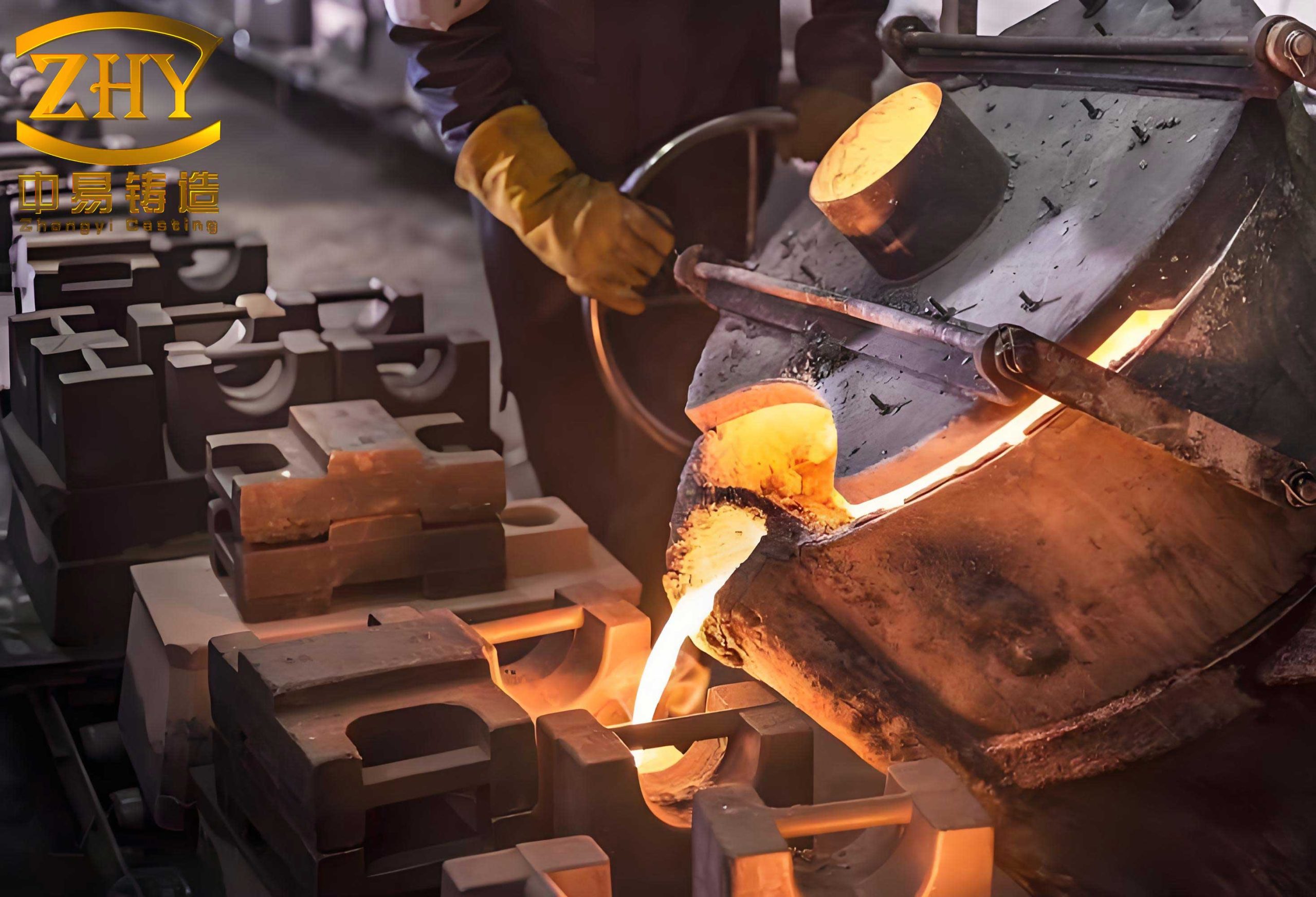
Central to our success was the formulation of distinct sand and coating systems for cast steel and cast iron parts. The sand mixtures had to meet specific performance criteria: for cast iron parts, higher hot strength and better collapsibility were essential to prevent defects like veining or expansion scars. Table 2 details the sand compositions and properties:
| Material/Property | Cast Steel Face Sand | Cast Iron Parts Face Sand |
|---|---|---|
| Quartz Sand (%) | 100 | 100 |
| Bentonite (%) | 6–8 | 5–7 |
| Starch Paste (%) | 0.5–1.0 | – |
| Coal Dust (%) | – | 3–5 |
| Soda Ash (% of bentonite) | 4–5 | – |
| Compactibility (%) | 35–45 | 38–48 |
| Moisture Content (%) | 3.0–4.0 | 3.2–4.2 |
| Permeability | >100 | >120 |
| Hot Wet Tensile Strength (kPa) | >2.5 | >2.0 |
| Gas Evolution (mL/g) | <15 | <20 |
| Thermal Crack Initiation Time (s) | >20 | >15 |
| Green Compressive Strength (kPa) | 80–120 | 70–110 |
The properties can be modeled using equations such as the compactibility ratio: $$ C = \frac{V_0 – V_f}{V_0} \times 100\% $$ where \( C \) is compactibility, \( V_0 \) is initial volume, and \( V_f \) is final volume after compaction. For cast iron parts, the addition of coal dust improves the sand’s behavior by increasing gas evolution and reducing burn-on defects. The thermal crack initiation time is critical for both materials, but especially for cast iron parts due to their higher carbon content and solidification characteristics.
Coatings played a vital role in achieving smooth surface finishes. We developed water-based or fast-drying coatings tailored to each material. Table 3 summarizes the coating formulations and key performance indicators:
| Material/Property | Cast Steel Coating | Cast Iron Parts Coating |
|---|---|---|
| Quartz Flour (%) | 100 | – |
| Flaky Graphite Powder (%) | – | 50–60 |
| Amorphous Graphite Powder (%) | – | 40–50 |
| Resin Binder (%) | 2–3 | 2–3 |
| Modified Bentonite (%) | 1–2 | 1–2 |
| Alcohol Carrier | As needed | As needed |
| Suspension Stability (2h, %) | >95 | >90 |
| Density (g/cm³) | 1.65–1.75 | 1.55–1.65 |
| Viscosity (Ford Cup #4, s) | 12–18 | 10–16 |
| Thermal Crack Initiation Time (s) | >30 | >25 |
| Gas Evolution at 1000°C (mL/g) | <25 | <30 |
The coating viscosity is governed by the Ford cup formula: $$ \eta = k \cdot t $$ where \( \eta \) is dynamic viscosity, \( t \) is flow time, and \( k \) is an instrument constant. For cast iron parts, graphite-based coatings provide excellent lubricity and heat resistance, reducing metal penetration and improving peel-off behavior.
In terms of production methodology, we adopted a batch-alternation approach. Initially, we considered using a single sand system with different coatings, but trials revealed quality issues and managerial complexities. Instead, we implemented cyclic production: the line would run cast steel parts for 2–3 months, then switch to cast iron parts for a similar duration. This required meticulous management of raw materials, patterns, sands, and processes. During switchovers, the sand system was completely purged and reconfigured to avoid cross-contamination—a crucial step for maintaining the integrity of cast iron parts. Dedicated teams oversaw the transition, ensuring that parameters like sand composition, coating application, and melting practices were precisely adjusted. This cyclic mode proved viable, as evidenced by production data over several years. Table 4 outlines the line’s output from 1991 to 1993:
| Year | Cast Steel Parts | Cast Iron Parts | ||||
|---|---|---|---|---|---|---|
| Melts | Pourings | Output (tons) | Melts | Pourings | Output (tons) | |
| 1991 | – | – | – | Trial | Trial | Trial |
| 1992 | 120 | 2,500 | 450 | 80 | 1,800 | 150 |
| 1993 | 150 | 3,000 | 500 | 100 | 2,200 | 180 |
Note: Pouring numbers represent a subset of total foundry output; trials in 1991 focused on process validation for cast iron parts.
Quality outcomes were promising. For cast iron parts like the crankcase, initial qualification rates exceeded 85%, with defects such as gas holes, sand inclusions, and scabs accounting for less than 10% of rejections. For cast steel couplers, qualification rates reached over 90%, with similar defect profiles. The quality can be quantified using a yield formula: $$ Y = \frac{N_{\text{acceptable}}}{N_{\text{total}}} \times 100\% $$ where \( Y \) is yield percentage, \( N_{\text{acceptable}} \) is number of sound castings, and \( N_{\text{total}} \) is total castings produced. For cast iron parts, stringent control over sand moisture and coal dust content was key to minimizing gas-related defects. Table 5 provides a snapshot of quality metrics:
| Component/Year | Qualification Rate (%) | Defects (Gas, Sand, Scab) as % of Rejects |
|---|---|---|
| Crankcase (Cast Iron Parts) – 1992 | 86.5 | 8.2 |
| Crankcase (Cast Iron Parts) – 1993 | 88.0 | 7.5 |
| Coupler (Cast Steel) – 1992 | 91.2 | 6.8 |
| Coupler (Cast Steel) – 1993 | 92.5 | 6.0 |
The defect rate for cast iron parts is influenced by factors like sand gas evolution, which can be modeled as: $$ G = k_g \cdot m_c \cdot T $$ where \( G \) is total gas volume, \( k_g \) is a material constant, \( m_c \) is coal dust mass, and \( T \) is temperature. Optimizing \( m_c \) was essential for producing sound cast iron parts.
In reflection, this practice demonstrates that a high-pressure molding line can successfully alternate between cast steel and cast iron parts production, provided that comprehensive technical adaptations are implemented. Key lessons include the necessity of separate sand systems, tailored coatings, and rigorous cycle management. The economic benefits are substantial: by leveraging idle capacity, the foundry could diversify its product portfolio and improve profitability. However, challenges persist, such as the need for rapid changeovers and the risk of sand contamination. Future work could focus on developing universal sands or advanced coatings to further streamline the process. Nonetheless, our experience confirms that with diligent engineering, the production of high-integrity cast iron parts on a line designed for cast steel is not only feasible but also operationally efficient. This approach has paved the way for more flexible foundry operations, emphasizing adaptability in an ever-evolving manufacturing landscape.