
The production of high-strength gray iron castings, such as HT250, using the lost wax casting process presents a unique set of challenges and opportunities distinct from conventional sand casting methods. My experience in developing a robust production process for a complex bracket component has yielded significant insights into alloy design, melt treatment, and process control specific to this precision forming technique. The inherent characteristics of lost wax casting—including the use of pre-heated ceramic shells, directional solidification patterns, and generally slower cooling rates—demand a tailored metallurgical approach to consistently achieve the required microstructure and mechanical properties.
The lost wax casting process, renowned for its ability to produce components with exceptional dimensional accuracy and surface finish, involves creating a wax pattern, building a ceramic shell around it, dewaxing, and firing the shell before pouring molten metal. This sequence results in a mold with high thermal capacity and temperature, fundamentally altering the solidification dynamics compared to a cold sand mold. For gray iron, this translates to specific challenges: prolonged solidification times can lead to graphite coarsening, while thermal gradients from the gating system can cause inconsistent pearlite formation and promote undesirable undercooled graphite structures (Type D/E) in certain sections of the casting. Therefore, a successful strategy must address both chemical composition and processing techniques to overcome these inherent process sensitivities.
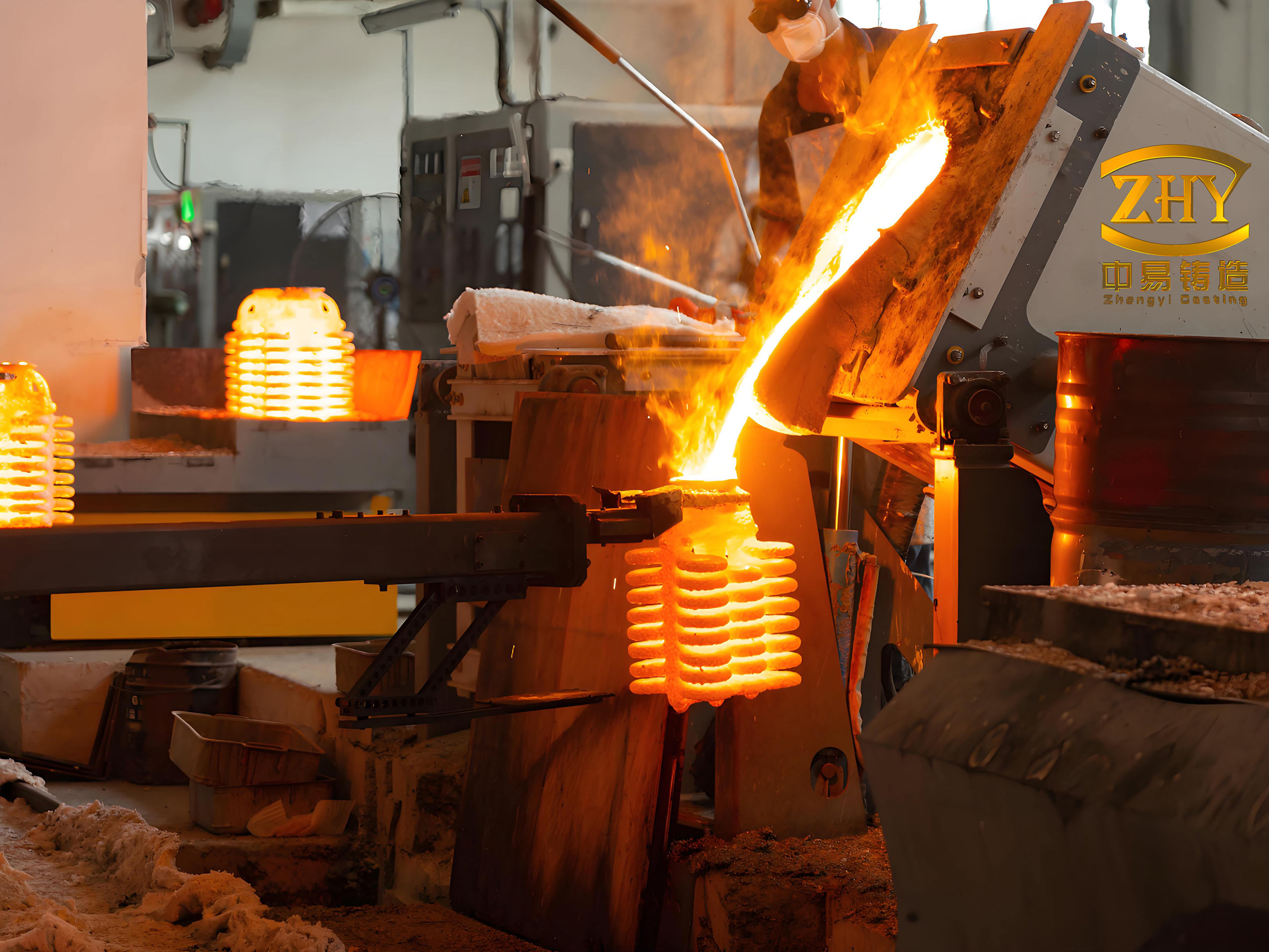
The cornerstone of producing HT250 via lost wax casting lies in the precise design of the chemical composition. The goal is to ensure adequate fluidity and low shrinkage tendency while promoting a fully pearlitic matrix with fine, uniformly distributed Type A graphite. The standard carbon equivalent (CE) formula for gray iron is given by:
$$ CE = \%C + 0.3(\%Si + \%P) $$
For lost wax casting, a CE in the range of 3.6 to 3.8 is often targeted to balance castability and strength. However, the individual element ranges require careful optimization.
| Element | Target Range (wt.%) | Primary Function in Lost Wax Casting HT250 | Rationale & Notes |
|---|---|---|---|
| Carbon (C) | 3.1 – 3.3 | Governs graphite formation, fluidity, shrinkage. | Higher than typical sand-cast HT250 to improve mold filling of complex, thin sections in the ceramic shell. Essential for counteracting chilling tendency from shell. |
| Silicon (Si) | 1.7 – 1.9 | Powerful graphitiser, strengthens ferrite. | Kept at the lower end to suppress excessive ferrite formation under slow cooling, promoting pearlite. Works in tandem with C to control CE. |
| Manganese (Mn) | 0.70 – 0.90 | Combines with S, strengthens pearlite. | Necessary to neutralize sulfur. The ratio Mn/S is critical. A minimum ratio is often maintained: $$ Mn_{min} = 1.7(\%S) + 0.3 $$ |
| Sulfur (S) | 0.06 – 0.12 | Influences graphite morphology, acts as nucleation sites. | Contrary to common low-S practices, a controlled level is vital in lost wax casting. It provides nucleation sites for graphite, refining its size and distribution. Too low S leads to poor graphite formation and risky shrinkage. |
| Chromium (Cr) | 0.20 – 0.30 | Pearlite promoter, refines pearlite, increases hardness & strength. | Counteracts the ferritizing effect of Si under slow cooling. Increases undercooling, leading to finer pearlite lamellae. Must be balanced to avoid carbides. |
| Copper (Cu) | 0.30 – 0.50 | Pearlite promoter, refines graphite and pearlite, mild strengthening. | Synergistic with Cr. Enhances hardenability and uniformity of microstructure across varying section thicknesses, reducing sensitivity. |
| Phosphorus (P) | ≤ 0.10 | Forms low-melting point phosphide eutectic. | Strictly limited to avoid embrittling phosphide networks, especially important in precision castings requiring integrity. |
The synergistic addition of Cu and Cr is particularly effective in the lost wax casting process. Chromium is a potent carbide stabilizer and pearlite promoter but can increase chilling tendency in thin sections. Copper, being a graphitiser, compensates for this. Together, they significantly improve the homogeneity of microstructure and hardness across different casting sections—a common issue in investment castings. Their combined effect on increasing tensile strength can be conceptually modeled as a synergistic strengthening increment beyond their individual contributions.
Melt quality is paramount. The practice of bottom purging the induction furnace with Argon (Ar) has proven highly beneficial. The inert gas bubbles scavenge dissolved gases (hydrogen, nitrogen) and non-metallic inclusions (oxides, slag particles) by flotation. This cleansing action leads to a cleaner melt with fewer potential sites for heterogeneous nucleation that could result in irregular graphite growth. The result is a more uniform and finer distribution of graphite and a higher nodule count of eutectic cells, which directly translates to improved mechanical properties and consistency. The effectiveness of this treatment underscores the importance of melt cleanness in achieving reliable high strength in lost wax casting.
Inoculation is the critical final step to activate the desired solidification pathway. Given the longer processing time from furnace to mold in lost wax casting (often involving transfer, inoculation, and pouring of multiple shells), resistance to fade is essential. A strontium (Sr) or barium (Ba)-bearing ferrosilicon inoculant is preferred. These “late” inoculants provide longer-lasting nucleation potency. The inoculant addition, typically 0.4-0.6% of the tap weight, must be performed during the tap into the pouring ladle to ensure uniform distribution and maximum efficiency. The inoculant size (1-4 mm) is chosen to promote rapid dissolution without excessive oxidation. The inoculation process can be seen as increasing the effective nucleation sites, $N_{eff}$, shifting the solidification curve towards finer graphite:
$$ \lambda_G \propto \frac{1}{\sqrt{N_{eff}}} $$
where $\lambda_G$ is a measure of graphite spacing or size. Effective inoculation ensures the formation of Type A graphite, suppresses undercooled graphite, and minimizes the chilling tendency at thin edges or near the ceramic shell interface.
The melting practice follows a disciplined protocol. Charge materials comprise 45-60% high-quality pig iron (for low trace elements and consistent C/Si), 25-40% internal returns (gates, risers, scrap castings), and the balance in steel scrap. The melt is superheated to 1500-1550°C and held for 8-10 minutes to ensure complete dissolution and homogenization. Tapping is done at 1480-1520°C into a preheated ladle containing the inoculant. The entire operation from the start of inoculation to the completion of pouring must be completed within 4 minutes to avoid significant fade. Pouring temperatures for lost wax casting are typically higher than for sand casting, in the range of 1400-1430°C, to ensure complete filling of the complex shell cavities before the metal begins to solidify.
The results from implementing this comprehensive approach for lost wax casting of HT250 are definitive. Test bars cast alongside production components consistently exhibit tensile strengths exceeding 250 MPa, often reaching 280-320 MPa. Hardness values fall reliably within the 180-250 HB range. Microstructural evaluation confirms the target specifications:
| Microstructural Feature | Result | Standard Reference |
|---|---|---|
| Graphite Form | Predominantly Type A, uniformly distributed. | ASTM A247 Type I, II |
| Graphite Size | ASTM Size 4 to 6 (fine to moderately fine). | ASTM A247 |
| Pearlite Content | ≥ 90% by volume. | ASTM E562 / GB/T 7216 |
| Cementite Content | ≤ 1% by volume. | ASTM E562 / GB/T 7216 |
The matrix is composed of fine, well-dispersed pearlite with minimal ferrite. The absence of significant carbides and the fine graphite dispersion confirm the effectiveness of the balanced composition and potent inoculation in mitigating the inherent slow-cooling effects of the lost wax casting process.
In conclusion, the successful production of high-strength HT250 gray iron castings via the lost wax casting method is a feat of precise metallurgical control. It hinges on a triad of interdependent factors: a carefully balanced alloy chemistry leveraging Cu and Cr synergism; rigorous melt purification practices like Argon purging; and a robust, fade-resistant inoculation treatment. This integrated approach directly addresses the unique thermal conditions of the investment shell process, transforming potential weaknesses—like slow cooling and thermal gradients—into a controlled environment for achieving a refined, high-quality microstructure. The lost wax casting process, therefore, when coupled with this specialized metallurgical protocol, is fully capable of producing gray iron components that meet stringent mechanical and microstructural specifications, opening avenues for its application in high-performance, complex-shaped parts where precision and strength are non-negotiable. The consistent replication of these results validates the process as a reliable manufacturing route for premium gray iron castings.