
Digital Array Module (DAM) components serve as the core elements in phased array radar systems, with each radar unit incorporating hundreds to thousands of these modules. Their design and manufacturing directly influence radar performance, overall system quality, cost, and production timelines. As radar technology advances in vehicular, airborne, and spaceborne applications, DAM enclosures are evolving towards higher integration, multifunctionality, and lightweight designs. Consequently, these enclosures often feature thin-walled, compact, and precisely fitted structures. Traditional manufacturing methods, such as machining combined with electrical discharge machining (EDM) for internal features like wire routing channels and holes, are plagued by high material waste (over 90% of the raw material), low efficiency, extended cycles, and elevated costs. In contrast, precision investment casting, a near-net-shape technology, offers high material utilization, reduced costs, improved efficiency, dimensional accuracy on the order of 0.1 mm, and surface roughness as fine as Ra ≤ 1.6 μm. This makes it ideal for mass-producing complex parts like DAM enclosures.
This article explores the feasibility of applying precision investment casting to a high-volume aluminum alloy DAM enclosure. We analyze the structural characteristics and process challenges, and detail the overall process route, material selection, structural optimization, and specific investment casting techniques. Through prototype validation, we demonstrate that this approach meets the required quality, dimensional precision, and chemical composition standards, establishing its viability for批量 production. The findings provide valuable insights for the design and low-cost manufacturing of similar enclosure components in radar systems.
Process Analysis
The DAM enclosure under study exhibits several critical characteristics that influence the manufacturing approach. Firstly, it possesses a highly complex structure with numerous features. The enclosure is a flat aluminum alloy plate measuring 271 mm × 236 mm × 23.1 mm, with a mass of approximately 0.75 kg. Internally, it contains eight large and small cavities, along with various long and short ribs, convex and concave mounting steps, wire routing channels, feedthrough holes, mounting lugs, and screw installation holes. Externally, two protruding thin-walled mounting plates are present. Secondly, the enclosure is predominantly thin-walled, leading to poor rigidity. While the outer frame walls are thicker (5–10 mm) and serve as the primary load-bearing structure, internal ribs, cavity bottoms, and the external mounting plates are exceptionally thin, ranging from 1 mm to 1.5 mm. This low rigidity makes the parts susceptible to stress-induced deformation during both machining and casting processes. Thirdly, the enclosure demands high dimensional accuracy. Critical dimensions require tolerances within ±0.05 mm, while others must be within ±0.1 mm. The back face, being a mating surface, has a flatness requirement of 0.1 mm. For casting, this translates to a dimensional tolerance grade of CT6 and a surface roughness Ra controlled within 3.2 μm.
The primary process difficulties stem from this combination of complexity and thin walls. The intricate geometry increases the risk of incomplete mold filling during casting, leading to scrap. Furthermore, variations in wall thickness cause differential cooling rates, resulting in non-uniform solidification and shrinkage, which readily induces distortion. The stringent accuracy and surface finish requirements impose high demands on mold material selection and preparation processes. Addressing these challenges necessitates a comprehensive strategy involving appropriate casting material selection, structural design optimizations for manufacturability, and a rigorously developed and validated precision investment casting process.
Process Implementation
Overall Process Route
The devised manufacturing sequence for the DAM enclosure via precision investment casting is systematic and encompasses several critical stages. It begins with material preparation and wax pattern fabrication, followed by shell mold building. Key steps include wax injection using optimized parameters, assembly of wax patterns, shell construction with specific refractory materials, dewaxing, and mold firing. The metal casting phase involves alloy melting, precise refining and modification treatments, vacuum-assisted pouring with a controlled gating system, and subsequent shell removal. Post-casting operations include trimming, fluorescent inspection for defects, dimensional verification, chemical analysis, and a tailored heat treatment regimen comprising solution and aging treatments to enhance mechanical properties and relieve stresses. Finally, the components undergo final inspection before storage. This holistic route ensures quality and consistency throughout production.
Material Selection
Selecting the appropriate alloy is paramount for DAM enclosures, which require lightweight properties, high thermal conductivity, weldability, excellent corrosion resistance, and good castability. The internal high-power devices generate heat dissipated through the enclosure to a cold plate, necessitating efficient heat conduction. Repairability via welding for local defects is also essential. Harsh operational environments, including humidity, salt spray, and temperature extremes, demand superior corrosion resistance. The thin-walled nature further underscores the need for a highly castable material.
Common casting aluminum alloys include Al-Si, Al-Cu, Al-Mg, and Al-Zn systems. Al-Cu alloys offer high strength but poorer castability and corrosion resistance. Al-Mg alloys exhibit excellent corrosion resistance but are less castable than Al-Si types. Al-Zn alloys have good castability but suffer from inferior heat resistance, moderate strength, and average corrosion resistance. After evaluating performance and economic factors, ZL101A alloy, an Al-Si-Mg type, was selected. It demonstrates excellent castability, making it suitable for complex, thin-walled investment castings requiring high airtightness. Its mechanical properties include a tensile strength of approximately 280 MPa, outstanding corrosion resistance (further enhanced by anodizing), good thermal conductivity (151 W/(m·K) at 25°C), and excellent weldability—defects can be repaired by welding and re-heat-treated without significant degradation. Post-casting heat treatments allow for stress relief and mechanical property enhancement.
| Element | Al | Si | Mg | Cu | Fe | Zn | Ti | Ni | Mn | Sn | Pb |
|---|---|---|---|---|---|---|---|---|---|---|---|
| Specification | Bal. | 6.5-7.5 | 0.25-0.45 | ≤0.1 | ≤0.20 | ≤0.1 | ≤0.20 | ≤0.05 | ≤0.1 | ≤0.05 | ≤0.05 |
| Prototype | Bal. | 6.73 | 0.33 | 0.08 | 0.11 | 0.06 | 0.14 | – | – | – | – |
The thermal conductivity can be described by Fourier’s law for heat conduction. For one-dimensional steady-state conduction, the heat transfer rate is given by:
$$ q = -k \frac{dT}{dx} $$
where \( q \) is the heat flux (W/m²), \( k \) is the thermal conductivity (W/(m·K)), and \( \frac{dT}{dx} \) is the temperature gradient. The high \( k \) value of ZL101A facilitates efficient heat dissipation from internal components.
Structural Optimization for Manufacturability
Initial prototyping revealed a propensity for distortion in the thin internal ribs and the two external side plates after casting. To mitigate this, structural optimizations were implemented. The primary enhancement involved adding 2 mm thick vertical stiffening ribs to the thin side plates. This modification significantly increased the local rigidity, effectively suppressing deformation during solidification and cooling. Such design-for-manufacturability changes are crucial for successful precision casting of thin-walled components, ensuring dimensional stability and reducing rejection rates.
Precision Investment Casting Process Design
Wax Pattern Fabrication
The DAM enclosure’s main body features continuously varying wall thicknesses, but the primary challenge lies in the multi-directional wire channels and holes on the side walls. The wax pattern molding strategy employed a holistic injection approach with segmented core pulls to form these side features. Given the thin walls, net-shape requirements, and strict tolerances, a low-temperature wax with superior flowability and replication accuracy was chosen. Optimized injection parameters were established through experimentation: room temperature (22±2)°C, mold clamping pressure of 5 MPa, wax cylinder temperature of 65°C, injection temperature of 65°C, injection pressure of 2 MPa, injection time of 30 s, holding pressure of 1.8 MPa, holding time of 60 s, and a cooling duration of 2 hours. These settings—lower injection temperature coupled with higher injection/holding pressures and times—ensure complete cavity fill while minimizing pattern shrinkage and distortion, critical for achieving the required dimensional precision in the wax stage itself.
Shell Mold Construction
The investment casting process for the DAM enclosure utilizes a gypsum-based shell system. Gypsum molds excel at replicating fine details, enabling cast surface roughness between 0.8 μm and 3.2 μm. Their low thermal conductivity aids in filling thin sections, allowing the casting of walls as thin as 0.5 mm, and they offer good collapsibility for easy shell removal post-casting. To further enhance mold quality, the shell formulation incorporates silica sol as a binder, with zircon flour and mullet sand as refractory materials. Silica sol improves the shell’s high-temperature strength and creep resistance. Zircon flour, used for the face coat, boasts a low thermal expansion coefficient, high hot strength, and chemical stability, resisting thermal shock and reactions with molten metal to prevent casting cracks. Mullet sand, employed for the backup layers, provides adequate high-temperature strength while ensuring sufficient permeability, collapsibility, and friability, resulting in low residual shell strength after pouring for easy removal and minimizing inclusions in the final casting.
The shell building process involves successive dips and stuccos. The yield strength of the ceramic shell material can be approximated as a function of temperature. A simplified model for the ultimate strength \( \sigma_u \) might be:
$$ \sigma_u(T) = \sigma_0 \exp\left(-\frac{T}{T_c}\right) $$
where \( \sigma_0 \) is the strength at room temperature, \( T \) is the operating temperature, and \( T_c \) is a characteristic temperature constant. This highlights the importance of material selection for maintaining integrity during pouring.
Aluminum Alloy Refining and Modification
Molten aluminum treatment is vital for producing high-integrity castings. Refining removes dissolved hydrogen gas, alumina inclusions, and other slag, purifying the melt. For the DAM enclosure, the Rotor Degassing method was employed. The aluminum melt is heated to (730±10)°C and held for complete melting. An inert gas (Argon) is introduced at 0.2 MPa into the melt bottom through a rotating impeller for 15 minutes. The rotation creates a vortex, dispersing the gas into fine bubbles uniformly throughout the melt. Due to the partial pressure difference, hydrogen diffuses into the argon bubbles and rises to the surface, carrying impurities—this achieves efficient degassing and cleaning. This method is fast, effective, economical, and maintains a calm melt surface.
Modification treatments refine the as-cast microstructure and improve mechanical properties. The melt was treated with 0.15% AlSr10 and 0.2% AlTi5B1 master alloys. Al-Sr modifier offers long-lasting effectiveness, low addition rates, and retains its effect upon remelting, making it suitable for the potentially longer cycle times in investment casting. ZL101A contains about 7% Si, which can form coarse eutectic silicon platelets during solidification, impairing mechanical properties. Strontium (Sr) adsorbs onto the silicon growth interfaces, inhibiting its growth and transforming the coarse plate-like structure into a fine fibrous eutectic, thereby refining the grain structure and enhancing properties.
The kinetics of degassing can be described by the rate of hydrogen removal. The change in hydrogen concentration \( C \) over time \( t \) can be modeled as:
$$ \frac{dC}{dt} = -K (C – C_e) $$
where \( K \) is a rate constant dependent on gas flow rate and bubble size, and \( C_e \) is the equilibrium solubility. This emphasizes the importance of process parameters like gas pressure and treatment time.
Pouring and Solidification Process
The casting process employs vacuum suction pouring with a bottom-gating system. This allows precise control over filling pressure, enabling smooth metal entry and rapid establishment of a metallostatic head. To ensure sound castings free from shrinkage porosity and voids, proper feeding conditions and directional solidification are essential. Chills were placed at the extremities of the casting to create a steep temperature gradient, promoting solidification from the extremities towards the feeder. Insulation was applied around the feeder to delay its solidification, maintaining a liquid metal reservoir for feeding over a longer period. Additional in-gates were strategically located at thick-thin transitions and potential defect-prone areas to enhance local feeding capabilities.
Optimized pouring parameters were determined: mold preheat temperature of 490°C held for over 2 hours before pouring, pouring temperature of 720°C, and a constant vacuum of 0.15 MPa maintained throughout the pouring operation. The fluid flow during mold filling can be described by Bernoulli’s principle, considering the pressure difference \( \Delta P \) due to vacuum:
$$ \frac{1}{2} \rho v^2 + \rho g h + P = \text{constant} – \Delta P $$
where \( \rho \) is the melt density, \( v \) is velocity, \( g \) is gravity, \( h \) is height, and \( P \) is pressure. The vacuum assist \( \Delta P \) helps overcome surface tension and viscous forces, improving fillability of thin sections.
Heat Treatment Process
Post-casting heat treatment is critical for stress relief, dimensional stabilization, microstructure homogenization, and mechanical property enhancement. The DAM enclosures undergo a T6 treatment: solution treatment followed by artificial aging. The solution treatment involves heating to 535°C, holding for 12 hours, and then water quenching to 80°C. Quenching water temperature is controlled to prevent excessive cooling rates that could induce cracking. Subsequently, artificial aging is performed at 155°C for 8 hours, followed by air cooling. This sequence dissolves soluble phases, homogenizes the structure, and then precipitates strengthening phases uniformly.
The aging kinetics for precipitation hardening can often be described by an Avrami-type equation for the fraction transformed \( y \):
$$ y = 1 – \exp(-k t^n) $$
where \( k \) is a rate constant, \( t \) is time, and \( n \) is the Avrami exponent. This governs the development of strength during the aging process.
Casting Validation and Results
The implemented precision investment casting process, incorporating the described optimizations, successfully produced DAM enclosure prototypes. Mechanical testing on cast samples revealed a Brinell hardness (HBS) of 78.8, a tensile strength (Rm) of 290 MPa, and an elongation of 5.5%, meeting the product performance specifications. Chemical analysis confirmed the composition was within the ZL101A standard requirements, as detailed in Table 1. Metallographic examination of the cast microstructure showed a refined eutectic silicon morphology and the absence of critical defects such as cold shuts, cracks, shrinkage porosity, or penetrating porosity, confirming sound casting quality. Dimensional inspection and surface roughness measurements also conformed to the design specifications, validating the capability of the precision casting process to achieve the required geometrical accuracy.
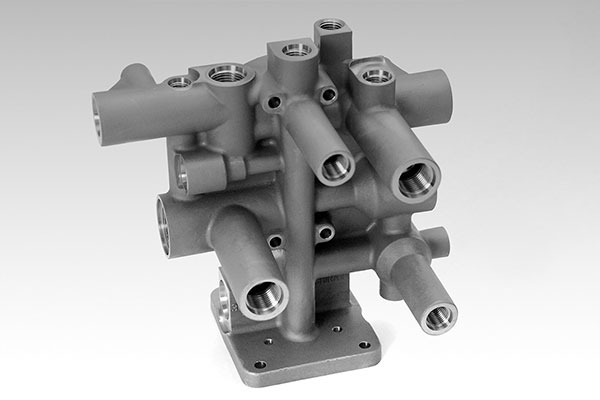
The successful application of precision investment casting for such a complex, thin-walled component demonstrates the maturity and capability of this manufacturing route. The integration of material science, structural mechanics, and detailed process engineering enabled the transition from a challenging machined part to a viable cast component. This approach aligns with the broader industry trend towards near-net-shape manufacturing for cost reduction and efficiency gains.
Conclusion
The DAM enclosure, characterized by its structural complexity, thin walls, and high precision demands, presents significant challenges for conventional machining, leading to high costs, long lead times, and production inefficiencies. This study demonstrates the successful application of precision investment casting as a feasible alternative. Through a comprehensive approach involving optimal material selection (ZL101A alloy), structural enhancements for improved rigidity, and a meticulously designed and optimized investment casting process—encompassing wax pattern fabrication, advanced shell building, melt treatment, controlled vacuum pouring, and tailored heat treatment—we produced prototype enclosures that satisfied all mechanical, chemical, and dimensional requirements. The results confirm the suitability of precision investment casting for the mass production of DAM enclosures, offering a path towards lower cost and higher efficiency while maintaining performance standards. This research provides a valuable framework for the design and manufacturing of similar high-integrity, thin-walled components across various applications, highlighting the critical role of precision casting technologies in modern industrial processes.