
The imperative to enhance thermal efficiency and reduce carbon emissions from fossil fuel-based power generation has driven the development of advanced ultra-supercritical (USC) boilers. These systems operate at steam temperatures exceeding 650°C and pressures above 300 bar, presenting severe demands on material performance. Key components like superheater and reheater tubes require alloys with exceptional creep strength, resistance to steam oxidation, and corrosion stability under aggressive flue gas environments. Austenitic stainless steels have been widely utilized due to their good high-temperature strength and corrosion resistance. However, for the next generation of plants targeting 700°C and beyond, conventional steels reach their limits. This has spurred intensive research into a new class of materials: advanced heat-resistant austenitic steels, often strengthened by nano-scale precipitates. The manufacturing of complex, thin-walled boiler tubing and intricate fittings for such demanding applications finds an ideal partner in precision investment casting. This process allows for the net-shape production of components with excellent surface finish, dimensional accuracy, and the ability to form complex internal geometries that are difficult or impossible to achieve through machining or forging. This article, from a research and development perspective, delves into the performance optimization of a specific heat-resistant austenitic steel tailored for manufacturing boiler pipe fittings via precision investment casting.
The core material investigated here is an alumina-forming austenitic (AFA) steel with a nominal composition designed for high-temperature service. The base chemistry is centered around an Fe-15Cr-25Ni matrix, with key additions of aluminum (Al) for oxidation resistance and niobium (Nb) combined with carbon for precipitation strengthening. The specific target composition and the actual analyzed composition of the laboratory-melted heat are summarized in Table 1. Precise control over chemistry, especially low levels of impurities, is critical for consistent performance and is a hallmark of high-quality precision investment casting feedstock.
| Element | Target | Actual |
|---|---|---|
| Ni | 25.00 | 24.39 |
| Cr | 15.00 | 13.39 |
| Al | 3.50 | 3.83 |
| Mo | 2.00 | 2.11 |
| Nb | 0.60 | 0.53 |
| C | 0.02 | 0.048 |
| Fe | Balance | Balance |
The initial processing involved vacuum induction melting to minimize gaseous impurities, followed by casting into a mold. To simulate the consolidation and homogenization that occurs during the precision investment casting process and subsequent heat treatment, the cast ingot was subjected to a high-temperature solution treatment at 1200°C for 40 minutes, followed by water quenching. This state, designated AFA-0, represents the baseline fully austenitic microstructure with all alloying elements in solid solution. To study the effect of mechanical working—a step sometimes applied to cast components to enhance properties—samples were then cold-rolled to different levels of deformation: 20% and 50%, creating conditions AFA-20% and AFA-50%, respectively.
Understanding the thermodynamic stability of phases is paramount for predicting long-term microstructural evolution in service. Using computational thermodynamics (JMatPro software), the equilibrium phase fractions for the AFA alloy were calculated over the temperature range of 600°C to 1200°C. The results, shown graphically below, are crucial for defining heat treatment windows and anticipating stable precipitates. The calculations predict that the matrix remains a single-phase austenite (γ) across this entire range. The key strengthening and intermetallic phases predicted to form include:
- NiAl-type (B2) Phase: A coherent, ordered phase providing significant precipitation strengthening.
- σ Phase: A brittle, topologically close-packed (TCP) phase that is generally undesirable but can form under certain conditions.
- Carbides: Primarily fine MC-type (e.g., NbC) and grain boundary M23C6-type carbides.
The mass fraction of these phases at a typical service temperature of 650°C can be approximately described by the relation derived from the equilibrium calculation:
$$ W_{\text{total precipitate}} \approx W_{\sigma} + W_{\text{NiAl}} + W_{\text{MC}} $$
where at 650°C, $W_{\sigma} \approx 10.9\%$, $W_{\text{NiAl}} \approx 6.6\%$, and $W_{\text{MC}} \approx 0.2\%$, with the austenite matrix constituting the remaining ~82%. This information guides the development of aging heat treatments to optimally precipitate the beneficial NiAl and MC phases while suppressing excessive σ phase formation.
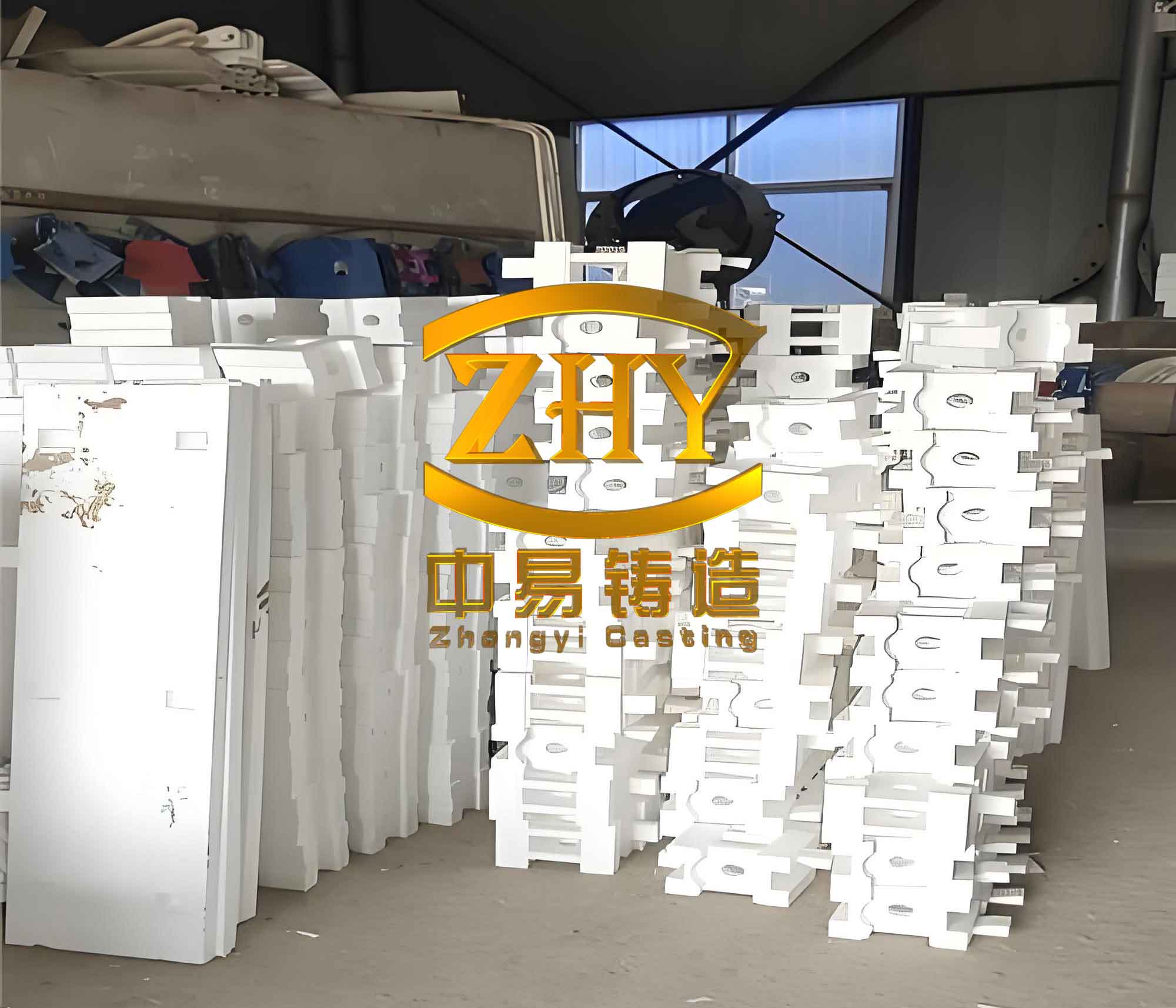
The image above illustrates the complexity of mold systems in advanced casting processes. While depicting a lost foam casting setup, it underscores the intricate patterns and gating systems required to produce sound castings. In precision investment casting, a ceramic shell is built around a wax or polymer pattern of the component. After dewaxing, the resulting hollow ceramic mold is filled with molten alloy. This technique is exceptionally suited for the AFA steels discussed here, as it allows for precise control of cooling rates and minimizes macro-segregation, leading to a more homogeneous microstructure in the final cast component compared to conventional casting methods.
The mechanical performance of the steel in its solution-treated and cold-worked states was evaluated through tensile testing at room temperature and at 700°C. The results, summarized in Table 2, reveal the significant impact of cold deformation.
| Condition | Test Temp. (°C) | Tensile Strength (MPa) | Yield Strength (MPa) | Elongation (%) |
|---|---|---|---|---|
| AFA-0 | 26 | 798 | 405 | 50 |
| AFA-20% | 26 | 1082 | 866 | 29 |
| AFA-50% | 26 | 1131 | 889 | 15 |
| AFA-0 | 700 | 569 | 346 | 28 |
| AFA-20% | 700 | 722 | 630 | 16 |
| AFA-50% | 700 | 643 | 532 | 19 |
At room temperature, cold deformation dramatically increases strength through work hardening, described by the relationship between flow stress and dislocation density ($\rho$):
$$ \sigma_y = \sigma_0 + \alpha M G b \sqrt{\rho} $$
where $\sigma_0$ is the lattice friction stress, $\alpha$ is a constant, $M$ is the Taylor factor, $G$ is the shear modulus, and $b$ is the Burgers vector. The increase from 405 MPa (AFA-0) to 866 MPa (AFA-20%) in yield strength is substantial. However, increasing deformation to 50% provides only a marginal further increase in strength (889 MPa) while severely compromising ductility (elongation drops from 29% to 15%). At the service temperature of 700°C, the trend changes. The AFA-20% condition maintains a clear strength advantage over the solution-treated state. Interestingly, the AFA-50% condition shows lower strength than AFA-20% but a slight recovery in ductility. This can be attributed to the onset of recovery and recrystallization processes during testing at high temperature, which partially annihilate the dislocation structure introduced by cold working. The optimal condition for a combination of high strength and adequate toughness appears to be the 20% cold deformation. For components made via precision investment casting, a post-casting cold working operation (like pilgering or drawing) could be applied to tubular products to achieve this beneficial level of strain and enhanced strength.
Beyond mechanical strength, resistance to corrosive environments is a critical performance metric. Boiler tubes are exposed to complex atmospheres containing oxygen, water vapor, carbon dioxide, and sulfur compounds. The studied AFA steel, alongside commercial benchmark alloys like S31035 and S31042, was subjected to oxidation-corrosion tests in a simulated flue gas atmosphere (comprising N2, CO2, O2, H2O, and SO2) at temperatures ranging from 650°C to 725°C. The degradation was assessed by measuring the depth of internal corrosion pits and the thickness of the external oxide scale and internal oxidation zone. Key data is consolidated in Table 3.
| Temperature (°C) | Material | Corrosion Pit Depth (μm) | External Oxide Scale (μm) | Internal Oxidation Zone (μm) |
|---|---|---|---|---|
| 650 | AFA (C-HRA-5) | 20-80 | 0-20 | 0-15 |
| S31035 | 20-60 | 0-20 | 0-15 | |
| S31042 | 10-40 | 0-20 | 0-15 | |
| 700 | AFA (C-HRA-5) | 30-120 | 10-30 | 15-30 |
| S31035 | 40-120 | 20-30 | 15-30 | |
| S31042 | 20-30 | 0-20 | 10-20 | |
| 725 | AFA (C-HRA-5) | 30-150 | 20-30 | 20-40 |
| S31035 | 50-120 | 20-50 | 20-50 | |
| S31042 | 20-50 | 20-30 | 10-30 |
The data shows a clear positive correlation between temperature and the extent of corrosion damage for all materials. The AFA steel (labeled C-HRA-5 in this comparison) performs comparably to the advanced commercial alloy S31035 across the temperature range. Both exhibit significantly greater pit depths and oxide scale thickness than the highest-grade alloy, S31042, which demonstrates superior corrosion resistance. The AFA steel’s aluminum content is designed to form a protective, slow-growing Al2O3 scale. The performance is promising but indicates that for the most aggressive environments, further optimization of the Al/Cr/Ni balance may be necessary. The homogeneity achieved through precision investment casting is vital here, as any micro-segregation could lead to localized breakdown of the protective oxide scale.
In conclusion, the development of next-generation boiler components requires a synergistic approach between advanced material design and sophisticated manufacturing processes. The studied alumina-forming austenitic (AFA) steel shows a promising combination of high-temperature strength, achievable through a combination of solid solution strengthening, nano-sized NiAl precipitate formation, and optional cold work, and adequate oxidation-corrosion resistance. Thermodynamic calculations provide an essential roadmap for stabilizing the beneficial microstructure. The mechanical tests indicate that a cold deformation level of approximately 20% offers an optimal balance of strength and ductility for service conditions around 700°C. To translate this laboratory alloy into a reliable engineering component, precision investment casting stands out as a key enabling technology. It facilitates the production of complex, net-shape pipe fittings with the dimensional accuracy, surface quality, and microstructural uniformity required to harness the full potential of this heat-resistant austenitic steel in advanced ultra-supercritical power plants, ultimately contributing to higher efficiency and lower emissions.